What Your Child’s Arrival Tells You About Their Childcare
What This Article Explores
- Why the question “is my child truly okay?” sits so deeply in every Singapore parent’s chest
- How quality childcare operates on two levels — the visible and the interior
- What genuine thriving looks and feels like from your child’s perspective
- Practical ways to read your child’s internal experience
- What quality childminding actually offers families in Singapore
The Question Every Singapore Parent Carries
Singapore parents carry something particular. You plan early. You research carefully. You choose preschools and childcare arrangements with a rigour that would impress any educator. You are, by almost any global standard, extraordinarily engaged in your child’s development.
But alongside that engagement lives something else. A quiet wondering. A soft anxiety that does not announce itself loudly but is always there, just beneath the surface of the morning routine and the evening bathtime. It asks: is my child truly okay?
Not safe — you trust that, or you would not have made the choice you made. But okay. Happy. Secure. Growing into themselves in the way they deserve to be.
This wondering is not a sign of doubt. It is a sign of love. And it is one of the most underserved emotional needs in the landscape of childcare information available to parents today.
Most of what exists answers a different set of questions — questions about curriculum, ratios, licensing, reviews. Useful questions. Practical questions. But they do not answer the one that sits in your chest at seven in the morning when you hand your child to someone else and trust them with the most precious thing in your life.
The Two Levels of Every Childcare Environment
There is a way of thinking about this that changes everything — not a framework or a checklist, but a shift in perspective. A way of seeing what has been there all along.
Every childcare environment has two levels. The first is visible. It is the room itself — the space, the schedule, the ratio of children to caregivers, the activities on the weekly plan. This is the level that reviews describe and frameworks measure. It is real, and it matters.
But there is a second level. The interior level. The one that exists in the quality of attention a caregiver gives when a child falls and looks up for reassurance. The one that lives in the pause before a response — whether it is a moment of genuine attunement or a reflex of redirection. The one that shapes whether a child walks into a room and feels this is a place where I am known, or simply this is a place where I am.
This interior level is not easy to see from outside. It does not appear in inspection reports or curriculum documents. But it is the level at which children actually live. It is the level at which they are developing their sense of self, their trust in the world, their belief about whether other people are reliable, whether they are worthy of care, whether the emotions they feel are valid and seen.
Because a child who is merely supervised and a child who is truly known are not having the same experience. Not even close.
What Thriving Looks Like From the Inside
Consider what it looks like when a child is genuinely thriving. You may not see it in the photographs. You may not read about it in the daily reports. But there are signals — real signals — that a child is living through days that are nourishing rather than merely containing.
Arrival: The Lightness of Recognition
Watch a child upon arrival. Not on the first day, when all children are adjusting, but after the settling period has done its work. A child who is settling well into quality care will show you something in the way they move toward the door.
There is a lightness. Not the lightness of excitement alone — children can be excited about many things. This is something different. It is the lightness of recognition. Oh, there she is. There is my person. This is the place where things make sense.
When a caregiver has genuinely attuned to a child — when she knows the child’s rhythms, their thresholds for stimulation, the moments when they need to be held and the moments when they need space — the child feels it. They do not have the language for it yet, but they feel it the way we feel the difference between a room that is merely warm and a room that is home.
Social Curiosity: Reaching Outward From a Foundation of Security
Watch the child’s social curiosity. A child who feels secure inside a quality care environment begins to reach outward. They notice other children. They experiment with sharing, with collaboration, with the first tentative negotiations of play.
This does not happen in a vacuum. It happens because the inner foundation of security has been laid. A child who is anxious, who is merely contained in an environment that does not attend to their emotional world, will not reach outward with this kind of confidence. They will be too busy managing their own distress.
Emotional Range: Learning to Feel Big Feelings
Watch the child’s emotional range. Not just the happy moments — every child has those. But the moments of frustration, of disappointment, of anger.
A child in quality care is learning to feel big feelings in the presence of a caregiver who can hold them. Who does not dismiss, minimise, or rush past the emotion. Who says, in one way or another, I see that this is hard for you. I am still here.
This is where emotional regulation begins — not in a lesson about breathing techniques, but in the lived experience of having your feelings witnessed and accompanied.
Coming Home: What the Child Carries
Watch what the child carries home. Not in their bag — in their being.
The child who has spent a day inside quality care comes home with something. A readiness for connection. A capacity to settle. An ease in their own skin. You may not be able to name it precisely, but you feel it. The family feels it. The evening is different. The dinner is different. The bedtime is different.
This is what thriving looks like from the inside — not just the visible work of activities and routines, but the invisible work of building a child’s inner architecture. Their sense of who they are. Their trust in other people. Their belief that the world is a place where they can grow.
Safe vs. Feeling Safe
There is a difference between a child who is safe and a child who feels safe — and this distinction matters enormously.
A child can be physically safe in a room. Ratios can be met. Doors can be locked. Sanitation protocols can be followed. And yet that child can still feel, inside themselves, a low hum of anxiety that they do not have the words to describe.
Because safety is not only about the absence of danger. It is about the presence of reliable, attuned, responsive care. It is about the quality of the human relationship at the centre of the environment.
A child who feels safe has internalised something profound. They have internalised the understanding that when something goes wrong — and something always goes wrong, because that is what childhood is — there is someone who will come. Someone who will listen. Someone who will help them make sense of it.
The caregiver-child dynamic in those first years is not one context among many. It is the context from which so much else unfolds.
Reading Your Child’s Internal Experience
So how do you know what is happening inside the room when you are not in it? Here is a way of paying attention. A language for what you may already be sensing.
Begin With Your Child’s Body
Children communicate through their bodies long before they have words. Notice how your child arrives at childcare in the morning. Does their body soften as they approach the door, or does it stiffen? After the initial hello, does play begin relatively quickly, or does the child linger at the threshold, watching?
These are not definitive signals — all children have difficult mornings sometimes. But patterns matter. A child who consistently arrives with tension in their body is telling you something about their internal experience, even if they cannot say it in words.
Listen for Specifics in How Your Child Talks About Their Caregiver
Notice your child’s language about the caregiver. Not just “I like Miss” — children often say this even in environments that are not nourishing them. Listen for something more specific:
- “Miss knows I don’t like the loud music.”
- “Miss always saves me a seat.”
- “Miss gives the best hugs when I’m sad.”
These small, specific details are windows into the quality of the relational connection. They suggest that the caregiver is not simply performing a function but is genuinely present to this particular child.
Notice How Your Child Talks About Other Children
A child in a high-quality environment will often develop what researchers call a “sense of group” — a feeling of belonging to a social world that includes other children. They will mention friends. They will talk about sharing, about playing together, about the small dramas and joys of peer life.
A child who never mentions other children, who presents the experience as isolated, may be in an environment that contains them without truly including them in a social world.
Notice What Happens at Home in the Evenings
Not just behaviour — though that matters — but the overall quality of connection. Is your child able to be present with the family? Can they settle? Can they engage?
When a child’s days are spent in an environment that is merely containing them, they often come home running on empty. They are depleted not because they have been doing too much, but because they have been managing too much alone.
A child who is genuinely thriving in care comes home with something to give. With presence, with capacity, with the quiet energy of security.
If the patterns you are noticing suggest that something is not right inside your child’s experience of care, that wondering is worth honouring. It is data. It is your child’s most reliable reporter telling you something through you.
What Quality Childminding Actually Looks Like
There is a form of childcare that is designed, by its very structure, to attend to this interior world. It is home-based childminding — and understanding what makes it different can help you think more clearly about what you are really choosing when you choose care for your child.
The Ratio That Makes Attunement Possible
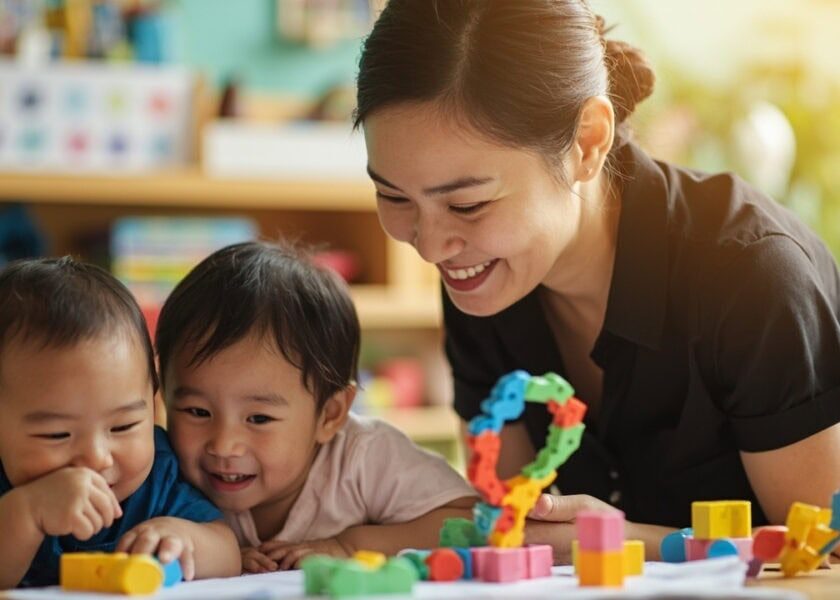
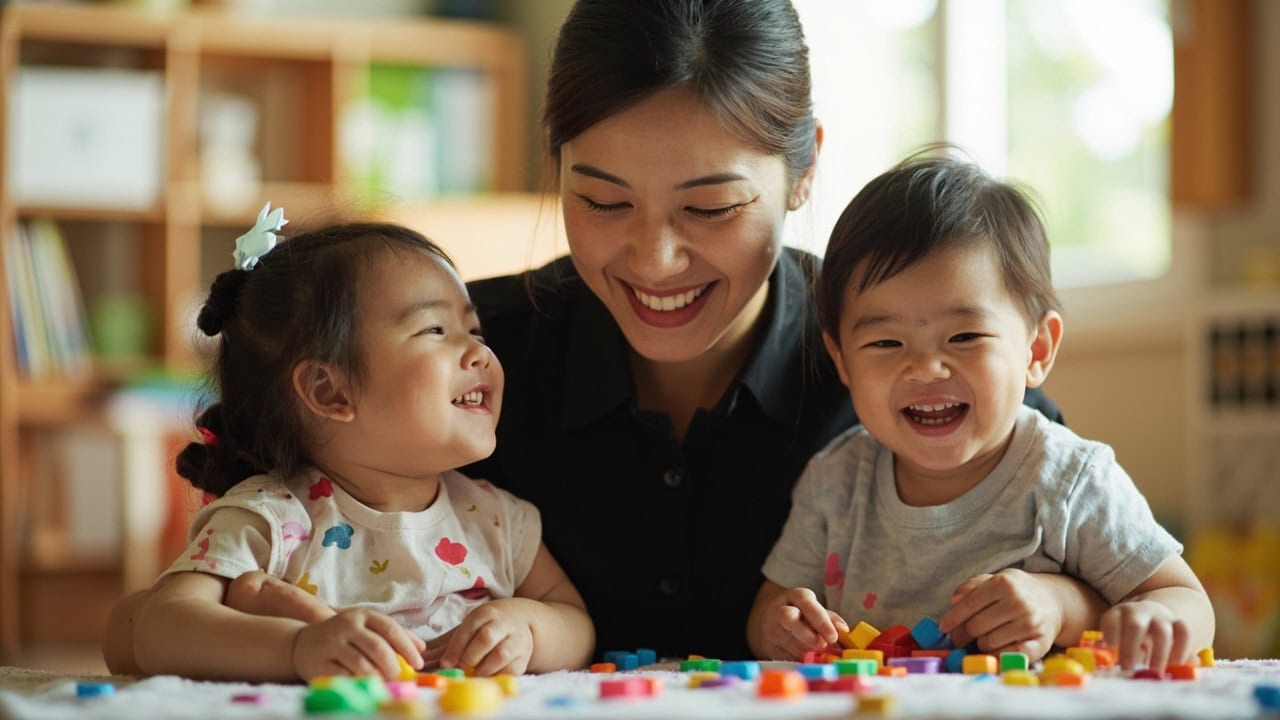
In home-based childminding settings like EduNanny Singapore, caregiver ratios of up to one to three infants are maintained. This is not an accident of policy — it is a design decision rooted in developmental understanding.
When a caregiver is responsible for fewer children, she can truly attune. She can notice what each child is feeling, what they need in this moment, what they are reaching toward. She can be the consistent, reliable presence that builds the inner compass we have been talking about. She can know your child the way you know your child.
Home as a Secure Base
The home environment itself offers something that larger centre settings cannot replicate quite as easily: the intimacy and predictability of a domestic space. A consistent caregiver. A consistent space. A consistent routine.
For a young child, this predictability is not boring — it is the foundation of security. It is what allows them to venture out and explore, because they know exactly where and who they will return to.
Partnership With Parents
The best childcare relationship is one in which you are not outside the equation. You are not dropping your child into a system and hoping for the best.
You are the primary interpreter of your child’s inner experience. You are the one who knows your child’s history, your child’s temperament, your child’s particular joys and vulnerabilities. And the best childcare relationship is one in which that knowledge is honoured, welcomed, and woven into the daily care your child receives.
Where deployed, transparency measures including regular updates and, in applicable settings, CCTV access give parents a window into the daily experience. Not surveillance — connection. The ability to see what your child’s day looks like, to receive updates that go beyond “had lunch and slept well,” to feel genuinely included in the story of your child’s life during the hours you are apart.
The Human Work at the Centre
The work of caring for a young child — truly caring, not merely supervising — is among the most demanding, most consequential, and most underrecognised forms of labour that exists.
It requires patience that feels infinite. It requires attention that is both acute and sustained. It requires the ability to read a child’s needs before they are spoken, to respond with calm when everything inside you wants to react, to be fully present to one small person’s world while holding the larger world in mind.
EduNanny’s caregivers are not anonymous staff. They are trained professionals who understand child development, who are equipped to support the interior world of the children in their care, and who take genuine pride in the relational work they do every day.
When we say that EduNanny’s caregivers are central to quality care, we mean it literally. The ratio, the training, the relational culture — these are not abstractions. They are the conditions that allow a caregiver to do what she does best: know your child.
Quality Care Should Be Accessible
Quality care should not be a privilege available only to families with significant resources. In Singapore, where the cost of raising children is a genuine consideration, EduNanny’s pilot fee structures are designed to make quality childminding accessible. CDA and Baby Bonus can be applied, reducing the financial weight on families at a stage of life when every dollar matters.
Every child deserves to be known.
When a Child Thrives, the Whole Family Feels It
When a child is thriving from the inside — when they are genuinely secure, genuinely known, genuinely growing into themselves — the family feels it. Not abstractly. Measurably.
In the quality of the evening. In the ease of bedtime. In the conversations you have with your partner after the children are asleep when you say, quietly, I think this is really good for her.
This is what quality childcare makes possible. Not just for the child, but for the whole family. Because when your child is well, something unlocks in the household. The pressure eases. The guilt that Singapore parents carry — that quiet, background hum of wondering if they are doing enough — softens.
The parent-child relationship can breathe, because the child is coming home whole rather than depleted, ready to connect rather than needing to be managed.
In Singapore, where the pressures on families are particular and real, where the pace of life is fast and the expectations are high, this kind of support is not a luxury. It is a necessity.
No family in this city should have to choose between quality care and accessible care. No child should have to be merely supervised when they could be genuinely known. No parent should have to wonder alone about what is happening inside the room.
What to Look For When Choosing Childcare in Singapore
If you are beginning the process of choosing childcare — or if you are wondering whether your current arrangement is truly serving your child — here are some questions worth sitting with:
- When you observe arrival, how does your child’s body respond? Look for the lightness of recognition, not just tolerance.
- Does your child speak about their caregiver as a person? Specific, personal references are a window into relational quality.
- Does your child mention other children? A developing sense of group suggests emotional security.
- How does your child come home? Presence, capacity, ease — or depletion and need for management?
- How does your child respond to big emotions? A child learning emotional regulation will have moments of frustration, but should also be developing the language and capacity to move through feelings with increasing steadiness.
These are not tests to pass or fail. They are signals to pay attention to. And the fact that you are reading this article — that you are willing to look inside the experience rather than just at the surface — is itself a sign of the kind of awareness that serves children well.
Walking This Journey Together
We have tried to take you somewhere you may not often go in discussions about childcare. Inside the experience. Into the child’s world. Not to make that world strange or unfamiliar, but to make it visible — to give language to what you already sense, to offer a framework for what you already feel, and to invite you to trust your own capacity to read your child’s inner experience with the same wisdom you already bring to everything else.
Your child is not just a person in your care who happens to go somewhere during the day. Your child is a whole world — interior, rich, complex, and deeply responsive to the quality of the relationships they experience.
And when that world is tended to with attentive, attuned, warm, and consistent care — your child becomes someone who feels safe enough to explore, brave enough to connect, and secure enough to grow.
That is what EduNanny Singapore is working toward every day. Not the management of children. Not the administration of care. The cultivation of that interior world — the one where your child’s sense of self is being built, quietly and profoundly, one interaction at a time.
We understand the weight of the question you carry. We understand the care with which you made the choices you have already made. And we understand that the decision you are making now — or reconsidering now — is not just logistical. It is deeply personal. It is about your child. It is about your family. Your evenings. Your peace of mind. Your capacity to show up as the parent you want to be.
If what you have read here resonates — if the idea of your child being truly known, not just watched, feels like what you have been looking for — we would be glad to hear from you.
We are grateful you are here. And we are honoured to walk this part of the journey alongside you and your child.
EduNanny Singapore offers quality home-based childminding under the ECDA Childminding Pilot. Learn more about who we are or explore our approach to childcare.