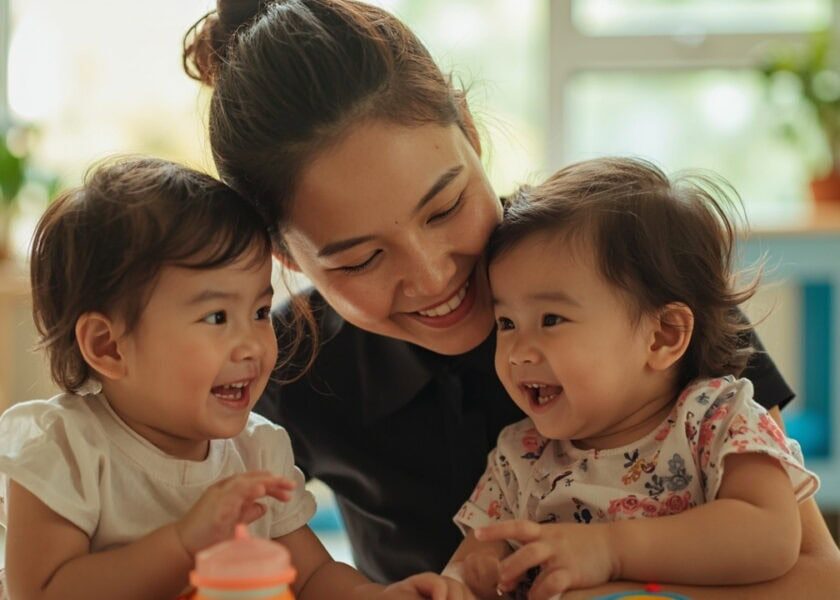
The Honest Guide to Quality Infant Care Singapore Parents Deserve
The Silence Around Singapore’s Youngest
Singapore is a city of ambition, practicality, and deeply loving parents. Many families—whether by necessity, by choice, or by the beautiful pull of wanting your child to have the best start—will face this moment of first separation. And yet, for something so significant, so emotionally freighted, the guidance available to Singapore parents has been remarkably thin.
You will find plenty written about toddler transitions. About the first day of preschool, the tears, the separation anxiety of a two-year-old. You will find checklists for choosing a childcare centre, articles about curriculum frameworks, blog posts on whether to return to work. But for the parent holding a four-month-old, navigating the very first separation from someone who cannot yet speak, who cannot yet tell you in words whether they are okay—there is a silence. A gap. And it is in that gap that anxiety thrives.
We believe that gap is unacceptable. Because leaving your infant is not a footnote in the childcare conversation. It is one of the most significant, most vulnerable decisions a parent will make in the early years. And it deserves more than a checklist. It deserves honesty, empathy, and a clear account of what quality actually looks like.
What No One Tells You About That First Leaving
It is not just your infant who is learning to separate. It is you.
The physical pull of attachment—the way your body registers even a small distance from your baby—is not weakness. It is not irrationality. It is biology. Decades of research on infant attachment, built on the foundational work of John Bowlby and Mary Ainsworth, have shown us that the parent-infant bond is not sentimental. It is structural. It shapes how your baby learns to trust the world, and it shapes how you move through the world as a parent.
When you leave your infant in care, you are not simply dropping them off. You are navigating your own developmental transition as a parent. Your baby cannot yet understand that you will return. They experience the world through sensation, through the quality of voice and touch and presence they receive moment by moment. And you—you are experiencing the most acute test of trust you may have ever faced.
In those early weeks, as you adjust to a new rhythm of mornings and goodbyes, you may feel grief alongside gratitude. You may feel guilt alongside relief. You may feel, on different days and sometimes on the same day, that you are both the best and the worst parent in the world. All of these feelings can be true simultaneously, and acknowledging this is not indulgence. It is honesty.
What we have observed, across families in our care, is that parents who are given space to feel these things—who are not told to simply “trust the process” without any scaffolding—move through the transition with far greater resilience. And parents who feel genuinely seen and supported by their child’s caregiver are, paradoxically, able to let go more peacefully, because they are not holding the separation alone.
What Quality Infant Care Actually Looks Like
Here is something that is rarely said plainly in Singapore’s childcare landscape: not all infant care is the same, and the differences matter enormously.
Infants develop at a pace that is staggering in its complexity. In the first year of life—and neuroscience has been clarifying this with increasing precision—a baby’s brain forms neural connections at an extraordinary rate. The sensory environment they inhabit, the quality of responsiveness they receive, the consistency and warmth of their primary caregiver—these are not soft, aspirational ideas. They are the architecture of your child’s future capacity for trust, for learning, for emotional regulation.
Quality infant care is not about a clean, bright room. It is not about having the latest app for parent updates. It is about a caregiver who understands that a baby’s cry is communication, not noise. It is about a ratio—the number of infants per caregiver—that allows for genuine, unhurried responsiveness. It is about an environment that is warm and predictable, where an infant can learn the world is safe because the people in it are reliable.
Signs of Quality You Can Look For
- Physical attunement: Watch how a caregiver holds your baby. Is their attention fully present, or divided between the infant and other tasks?
- Responsive feeding: Mealtimes are not mechanical but relational—moments of exchange and comfort, not just nutrition delivery.
- Respect for rhythms: Infants are not on adult schedules. Quality care adapts to your baby’s natural patterns, not the other way around.
- Calm transitions: Notice how drop-off and pick-up are handled. A quality caregiver understands these are sensitive moments for both parent and infant.
- Transparent communication: You should receive honest, regular updates about your baby’s day—not just photographs, but meaningful observations.
The Secure Base Effect
In a high-quality infant care setting, you will see something remarkable over time. You will see it in the way your infant begins, over days and weeks, to settle more quickly at drop-off. Not because they have forgotten you. But because they have begun to understand—through experience, not through words—that the person caring for them is trustworthy, and that you chose that person with love.
Research confirms what experienced caregivers know: infants are exquisitely attuned to the quality of their environment. They register inconsistency. They respond to warmth. And when the care they receive is consistent, responsive, and nurturing, they develop what psychologists call a secure base—the foundation from which they can explore, grow, and eventually, with confidence, separate.
A Day in Quality Infant Care: What Actually Happens
Let us speak about what actually happens in a quality infant care day, because this is where many parents’ imagination fills in details that need not be frightening.
In a well-structured infant care environment, the day is built around the rhythms and needs of the infants themselves. There is no rigid, school-like schedule imposed on children who cannot yet sit still on command. Instead, there is a gently predictable flow—feeding, rest, play, observation, care routines—that allows infants to develop a sense of sequence and safety.
Play Is Work
Play, in quality infant care, is not entertainment. It is the infant’s work. Through sensory exploration, through responsive interaction with a caregiver, through the simple act of being held and spoken to with attention, your baby is building the neural pathways that will support language, cognition, and emotional intelligence for the rest of their life. The caregiver’s role is not to entertain. It is to facilitate, to observe, and to be fully present.
Rest Is Development
Rest—this is so often overlooked in discussions of infant care—is not a break between activities. For infants, rest is active development. It is during sleep that the brain consolidates the learning of the waking hours. A quality infant care environment honours this by creating conditions for genuine, safe, undisturbed rest, with caregiver proximity that allows infants to move between sleep cycles with the reassurance of familiar presence.
When you understand this—that the day is not about filling time but about supporting development in its most fundamental forms—the anxiety of the unknown begins to dissolve. You are not leaving your infant in a holding pattern. You are placing them in an environment designed to support exactly who they are at this moment of their life: a person whose every need is still being discovered, and whose every experience is building the foundation of everything they will become.
Singapore’s Infant Care Standards and the Trust Journey
Singapore’s early childhood landscape has taken meaningful steps to elevate infant care standards, and it is worth naming these developments with honesty and appreciation.
The Early Childhood Development Agency (ECDA) has established frameworks and pilot programmes that recognise the distinct needs of infant care—not as a scaled-down version of toddler care, but as a discipline in its own right. The ECDA Childminding Pilot reflects a growing understanding that infant care requires specific expertise, particular ratios, and a philosophy that centres the infant as a whole person, not a checklist of developmental milestones.
Questions to Ask When Evaluating Care
- Caregiver-to-infant ratios and how they compare to recommended guidelines
- Staff training and qualifications specific to infant care
- How the programme handles feeding, sleep, and individualised routines
- Communication protocols and how updates are provided to parents
- How consistency of caregiver assignment is maintained
Financial Considerations
We understand that excellence in infant care should not be the exclusive preserve of those who can pay premium rates. Many families can access support mechanisms that ease the financial weight of quality care. These include the Child Development Account (CDA) and Baby Bonus schemes, which are designed to help Singapore families manage the costs of early childhood development. Understanding what subsidies and schemes you are eligible for can transform what feels like an impossible expense into a manageable investment in your child’s foundation.
The Trust Triangle
Trust is not built overnight. It is built in moments. When you enrol your infant in care, the first days will not feel easy. That is the truth, and we will not dress it up. You may feel a physical weight in your chest each morning. You may find yourself checking your phone compulsively, scanning for updates, wondering if your baby is crying, wondering if they felt abandoned, wondering if you have made a terrible mistake.
These feelings are not signs of failure. They are signs of love doing exactly what love is supposed to do—searching for reassurance, demanding to be sure.
Healthy infant care relationships are built on three interconnected bonds:
- Caregiver to infant: The quality of attention, responsiveness, and warmth your baby receives
- Parent to caregiver: The professional respect, honest communication, and mutual understanding between you and the person caring for your child
- Parent to infant: Your growing confidence that your child is safe, nurtured, and thriving in your absence
When all three bonds are strong, the entire care ecosystem becomes more secure. When a caregiver understands that their role includes holding the parent—not with pressure or false reassurance, but with the same attentiveness they bring to the infant—the entire experience transforms.
The Caregiver: A Figure of Consequence
We believe that the childminder—the caregiver—is one of the most consequential figures in a child’s early life, and that their role deserves recognition, dignity, and investment.
The word “childminder” can sometimes be undersold. It can sound like supervision, like babysitting, like an arrangement of convenience. But the reality is profoundly different. A childminder in the truest sense of the word is a professional of extraordinary skill—someone who can read an infant’s non-verbal communication with precision, who can support feeding and sleep with attunement, who can hold the emotional weight of a parent’s anxiety while maintaining the calm, steady presence that is the very thing an infant needs to feel safe.
Caregivers are not interchangeable. They are not background figures in a service. They are the heart of quality infant care. Research consistently shows that caregiver stability and quality are among the most significant predictors of positive infant care outcomes. A child who has consistent, warm, responsive care in the first years of life demonstrates stronger attachment security, better social-emotional development, and greater readiness for future learning.
The caregiver is not a stopgap. The caregiver is, in the most literal sense, a person who shapes your child’s future.
Standing at the Door: A Conclusion
So here is what we want you to carry with you, as you stand at that door—or as you consider standing at that door for the first time.
Your love for your child is not diminished by needing care outside your home. Your instincts are not wrong because you feel anxious. Your desire to give your child the best possible start—whether that means returning to work you find meaningful, or simply knowing that your baby is in extraordinary hands during the hours you are apart—is not in conflict with your role as a parent. It is an expression of it.
What your infant needs is not a parent who is physically present at every moment. What your infant needs is a parent who chooses wisely, who advocates fiercely, and who can eventually—through the experience of seeing their child thrive—arrive at a place of genuine peace.
When you choose infant care—when you make that decision with your heart and your head, when you visit and ask questions and weigh options and ultimately make a choice—you are not making a compromise. You are making a declaration. You are saying: My child deserves to be cared for by people who understand what this means. My child deserves a caregiver who will hold them with attention, with warmth, with genuine love for their work. My child deserves to feel safe even when I am not in the room.
This is not a compromise. This is one of the most intentional acts of love a parent can perform.
EduNanny Singapore exists because we believe that the first separation between a parent and an infant should not be a leap into the dark. It should be a deliberate, supported, trust-building journey—one that honours the weight of what it means, and one that ends, not with relief that it is over, but with the quiet, powerful realisation that your child is not just being cared for.
They are being loved.
If you are navigating this decision for your family, we invite you to have a conversation with us. Not to pressure you—but to answer your questions honestly, to show you what quality care looks like in practice, and to walk alongside you through whatever stage of this journey you are in.
The door is not one you have to stand at alone.
Connect with EduNanny Singapore and discover what supported, quality infant care feels like.