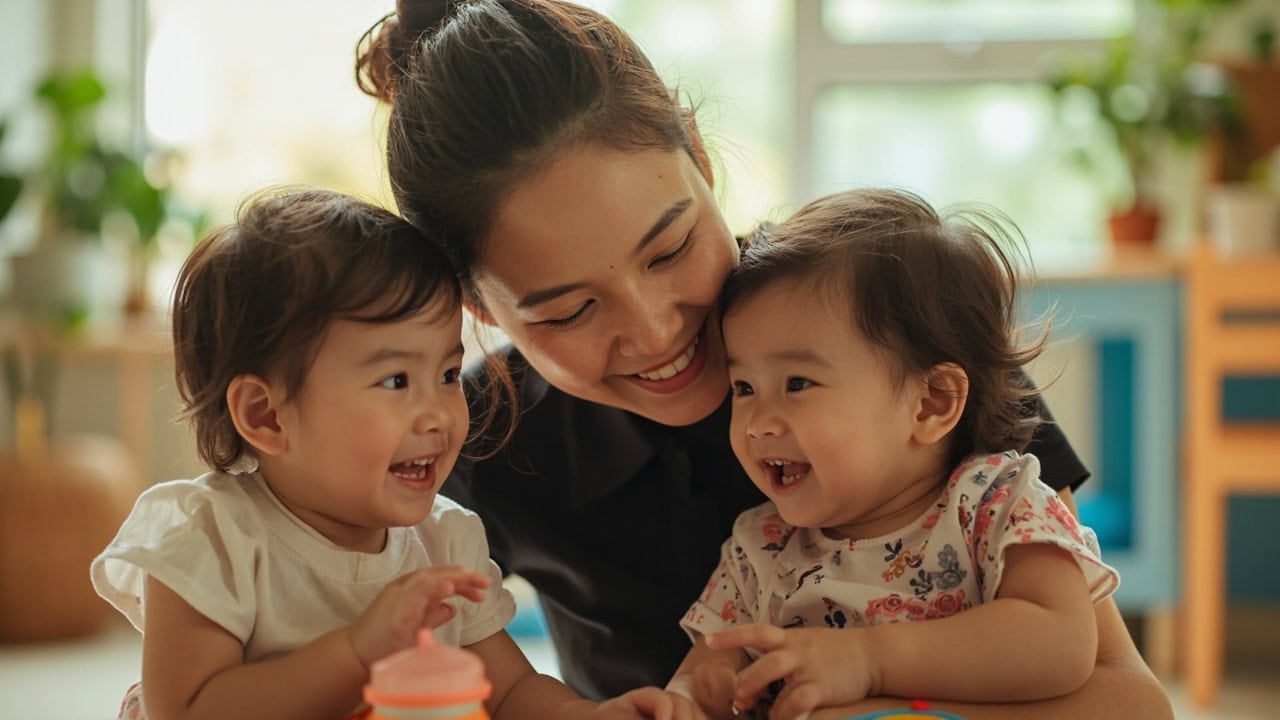
The First Thousand Days: Why Singapore’s Youngest Learners Need Quality Care
“`html
Why the First Thousand Days Shape Everything
The science of the first thousand days has transformed our understanding of human development in ways that should reshape how we think about childcare entirely.
When researchers refer to the first thousand days, they mean roughly the period from conception through a child’s first three years—a window now understood as the most consequential for the architecture of the developing brain. The neural connections that form during this period, the pathways carved out by experience and repeated interaction, become the structural foundation upon which all subsequent learning, emotional regulation, and social capacity is built.
What happens in this window matters not in some vague, sentimental way but in measurable, lasting ways that show up in your child’s ability to concentrate, to manage disappointment, to form trusting relationships, and to approach the world with curiosity rather than fear.
What This Means for Singapore Families
In Singapore, where many families rely on formal childcare arrangements from an early age, this understanding has immediate practical implications. The hours your child spends in care are not separate from their development. They are part of it.
Singapore parents often face pressure to return to work while managing the competing demands of career and family. Understanding why the early years matter gives this pressure a different context. It is not about guilt. It is about recognizing that the decisions you make during this period—whether to return to work, what kind of care to choose, how to evaluate your options—are developmental decisions, not just logistical ones.
What Attachment Science Tells Us About Early Relationships
To understand why the care environment matters so profoundly, we need to look at what developmental researchers call attachment theory.
The framework emerged through decades of careful observation by researchers who noticed something striking: the quality of care a young child receives in their earliest relationships does not simply make them feel loved or secure in the moment. It shapes the internal working models that the child carries forward into every subsequent relationship for the rest of their life.
When a child experiences consistent, responsive, nurturing care—when they learn that their signals are met with attention, that their needs are understood, that the people who care for them can be relied upon—they develop what researchers call a secure attachment base. This becomes the foundation from which they explore the world, take age-appropriate risks, and return when they need comfort or reassurance.
The Developing Brain Is Always Working
Here is what is essential for parents to understand: this developmental work does not pause during working hours.
The infant and toddler brain is not waiting politely for a parent to return home before continuing its intricate construction work. From the moment a child wakes in the morning to the moment they are reunited with their family in the evening, their nervous system is absorbing information, calibrating expectations, and building the neural circuitry that will govern their emotional and social functioning for decades to come.
The care environment is not a passive backdrop to development. It is an active environmental force, shaping the very architecture of the child’s brain in real time.
There is no neutral option.
Adequate Supervision vs. Developmental Contribution
Research has been remarkably consistent on what quality care looks like. Consistent, nurturing care produces measurable advantages that researchers have documented across language acquisition, executive function, social competence, and school readiness.
Children who experience high-quality early care show greater capacity for sustained attention, better ability to manage frustration, stronger emerging skills in perspective-taking and empathy, and more positive approaches to learning. These are not soft outcomes or aspirational goals. These are documented results of environments that provide developmental contribution rather than mere adequate supervision.
Adequate Supervision
A child is kept safe, fed, and perhaps entertained. This is the baseline—the floor. It is necessary but not sufficient.
Developmental Contribution
The care environment is actively tuned to the child’s developmental stage, responsive to their individual cues, rich in language exposure and social engagement, and structured to support the skills that are emerging during that critical period.
A childcare environment that provides adequate supervision may be perfectly acceptable for an adult. But it is not what the developing brain is asking for. The infant brain is building social and emotional circuitry at a rate that will never be repeated. It needs more than safety. It needs the right kind of input, the right kind of interaction, the right kind of relational environment to build that circuitry well.
What Quality Childminding Actually Looks Like
When you understand that the care environment is doing developmental work on your child’s brain, you stop evaluating options based on aesthetics, branding, or the comfort of the lobby. You start asking different questions.
Research points to several key indicators of quality care that Singapore parents can look for when evaluating their options:
- Caregiver-to-child ratios: Smaller ratios allow for more individual attention, more responsive interactions, and more opportunities for meaningful connection. In infant care settings, lower ratios—ideally one caregiver to every two or three infants—are associated with better developmental outcomes.
- Consistency of caregiver: Will your child be cared for by the same person each day, or a rotating cast of faces that prevents any meaningful attachment from forming? Consistent caregiving allows the child to form stable relational bonds that support secure attachment.
- Language exposure: Is the environment rich in language? Research consistently shows that the quantity and quality of language exposure in the early years predicts later language and literacy outcomes. Children need caregivers who talk to them, narrate their experiences, respond to their attempts at communication, and engage them in back-and-forth interaction.
- Responsiveness to emotional cues: Do caregivers notice when a child is frustrated, tired, or overwhelmed? Do they respond with comfort and validation, or dismissal and distraction? The way caregivers respond to emotional distress teaches children about managing their own emotions.
- Daily rhythm and predictability: Children thrive on predictability and routine, particularly in the earliest years when the world can feel overwhelming. Knowing what comes next allows children to relax, explore, and engage rather than spending their energy on constant vigilance.
- Opportunities for unhurried interaction: Does the daily rhythm allow for the kind of spontaneous, responsive moments that build secure attachment? Environments that are overstimulated, overscheduled, or understaffed may not allow for these critical exchanges.
The EduNanny Approach: Science-Informed Care for Singapore Families
EduNanny Singapore was designed to address the gap between what developmental science tells us children need and what practical options Singapore families actually have.
EduNanny operates within the ECDA Childminding Pilot, a framework designed with exactly this developmental evidence in mind. The pilot structure reflects what the research tells us about what young children need: small ratios that allow for genuine responsiveness, consistent caregivers who can form the kind of stable relational bonds that support secure attachment, and an approach that treats childcare not as warehousing but as a critical developmental environment.
Structure That Supports Development
EduNanny offers pathways that give Singapore families real choice in how their children receive quality care. Whether through home-based arrangements that bring professional childminding support into the familiar environment of the child’s own home, or through community and centre-based options that create rich peer and social environments, EduNanny is structured around the evidence rather than around convenience alone.
The infant ratios maintained within the pilot—up to one to three in infant care settings—are designed precisely to allow for the kind of individual attention and responsive interaction that the developing brain requires. These are not arbitrary numbers. They reflect what developmental research has demonstrated about the relationship between caregiver attention and developmental outcomes in the earliest years.
Accessibility as a Developmental Imperative
For many Singapore families, the question of affordability has historically created an impossible tension between the science and the reality of their budgets. EduNanny’s pilot structure addresses this directly.
The fee structures are designed to be affordable within the pilot framework, and families can access support through CDA and Baby Bonus schemes, making quality developmental care a realistic option rather than a privilege reserved for those with significant financial resources.
This matters because the science does not apply only to children in certain postal districts or certain economic brackets. The developing brain is building its architecture in every child, in every family. Every child deserves environments that support that construction well.
Transparency and Trust
The daily practical reality of EduNanny reflects these principles. Monday through Friday care blocks are structured to provide the consistency that developmental research has shown to be essential.
Parents often express a deep need for transparency and trust when it comes to the hours their child spends in care. EduNanny has responded to this through communication practices designed to keep parents informed, connected, and confident in what is happening during the day. Where deployed, measures such as CCTV access give parents a window into the care environment, not as surveillance but as reassurance. Regular updates, open channels for questions, and a commitment to openness reflect the understanding that parents cannot evaluate what they cannot see.
Common Questions Singapore Parents Ask
“Will my child form attachments to the caregiver instead of me?”
This is an understandable concern, but research suggests it mischaracterizes how attachment works. Children can form multiple attachment relationships. What matters is the quality of those relationships, not the quantity. A secure attachment with a consistent, responsive caregiver can complement—not compete with—the attachment your child has with you. In fact, children whose other attachment relationships are secure often adjust more easily to separations and reunions with their parents.
“How do I know if the care is actually high quality?”
Ask specific questions: What is the caregiver-to-child ratio? How consistent is the staffing? What does a typical day look like? Is there time for unhurried interaction? How do caregivers respond to emotional distress? If a provider cannot answer these questions clearly, that itself is information. Quality providers are usually happy to discuss their approach because they know it matters.
“We cannot afford the most expensive option. Does that mean our child will fall behind?”
Cost does not always correlate with developmental quality. What matters is the presence of the key elements we have discussed: consistent, responsive caregiving; appropriate ratios; language-rich interaction; and emotional attunement. A more affordable arrangement that provides these elements may be developmentally superior to an expensive one that does not. Look for evidence-based indicators rather than price as a proxy for quality.
“I feel guilty for not being there myself.”
Guilt is a natural response, but it is not useful information. What matters is making the best choice available given your family’s circumstances. If you need to work, working is not a failure of parenting. Making an informed choice about the care environment that will support your child’s development is an act of developmental stewardship—exactly what your child’s brain requires. Guilt distracts from that work. Understanding empowers it.
Questions to Ask Any Childcare Provider
- What is the caregiver-to-child ratio, especially for infants?
- How consistent is the staffing? Will my child have the same primary caregiver each day?
- What does a typical day look like? Is there time for free play, guided interaction, and rest?
- How do caregivers respond to emotional distress?
- What is the language environment like? Are children talked to and engaged in conversation?
- Can I observe or visit?
- What training do caregivers have in child development?
- How do you handle sick children, emergencies, and communication with parents?
Building a Village for Singapore’s Children
When you understand what developmental science reveals about the first years of life, you cannot look at childcare as mere babysitting or even simple supervision. You see it as what it actually is: a critical developmental environment where the architecture of a human being is being constructed in real time.
The work of raising the next generation has always been a collective endeavor, and it remains so today. Parents cannot do it alone, nor should they be expected to. The village that used to surround families has taken different forms in modern Singapore, but the need for it has not diminished.
There is something deeply hopeful in this understanding. The brain that is built in these early years is not fixed or predetermined. It is being shaped by experience, by relationship, by the quality of attention it receives.
Which means that every positive interaction, every responsive moment, every instance of a caregiver who sees your child and meets them where they are, is adding to the architecture in ways that will serve your child for the rest of their life.
The stakes are high, yes. But so is the potential. Every child who receives nurturing, developmentally informed care in their earliest years is building capacities that will help them navigate disappointment, sustain attention, form healthy relationships, and approach the learning that lies ahead with curiosity and confidence.
As we consider what we want for the children of Singapore—for the generation that will grow up to navigate a world we cannot fully imagine—the answer begins not in Primary One or even in preschool. It begins in the first thousand days, in the quality of the hands that hold our infants, in the voices that speak to our toddlers, in the consistency and warmth of the environments where our children spend their earliest waking hours.
This is where the foundation is laid. This is where the work must begin.
Your child’s brain is building something extraordinary right now. It is our responsibility, and our privilege, to make sure the environment it is building in is worthy of that work.
Learn more about EduNanny Singapore’s approach to developmental care and what science-informed infant childcare can look like for your family. If you have questions about how EduNanny can support your child’s early development, we welcome the opportunity to connect.
#earlychildhooddevelopment #Singaporeparenting #infantcareSingapore #childminding
“`