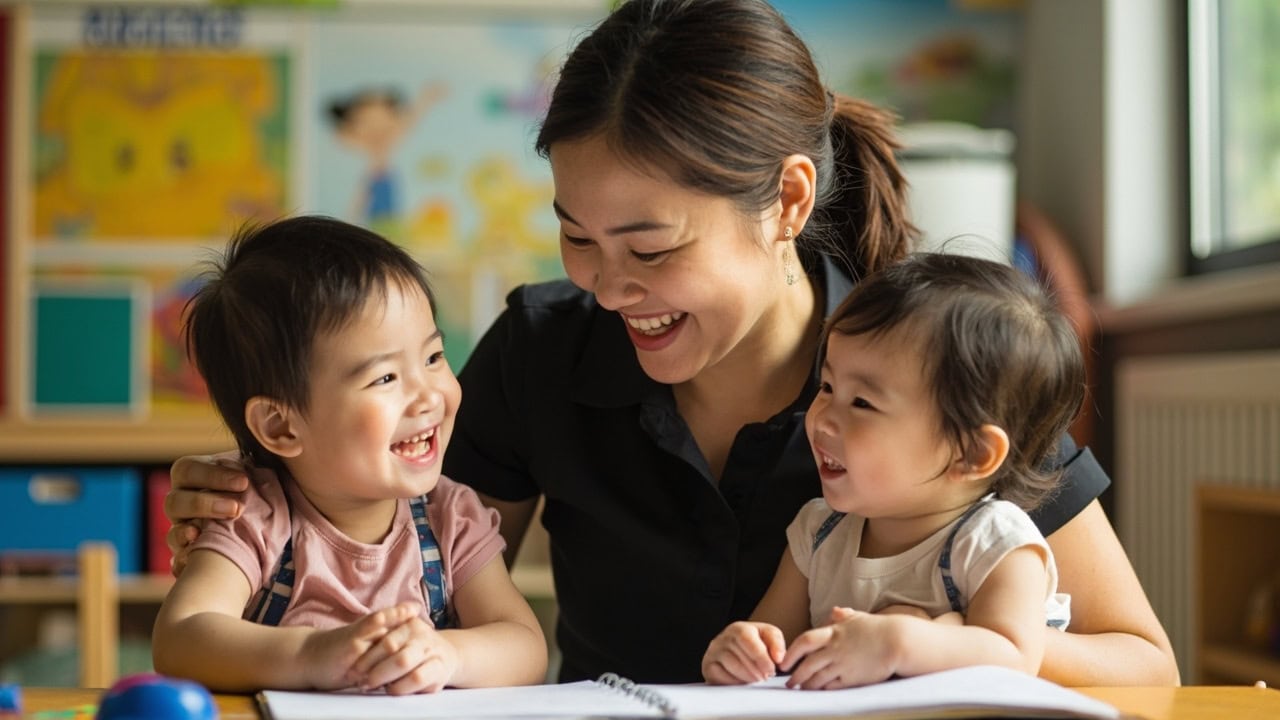
Finding Someone to Hold Your Heart When You Cannot Be There
The Question You Cannot Bring Yourself to Ask
Singapore parents are deeply fortunate. Our parental leave policies have expanded over the years, giving mothers and fathers more time at home than previous generations ever had. And yet, the mathematics of modern Singaporean life mean that for most families, parental leave is a season, not a destination. The mortgage still waits. The career still needs tending. The world, which paused just enough for you to fall completely in love with this new person, has started moving again.
So you plan. You visit childcare centres. You read reviews. You ask friends. You weigh the logistics — the distances, the fees, the CDA contributions you can stretch, the Monday-to-Friday reality of dropping everything and trusting someone else with the most fragile, precious thing you have ever held.
And somewhere beneath all that planning, there is a question you cannot bring yourself to ask out loud, because it sounds irrational and you are supposed to be a rational adult.
The question is this: How do I trust someone else to hold my heart while I am not in the room?
That question is not weakness. It is love, in its most honest form. And it is the question that every parent in Singapore carries — often in silence — when they return to work after parental leave.
Why the First Separation Is a Milestone, Not a Failure
Let us be honest about something the science of early childhood development has quietly confirmed, and that every experienced caregiver and educator knows in their bones: the first separation between a parent and infant is not a failure of bonding. It is a milestone of it.
When your child develops a strong, secure attachment to you — the kind that allows them to feel safe enough to explore, to cry, to reach back for you and know you will be there — that attachment becomes the foundation from which they can eventually reach beyond you. The secure base that John Bowlby described in his theory of attachment is not a wall. It is a launching pad.
What this means, practically and emotionally, is that the separation you are about to navigate is not a break in your relationship with your child. It is an expansion of it. Your child takes your love with them into that new space. The childcare you choose does not replace you. It extends you. It becomes the second arm of the secure base your child is learning to trust.
What This Looks Like for Your Child
Consider what is actually happening in your child’s brain during these early months. In the first thousand days of life, the brain is building its architecture faster than it ever will again. Every interaction, every responsive touch, every consistent presence shapes the neural pathways that will influence how your child manages stress, forms relationships, and trusts the world.
When separation is handled well — with predictable hellos and goodbyes, with caregivers who attune to your child’s cues, with consistency that teaches your child that leaving always leads to returning — your child is learning something profound: the world contains more than one person who loves them.
What This Looks Like for You
The grief that Singapore parents carry during this transition is real, and it is layered.
- The grief of time — the loss of those unhurried mornings when the day belonged only to the two of you
- The grief of identity — the quiet terror that perhaps you are not the parent you promised yourself you would be
- The guilt — sharp and irrational and completely human, that whispers you are choosing your career over your child when the truth is that you are choosing your family’s future and your own wholeness
These feelings do not make you a bad parent. They make you a parent who is paying attention. The parent who lies awake at night replaying the morning hand-off is the parent who cares so deeply that the thought of getting it wrong is unbearable.
What Quality Childminding Actually Looks Like
There is childcare that supervises. And there is childcare that holds.
One watches a child. The other sees a child. One manages schedules and safety ratios. The other reads the micro-expressions of a twelve-month-old who has just walked through a door for the first time and is deciding whether the world is a place worth trusting.
The best childcare does not just keep your child safe. It holds emotional space. It communicates in ways you may never see:
- Through the tone a caregiver uses when your child is tired
- Through the way a room is arranged to invite rather than overwhelm
- Through the small rituals of greeting and goodbye that teach your child that separations end and reunions happen
Beyond Licensing: Indicators of Quality
Most parents start by checking the obvious: licensing, ratios, curriculum, location. These matter. But they do not tell you whether your child will be held. When evaluating infant care options in Singapore, understanding what quality actually looks like beyond the checklist makes all the difference.
- Responsive caregiving: Your child does not wait in line for comfort. When they signal distress, someone responds — not eventually, but immediately. This is especially critical in infant care, where distress that goes unsoothed does not teach independence; it teaches withdrawal.
- Consistent relationships: Your child benefits from predictability. They need to see the same faces, hear the same voices, experience the same rhythms. High staff turnover undermines the secure base.
- Emotional attunement: Caregivers who notice the subtle shifts in your child’s mood — from curious to overwhelmed, from playful to hungry — and adjust accordingly.
- Partnership with parents: When you ask, “How was my child today?” you are not just asking for a report. You are asking for proof that your child is okay. Quality care providers respond with transparency, not defensiveness.
Signs That Your Child Is in a Space That Holds
How do you know if a childcare setting is truly holding your child? Look for these indicators during your visits and conversations:
- Caregivers who speak about your child’s individual temperament, not just developmental milestones
- Routines that feel responsive rather than rigid
- Staff who ask about your child’s specific needs — sleep patterns, comfort objects, feeding cues
- An environment where teachers seem calm and regulated, because their own regulation is what allows them to help your child regulate
- Communication that goes beyond daily logs to include relational details — “She smiled at the mobile this morning” or “He needed an extra cuddle after lunch”
Singapore’s ECDA Childminding Pilot: New Options for Working Families
Singapore’s childcare landscape has evolved to address gaps that parents have long identified. The ECDA Childminding Pilot was designed with a clear understanding that traditional centre-based care, for all its strengths, sometimes cannot fully provide the individual attention and flexible emotional attunement that infants and their families need.
What makes this approach different? The Pilot creates space for home-based and centre-based pathways that prioritise:
- Individual attention: Lower caregiver-to-child ratios mean your infant does not have to wait for comfort
- Flexible attunement: Care that adjusts to your child, rather than asking your child to adjust to a fixed schedule
- Financial clarity: Transparent fee structures that allow families to plan with confidence
- Accessibility: CDA and Baby Bonus fund access, making quality care genuinely within reach for more families
Within the Pilot’s framework, communication tools and transparency measures serve a deeper purpose than data collection. They are trust infrastructure. When you can see what your child’s day looked like — through structured updates, through daily details that go beyond the perfunctory — you can return to your desk and breathe. Not because you are surveilling, but because you are connected. The thread between you and your child remains intact, even when you are physically apart.
Your Real Concerns, Honestly Answered
Before you can trust anyone with your child, you need your concerns to be heard — not dismissed, not minimised, but genuinely understood.
“Am I failing my child by going back to work?”
No. You are not failing your child. You are responding to the full reality of your family’s needs. Research consistently shows that children thrive when they have secure attachments and when their parents are emotionally present — and parents can be emotionally present while also having careers, ambitions, and lives beyond the nursery door. The question is not whether you work. It is whether your child is in a space that holds them the way you would.
“How will my child cope with separation anxiety?”
Separation anxiety is not a sign that your child is not ready for childcare. It is a sign that your child has a healthy attachment to you. The most securely attached children often show the most pronounced separation responses — because they have learned, correctly, that you are the safest base from which to explore. What matters is how the childcare setting responds to that anxiety: with consistency, with warmth, with the message that Mama and Papa always come back, delivered not just in words but in the quality of presence your child experiences.
“What if the caregiver does not love my child the way I do?”
No one will love your child exactly the way you do. That is not the goal. The goal is a caregiver who respects your child’s individuality, who responds to their needs with genuine attentiveness, and who works in partnership with you to extend the emotional security you have built. Your child does not need a replacement parent. They need a trusted extension of the safe base you have created.
“What if something goes wrong and I am not there?”
This fear is real, and it deserves a real answer. Ask potential childcare providers about their safety protocols, their communication procedures, their emergency training, and their approach to medical situations. Then ask yourself: does this provider communicate with the kind of transparency that makes you feel included even when you are physically apart? Trust is built through evidence, not faith. Look for the signs that this is a place where you can breathe.
How to Choose a Childcare Partner You Can Genuinely Trust
Here is what to look for when you are evaluating infant care options — not just checking boxes, but looking for the signs that your child will be held.
Questions to Ask During Your Visit
- How do you handle the transition period when a child first enrols?
- What does a typical day look like for an infant in your care?
- How do you communicate with parents throughout the day?
- What is your caregiver-to-child ratio, and how consistent is the staffing?
- How do you approach separation anxiety during the settling-in period?
- Can you describe a specific moment when you knew a child in your care needed something they could not yet verbalise?
- How do you use my child’s CDA or Baby Bonus funds?
Red Flags to Notice
- Generic responses that do not acknowledge your child as an individual
- Defensiveness when you ask detailed questions
- High turnover rates among staff
- Rigid schedules that do not account for your child’s unique rhythms
- Limited or no communication with parents during the day
- Environments that prioritise efficiency over emotional attunement
What “Good Enough” Actually Means
You may be waiting for a childcare setting that feels perfect. You will not find one. No solution is perfect, and anyone who tells you otherwise is not being honest. What you are looking for is a genuine, thoughtful, human answer to the question you have been carrying. Look for the signs — the ratios, the communication, the transparency, the quality of the people who will hold your child — and find a place where the values you hold as a parent are reflected in the hands that will care for your child when you cannot be there.
The Morning Hand-Off Is Not a Goodbye. It Is a Beginning.
When you choose childcare as a deliberate act of family strategy — not as a reluctant surrender, not as a compromise you are making while hoping it does not damage your child — you change something. You change the narrative. You stop asking, “Am I failing my child by going back to work?” and you start asking, “What does my child need in order for our whole family to thrive?”
The answer is not just a safe, supervised child. It is a child in a space that holds them, that sees them, that gives them the emotional fuel to grow into someone curious and capable. It is a parent who can return to work not with guilt hanging over them like a cloud, but with the quiet, earned confidence of someone who has made a choice that serves their entire family.
What Your Child Is Learning
In that morning doorway, something profound is happening. A child is learning that the world contains more than one person who loves them. A child is learning that love can travel, that it does not only live in one place, that they can be held by more than one pair of hands and still feel completely, utterly safe.
What You Are Learning
You are learning something too. That your love is so strong, so foundational, that it can extend beyond the walls of your home and still remain whole. That you are not two different people with competing demands. You are one whole person, and your family deserves a childcare partner that sees you that way too.
Your Village Is Already Here
All of the details matter — the ratios, the pathways, the communication tools, the fee structures. They are the architecture of care. But what holds the building up, what makes any of it meaningful, is something that cannot be legislated or audited into existence.
It is the quality of the people who show up every morning, who learn the particular way your child takes a nap, who notices when the mood shifts, who holds a child during the part of the day when the missing is the worst and makes it okay to miss.
That quality — that human quality — is where the work happens. It is in the space between the policy document and the child. It is in the greeting at the door, the voice that says, “Mama is coming back, and we are here until she does.” It is in the daily act of extending the secure base so that your child can believe, truly believe, that the world is safe even when you are not in it.
EduNanny Singapore operates within Singapore’s ECDA Childminding Pilot to offer both home-based and centre-based pathways, with care ratios designed to ensure your infant receives immediate comfort when needed. We are here because we understand what parents need when they walk through that door for the first time — not to replace you, but to stand beside you. To extend your reach. To hold the space you cannot be in. To be the second arm of the secure base your child is learning to trust.
If you are standing in that doorway, holding your child’s hand, wondering how you will let go — know this: you are not alone in it. And there are people who understand exactly what that moment means, and who will hold your child with the same love, the same attention, the same fierce care that you bring to it yourself.
Go back to your ambitions, your projects, your conversations with adults, your coffee that is still hot. Go back to the person you are outside the door of that classroom. And know, with something more than hope and more than faith — know with the kind of knowledge that comes from seeing the evidence — that your child is safe, and seen, and held, in a space that understands exactly what it means to love them the way you do.
The village is real. And it is closer than you think.