What Your Child Actually Learns in Quality Infant Care
What the Invisible Curriculum Actually Contains
Before we go further, let us be precise about what we mean. The invisible curriculum is not a metaphor or a marketing phrase. It is a description of real, intentional practices that quality childcare environments design and execute every single day.
Understanding its components will help you see what we see—and ask better questions when you visit any setting. Here are its essential elements:
- The sensory and spatial environment—how a room is arranged, what textures and sounds and light a child encounters, and what those choices communicate about the world
- The rhythm and transition architecture—how the day moves from one activity to another and what emotional skills a child builds in that predictable movement
- The peer dynamic curriculum—what social intelligence looks like when it is born through experience rather than instruction
- Caregiver responsiveness—the practiced skill of reading a child’s needs in real time and adjusting accordingly
- Observation and documentation—how skilled caregivers track a child’s individual growth story over days and weeks and months
- Play as the primary curriculum—why the best infant care settings treat play not as recreation but as the central method of learning
Each of these elements runs simultaneously, quietly, and with tremendous intentionality. Your child may not be able to describe what happened today. But their nervous system is being built by it. Their capacity for self-regulation, their social confidence, their curiosity about the world—these are all taking shape in the ordinary Tuesdays that, one after another, quietly build everything that matters.
The Designed Environment Your Child Wakes Into
Your child arrives at a space that has been arranged not by accident but by design. The lighting is considered. The textures available to small hands are chosen. The way the room is divided—where the blocks are placed, where the book corner breathes, where the caregiver’s own seat sits at just the right height to be present without dominating—every element of that physical environment is a deliberate pedagogical choice.
In quality infant care, we call this the sensory and spatial architecture. It sounds technical, but what it means in practice is something very simple: children learn through their bodies, through what they touch and see and hear and smell, long before they can sit still and listen to an explanation.
A room that is designed well is not a room that is simply clean and colourful. It is a room that communicates to a child, through every surface and every sound, that the world is organized, that there are interesting things to discover, and that someone has thought carefully about what you need today.
The Daily Rhythm
Watch what happens as the morning unfolds. There is a rhythm to the day that may look, from the outside, like a simple schedule—snack time, then play time, then nap time. But inside that rhythm is something far more important than routine. It is scaffolding for emotional regulation, one of the most underappreciated skills a young child develops.
When a child knows, in their body and not just in their mind, that after free play there will be a transition—a song, a tidy-up ritual, a change of activity—they are learning something profound about the structure of time and about their own capacity to move between states of engagement. They are building the neurological foundations for self-control, for flexibility, for the ability to manage disappointment and anticipation.
This is not something that is taught. It is something that is lived, day after day, in the architecture of an ordinary morning.
Learning Among Peers
Then there are the other children. Peer dynamics in infant care are one of the most underestimated aspects of the early learning environment. In a mixed-age group or a small homely setting, your child encounters other children who are not their siblings, who do not share their home values automatically, who have different ways of expressing need and different rhythms of comfort and distress.
This is not a minor thing. This is where social intelligence is born—not in instruction, but in experience.
A child who has learned to navigate a dispute over a toy with a peer, in the presence of a calm and responsive caregiver who does not rush in too quickly but does not stay away too long, is learning something about negotiation, empathy, and resilience that no book can teach in the same way.
Caregiver Responsiveness and Skilled Observation
The person in the room matters more than any programme or philosophy. And we want to speak about this with the respect it deserves, because what a skilled caregiver does in the course of an ordinary morning is nothing short of extraordinary.
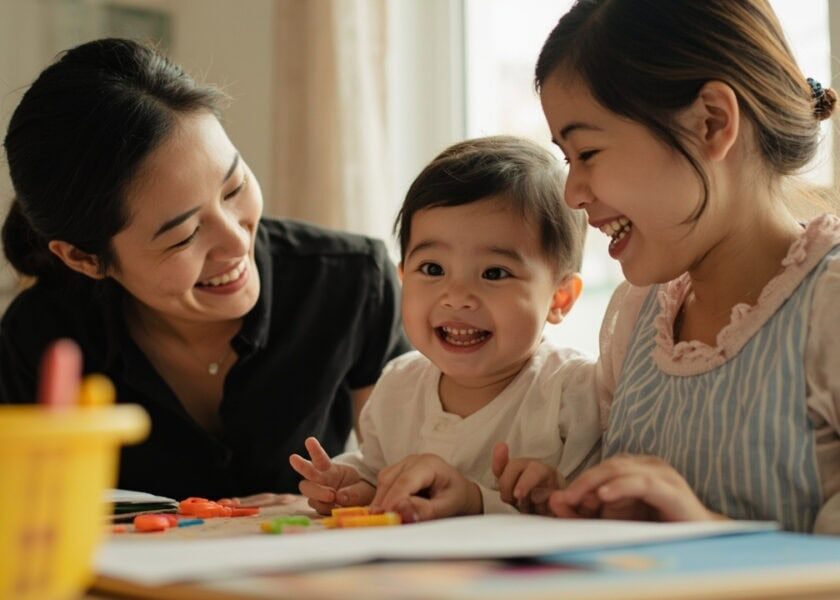
Caregiver responsiveness is not a personality trait. It is a learnable skill, a discipline, a practice built on close observation and genuine attunement. When a caregiver notices that your usually placid child is slightly more agitated than usual and adjusts the morning’s plan accordingly—when she reads the signs of fatigue in a toddler’s walk before the meltdown arrives and offers a quiet book moment instead of pushing forward into group activity—she is doing something deeply sophisticated.
She is practicing what educators call the sensitive baseline: the constant, quiet calibration of her own responses to the individual child’s needs in real time. This is not instinct alone. It is training, reflection, and a culture of observation that quality childcare settings cultivate deliberately.
What your child does during the day is not simply experienced and forgotten. In quality settings, it is observed. It is noted. It is built into a picture over days and weeks and months—a picture that reveals your child’s individual growth story.
How does your child approach a new material? What happens when the play becomes complex? Where does she seek comfort, and when does she venture out alone? These observations are not data for data’s sake. They are the evidence of learning, and they are what transform a childcare experience from a helpful arrangement into a genuinely individualized developmental environment.
When a parent receives an update that says something specific and true about their child’s day—something that could only have been noticed by someone paying close and skilled attention—the distance of the unseen hours collapses. You are no longer guessing. You are beginning to see what we see.
Play Is Not What Children Do When They Are Not Learning
Play, of course, is at the centre of all of this, and we want to say plainly what quality childcare understands intuitively: play is not what children do when they are not learning. Play is how children learn when they are too young to know they are learning anything at all.
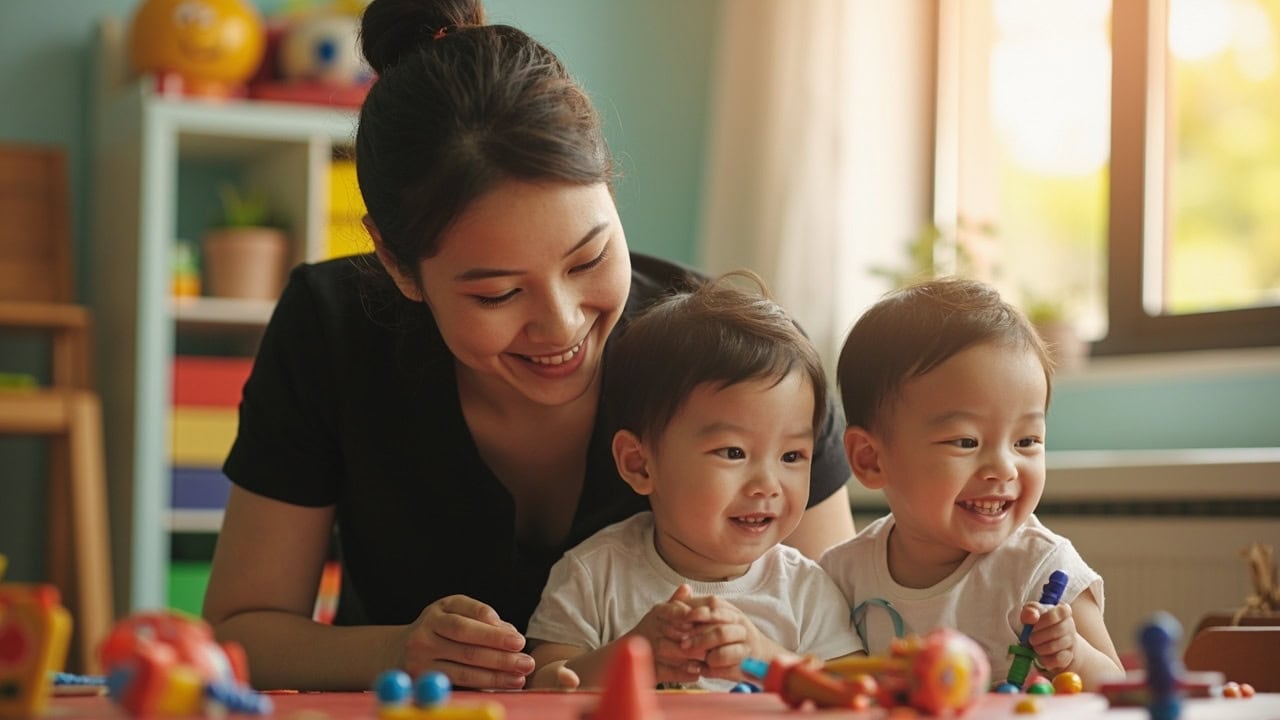
In the best infant care settings, play is engineered. Not in the sense of being rigidly controlled, but in the sense of being intentionally prepared—materials are selected, environments are arranged, and caregivers are trained to support and extend play without interrupting it.
When a toddler builds a tower and knocks it down and builds it again higher, she is developing spatial reasoning, persistence, cause and effect, and the deep satisfaction of mastery. When a baby mouths a wooden object and a caregiver narrates gently—”You found the smooth edge, didn’t you?”—the baby is building language pathways through the simple miracle of being spoken to with attention.
This is the curriculum running beneath the surface. And it is every bit as real as the curriculum that comes later, though it announces itself with far less fanfare.
It is also the difference between supervision and intentional care. Supervision is necessary—it is the baseline. Your child needs to be safe, to be fed, to be warm, to be watched. But supervision, on its own, does not build a child’s capacity to regulate her own emotions over time. It does not build her confidence in social situations. It does not build the cognitive readiness that will serve her when she sits in a primary school classroom for the first time.
Those capabilities are built in the designed hours—the hours between drop-off and pick-up, in the ordinary Tuesdays that, one after another, quietly build everything that matters.
Where EduNanny Fits Into This Picture
This is why EduNanny exists. And we want to tell you what that means, plainly and honestly, because you deserve to know exactly what you are considering.
EduNanny operates within the ECDA Childminding Pilot, and this matters for reasons beyond policy. The Pilot was designed with a clear understanding that infant care in Singapore cannot be a one-size-fits-all arrangement. Some families need centre-based care with all the resources and community that a centre provides. Some families need something smaller, more homely, more aligned with the rhythms of their own home.
EduNanny offers both pathways—the community and centre-based option and the home-based option—and both are held to the same standards of intentional care. In our home-based settings, we work with ratios of up to one to three infants, because we know that in the earliest months and years, the quality of individual attention is not a luxury. It is the condition for everything else.
In our centre-based pathways, that same commitment to small group quality and intentional curriculum design is maintained, because the philosophy does not change simply because the setting grows larger.
We know that affordability is not a secondary concern for Singapore families. It is a primary one. And we have designed our pilot fee structures with that reality in mind. Many families are able to access EduNanny care using their Child Development Account and Baby Bonus funds, and we have structured our Monday to Friday care blocks to align with the actual working lives of Singapore parents.
We also know that trust cannot be built on promises alone. It must be built on transparency. Where our settings deploy communication tools, updates, or safety measures such as CCTV, we do so not because we have something to hide, but because we believe parents have a right to see into the daily curriculum we have been describing.
We want you to know what we see. We want to help you learn to read the invisible classroom that your child attends every ordinary Tuesday, every ordinary Thursday, every ordinary morning you walk back to your car and feel that unnameable question rising in your chest.
We want to answer that question. Not with a brochure, but with evidence.
Questions to Ask When You Visit Any Setting
We believe parents deserve to be empowered observers, not passive consumers of childcare marketing. Here are questions and observations that can help you evaluate any setting you visit—not just ours, but any childcare environment in Singapore.
About the physical environment
- Is the space arranged with intention? Can you see different learning zones—quiet, active, creative, social?
- Are materials accessible to children at their eye level, or are they stored away in adult spaces?
- Does the room feel warm and textured, or does it feel sterile and uniform?
About the daily rhythm
- Is there a predictable flow to the day, and are transitions handled with rituals or signals?
- Can children move freely between activities, or is everything structured as group time?
- Is there space built into the day for child-led as well as caregiver-led activity?
About caregiver practice
- Do caregivers narrate what they observe to the children—”You’re stacking the red blocks on top”?
- Can you see a caregiver responding to individual children in the middle of a group activity?
- Do caregivers kneel or sit at children’s level, or do they remain standing above?
About observation and communication
- How does the setting track individual children’s progress over time?
- What does a typical parent update look like—is it generic or specific to your child?
- Are you able to schedule a visit that allows you to observe, not just tour?
The Invitation
So let us return to that Tuesday morning. You have dropped your child at childcare. The gate closes. You walk away.
But here is what we want you to carry with you, because we see it every day and we believe it with complete conviction: your child has not entered a waiting room. Your child has entered a designed environment where the lighting, the textures, the rhythm, the peers, the caregiver’s responsive attention, the careful observation of their individual growth, and the rich, purposeful play that fills every ordinary hour—where all of this is running simultaneously, quietly, and with tremendous intentionality.
Your child is not simply being looked after. Your child is being built up, day by day, in the thousand small experiences that no report can fully capture but that a skilled and attentive environment provides without fail.
And the invisible curriculum and your home curriculum are not separate. In quality childcare, the daily design honours and mirrors the values you are building with your child at your own kitchen table. When a childcare environment teaches a child emotional regulation through the rhythm of the day, it is teaching what you are already teaching in the small, patient ways you comfort a frustrated toddler or celebrate a small triumph.
The invisible curriculum and the home curriculum are not parallel. They are continuous.
We invite you to look deeper. To ask the questions. To visit the settings and watch with the new eyes that understanding brings. To trust that what you sense is real—that something important is happening in those unseen hours—because it is.
And to know that EduNanny is here not merely to care for your child, but to illuminate the extraordinary work that is happening in every ordinary day, and to walk alongside you in the profound, demanding, rewarding work of raising a human being.
That is what the invisible curriculum is. And that is what it is quietly, carefully, and persistently building: your child.
Ready to see the invisible curriculum in action? We welcome parents to visit our settings, observe a morning, and ask every question that comes to mind. Because we believe the best way to build trust is not with promises—but with transparency.
We invite you to connect with EduNanny to learn more about our infant care and childminding options, or to read more about our approach to developmental, relationship-based childcare.