Why Siblings Thrive When They Grow Up Together
The Question Beneath the Question
You may have wondered whether siblings in the same environment will compete for attention. Whether the younger one will always trail in the elder’s shadow. Whether the elder, who so badly wanted to be the only one, will feel displaced by a sibling who now occupies the same rooms, the same routines, the same eyes.
You may have wondered whether keeping them together will dilute who they are—smooth away the edges that make each of them unrepeatable.
Or you may have wondered the opposite: whether keeping them apart will starve something precious. Whether the bond you glimpsed this morning across the breakfast table—that quiet leaning-toward-each-other—needs more than shared weekends and shared bathwater to grow into what it has the potential to become.
These are not small concerns. They are not the anxieties of a parent who is doing it wrong. They are the concerns of a parent who is paying attention. And they deserve more than reassurance. They deserve an honest answer.
Quality Childcare Does Not Force a Choice
The answer begins with a reframing. Quality childcare does not force you to choose between your children’s connection and their individual development. The two are not in opposition. In the right environment, they are not even in tension. They are, in fact, deeply reinforcing of each other.
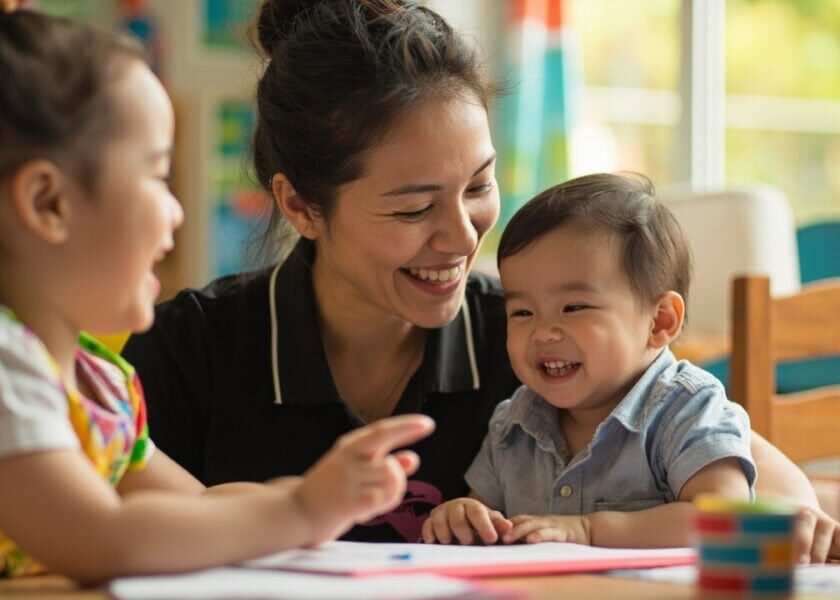
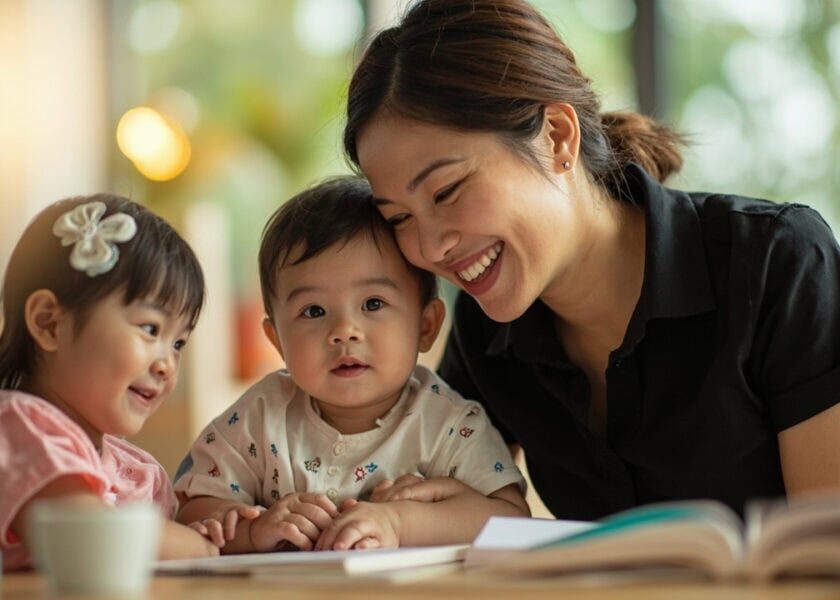
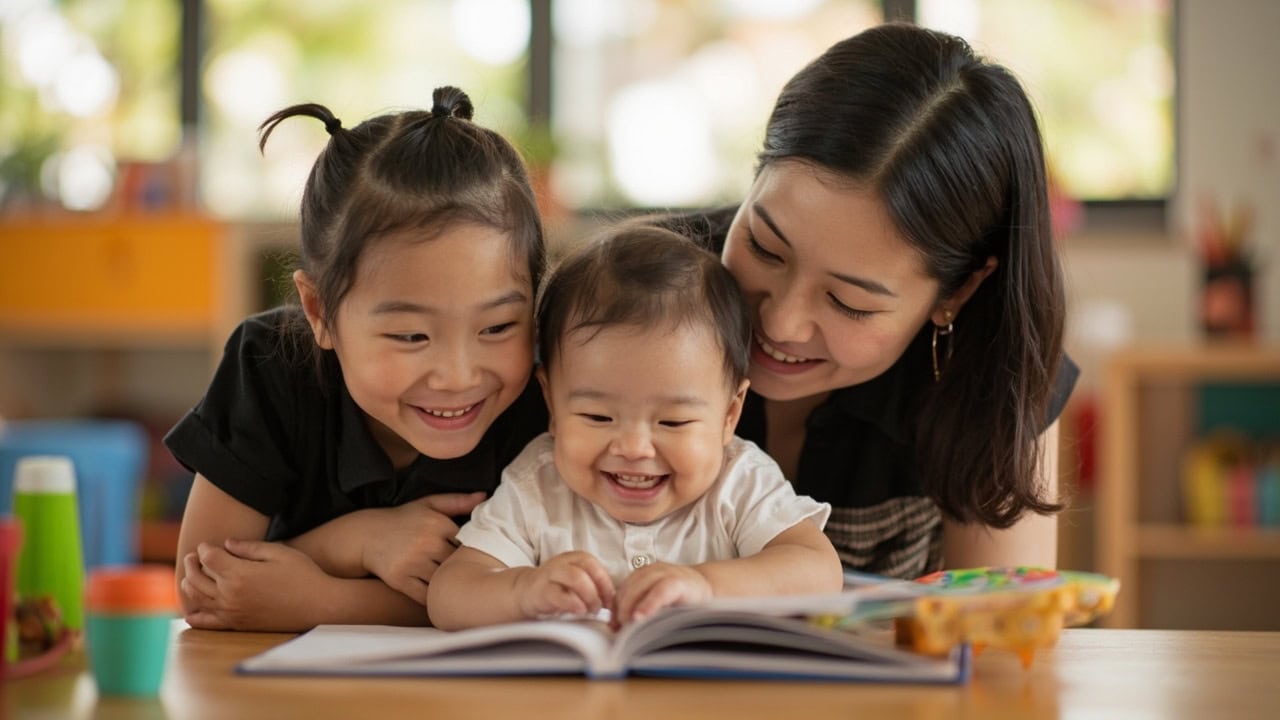
Here is what is often missed in the conversation about siblings and childcare: siblings are not simply people who happen to live together. They are, in the earliest years especially, each other’s first and most influential peer group.
What Siblings Give Each Other in Quality Care
The Beginning of Empathy: Emotional Co-Regulation
When siblings share a consistent, quality childcare environment, something extraordinary happens. They begin to co-regulate. They learn to read each other’s emotional cues with a fluency that even the most attentive caregiver cannot quite match.
Your two-year-old notices that her brother is frustrated before anyone else does. She offers him a toy, not because she was taught to, but because she feels the shape of his distress and has, in him, a safe person to offer comfort to.
This is not incidental. This is the beginning of empathy. This is the beginning of a moral imagination that will serve your children for the rest of their lives. And it is happening not in spite of shared childcare, but partly because of it.
Peer Modeling: Learning Through Living
Siblings in a quality environment also model for each other. The elder child, arriving at childcare with a set of skills and expectations about how the world works, shows the younger one what is possible.
Watch a toddler watch her four-year-old brother negotiate a turn on the slide. Watch her absorb that negotiation, file it away, and six months later deploy it herself in a different form with a different child.
This is not mimicry. It is learning at its most organic, most deeply embedded, most durable. The younger child is not diminished by having an elder sibling as a model. She is accelerated by it. She is given a lived demonstration of competence that she internalizes as something she, too, is capable of.
And the elder child? In being looked up to, in being sought out, in being the one whose younger sibling follows, she develops a sense of responsibility and confidence that is uniquely affirming. Both children grow, but they grow in relation to each other.
The Shared Narrative: Building a World Together
There is also something that happens in shared childcare that is easy to overlook because it is so quietly powerful. Siblings begin to construct a shared narrative.
They come home at the end of the day and they have been in the same space, but they have not had the same experience. Each child processed the day differently, noticed different things, felt differently about the same small moment.
And so they begin, in the car on the way home or at the dinner table, to trade accounts. To compare notes. To say things like:
“Mama, did you know that Ah Ma made the blue playdough today?”
“I sat next to Jia En at snack time.”
“Aiden fell down but he was okay because the teacher came.”
What you are witnessing is the construction of a shared world. Your children are building the story they will carry together through their entire lives. They are creating the foundation of a relationship that will outlast your home, your presence, possibly even your time.
Why Individual Attention Is Not Negotiable
Now, let us be honest about the other side of the question. Because you are right to ask it. The concern about individual attention is a legitimate one, and it deserves a direct answer.
In a childcare setting where one caregiver is responsible for too many children, the fear is not unfounded. Siblings—or any children—in an overcrowded environment can begin to blur into a single unit.
- The louder child gets attention
- The quieter one learns, sometimes permanently, to make herself smaller
- The elder child who is used to leading is given no space to lead
Individual development does require something specific. It requires that each child be seen. Not glimpsed. Not noted in passing. Seen. Known. Understood as a full and whole person with their own temperament, their own pace, their own fears, and their own extraordinary potential.
The Architecture of Attention: Why Ratios Matter
This is precisely why the structure of care matters so much. Low ratios are not an administrative detail. They are the precondition for individual attention.
When a caregiver is responsible for no more than three infants at a time, something changes. She learns the particular cadence of each child’s cry. She notices when your two-year-old is approaching a developmental leap and adjusts her support accordingly. She knows that your youngest, who is still so new to group care, needs a longer settling period in the morning and that she should not rush that transition.
She is able to give each child what they need precisely because she is not simultaneously managing seven or eight others.
The ratio is not a number on a page. It is the architecture of individual attention. It is the reason siblings in quality care grow closer rather than apart—because they are not competing for scarcity. They are each receiving what they need, and in that abundance, they have room to turn toward each other.
What to Look For: A Practical Guide for Singapore Parents
When evaluating childcare options for multiple children in Singapore, consider these factors:
- Ratio transparency: Ask about caregiver-to-child ratios. For infants, lower ratios mean more individual attention.
- Observation of sibling interaction: Notice how caregivers respond when siblings have different needs in the same moment.
- Consistency of care: Ask whether your children will have the same primary caregiver day over day.
- Space for individuality: Quality care should allow each child to be known as themselves, not just as part of a pair.
- Communication: Ask how the team shares observations about each child’s development separately and together.
What EduNanny Singapore Offers
EduNanny Singapore, developed by BUTLER, understands this architecture intimately. As an ECDA Childminding Pilot participant, EduNanny operates within a framework that recognizes how profoundly the early years shape a child’s trajectory.
Pathways Built for Singapore Families
The pilot model offers families both home-based and centre-based pathways, because Singapore families are not a single type. Some children thrive in the warmth of a home setting with a dedicated caregiver. Others bring a particular energy to a community environment with their peers.
Both pathways share a foundational commitment: each child, up to a maximum ratio of three infants per caregiver, receives individual, attentive, relationship-based care.
Consistency as a Developmental Necessity
The care blocks, available Monday through Friday, are structured to provide consistency—consistency which is not a luxury for young children. It is a developmental necessity.
Consistency is the soil in which trust grows. And trust is the foundation upon which everything else is built, including the sibling bond.
Making Quality Care Accessible
For families navigating the very real financial dimensions of childcare in Singapore, EduNanny’s pilot fee structures are designed with accessibility in mind. Government support mechanisms including the Child Development Account and Baby Bonus can be utilized, making quality care not only a developmental choice but a feasible one.
This matters. The conversation about sibling bonds and individual development should not be a conversation available only to families with significant resources. Every child in Singapore deserves to be seen. Every sibling pair deserves the chance to grow up together in a space that honors both who they are together and who they are apart.
The Foundation We Are Building
There is a question that sits beneath all the logistics, all the curriculum comparisons, all the site visits and orientation meetings.
The question is not really about ratios or fee structures or which pathway is right for your family—though those things matter and deserve careful thought.
The question beneath the question is this: what kind of foundation are we building? Not for childcare. For our children. For the relationship between them. For the persons they are becoming.
And the answer, if we are honest and if we are brave enough to trust the process, is that the foundation we are building is not for us to see completed. It is for our children to inhabit, long after we are no longer the ones laying it down.
Children Who Grow Into Each Other
Children who grow up together in quality care do not simply grow alongside each other. They grow into each other.
The sibling bond, when nurtured in an environment that attends to each child’s individual development, becomes something remarkably powerful. It becomes a place your children will return to throughout their lives—a place of recognition, of comfort, of the kind of understanding that no friendship, however deep, quite replicates.
They will draw on it in adolescence when everything feels uncertain. They will rely on it in adulthood when the world is heavier than they expected.
The sibling bond is not a by-product of shared genetics. It is a living relationship, built in small moments, in the ordinary architecture of shared early years. And quality childcare, when it is structured with intention and care, provides precisely the conditions for that bond to deepen and flourish.
They are growing up together. Let us make sure that together means everything it can mean.
If you are ready to explore how EduNanny Singapore can support your children’s bond and individual growth, we would be glad to hear from you. Connect with us to learn more about our ECDA-approved childminding pathways, or to arrange a visit to see our approach in action.