Honoring Grandparents While Embracing Modern Childcare in Singapore
Why Grandparent Childcare Matters—and Where Science Meets Intuition
In Singapore, grandparent childcare is not merely a convenience. It is a cultural institution. For decades, multigenerational care has been the backbone of how Singapore raises its children. Grandparents step in with devotion, with love accumulated across lifetimes, with an authority rooted in having successfully navigated parenthood themselves.
The phrase “I raised my children and they turned out fine” is not just a defense—it is a declaration of experience, of hard-won competence, and of a bond that deserves deep respect.
What grandparents offer a child cannot be measured in developmental milestones or captured in observation reports. It is the weight of history in a bedtime story. The particular tenderness of someone who has already loved and let go, and who now holds the next generation with hands made gentle by time. It is cultural continuity—dialects spoken, traditions observed, a sense of belonging that runs deeper than nationality, deeper than language, rooted in blood, memory, and the daily acts of care that bind a family together.
But here is what contemporary understanding adds: the science of early childhood development has moved forward in ways that matter. In the first years of life, a child’s brain forms neural connections at a pace that will never be matched again. Attachment patterns crystallize. Language acquisition accelerates. Motor skills emerge through countless repetitions, through exploration, through the simple miracle of a safe space in which to move, fall, and rise again.
The emotional architecture that shapes a person’s capacity for relationship, resilience, and empathy—it is all being built in these years, brick by brick, moment by moment. Grandparents understand this intuitively. They know that young children are not merely small adults waiting to become themselves.
What modern early childhood education offers is a refined understanding of how to support that process—the rhythms of stimulation and rest, current guidance on language exposure, updated thinking on safety and nutrition, and the gentle art of encouraging development without pressuring it. These are areas where contemporary frameworks have deepened since today’s grandparents were raising their own children.
This is not a judgment. It is simply the nature of knowledge. Every generation inherits both wisdom and gaps. The gift of one generation becomes the starting point for the next.
The Tension Parents Feel Is Not Ingratitude
The tension that Singapore parents often feel is not a sign of ingratitude. It is a sign of love that wants to do well by all parties—by the child, by the grandparents, by the family as a whole.
It is the desire to honor what has been given while also embracing what is now understood. It is the wish to say: We see what you have done. We are grateful beyond words. And we want to build on it, not replace it.
Singapore parents are navigating genuine complexity. They want their children to know their grandparents’ love—the kind that comes from decades of lived experience, that carries history in its hands. At the same time, they carry awareness of developmental research, the pressures of dual-income households, and the desire to give their children every possible advantage.
These desires do not cancel each other out. They can coexist, and when handled with care, they strengthen each other.
What Quality Childminding Looks Like—and How EduNanny Fits In
Quality childminding is not about replacing the warmth of a familiar home. It is about bringing intentionality to the developmental opportunities that arise in daily care. This means:
- Structured observation: Attentive caregivers notice how each child plays, responds to challenge, and grows day by day
- Developmentally appropriate environments: Spaces prepared for infant safety and designed to encourage the kind of exploration the early years demand
- Consistent, meaningful ratios: Caregivers who can give individual attention because they are not stretched across too many children at once
- Communication that connects: Updates that help parents see their child’s day as a coherent story rather than a series of disconnected episodes
- Coordination with family care: A willingness to ask about home routines, listen to what grandparents have observed, and integrate professional care into a larger picture
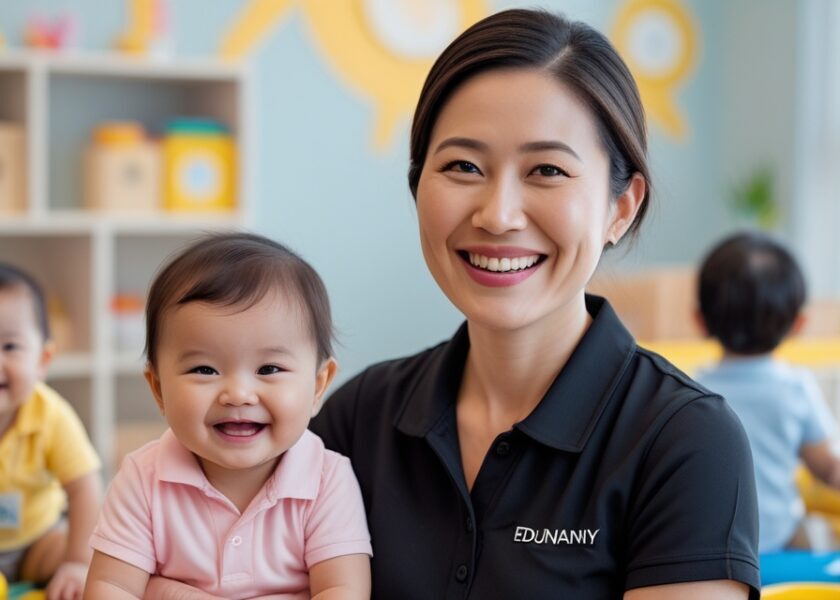
EduNanny operates within the ECDA Childminding Pilot, offering home-based care that keeps children in familiar, nurturing environments. Our infant ratios are carefully maintained to ensure meaningful individual attention. Families can draw on CDA and Baby Bonus where applicable.
But the deeper work is something more subtle than logistics. When we care for a child, we do not pretend the grandparents do not exist. We ask about the child’s routines at home. We listen when parents share what grandparents have observed. We recognize that a grandmother who has spent every Tuesday with a child for two years understands that child in ways we never could in the same timeframe. We honor that knowledge while contributing our own: contemporary early childhood frameworks, intentional observation, and structured support for development that may not arise naturally in a loving but unstructured environment.
Addressing the Real Concerns Singapore Families Have
“Will my parents feel replaced or judged?”
This is perhaps the most common concern, and it is a deeply compassionate one. When families recognize that their child could benefit from additional structured support, they are not betraying their grandparents. They are being honest about the complexity of raising a child in a world that has changed. The relationship between a grandparent and grandchild is sacred in its own right. EduNanny is not here to evaluate it, grade it, or overshadow it. We are here to supplement it, to support it, to contribute what we can so that the child has every possible advantage and the grandparent’s role is honored rather than diminished.
“My parents feel hurt that we are considering outside care.”
This reaction is understandable. When grandparents have devoted themselves to caring for a grandchild, any suggestion of additional support can feel like a quiet criticism. The conversation with grandparents matters enormously. We encourage parents to be honest, kind, and clear: We are not doing this because anything is wrong. We are doing this because we want our child to have a coordinated village, and we believe that village can include you even more fully when we are not asking one person to carry everything alone.
“Will my child struggle with different caregiving environments?”
Children are remarkably adaptable, especially when transitions are handled with warmth and consistency. When grandparent care, parental care, and professional care share communication and basic rhythms, children benefit from the variety. They learn that love comes in different forms, that different people have different gifts to offer, and that their world is large enough to hold all of it.
“What if my parents disagree with our parenting choices?”
This is a natural tension in any multigenerational household. Grandparents raised children in a different era, and some practices have shifted—not because the old way was wrong, but because new knowledge has emerged. The goal is not to override grandparent authority but to gently introduce what contemporary understanding adds. Parents who articulate their hopes clearly—not as corrections but as invitations—often find grandparents are more receptive than expected.
There are also seasons when grandparent care benefits from extra support. Grandparents age. Their energy changes. Health challenges arise. The demands of full-time childcare can be heavy for anyone, regardless of devotion. Sometimes there are gaps—not of love but of knowledge, of updated practice, of the ability to provide the kind of structured, intentional stimulation that modern early childhood understanding recommends.
When families recognize these seasons and seek additional support, they are making a wise and courageous choice. Asking for help is not an admission of failure. It is an act of love on behalf of the child—and, ultimately, on behalf of the grandparents themselves, whose relationship with their grandchildren thrives when it is not stretched beyond sustainable limits.
Practical Guidance: Building Your Village
For parents beginning to think through their childcare arrangements, here is how to approach the grandparent bridge thoughtfully.
- Start with honest conversation, not assumptions. Before arranging care, have an open dialogue with your parents about what you are hoping for. Share your thoughts as aspirations, not criticisms. Ask what concerns they have. Listen fully before responding.
- Identify what each caregiver does best. Grandparents excel at unconditional presence, cultural transmission, and emotional warmth. Professional care excels at developmental intentionality, structured observation, and consistent routines. Neither replaces the other.
- Create continuity between environments. Share basic rhythms and routines across settings. If your child eats lunch at a certain time at home, let that carry over. If grandparents use particular comforting strategies, let your caregiver know. Small consistencies reduce a child’s cognitive load and increase their sense of security.
- Expect adjustments over time. The arrangement that works when your child is six months old may not work at two years. Childcare arrangements should evolve as your child’s developmental needs change. That is not a sign of failure—it is responsive parenting.
- Include grandparents in transparency. If your caregiver notices something noteworthy about your child’s day, share it with grandparents too. When grandparents feel included rather than excluded from the larger picture, they often feel more connected, not less.
- Remember that coordination is an act of love. The work of aligning different caregivers—schedules, philosophies, expectations—takes effort. That effort is itself a gift to your child. It tells them that their wellbeing matters enough for adults to work together.
To Grandparents: You Are Not Being Replaced
To the grandparents who may be reading this: we see you. We honor what you have given. We know that the love you pour into your grandchildren is not something any programme can replicate, and we would never try.
When your children choose to include EduNanny in their family’s childcare arrangement, it is not because they think you have done something wrong. It is because they are trying, as all parents do, to give their children every possible advantage—including the advantage of a coordinated, intentional, multigenerational village that does not rely on any single person to carry everything alone.
You are not being replaced. You are being joined. And your grandchildren will grow up knowing that they were loved not by one form of care but by many—by the particular love of grandparents who carry history in their hands, and by the thoughtful support of caregivers who bring contemporary understanding to the art of nurturing young minds.
That is not a diminishment of your role. It is an expansion of your grandchild’s world.
The Melody Continues
Let us return to that opening image: the grandmother, the child, the melody passed down through generations. That moment will continue. It will happen on weekends, on holidays, in the quiet hours when grandparents and grandchildren have each other to themselves. It will happen in Hokkien endearments and Mandarin proverbs, in the particular way a grandfather stirs a pot of soup, in the smell of a grandmother’s kitchen and the sound of her voice reading a book she once read to your own childhood self.
That is not ours to touch. That is yours, permanently, irrevocably, as a family.
What EduNanny offers is not an alternative to that. It is the addition of a steady, informed, loving presence on the days when grandparents are not available, or when parents need support, or when a child’s developmental needs call for something more structured than any single caregiver can provide alone.
Singapore families are navigating something genuinely new—that has no historical precedent, because no previous generation has had access to the same combination of multigenerational family structures, dual-income pressures, and sophisticated early childhood knowledge. They are navigating it with courage, with love, with the occasional misstep and the frequent triumph of families who manage to hold complexity without breaking.
There is no perfect solution to the complexity of modern family life. But there are thoughtful ones. Respectful ones. Ones built on the understanding that Singapore families deserve more than binary choices—that they deserve partners who can walk alongside them, honoring what came before while embracing what lies ahead.
If you are considering how professional childminding might fit within your family’s village, we welcome the opportunity to talk. No obligations, no pressure—simply an honest conversation about what your family needs and how we might support it.
To learn more about EduNanny and our approach to thoughtful, development-oriented childminding, or to read about who we are and what we stand for, we invite you to explore our site at your own pace.