Trust Your Instincts When Choosing Childcare in Singapore
Your Instincts Are Your Most Valid Assessment Tool
Here is what you need to understand: your instincts are not the vague, sentimental reactions of an overprotective parent. They are the trained responses of someone who knows your child better than anyone else alive.
You know what your child’s laugh sounds like when it is real. You know the difference between your child being briefly upset and your child being genuinely distressed. You know the temperature of your family’s life — the rhythms, the tolerances, the things that soothe and the things that spike anxiety.
This knowledge is not irrelevant to choosing childcare. It is the most relevant thing you have.
The problem is that parents have been encouraged to set this knowledge aside. They have been handed checklists instead.
Checklists are designed for things you can measure — square footage, teacher-to-child ratios, whether the kitchen has a current license. These things matter, but they do not tell you:
- What it feels like to be in a room
- Whether the caregiver’s attention is present or merely performing
- Whether the children’s movements are free and curious or constrained by routine
- Whether your child will thrive in that environment — because only you know your child well enough to imagine that
You do not need a degree in early childhood education to recognize quality. You need only to notice that it is happening.
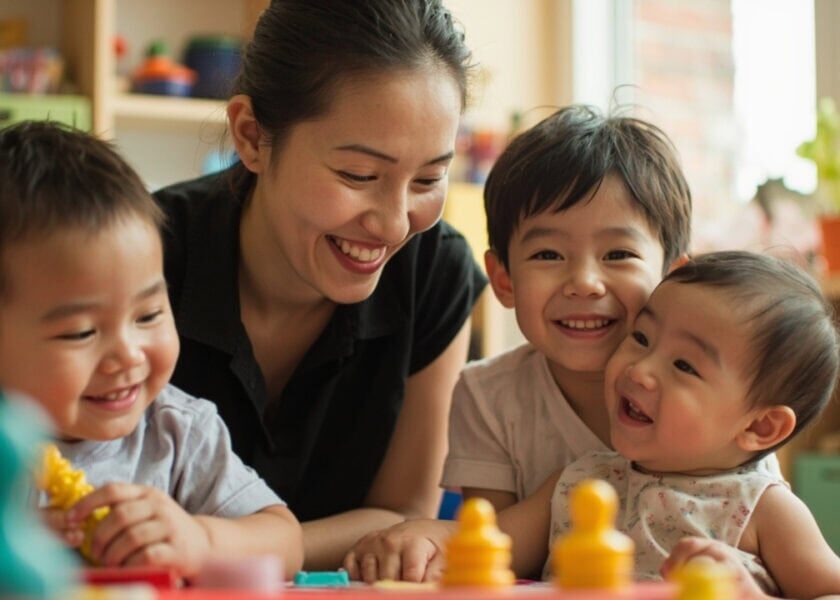
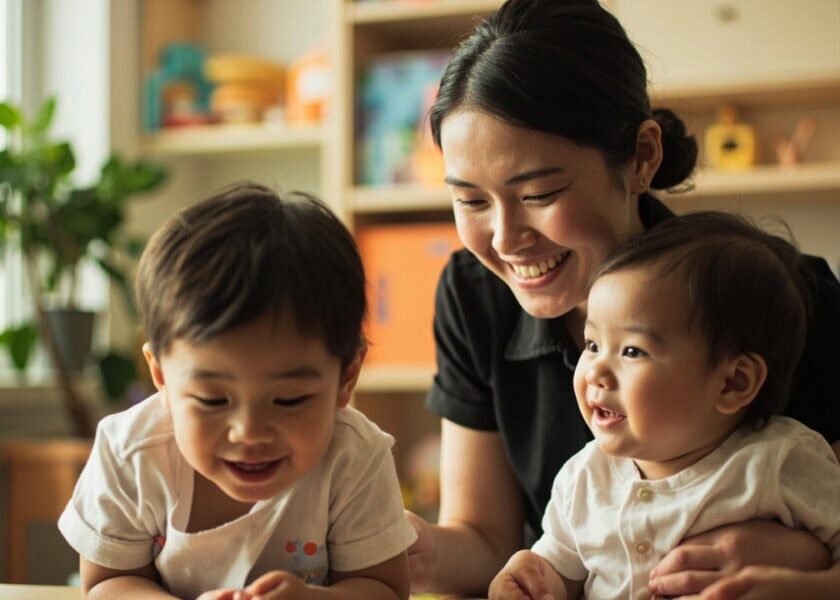
A caregiver kneels down to tie a shoe. She does not rush. She speaks while she ties — not at the child, but to the child, as though the child is a person whose company she enjoys. A child drops something and looks up, alarmed. Before the child speaks, the caregiver has noticed, has moved closer, has said something small and calming.
These are not technical skills. These are the skills of presence, of attentiveness, of genuine care. You do not need a degree to see them. You only need to watch.
How to Watch With Intention
When you walk into a childcare space — whether it is a centre or a home-based setting — do not look at the walls first. Look at the people. Look at the children.
Notice how they move through the room. Are they moving toward things or away from things? Do they navigate the space with a sense of ownership, picking up a toy here, pausing at a window there? Or does the movement feel regimented, directed, a kind of controlled choreography?
Neither is automatically wrong, but they are different. And the difference tells you something about how this environment understands freedom and trust.
How to Read the Caregivers
Now watch the caregivers. Not what they are saying — watch what they are doing.
Notice how they hold themselves when they are not speaking to a visitor. Are their shoulders relaxed or tense? Are they kneeling to a child’s level or speaking down from above?
When a child approaches with a need — not a big need, not a crisis, just a small need, a question, a request for help with a puzzle piece — how quickly does the caregiver respond? And how?
Is there a pause, a sigh, an expression that communicates impatience or distraction? Or is there a presence, a turning-toward, an energy that says: I am here, I see you, you matter?
These small moments are not incidental. They are the actual substance of a child’s day. Your child will not remember the curriculum. Your child will remember whether someone turned toward them when they needed to be seen.
What Repeated Visits Reveal
The first visit is not for evaluation. It is for orientation. You are learning the landscape. You are getting a sense of the room, the people, the general atmosphere. Give yourself permission to not know yet.
The second visit is where observation sharpens. By then, some of the newness has worn off. You have a baseline. You can notice if the energy you sensed on the first visit was a performance or a pattern.
- Does the caregiver you spoke to on Tuesday behave the same way on Thursday?
- Are the children responding similarly?
- Is the room arranged differently in ways that matter, or just cosmetically?
A centre that performs for visitors will show you something slightly different each time — a polished surface, a scripted interaction. A centre that serves will look more consistent, because the consistency is not for you. It is simply how they live.
The Difference Between Performing and Serving
This is one of the most useful distinctions you can learn: the difference between a centre optimized for the tour and a centre optimized for the children.
A performing centre has beautiful displays on the walls. It has a script for every question you ask. It speaks the language of parents — milestones, enrichment, readiness.
A serving centre has children who care about whether the bread at snack time is soft enough to chew easily, whether the caregiver sings the same good-morning song every day, whether they can find the same blue truck in the same basket because they have claimed it and want it to still be there.
When you visit, ask yourself: Is this space designed for me to be impressed, or for children to feel at home? Both can be true, but when the balance tips entirely toward impressing parents, you will feel it. There will be a hollowness beneath the polish.
Singapore’s Specific Context
Singapore presents specific pressures that make discernment harder, not easier.
We live in small spaces. We work long hours. We navigate multiple cultures and expectations — our parents, our employers, our own ideals. We are building something in a context that was not designed for ease.
Childcare spaces in Singapore are often compact. They have to be. And this is not a flaw — it is a reality that good childcare adapts to. What you should notice is whether the smallness feels cramped and hurried, or cozy and intentional.
Children do not need vast sprawling gardens to learn and grow. They need responsive adults, appropriate materials, and a sense that the world around them is safe enough to explore.
You will also notice cultural texture. Singapore’s diversity is not just a demographic fact — it is a daily lived experience in any childcare setting. How does the centre hold this?
- Do you see evidence of different traditions, different languages, different ways of being a family?
- Or is there a flattening, a homogenization that erases difference in the name of efficiency?
A thoughtful centre will have thought about this. A thoughtless one will not.
Practical Steps for Your Visit
Before You Go
Let your body settle. If you arrive anxious, your anxiety will color everything you see. You will be looking for threats, for problems, for reasons to say no.
Try to arrive calm. You are not looking for reasons. You are looking for clarity.
When You Are in the Space
Slow down. Resist the urge to absorb every piece of information. Instead, choose a single child — not your own, not yet, but one child in the room — and follow them for five minutes.
- Watch what they do
- Watch who notices them
- Watch whether they seem settled, curious, free
Now choose a caregiver and do the same. Watch how they move between children. Watch what they do with their hands. Watch their face when they think no one is watching.
This is the practice of attention. And it will tell you more than any brochure.
After the Visit
Write down what you felt, not what you thought. Feelings are data.
- If you left a centre feeling vaguely unsettled but cannot articulate why, that is information
- If you left another feeling quietly at ease, that is information too
The specific emotion matters less than the direction of it. Trust the direction.
And if you are still uncertain, go back. Ask for a second visit. Any centre that is confident in what it offers will welcome this. A centre that serves will want you to be sure, even if that means waiting.
If You Are Still Worried
What if I miss something important? You will not miss what matters if you watch with attention rather than with a checklist. The moments that shape your child’s day are not hidden. They are in the small interactions, the tone of voice, the way a caregiver turns toward a child. These are visible. You have always had the eyes to see them.
How do I know if the tour is staged? Return for a second visit. Notice consistency. Authenticity is consistent.
What if I choose wrong? Choosing with awareness — with your eyes open and your instincts engaged — is not the same as choosing perfectly. It is about reducing uncertainty by trusting what you actually observe rather than what you are told to look for. When you choose with clarity, the decision feels different. It feels like yours.
Home-Based Childminding as an Option
Childcare is not a monolithic product. Families are different. Children are different. The rhythm of a newborn’s day is not the rhythm of a toddler’s day, and neither is the rhythm of a working parent’s week.
Good childcare meets families where they are, not where a generic template says they should be.
Home-based and community-based childminding offers a different architecture of relationship and environment — one that allows for greater individual responsiveness, closer caregiver-to-child ratios, and the kind of intimacy that helps infants and toddlers feel genuinely secure.
In home-based settings, each child can be truly known — not just managed, but known. The environment is scaled for warmth rather than throughput. The rhythms can adapt to individual children’s needs rather than conforming to institutional schedules.
Finding Quality — And Where EduNanny Fits
There is a particular kind of peace that comes from making a decision with confidence rather than luck. Parents who have found it describe it differently — as a weight lifting, as a door opening, as finally feeling like themselves again.
The overwhelm does not disappear entirely, because parenting is always overwhelming in some way. But the specific anxiety of not knowing whether you chose well — that one lifts.
Because you chose with your eyes open. Because you trusted what you saw. Because you knew what to look for.
This is what the framework above is for. Not to overwhelm you with another checklist, but to give you permission to trust yourself. To remind you that you know more than you think you do. And to assure you that quality is not hidden in credentials or encrypted in curricula. It is visible — in the small moments, in the micro-interactions, in the way a caregiver turns toward a child who needs to be seen.
You have always had the capacity to see it. You just needed someone to tell you that your vision counts.
When you walk into one of our settings — whether a home-based or community-based childminding environment — you will see the things this article has asked you to look for. You will see children moving with ease. You will see caregivers who are present in the way described — not performing, but serving. You will see an environment that feels responsive rather than rigid, warm rather than polished, real rather than curated.
And you will feel it. That quiet recognition. That sense of, oh. This is what I was looking for.
We do not need to convince you. The framework shared here is yours now. Use it. Trust it. Walk into any childcare space with your eyes open and your instincts engaged. And when you find EduNanny, you will know it is not because you were swayed by marketing or misled by reviews. It will be because you looked, and you saw, and you chose with clarity.
What EduNanny Offers
EduNanny by BUTLER is part of the ECDA Childminding Pilot — a programme designed to expand quality pathways for Singapore families through home-based and community-based care.
- Caregiver-to-child ratios that allow each child to be truly known
- Transparent communication and visibility into your child’s day
- Care blocks designed around working parents’ actual schedules
- Fees structured within the pilot framework to be accessible
- Support for using the Child Development Account and Baby Bonus
We hold the work of childminding in high regard — training caregivers not just in practice but in presence. Because what happens in a child’s first thousand days shapes the architecture of who they become. This is not a burden. It is a privilege. And it is one we take seriously, not with grand gestures but with daily intention.
If you are ready to explore what attentive, relationship-based childminding looks like in Singapore, we invite you to reach out. Your instincts brought you here. Trust them.