The Daily Work Building Your Child Beyond What You Can See
The Invisible Architecture of Quality Childcare
There is a moment that happens in Singapore homes every evening—in HDB living rooms and condominiums, in Tampines and Tiong Bahru and Ang Mo Kio. A parent opens the door after a day at work. The child runs forward. And in that rush of reunion, something catches you off guard.
A word you did not teach. A way of holding a spoon. A confidence in their body you cannot explain. Something is different. Something happened today.
You chose the childcare. You trust it in principle. You visited, observed, perhaps asked the right questions. But you cannot see inside those hours. You see the outcomes at homecoming. You do not see the architecture that produces them.
That gap—between what you observe and what you cannot witness—creates a quiet, persistent wondering. What builds a child between the moments you can see?
This is not a failure of your curiosity. This is the fundamental tension of modern Singapore parenting. We trust institutions with our children during the most developmentally significant years of their lives. We see evidence that trust is warranted. We rarely understand why.
Until now.
What Quality Childcare Actually Does
Here is what the research consistently shows: quality childcare is not a mystery. It is a purposeful architecture of learning, responsiveness, and developmental scaffolding that operates through every routine, every interaction, every observation. When it is done well, it becomes invisible—not because it is absent, but because it is everywhere.
- Emotional regulation built through responsive caregiving and co-regulation
- Language development through millions of incidental, meaningful word exposures
- Social problem-solving skills through guided peer interaction
- Physical and cognitive development through intentionally designed environments
- Individualized attention through systematic observation and adaptation
Once you understand what quality childcare is actually doing during those invisible hours, the outcomes you witness at homecoming will no longer feel mysterious. They will feel inevitable.
Emotional Regulation: Building the Foundation
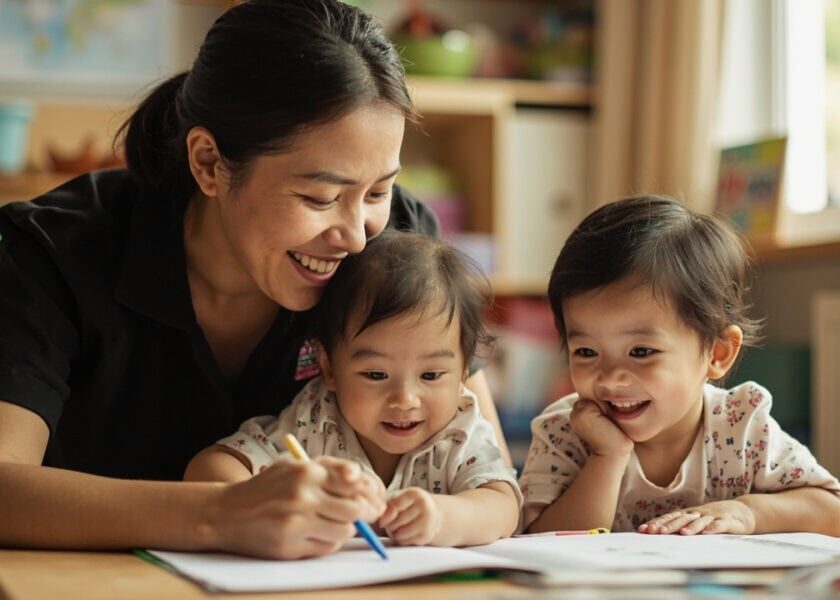
Consider the first hour of the morning. A child arrives, still adjusting to separation, and the caregiver kneels down to their level. Not a quick greeting. Not a distracted wave. A real moment of connection—eye contact, a warm voice, a hand offered.
What you see is a kind gesture. What is happening beneath that moment is the foundation of emotional regulation being laid, one greeting at a time.
Emotional regulation is not something children are born with. It is something they build, slowly, through thousands of experiences of being soothed, being met, being helped to name what they feel.
In a quality childcare setting with a caregiver-to-infant ratio of one to three, your child is not one of fifteen faces in a crowd. They are one of three. Which means that when frustration rises during play, when tiredness makes them irritable, when the big feelings of the two-year-old self arrive uninvited, there is a responsive adult who can notice, intervene, and co-regulate.
Every moment a caregiver helps a child move from dysregulation back to calm is a moment that builds the neural pathways the child will later use to calm themselves. The brain does not learn to self-regulate by being left alone with big feelings. It learns to self-regulate by experiencing regulation with another person, over and over, until the pattern becomes internal.
You will not see this at homecoming. What you will see is a child who seems more settled, more trusting of new situations, more able to recover from disappointment. You will call it good childcare. You will be right. But now you can see why.
Language and Social Skills: The Hidden Curriculum
Language development in the early years is not primarily about flashcards or scheduled lessons. It is about the incidental teaching that happens in every ordinary moment when a caregiver is present, attentive, and linguistically rich.
A child is having lunch. The caregiver sits nearby, not spoon-feeding in silence, but narrating, commenting, responding:
“I see you picked the carrot first today. That’s your favorite, isn’t it? You are holding your cup so carefully.”
This is not empty chatter. This is vocabulary being built through meaningful context, repetition, and the slow accumulation of language attached to real experience.
Research consistently shows that children in language-rich environments hear millions more words over their first three years than children in language-sparse environments. But it is not just quantity. It is quality—contingent, responsive, connected to what the child is actually experiencing.
Social problem-solving develops alongside language, through guided peer interaction.
Children in quality childcare are not merely supervised alongside other children. They are learning, through guided experience, how to be a person among people.
A caregiver watches two toddlers reach for the same toy. In a setting that understands development, the intervention is not swift confiscation. It is patient facilitation:
“I see both of you want the truck. We have one truck. What can we do?”
The caregiver might model sharing, offer a timer, or redirect one child to a similar toy. The goal is not immediate resolution. The goal is teaching—the slow work of helping a child understand that other people have wants, that problems have solutions, that they have agency and words and strategies beyond crying.
This is social cognition being built. This is empathy taking root. It cannot happen in isolation. It requires other children and a caregiver who understands development well enough to scaffold the interaction without overwhelming it.
The Physical Environment: The Silent Teacher
When you walk into a well-designed infant and toddler space, you may see what looks like simple play. Soft flooring. Open shelves with accessible materials. A climbing structure low enough to be safe but high enough to require effort.
What you are actually seeing is a developmental progression designed with intention.
The materials on the shelves are not random. They are chosen to offer appropriate challenge—manipulatives that build fine motor control, push toys that support walking development, art materials scaled for small hands. The space between furniture invites movement. The climbing structure is placed where a caregiver can be present without hovering, so the child experiences the productive discomfort of challenge within a safety net.
The environment is not a backdrop. It is a curriculum.
Children learn through their bodies. They learn spatial relationships by navigating space, object permanence by manipulating objects, cause and effect by experiencing consequences in safe, bounded ways. In a quality setting, every room arrangement, every material choice, every element of the physical environment is a teaching decision.
Observation: The Method Beneath the Moments
In quality infant and toddler care, observation is not casual. It is systematic.
Caregivers watch children not just for safety but for insight. They notice what makes a child light up, what makes them withdraw. They track developmental milestones not as a checklist but as a language for understanding where a child is in their journey. They observe play patterns to understand cognitive development. They note social preferences to support peer matching. They watch language attempts to know when to model, when to expand, when to simply wait.
This observation feeds individualization. Your child is not receiving a generic experience. They are receiving a carefully calibrated one, responsive to their temperament, their current developmental needs, their emerging interests.
When a caregiver notices that your two-year-old is ready for more complex block play and gently introduces a new challenge, that is observation-driven teaching. When they notice that your infant is approaching walking and create opportunities for supported standing, that is developmental scaffolding.
It is systematic, attentive, and deeply personal—even though it happens in a group setting.
Choosing With Confidence
When you visit a potential childcare setting, you can now look with different eyes. These questions reveal whether you are looking at genuine architecture or mere supervision:
- “How do you use daily routines as learning opportunities?” (not just “do you have activities”)
- “How do you individualize for each child?” (not just “what is your curriculum”)
- “How does your environment support developmental progression?” (not just “what is your teacher training”)
- “How does my child respond when they are frustrated, and what happens then?” (not just “is my child safe”)
Questions to Ask Any Infant Care Provider
- What is your caregiver-to-infant ratio, and why does that ratio matter?
- How do you use everyday moments—feeding, diaper changes, transitions—as learning opportunities?
- How do you support a child who is struggling with big emotions?
- How do you individualize care for each child’s developmental stage and temperament?
- How do you document and share observations about each child’s development with parents?
- How is your physical environment designed to support developmental progression?
The answers will tell you whether the invisible work is actually happening.
Understanding What You Are Choosing
This is why thoughtful childcare options like EduNanny exist—not as a replacement for parental love, but as a partner in the work of building children. EduNanny represents a particular understanding of what infant care and childminding can be: systematic, intentional, developmentally informed, and built on the belief that every ordinary moment is an opportunity for growth.
As a participant in the ECDA Childminding Pilot, EduNanny’s approach is recognized within Singapore’s broader framework for quality infant care. They maintain caregiver-to-child ratios that make responsiveness possible—up to one to three for infants—because the architecture we have described requires time, attention, and space.
For families navigating this choice, the practical dimensions matter. EduNanny’s pilot fee structures are designed with accessibility in mind, and eligible families can utilize CDA and Baby Bonus schemes, making quality care within reach across Singapore’s diverse communities. Monday to Friday care blocks provide the consistent rhythm that developing minds and bodies depend upon.
And for parents whose primary anxiety is the unknown hours, EduNanny implements communication and transparency measures, including CCTV where deployed, so that the architecture of care is not entirely invisible. Parents can see what is happening. They can trust what they see.
The Concern That Matters Most
Let us name the anxiety that sits beneath every Singapore parent’s decision about infant care.
Not “will my child be safe” alone—though safety is foundational. The deeper question is this:
Will my child be known? Will someone see them for who they are? Will someone notice when they are frustrated, celebrate when they discover something new, support them when the social world becomes complicated?
The answer, in quality care, is yes. Not because childcare is magic. Because it is methodical. Because it is built by adults who understand that development is not something that happens to children. It is something that children do—with support, in environments designed to help them.
Trust is not built through faith alone. It is built through visibility. When parents can see into the environment, when they receive regular communication about their child’s day, when they understand the philosophy guiding the care, trust becomes possible.
Not blind trust. Earned trust. The kind that allows parents to return to work with peace rather than guilt. The kind that allows children to flourish because the adults in their lives are aligned.
Carrying This Framework Forward
You chose to read this article, which means you care about getting this right. That care matters. That attentiveness is itself a form of architecture—the architecture of a thoughtful parent building their understanding so they can build their decisions.
Carry this framework with you. When your child arrives home changed by a day you never witnessed, you will now understand what you are seeing.
You will see the evidence of systematic kindness. The product of intentional design. The invisible architecture made visible.
Your child is being built. Right now. In every moment of their ordinary day. The words they learn at lunch. The patience they practice on the climbing structure. The empathy they develop watching a friend’s tears. The regulation they build being held by a responsive caregiver when the big feelings arrive.
None of this is random. All of it is designed.
Choose wisely. Trust thoughtfully. Know that what happens in the hours you cannot see is not a mystery.
It is a method. It is care raised to purpose. It is the daily work of helping a small human become who they are meant to be.
That work matters. Your child is worth it.
And now, you can see exactly why.
For families exploring quality infant care and childminding in Singapore, learn more about EduNanny’s approach or connect with the team to begin a conversation about your family’s needs.