What Siblings Really Teach Each Other in a Good Childcare Setting
The Question Childcare Forgets to Ask
Singapore parents with multiple children are not new to complexity. But amid the logistics, something important is happening that parents feel even when they cannot fully name it. Their children are not simply individuals growing alongside each other. They are in relationship. They are watching each other, learning from each other, developing a sense of themselves partly in response to the sibling who shares their world.
When a three-year-old speaks to her baby brother in that particular tender voice no one taught her, she is becoming an older sister. When a four-year-old notices his younger sibling is frightened of the vacuum cleaner and sits beside him, calm and steady, he is learning something about protection and courage that no lesson could teach. These are not just charming family moments. They are developmental architecture. They are building something in both children that will last.
And yet the world of childcare is largely designed as if children arrive one at a time. You search for infant care and find programmes built around individual developmental milestones. You look into preschool and find groupings by age. Rarely — very rarely — do you find anyone asking the question that families with multiple children are quietly wrestling with:
How does this arrangement serve my children together? How does it honour the bond between them while also meeting their individual needs? What happens to the younger child’s sense of security when the older one is not nearby? What happens to the older child’s confidence when she is not called upon to be the helper, the model, the big sister?
These are not abstract concerns. They are the real questions that keep parents awake at night, scrolling through childcare options and wondering if they are making the right call. They deserve a thoughtful answer from someone who understands that siblings are not simply two children who happen to share a surname. They are a system — a developing, evolving, profoundly important system that quality childcare should be designed to support.
Should Siblings Be Together or Apart?
When parents consider childcare for more than one child, the central tension quickly becomes clear: should siblings be in the same arrangement, or different ones?
The case for keeping siblings together brings comfort and familiar faces. The reassurance of a family anchor in an unfamiliar environment. The three-year-old who is struggling to settle may calm faster when she can see her younger brother playing contentedly nearby. The eighteen-month-old may take his first steps to the delighted shriek of his older sibling cheering him on. These are not small things — they are the texture of early childhood, and they matter.
The case for separate arrangements holds its own weight. Siblings kept together too long can become dependent on each other in ways that limit rather than expand their world. The older child who is always the helper may never learn to be the learner. The younger child who always has a model may never develop the confidence to chart her own path. And practically speaking, a newborn who needs to sleep every ninety minutes and a four-year-old who has just discovered the joy of active play are not naturally compatible in the same environment. Different developmental stages have different needs, and pretending otherwise does no one any favours.
The truth — which parents often sense but rarely hear articulated clearly — is that there is no universal right answer. Sometimes siblings thrive together. Sometimes they need to be apart. Sometimes they need both: together for some phases, apart for others. That flexibility is not a failure of planning but a recognition that children are not static, and neither should be the arrangements that serve them.
What matters is not whether siblings are together or apart. What matters is whether the childcare you choose understands this question as well as you do — and has the capacity, the attention, and the genuine interest to navigate it with you as your children’s needs evolve.
What Quality Sibling-Aware Childcare Looks Like
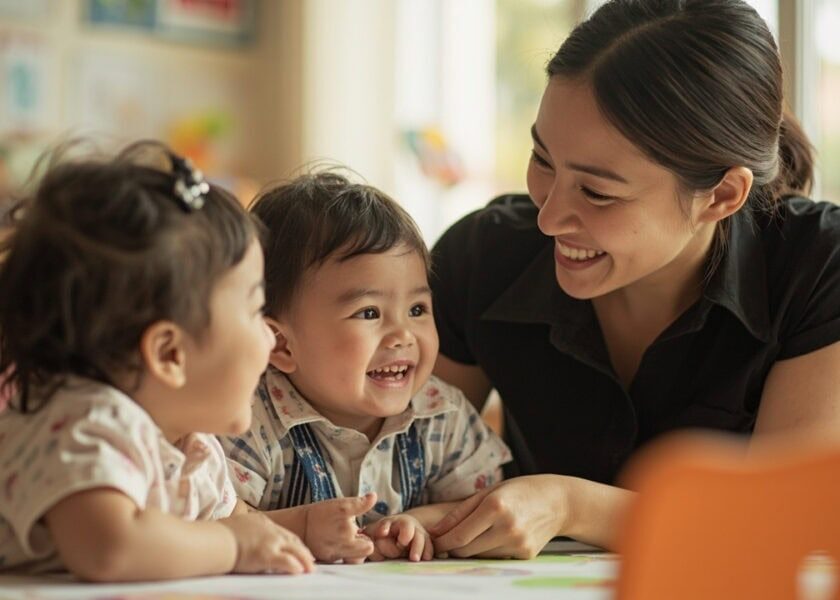
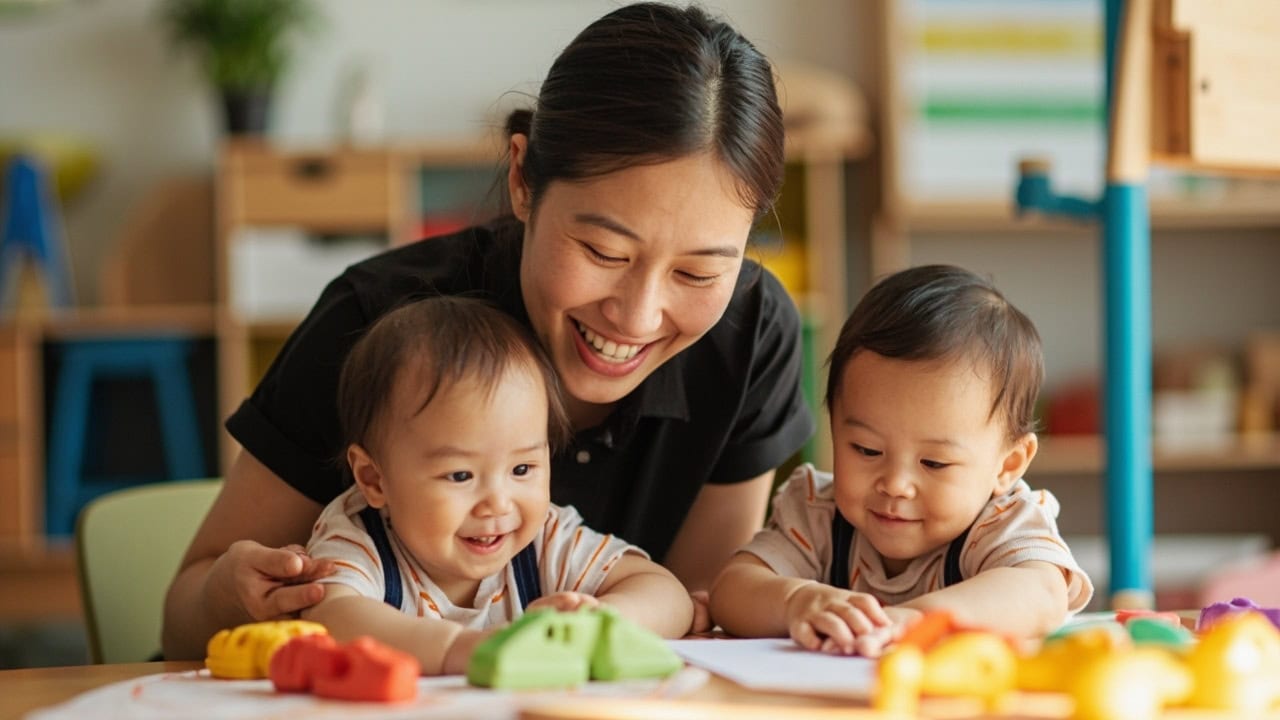
When siblings share a quality childcare environment, they become something more than siblings who happen to live in the same house. They become co-developers. They become a learning resource for each other.
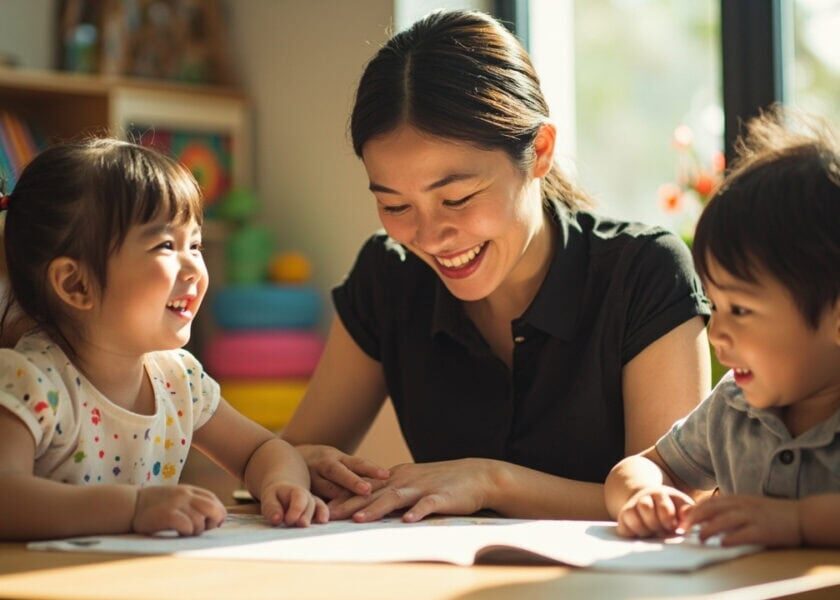
When the younger child watches the older one solve a puzzle, he is not just watching — he is absorbing strategy, building neural pathways that will support his own problem-solving when his time comes. When the older child is asked to help a younger peer, she is not just being put upon — she is consolidating her own learning through teaching, developing leadership skills and empathy in ways that cannot be replicated through adult-led instruction alone.
This is why siblings raised together often seem to grow in parallel, each spurring the other forward. You notice it at home: the younger one starts talking in sentences almost the moment the older one begins school, absorbing vocabulary and social cues like a sponge. The older one’s reading confidence grows when she realizes her younger sibling is watching, eager to learn whatever big sister knows. These are not coincidences. They are the organic, beautiful consequence of siblings being in relationship — and they happen even more powerfully in a childcare environment that understands how to support and guide them.
But here is what many parents do not fully appreciate: this natural sibling learning can be accidental or it can be intentional.
In a poorly designed environment, siblings may be present together but not truly benefiting from each other. They may be occupying the same room without meaningful interaction. They may be competing for attention in ways that undermine rather than build.
In a well-designed sibling-aware environment, something different happens. Caregivers notice when siblings are energising each other and when they need space. They facilitate moments where collaboration is possible and independence is encouraged. They observe the subtle dynamics — when one child is dominating and another is retreating, when a helping hand is genuine and when it is smothering, when siblings need to be redirected toward parallel play and when they are ready for something more complex.
Parents whose children have been in quality shared childcare often describe moments that surprise them. The older child comes home and the younger one runs to greet him — and the older one kneels down to his level, patient and warm, reflecting something he absorbed. The two children develop their own private language, their own games, their own understanding of each other that feels distinct from anything they share with children outside the family. These moments do not happen by accident. They emerge from the conditions you create around them.
As children grow and enter the school system, this foundation carries forward. The older child who learned patience and nurturing in a shared childcare environment carries that into the playground, the classroom, the friendships that will define her primary school years. The younger child who learned to observe, to model, to work toward what his sibling could do carries that into his own academic and social journey. They have a shared history of growth that becomes a shared language for navigating the wider world. Siblings who have had quality shared childcare often transition to school more smoothly — they know how to be part of a group, how to share attention, shared activity, shared rest.
Singapore Parent Realities: Cost, Logistics, and What Families Actually Need
Singapore parents face constraints that deserve honest acknowledgment. The cost of raising children here is real. The schedules are demanding. The logistics of getting a three-year-old to her preschool in one neighbourhood while dropping a seven-month-old at infant care in another — while somehow making it to work on time — these are the stuff of daily heroism that often goes unrecognised.
When parents consider childcare for multiple children, they are not just weighing quality. They are weighing it against a budget, a schedule, a whole life that includes work and extended family and the simple exhaustion of keeping small humans alive and thriving.
EduNanny’s approach to pricing within the ECDA Childminding Pilot is designed with these realities in mind. Our pilot fee structures are developed to be affordable, and we actively support families in accessing available subsidies and schemes.
- Your Child Development Account funds can be used.
- Your Baby Bonus can stretch further.
- We help families navigate available government support.
We believe that quality sibling-aware childcare should not be the exclusive privilege of families with unlimited resources. It should be available to the families who need it most — because those families are often the ones whose children have the most to gain.
The pathways EduNanny offers — home-based, community, and centre-based — are not interchangeable options designed to fill a menu. They are distinct approaches to meeting families where they are:
- If your family needs the comfort and continuity of care in your own home, we have a pathway for that.
- If community-based care fits better with your neighbourhood and your children’s social world, we have that too.
- If a centre-based environment is what your family needs, we have built it with the same intentionality we bring to all our services.
The arrangement adapts to your life. Your life does not have to bend to fit the arrangement.
How EduNanny Approaches Sibling Care
What EduNanny offers to families with multiple children is not a formula. It is a way of thinking about sibling relationships that takes them seriously — as developmental forces, as emotional anchors, as the first and perhaps most enduring peer relationships your children will ever have.
When you bring your children to EduNanny — whether through our home-based pathway, our community pathway, or our centre-based services — you are bringing them into an environment designed to see them as individuals and as siblings. Our caregivers understand that each child has their own developmental trajectory, their own temperament, their own needs. But they also understand that your children are in relationship — that what happens to one affects the other, that the sibling bond is a resource to be nurtured rather than a complication to be managed.
This shows up in practical ways throughout our programme. In the way our caregivers observe sibling dynamics and know when to step in and when to step back. In the way our environments offer both shared space for collaboration and separate spaces for individual exploration. In the way we think about ratios — because with up to one caregiver to three infants, our team has the attention available to notice the subtle moments that matter, the small interactions that are quietly building something large.
When you have more than one child in care, you are not just wondering about one child’s day. You are wondering about both — and about how their day together went, whether they played well, whether there were moments of friction and how they were handled, whether each child was seen and valued as an individual. Our communication practices are designed to give you a window into both: each child’s individual experience and the sibling relationship itself. Where CCTV measures are in place, you have the transparency to see for yourself. Where direct communication is the norm, you hear not just that your children were happy, but how they were happy — together, and growing.
Questions to Ask — and the Lasting Gift of Siblings
If you are weighing childcare options for two or more children, here are questions worth asking:
- Does this arrangement see my children as individuals? Each child should have their developmental needs met, not subsumed into a generic sibling unit.
- Does this arrangement understand sibling dynamics? Caregivers should be able to articulate how they support both connection and autonomy between siblings.
- Can this arrangement flex as my children change? What works now may not work in six months. Can the arrangement evolve with your family?
- How will I hear about both children? Communication should give you insight into each child’s day and their relationship with each other.
- Does this feel like partnership? You know your children best. A good childcare provider will listen to what you observe and incorporate it into care.
There is something else worth sitting with: the children you are raising are not in childcare for a season. They are in relationship with each other for a lifetime.
The sibling bond is not something to be managed and optimised in the short term. It is a relationship that will outlast childhood, that will shape how they navigate adolescence and adulthood and parenthood and old age. It is one of the few relationships in their lives that is truly non-negotiable — they did not choose each other, but they are bound to each other, and what you build in these early years of shared experience will echo forward in ways you cannot fully imagine.
You feel this already. When you watch your children together, you know that what they are building is beyond your control and beyond your full understanding. You can nurture it. You can provide the conditions for it to flourish. But you cannot engineer it — and you know, somewhere in your parental wisdom, that the best thing you can do is find partners who understand this as deeply as you do.
EduNanny has seen how siblings in quality childcare develop together — not just beside each other, but from each other. We have seen how a shared environment becomes a shared story, and how that shared story becomes a foundation for everything that comes after. We know that when siblings are in the right place, something remarkable happens. They grow into each other in ways that no curriculum could prescribe. They build a language of their own. They become a resource for each other that no adult can fully replace.
And we know that this is not a small thing. It is not an incidental benefit of childcare. It is one of the most profound gifts you can give your children — the gift of each other, in an environment that understands how to let that gift unfold.
If you are a parent with more than one child in Singapore and you are thinking about childcare — infant care, childminding, preschool — we would be glad to talk through what your family actually needs. Not to fit you into a programme, but to understand your situation and explore whether EduNanny is the right partner for the journey you are on.
The sibling bond your children carry with them always deserves nothing less.
If you would like to learn more about EduNanny’s approach to sibling care and the options available to your family, we invite you to get in touch or explore our homepage to see how we support families across Singapore.