Trust Your Instincts: Finding Childcare That Really Listens in Singapore
You Already Know More Than You Think You Do
Somewhere between the morning diaper change and the walk to the grandmother’s flat, you noticed it. A slight hesitation in the way your child reached for the toy you always hold out first. A flicker of something—not quite resistance, but not quite ease either.
You adjusted how you held the spoon that evening. Without thinking much about it, you tilted it just a little differently the next time you fed them. The child ate more. You barely registered it.
But you noticed. You always notice.
That moment—that small and quiet act of reading your own child’s unspoken language—is not a trivial thing. It is something parents in Singapore do every single day, with a consistency and attentiveness that no training manual can replicate.
And yet, somewhere along the way, most of us have been led to believe that when it comes time to choose childcare, we must set that knowledge aside. We are asked to be objective. To be systematic. To rely on checklists and credentials and reviews, as though the person who has spent every day of this child’s life in their presence is somehow the least qualified to assess what they need.
This is the quiet tension that most articles about childcare never name. They tell you what to look for. They tell you what good looks like. They tell you to trust the credentials, the ratios, the facilities.
And all of that matters. But none of it addresses the deeper question that Singapore parents carry into every search, every visit, every decision: Am I allowed to trust what I already know about my own child?
The answer, we believe, is a profound yes.
The Gap Between What Parents Know and What They Trust
You know your child’s rhythms the way a musician knows a familiar melody. You know which transitions will frustrate them and which will delight them. You know the precise pitch of comfort your child needs when something startles them. You know the difference between their cry when they are tired and their cry when something genuinely needs your attention.
This is not guesswork. This is the accumulated knowledge of daily presence, of thousands of small observations, of a relationship that began before your child could form their first word. It is the most authoritative knowledge that exists about any child—and it belongs entirely to you.
The challenge is that choosing childcare happens in a context that often makes it difficult to trust that knowledge. You are navigating it alongside the demands of work, the logistics of getting back to the office, the rhythms of a household that needs your attention in a hundred directions. You are doing research on top of everything else—reading reviews, visiting centres, asking friends.
In that process, it is easy to let your own observations become background noise. It is easy to decide that what you know is soft data, sentimental knowledge—the kind of knowing that belongs at home but not in a decision-making meeting.
But that framing is wrong. What you know is precise. It is specific. It is the most relevant data point in the entire search.
What Good Childcare Actually Looks Like
Quality childcare begins with a simple but powerful question: What is this child communicating, and who is listening?
Trained observation, when done well, is not passive recording of what a child does during the day. It is an active, disciplined practice of listening to what a child is communicating through their behaviour, their play, their responses, and their silence.
And critically, it means listening just as carefully to what you, as the parent, are communicating about your child. The notes that go home. The conversations at pick-up. The questions asked about what you are seeing at home, because the most complete picture of your child is one that includes your observations alongside the caregiver’s.
When these two sets of observations align—when what you see at home and what the caregiver sees during the day tell a consistent story—something powerful happens. Your confidence deepens. The care becomes more attuned. And your child feels the coherence of being known fully, by more than one set of eyes.
What Partnership Looks Like in Daily Life
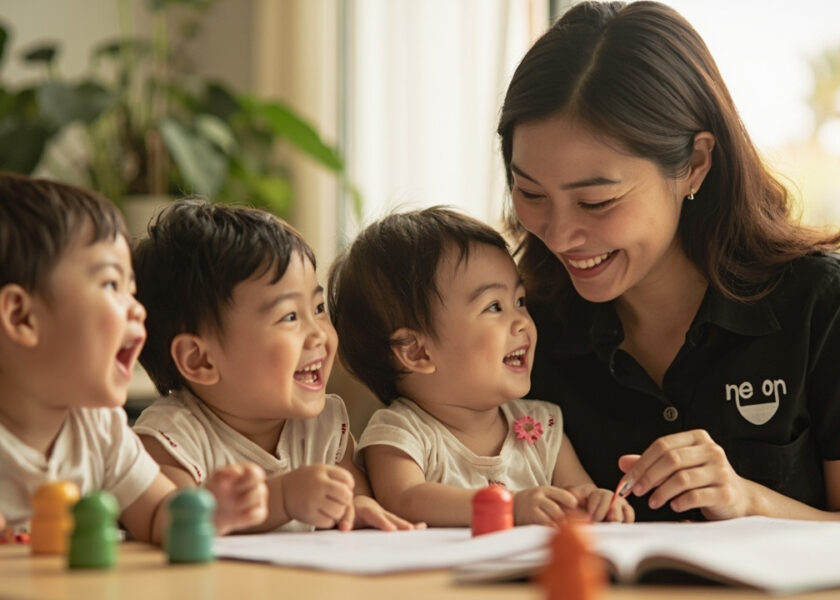
Not the kind of partnership that sounds warm in a brochure and disappears in practice, but a real one. One where a caregiver takes what you share about your child’s preferences, their emerging patterns, their particular ways of expressing themselves, and weaves it into the texture of the day.
It looks like this:
- The child who thrives on a particular greeting each morning receives that greeting, consistently.
- The child who is just beginning to show interest in stacking blocks gets blocks placed within reach at exactly the right moment.
- The child who is going through a phase of separation difficulty is met with patience and a hand-off routine that mirrors the calm you have been carefully building at home.
This is not an accident. It is the result of intention, of training, and of a system that was designed to hear what parents are already saying.
The ECDA Childminding Pilot and What It Means for You
EduNanny Singapore operates as part of the ECDA Childminding Pilot—a programme built on the recognition that not all families need the same thing, and that some children, particularly in their earliest months and years, are better served in smaller, more attuned environments.
We do not believe that childcare begins with what the centre knows. We believe it begins with what you, the parent, already know. Our role, our trained caregivers, our observation methodology, our entire approach exists to listen to that knowledge and to act on it—not to replace it, not to validate it through our own authority, but to reflect it and build the daily experience of your child’s care around what is already true about them.
Where EduNanny provides home-based childminding, it does so with caregiver-to-child ratios that allow for precisely this kind of individual attention. In our centre-based settings, the same principle holds.
We believe that the ratio of one to three in infant care is not simply a regulatory standard. It is an environment where a caregiver can genuinely know each child as an individual, can notice the small shifts in mood and development that larger groups make invisible, and can respond with the specificity your child deserves. It is one of the practical foundations that makes genuine observation possible.
Addressing the Concerns That Matter Most
On cost: The Childminding Pilot is structured to be accessible, with fee structures designed to make quality care a realistic option rather than a privilege. Where subsidies apply, they apply clearly. Your child’s CDA and Baby Bonus funds can be used for eligible services, which means the financial logistics are often more manageable than they first appear. We would rather you know that upfront than discover it later.
On trust and verification: We know trust must be earned and must be verifiable. Where CCTV measures are deployed, they are deployed for that purpose. Where communication is regular and transparent, it is because we believe you have every right to know what your child’s day looks like—not as a courtesy but as a standard. Daily updates. Observation notes. Photographs. The small details that help you feel connected to the hours you are apart.
Why the First Thousand Days Matter
There is something else worth naming here, because it is at the heart of why we do this work the way we do.
A childminder, a trained caregiver, holds a role of extraordinary dignity. They are not filling a gap in scheduling. They are standing in partnership with you during some of the most formative years of your child’s life.
The first thousand days of a child’s development are not a catchphrase. They are a biological and emotional reality. The connections being formed. The neural pathways being laid down. The sense of security or anxiety being shaped by the quality of care a child receives in these early years—these are not abstractions. They are the substance of a human life being built, day by day, in the hours that you and your caregiver share.
We take that seriously. Which means our caregivers are not only vetted and trained to high standards of safety and competence, but are also coached in the practice of observation, in the art of noticing, in the discipline of documentation that serves the child and informs the parent.
They are not asked to perform warmth. They are expected to cultivate it—not as a nicety, but as a professional skill.
Because a child who feels genuinely seen by the person caring for them is a child who is free to explore, to grow, to rest, to learn. And a parent who feels genuinely heard by that caregiver is a parent who can go to work with a different quality of presence, knowing that their child is not just being supervised but is being known.
Practical Guidance for Choosing Infant Care in Singapore
If you are in the research phase—visiting centres, asking questions, weighing your options—here is what we would encourage you to bring into that process:
- Trust your observations. If something feels off during a visit, take that seriously. Your instincts are grounded in thousands of hours with your child.
- Ask about observation practices. How do caregivers document and share what they see? How do they incorporate your observations from home?
- Notice the ratio, but understand why it matters. Small ratios are not just about safety—they are about the possibility of genuine individual attention.
- Ask about communication rhythms. What does daily connection look like? How do they handle the transition moments that matter most to you?
- Look for signs of mutual respect. The best care arrangements feel like partnerships. Do caregivers ask what you know? Do they listen when you share?
You Came Into This Search With Everything You Needed
You know your child’s rhythms. You know their preferences. You know the sound they make when they are about to turn a corner developmentally. You know the way their face changes in the thirty seconds before they fall asleep.
You know them.
And the right childcare will not ask you to prove that knowledge against a checklist. It will ask you to share it, because that knowledge—combined with trained, attentive, daily care—is what makes early childhood development not just effective but genuinely loving.
This is why EduNanny exists. Not to offer the most features, or the most impressive facilities, or the most comprehensive curriculum on paper.
We exist to be the kind of childcare that a parent describes not by listing what we have, but by saying something simpler and more meaningful:
“They really listened. They saw my child. They told me things about my child’s day that I did not know, but that made complete sense because they matched what I know to be true about them.”
That sentence, when it comes from a parent, is the highest standard we can meet.
Because it confirms that the circle of knowing around a child has widened, not contracted. That the care at home and the care during the day are not two separate worlds but two attuned environments that are building the same foundation. That you, as the parent, remain the centre of that circle—the primary authority, the first and most important observer.
And that we are simply there, trained and present and committed, to listen to what you already know and to help your child flourish in the light of it.
You are not making a final decision by reaching out. You are starting a conversation. We want to hear about what your family needs. We want to understand what matters most to you. And we want to tell you honestly whether we are the right fit.
If this approach resonates with you, we would welcome the chance to speak with you.