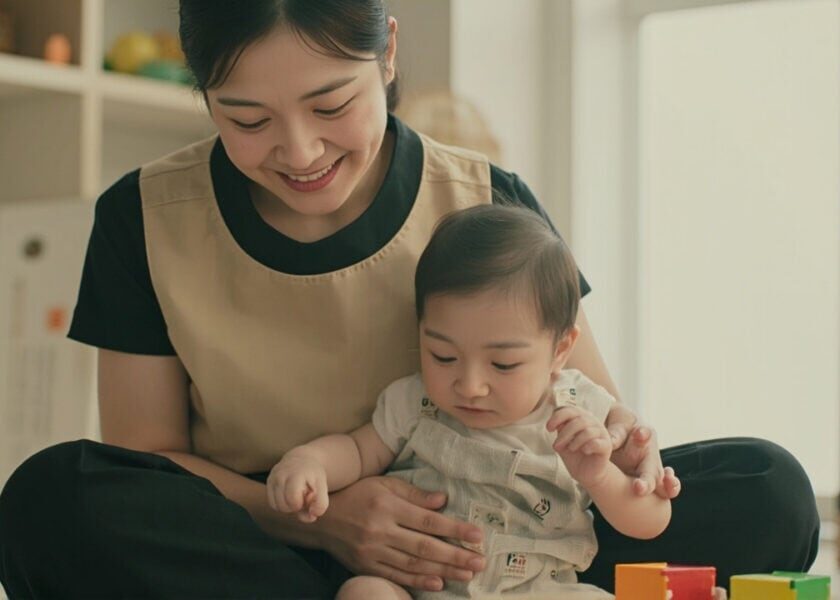
What Quality Childcare Builds in Your Child’s Emotional Foundations
What Your Child Is Building When You Are Not in the Room
There is a particular kind of quiet thoughtfulness that arrives in the car, in the shower, in those last minutes before sleep when you are a parent in Singapore. It comes not as worry exactly, but as something deeper, something that sits beneath the logistics and the schedules and the endless decisions about which option, which centre, which caregiver. It is the thought that asks, almost against your will: What is happening inside my child during all of those hours when I am not there?
You have chosen childcare. You have made the arrangements, weighed the options, perhaps toured a few places with your list of questions in hand. You have checked the ratios, noted the qualifications, looked at the photos on the walls. And yet, there remains a space in your mind that no amount of preparation has quite filled. It is not the question of whether your child is safe—that matters, of course—but something more difficult to name. It is the question of whether your child is known. Whether someone is noticing the particular quality of your child’s fussiness, the way their face changes when they are beginning to feel overwhelmed, the small moments when reassurance lands and when it does not.
You cannot see everything that matters, and no honest childcare provider would claim otherwise. What you can see is the evidence that accumulates over time—and understanding what quality care actually builds in your child can help you choose with genuine confidence rather than uncertain hope.
How Young Children Develop: The Science Behind the Hours Apart
In the first years of life, your child’s brain is building itself at a pace it will never again achieve. Neural connections are forming at a rate of more than one million per second. And while this is often discussed in terms of cognitive development, the architecture being constructed is not purely intellectual. It is emotional. It is relational. It is the foundational system that will determine how your child learns to regulate their own feelings, how they respond to stress, how they form relationships, and how they eventually move through the world with either a sense of quiet confidence or persistent anxiety.
This architecture is built through experience—specifically, through the experience of being responded to. When a caregiver notices a child’s distress and responds with calm, consistent comfort, something happens inside that child. The stress response system learns a crucial lesson: overwhelming feelings do not have to become overwhelming for long. Help is coming. The world is manageable. I can be upset and still be held.
This is not a sentimental notion. It is one of the most robust findings in developmental psychology. When children experience this kind of attuned, responsive caregiving in the early years, they develop what researchers call secure attachment. They learn, at a level below conscious thought, that they are worthy of attention. That their needs matter. That other people can be trusted to respond when they reach out. This becomes the internal working model that shapes all future relationships, all future encounters with the emotional world.
The Invisible Curriculum: Beyond Supervision to Genuine Attunement
There is a difference, and it matters enormously, between being supervised and being emotionally held. Every childcare environment provides some version of the first. The best ones provide the second.
When we talk about quality childcare, we often default to the visible markers. The clean facilities. The age-appropriate toys. The ratios printed on the wall. These things matter, of course. But they are the architecture, not the living. Being supervised means your child is safe, fed, clean, within sight. Being emotionally held means your child’s inner world is being attended to as carefully as their outer safety.
It means that when your child is frustrated, someone is helping them learn to manage that frustration rather than simply waiting for it to pass. It means that when your child is delighted, someone is sharing in that delight—which teaches your child that positive emotions are worth experiencing and worth sharing. It means that your child’s emotional life is treated as real and important, not as an interruption to the schedule but as the substance of what quality care actually does.
This kind of attention requires something that cannot be manufactured or mandated. It requires time, consistency, and a ratio that allows for genuine attunement. It requires the caregiver to have the capacity to actually see your child—to be present with your child—rather than simply managing a group.
When this happens, when a caregiver knows your child as a person and not just as a name on a roster, something remarkable begins. Your child learns, through repetition and consistency, that their emotional signals matter. When they reach out, someone responds. When they are overwhelmed, someone helps them calm. When they are curious and engaged, someone shares in that joy. These experiences accumulate into something profound: a quiet, sustainable confidence that the world is a trustworthy place where their needs will be met.
Quality care also builds social confidence. When a child experiences consistent, attuned responsiveness, they learn that other people are reliable. They learn that reaching out leads to connection, not rejection. They develop the relational trust that allows them to explore, to engage with peers, to navigate the social world with increasing sophistication. These are not skills that can be taught in a lesson. They are capacities built through hundreds of lived experiences of being known and responded to.
Signs Your Child Is Thriving: What Parents Can Actually Observe
You may wonder how you would know whether your child is receiving this kind of care. You are not in the room. And this is perhaps the most challenging aspect of the childcare decision for parents in Singapore and everywhere else. You are being asked to trust. And trust requires something to stand on.
Here is what we have found matters.
Observe Your Child After Care
Not just whether they are clean and fed, though those things matter, but how they are. A child who is being well-held emotionally often comes home with a particular quality of ease. They are glad to see you, of course, but they are also settled. They have been in an environment where their emotional needs were met, and this leaves a residue of calm.
Conversely, a child who is frequently dysregulated after care, who seems persistently anxious or withdrawn, may be in an environment where their emotional signals are not being read or responded to. This is not a perfect indicator, but it is a real one.
Ask Specific Questions
Not just “how was your child’s day,” but questions like: How did my child seem when they were tired? How did they respond when another child took their toy? How do they settle for naps? The answers to these questions will tell you whether the caregiver is truly observing your child as an individual, or whether your child is being managed as part of a group.
If the answers are specific to your child, if the caregiver speaks about your child’s patterns and preferences rather than general group dynamics, that is evidence of genuine attunement. If the answers are generic, that is worth noting.
Pay Attention to Your Own Intuition
You know your child better than anyone. If something feels off, if your child resists going to care in a way that feels different from ordinary separation anxiety, if your child seems fundamentally unchanged or worse after weeks in a new environment, that information is valuable.
Separation anxiety itself is normal and healthy. It reflects a secure attachment to you. What you are watching for is whether this anxiety settles over time, whether your child begins to show some ease in the care environment, whether they are building a secondary attachment to the caregiver. A child who is persistently dysregulated, who seems worse rather than gradually better, may be in an environment where their emotional needs are not being met.
Look for Transparency
Look for an environment where communication is genuine, where you receive not just pleasant reports but actual information about your child’s day. Where caregivers welcome your questions not as intrusions but as evidence of engaged partnership. Where there is nothing to hide and everything to share.
The EduNanny Approach: Built Around What Children Actually Need
At EduNanny Singapore, our approach is built around these understandings. As part of the ECDA Childminding Pilot, we are committed to care that goes beyond supervision—care that recognises the profound significance of those early years.
We offer both home-based care and community or centre-based pathways, because families are different and the right solution is the one that fits your actual life. Our infant ratios are designed to allow for genuine attunement, because we know that attention is not just a quality we hope for but a structural necessity. When a caregiver is not continuously pulled in twelve directions, when there are only one or two other infants in the space, something becomes possible: the kind of noticing that shapes a child’s emotional development.
Our caregivers are trained not just in the technical aspects of infant care, but in the much more demanding work of reading emotional cues, responding with consistency, and building the kind of secure relational foundation that will serve your child for years to come. They learn to recognise the look on a child’s face that means something is wrong before any cry emerges. They learn to match a child’s energy rather than contradict it. They learn that a hand on a back when frustration is rising is not just a soothing gesture but an act of emotional construction.
We also know that parents need care that is affordable, that fits within the reality of Singapore’s cost of living, and that is accessible in practical terms. Our pilot fee structures are designed with this in mind. Monday to Friday care blocks provide the consistency that children need and parents require for planning. CDA and Baby Bonus funds are usable for eligible families, which means that the financial architecture of quality care does not have to be a barrier. These are not afterthoughts. They are part of our commitment to making sure that good care is actually available to the families who need it.
Choosing With Confidence: Your Role and the Decision Ahead
When you choose a childcare arrangement, you are not simply choosing who will watch your child while you work. You are choosing an environment that will shape your child’s inner world. You are choosing a relationship that will teach your child something profound about what other people are like, about whether the world is trustworthy, about whether their feelings matter and whether their needs will be met.
These are not small things. They are the foundations on which everything else is built.
The research on child development does not support the idea that parental employment is inherently damaging to children. What matters is the quality of the care your child receives. Quality care can be genuinely beneficial, providing consistent, attuned responsiveness that supports your child’s development. Your child needs you to be financially present and emotionally present—and the right childcare arrangement supports rather than undermines the latter.
We believe that when you know what is happening, when you feel genuinely informed, you are better able to partner with your child’s caregiver in the ongoing work of supporting your child’s development. Your role does not end when you hand your child over. It continues. The emotional security your child develops in quality care must be reinforced at home. The attunement you practice as a parent complements and extends the attunement your child experiences in care. These are not separate worlds. They are two contexts in which your child’s emotional life is being formed, and the best outcomes happen when they work together.
Not because your child will not be safe in most care arrangements, but because safety is the floor, not the ceiling. What you want for your child is not merely the absence of harm but the presence of genuine emotional nourishment. You want your child to be known, not just watched. You want your child to be held, not just supervised. You want your child to be building something inside during those hours apart—something that will serve them as they grow into a person who can manage their own emotions, form healthy relationships, and move through the world with quiet, sustainable confidence.
When your child feels known and held and responded to with consistency, they begin to internalise it. They begin to believe it not just about this caregiver but about the world. This is the invisible gift of quality early care: the gift that keeps on giving, long after the hours are done, long after the handover, long after your child has moved on to school and beyond.
We know that choosing childcare is one of the most significant decisions you will make. We know that it is made more complicated by the fact that you cannot see everything that matters. But we also know that when care is built on attunement and attention and genuine knowledge of the child as a person, it becomes one of the greatest gifts you can give your child.
EduNanny Singapore was created to give this gift to the families of Singapore. We believe that every child deserves to be known, held, and supported in the crucial work of building their emotional foundations. We believe that parents deserve to feel not just comfortable with their childcare choice but genuinely confident that their child is thriving.
The hours apart are formative. We know that. We have built our entire approach around that knowledge. And we would be glad to be part of the solution for your family—to be the trusted environment where your child’s inner world is not just cared for but actively nurtured, where calm and confidence and connection are not just hopes but the actual outcomes of every day spent in our care.
If you are exploring your options, we invite you to connect with us or learn more about who we are and how we work with Singapore families.