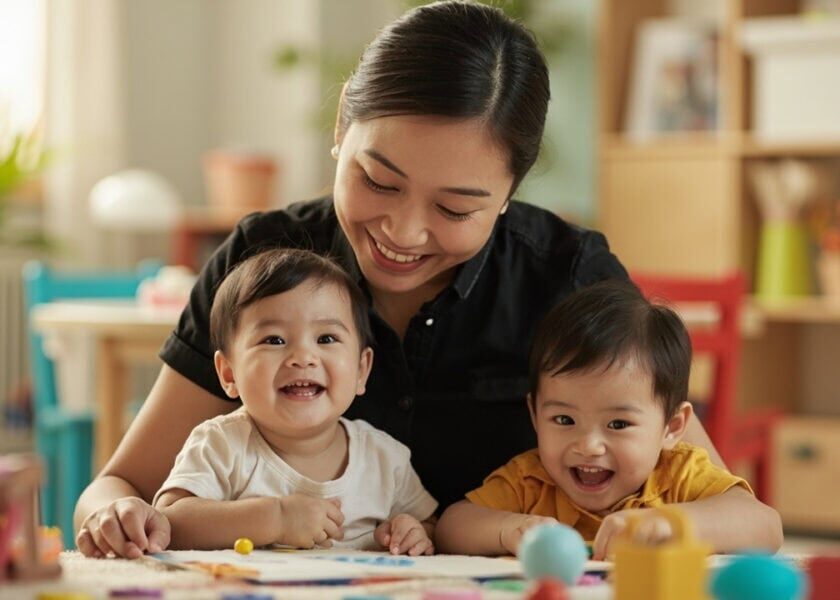
Where Your Child Is Seen and Not Just Watched
What Your Child Carries Through That Door Each Morning
Children do not experience a new environment the way adults do. There is no clean slate. When your child walks through a door in the morning—whether it leads to a home, a centre, or a community space—they are bringing with them everything they are.
Their particular temperament. The way they slept the night before, or did not sleep. The mood they woke in. The texture of their hunger, their fatigue, their joy. A confident child walks in one way. A watchful child walks in another. A child who is still learning to trust new faces walks in yet another. None of these ways are wrong. They are simply true.
What matters—what matters enormously—is who is there to meet them.
Seen, Not Just Watched
There is a difference, and it is not small, between being watched and being truly seen. A child who is watched learns to perform safety. A child who is seen learns to feel it. These are entirely different experiences, and the difference between them is the difference between care and genuine caregiving.
Being seen means that someone has taken the time—the quiet and patient time—to learn your child’s particular language before they have words for it. It means noticing that one child needs a few minutes to warm up before they can engage, and not mistaking that quietness for unhappiness. It means recognizing that another child carries their big feelings in their body before they can name them, and knowing how to meet that body with calm before the feeling becomes a storm.
In Singapore’s childcare landscape, this distinction matters more than ever. With infant care ratios set at 1:3 under quality frameworks, caregivers have the space to truly observe and respond to each child as an individual.
Why Training Makes Warmth Precise
This is not instinct alone. It is instinct informed by knowledge—by an understanding of child development that goes deep enough to honour the complexity of every small person who walks through the door.
Training helps warmth become precise. It helps a caregiver recognize what they are seeing in a two-year-old who is rebuilding the same block tower for the tenth time: this is not repetition—it is mastery. It is a child testing a hypothesis about the world and finding that the world holds up.
Your child arrives each morning carrying all of this. The question is whether the space they enter has been shaped to receive them as they truly are—not as a general category of “child,” but as this specific, unrepeatable person with their own rhythms, their own fears, their own wonders.
Felt Safety: The Foundation Everything Else Is Built On
This is where the deeper work of quality care begins: not in the curriculum, not in the activities, but in the slow, daily construction of felt safety.
Safety, for a young child, is not primarily a physical condition. It is a felt experience—the accumulated sense, built across hundreds of small moments, that the world is a place where they can let go of vigilance and simply be.
When a child feels genuinely safe, something remarkable happens. They begin to explore. Not tentatively, not from fear, but with the kind of full-bodied, fearless curiosity that is the birthright of every young human being.
- A child who feels safe will pick up a stone and study it with the concentration of a scientist.
- A child who feels safe will approach another child at play, unsure of the outcome but willing to find out.
- A child who feels safe will try to climb something just beyond their reach and, when they fall, look up for reassurance—not because they are weak, but because they have learned that falling is survivable, that someone will be there, that the world will catch them and then let them try again.
This is not a small thing. This is the beginning of resilience. This is the beginning of a person’s inner compass—the quiet, internal sense that tells them, even when no one is watching, that they are capable, that they are worthy of attention, that their questions matter and their discoveries are real.
Meaningful Play and the Caregiver’s Quiet Work
There is something specific that happens when quality care is genuinely intentional about how children spend their time.
A child in quality care does not simply fill time. They engage in what developmental psychologists call meaningful play—and meaning is the operative word. Meaningful play is not busy work. It is not an adult-designed activity that a child is directed through. It is the kind of play that arises when a child is given real materials, real space, and real freedom, guided by a caregiver who understands the developmental purpose beneath what looks like simple play.
Consider what is actually happening when a child pours water from one vessel to another: they are developing precision. They are experiencing cause and effect. They are regulating their own body. They are, in that small and quiet act, building the neurological foundations for focus, for patience, for the satisfaction of completing a task.
A child who is allowed to play with open-ended materials—blocks, sand, fabric, natural objects—is developing creativity in its truest sense: the ability to see possibilities where others see only what is.
The Role of Observation
A trained caregiver does not impose meaning on these moments. They create the conditions in which they can occur, and then they witness them:
- The moment a child’s face lights up with a discovery they made entirely on their own.
- The negotiation between two children who are learning, for the first time, that another person’s needs exist alongside their own.
- The child who has finally, after weeks of watching from the edge, stepped into the group and claimed their place.
These moments may never be told to you in full. But they are the substance of your child’s inner life in the hours between.
Your Attachment Is Extended, Not Replaced
Here is what is most important to understand: this kind of connection does not compete with the bond between you and your child. It grows from it.
A child who is genuinely attached to their parent can open themselves to other meaningful relationships precisely because their foundation is secure. A child who is anxious, who is not sure whether they will be seen or valued, will protect themselves by holding back. They will not explore freely. They will not take the risks that learning requires.
The attachment you have built with your child is not diminished by quality care. It is, in a quiet and beautiful way, extended. It reaches into those hours you cannot follow and holds your child in your stead, until you can hold them again yourself.
What Your Child Carries Home at the End of the Day
There is a word that parents sometimes use to describe the child who comes home from a day of quality care. They say their child seems lighter.
Not because they have been entertained or distracted from missing their parents, but because something has settled in them. They have been engaged. They have been challenged. They have been seen. And the combination of all of these things leaves a child not depleted but nourished.
They carry a feeling:
- The feeling of having spent a day in a place that knew them.
- The feeling of having been valued not for what they produced but for who they are.
- The feeling of safety robust enough to allow them to stretch, to fail, to try again, to discover something new about the world and about themselves.
And this is what allows parents, in turn, to feel something that is perhaps even more precious than the care itself. It allows parents to feel at peace. Not because they have surrendered their vigilance, but because they have found a place that shares their values. A place that understands what they are entrusting and treats that trust as sacred.
The EduNanny Approach: Quality Care for Singapore Families
EduNanny by BUTLER was built on exactly this understanding.
When ECDA launched the Childminding Pilot, it did so with the recognition that Singapore’s families need more than options—they need caregivers who are warm, reliable, and deeply trained in the developmental needs of infants and young children. They need arrangements that are not just logistically convenient but emotionally sound.
EduNanny is part of that system. Whether your child is in a home-based pathway, a community space, or a centre-based environment, the philosophy remains the same: every child deserves to be met where they are.
The Conditions That Make Quality Possible
Caregivers trained under the EduNanny framework work with small ratios—up to one to three in infant settings—because quality is not possible at scale. It requires attention. It requires the ability to see each child as an individual and to respond to that individual with consistency and care.
Making Excellence Accessible
EduNanny understands that for parents in Singapore, accessing quality care is not just an emotional decision. It is a financial one too. That is why EduNanny operates within the pilot fee structures, making this level of care not a luxury but a realistic choice for families who want the best for their children.
- CDA and Baby Bonus funds are usable where applicable.
- Care is available across Monday to Friday in structured blocks designed to fit the realities of working family life.
Transparency and Trust
Parents deserve transparency. You deserve to know what is happening with your child, even in the hours you cannot follow. Where communication measures are in place, EduNanny ensures that you are not left guessing.
Updates, daily check-ins, and where deployed, CCTV measures—all of these exist not to replace trust but to support it. Because trust, in this relationship, must be built and it must be reciprocal. You trust EduNanny with your child’s inner world. EduNanny trusts you to be partners in that world. And the child, at the centre, is held by both.
Questions Parents Ask Before Choosing Infant Care
These are the concerns that come up again and again—and they deserve honest answers.
How do I know my child is truly safe—emotionally, not just physically?
Emotional safety is built through consistency, attunement, and response. Ask how caregivers are trained to read and respond to children’s cues. Ask how they handle separation, frustration, and big feelings. The answer will tell you whether safety is treated as a checkbox or a foundation.
Will my child miss me?
Missing you is a sign of healthy attachment—and healthy attachment is exactly what allows your child to form other meaningful connections. A child who is genuinely attached to you can explore the world more freely because they know you will come back. The question is not whether they miss you, but whether they feel safe enough to still engage while they do.
How will I know what’s happening during the day?
Ask about communication practices. Quality care providers will have clear, consistent ways of keeping you informed—not just when something goes wrong, but about the ordinary richness of your child’s day. Updates and check-ins are standard where they should be.
Is this worth the investment?
Consider what you are actually investing in: not supervision, but the daily construction of felt safety. Not entertainment, but the neurological foundations for focus, resilience, and curiosity. Not a service, but a relationship that extends your child’s sense of being known and valued. The investment is in the person your child is becoming.
What questions should I ask when visiting a service?
Look for evidence that caregivers learn each child’s temperament, rhythms, and needs—not just their schedule and dietary requirements. Ask about developmental training, not just certifications. Notice whether caregivers are warm and present, not just busy and managed. And ask how they support children and parents through the settling period. Trust your instincts—they are usually right.
What You Are Really Choosing When You Choose with Care
We want to close by speaking directly to what you already know in your bones.
You are not a parent who drops off carelessly. Every morning, when you hand your child to someone else, you are making a decision—a decision rooted in love, in necessity, in the recognition that raising a child in this city, in this economy, at this pace, requires village.
You are not giving your child away for the day. You are placing them, carefully and intentionally, in a space you have chosen because you believe it will honour who they are.
That act of choosing with care is itself a form of love. And it is the act that EduNanny is here to prove worthy of.
What we offer is not supervision. It is not babysitting. It is not a service that merely keeps your child safe and fed and occupied. What we offer is more specific and more profound.
It is a carefully held space—built on training, shaped by observation, informed by developmental knowledge and by genuine tenderness—where your child’s inner life is understood, valued, and nurtured. Where a child’s felt sense of safety is treated as the foundation of everything, because it is. Where a caregiver learns your child’s temperament not from a form but from a hundred mornings of watching, and responding, and remembering. Where meaningful play is understood as the work of childhood, and where every moment of curiosity is treated as evidence of a mind that is growing exactly as it should.
This is what you are choosing when you choose with care. Not a place that watches your child. A place that sees them. And that sees, in your child, the extraordinary person they are already becoming in the hours you cannot follow.
That is what EduNanny is. That is what we hold. And that is the trust we are humbled to carry with every family who walks through our door—confident that the truest measure of what we do will never be seen by you directly, but will be felt every day in the life of your child, and carried home in the quiet, certain confidence of a child who knows, without any doubt, that they are loved, and that the world is a place where they belong.
EduNanny by BUTLER is currently accepting enrolment for infant care and childminding services under the ECDA Childminding Pilot. If you would like to learn more about how we care for your child’s inner world, we invite you to reach out and begin a conversation.