Beyond Watched: How Trained Caregivers Know Your Child
What You Cannot See: The Architecture of Attention
There is a moment that every parent in Singapore knows intimately, even if they wish they did not. It happens somewhere between the car seat clicking open and the classroom door closing behind you. Your child turns back. Your child does not turn back. Your child reaches for you or reaches for the caregiver.
And then you leave.
You walk to your car, or you walk to the train station, or you walk back to your desk. And the workday begins. And the question begins with it:
Is my child okay right now?
This is not a dramatic question. It does not arrive with panic or urgency. It is quieter than that—a low hum that runs beneath every workday, every meeting, every commute. It is the question that parents in Singapore have learned to carry without letting it spill over, because there is nothing to be done with it. The answer is simply: you are not there, and so you do not know.
Except, perhaps, you should.
Not in the sense of installing cameras in every corner or demanding hourly updates that interrupt both your work and your child’s care. But in the sense of understanding what professional childcare actually is—what it is built on, what systems hold it together, what trained people are doing when your child is not yours to watch.
Because what happens between drop-off and pick-up is not random. It is not mere supervision. It is, when done well, an architecture of attention. And that architecture matters more than most parents ever get to see.
The Invisible Gap: Trained Observation vs. Casual Supervision
Most parents believe they are hiring someone to watch their child. To keep them safe, fed, perhaps entertained. To prevent harm. And yes—safety is the floor. It is the absolute minimum. But premium childcare operates on an entirely different level. It is not just watching. It is trained observation.
The difference between those two things is the difference between a child being merely kept and a child being genuinely known.
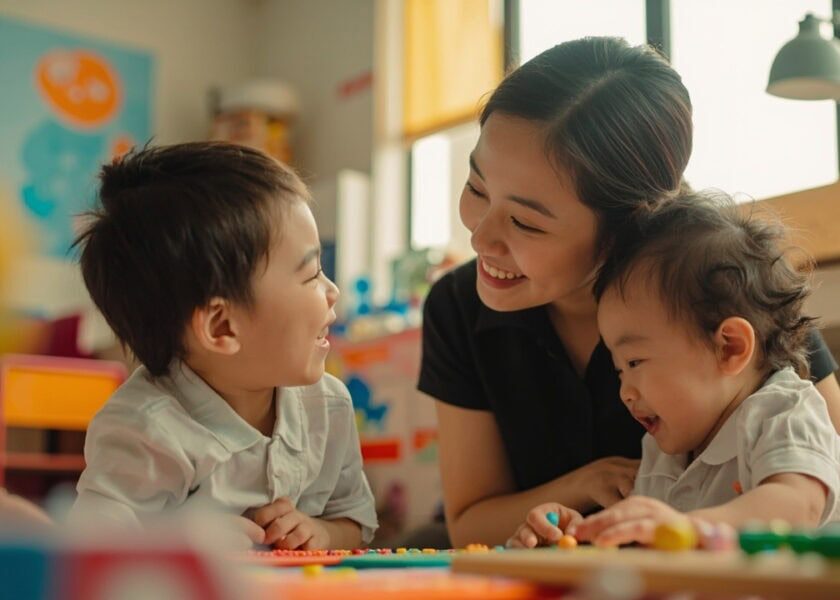
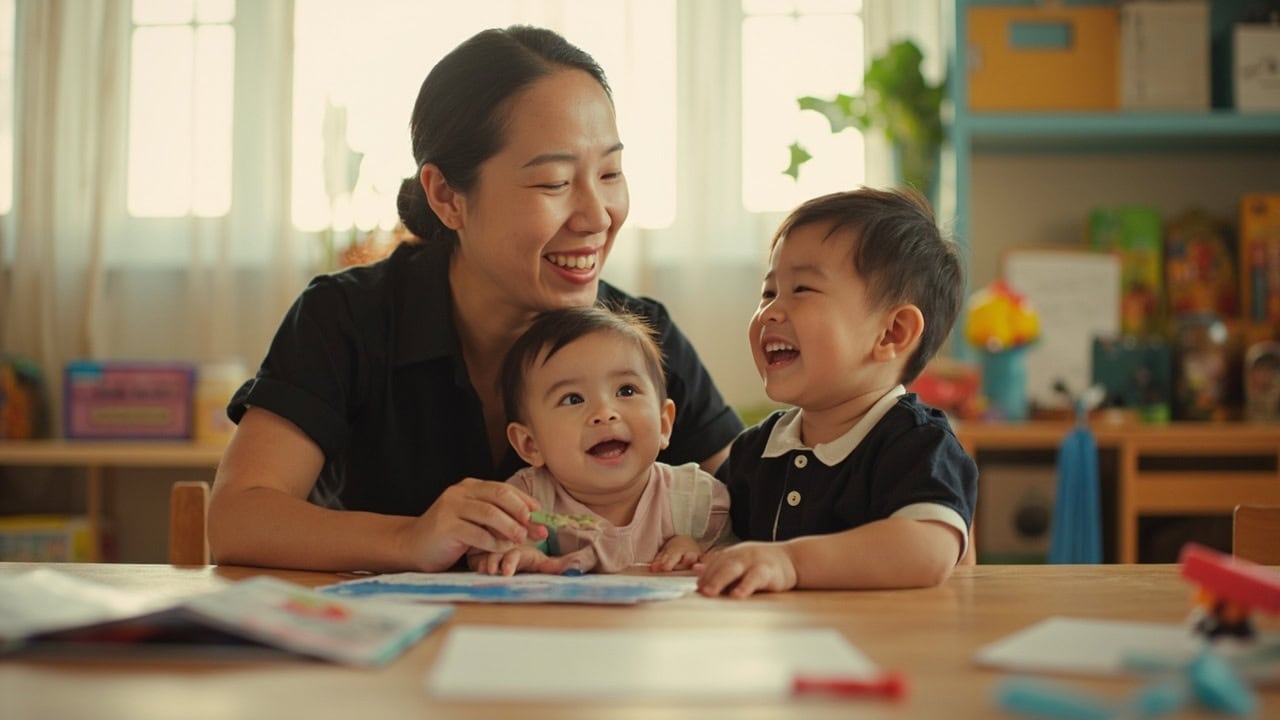
Think about what it means to observe a child professionally. An untrained observer notices that a baby is crying. A trained caregiver notices that the baby is crying in a specific way—a hunger cry versus a fatigue cry versus a cry that says something in the body is not right before the child has words to say it.
An untrained observer notices that a toddler is playing. A trained caregiver notices which materials the child returns to repeatedly, which social configurations the child seeks out, which challenges cause the child to persist versus retreat.
An untrained observer notices a child who is crying. A trained eye notices a child whose cry has changed in pitch, whose body is holding tension in a specific way, whose crying has a quality that might indicate not distress but illness—before a fever appears, before the child knows how to say my ear hurts.
An untrained observer notices a child who hit another child. A trained eye sees the sequence that preceded it—the frustration building, the social skill gap that made negotiation impossible, the trigger that might have been avoided with different environmental arrangement.
This is not intuition. It is a skill developed through specific training, intentional practice, and learning to see systematically rather than impressionistically.
Why the First Thousand Days Shape Everything
When you choose a childcare arrangement for your infant or toddler in Singapore, you are not simply entrusting them to warmth and goodwill. You are entrusting them to a team trained in the discipline of observation—caregivers who understand infant and toddler development not as general knowledge but as a daily working framework.
This matters because the early years are not simply a waiting period before real learning begins. The first thousand days of a child’s life are when the architecture of the brain is being built at its fastest pace. Neural connections are forming at a rate that will never be matched again. The emotional patterns, the stress response systems, the capacity for attachment and trust—these are all being established in these years.
What happens in these years is not recorded in any test. But it shapes everything that follows.
A trained caregiver tracks whether communication is emerging as expected, whether motor skills are building appropriately, whether social engagement is healthy and growing. They hold a picture of your child’s development that is far more detailed and consistent than any single parent visit could provide—because they are with your child every day, and they are looking with trained eyes.
Warmth without training is not enough. Warmth without observation is a feeling without follow-through. What children need, what parents need, is warmth that is directed by knowledge. Care that is both compassionate and competent.
Responsive Care: Following the Child, Not the Clock
Observation alone is not care. Observation is only the beginning. What transforms observation into genuine quality is what happens next: responsive adaptation.
There is a model of childcare that runs on schedules. Meals at twelve. Nap at one. Activity at three. This is administratively convenient. It is easy to manage. It creates the appearance of order. But it is not premium care. It is institutional convenience dressed as routine.
Premium infant and child care operates on a different principle entirely. It operates on responsiveness. This means that the caregiver is not following a schedule. The caregiver is following the child.
What Responsiveness Looks Like in Practice
When an infant shows early hunger cues—before the cry that tells you hunger is urgent—the trained caregiver responds. This matters because waiting until a baby is in distress is not just uncomfortable for the child; it teaches the child that their signals do not matter, that they must escalate before they will be heard.
Responsive care teaches the opposite: that your communication is valid, that your needs are noticed, that the world responds to you.
When a toddler is deeply absorbed in an investigation—a tower of blocks that keeps collapsing, a puddle of water spreading across tiles, a beetle being watched with absolute focus—a responsive caregiver does not interrupt to maintain the schedule. They protect that focus. They understand that sustained attention is a skill being built in these moments, and that interrupting it repeatedly teaches a child that their interests do not matter.
This is what responsive care looks like in practice. It is not dramatic. It is not a spectacle. It is a thousand small decisions throughout the day, each one asking: What does this child need right now?
It requires training. It requires staffing ratios that make it possible. And it requires a philosophy that prioritizes the child’s experience over administrative convenience.
Why Staffing Ratios Matter
In Singapore, the ECDA Childminding Pilot is designed to maintain exactly the kind of low ratios that make responsiveness possible. When you have one caregiver for every infant, or one for every three children at most, you have time to notice. You have time to adapt. You have time to truly know each child as an individual rather than managing a group.
This is not a luxury. It is a standard. And it is one that Singapore parents should understand to expect and demand.
The Quiet Work of Developmental Tracking
There is another dimension of professional childcare that parents rarely get to see, and it is perhaps the most important: the quiet work of developmental tracking.
This is not the same as observation. Observation is moment-to-moment attention. Tracking is the synthesis of those observations over time into a coherent picture of how your child is growing.
A trained caregiver is noting, across days and weeks and months, patterns that no single observation could reveal:
- Is this child’s language development progressing on track?
- Are there any areas where the child seems stuck or delayed?
- Are there behaviors emerging that warrant attention—a regression that might indicate stress, a sudden withdrawal that might indicate difficulty, a persistent frustration that might indicate an unmet developmental need?
This tracking happens quietly throughout the day. It is not a formal test. It is not a report card. It is the continuous, professional attention of someone who knows what typical development looks like, who knows the range of normal, and who is watching for anything that falls outside it.
Why Early Detection Changes Everything
In the early years, catching a developmental concern early matters enormously. The plasticity of the young brain means that intervention at two can accomplish what intervention at five will struggle to achieve. The eyes that are watching for these signals are not just caregivers. They are, in the truest sense, your child’s first teachers—trained not to perform lessons but to notice growth and respond to it.
And because this tracking is systematic and consistent, it becomes reliable. You are not relying on a single caregiver’s impressions. You are relying on a documented, professional process that maintains continuity even when individual caregivers are absent.
The systems that professional childcare providers build ensure that observation is recorded, that patterns are tracked, that nothing falls through the gaps of a casual Tuesday afternoon when maybe someone was a little tired or distracted. Quality is built into the infrastructure, not left to the luck of individual personalities or daily variations.
This is what makes consistency possible across days and caregivers. Not just goodwill. Not just habit. Systems.
What Professional Communication Actually Looks Like
All this knowledge is valuable only if it reaches you. This is where professional communication becomes not a nice-to-have but a core component of quality care.
Most parents have experienced the pickup conversation that tells them nothing. The child was fine. The child ate well. The child played. And you leave with a vague sense of reassurance that does not actually tell you anything about your child’s day, your child’s development, your child’s wellbeing.
Professional communication protocols are different. They are designed to actually inform you—not just reassure you, not just satisfy you for the moment, but genuinely give you insight into what is happening with your child.
Three Dimensions of Meaningful Communication
1. Sharing observation. What did your child focus on today? What new skill emerged or was practiced? What was the quality of their engagement with other children or caregivers? What moments seemed significant?
2. Sharing context. If your child was clingy at drop-off, it means explaining what preceded it—was there a disrupted night, a change at home, a developmental leap that sometimes causes regression before advancement? If your child was unusually quiet, it means explaining whether this was peaceful quiet or withdrawn quiet and what the caregiver observed about the difference.
3. Sharing partnership. What can you do at home this weekend that would support what is being worked on this week? What should you be watching for? What questions should you be asking?
This commitment to professional communication extends to the infrastructure of trust itself. Where technology is deployed in service of the relationship between parent and provider—not a replacement for human connection, but a bridge across the distances that busy lives create—this is what transparent childcare looks like. Not because there is nothing to hide, but because the work itself is worth showing.
The Sacred Work of Transitions
There is one more dimension of premium care that deserves attention, because it is so often overlooked: the intentional management of transitions.
Transitions—drop-off and pickup, the movement between activities, the shift from play to rest—are the moments when children are most vulnerable. They are the moments when stress hormones are most likely to spike. They are the moments when a child’s sense of security is tested most directly.
And yet in most childcare settings, transitions are handled casually. The parent drops off, maybe lingers too long or leaves too abruptly, and the caregiver moves on to the next task.
Premium care treats transitions as the sacred moments they are.
The Structured Goodbye
The structured goodbye is not about a ritual for its own sake. It is about creating a predictable, calm, emotionally attuned ending to the parent’s presence and a warm beginning to the caregiver’s presence.
The caregiver meets the parent and child together. They acknowledge the child’s feelings about the parent’s departure—however old the child is, whatever words they have. They give the child a moment to process, to cry if they need to cry, to be held if they need to be held, and then they gently redirect attention toward the day ahead.
The Structured Reunion
The structured reunion at pickup is the same principle in reverse. The caregiver shares not just the logistics of the day but the emotional texture of it. They help parents understand what their child was like when they arrived, how they settled, what they seemed to need. They bridge the gap between the hours so that parents can understand their child’s full day, not just the pieces they witness.
This is not sentimental. It is neuroscientific. Transitions handled well reduce cortisol, build attachment security, and teach children that the world can be trusted to manage changes smoothly.
When you evaluate a childcare setting, watch the transitions. This will tell you more than any tour of colorful classrooms or carefully curated activities.
How to Evaluate Quality: Questions and What to Watch
You now know what good care looks like from the inside. Here is how to evaluate it from the outside—during a visit, before you commit, wherever you are in Singapore.
Questions That Reveal Real Standards
- How do you handle drop-off? Look for a structured, unhurried process where the caregiver meets you and your child together, takes time to hear about the morning, and helps your child transition rather than simply accepting the handoff.
- What does a typical day look like? If the answer is a rigid minute-by-minute schedule, that is institutional care. If the answer describes rhythms and routines that adapt to children’s needs, that is responsive care.
- How do you track development? Listen for systematic documentation—not vague reassurances, but actual processes for noting patterns over time and sharing them with parents.
- What training have your caregivers received? Look for specific references to child development training, not just experience with children. Experience without training is just seniority.
- What are your ratios? For infants, one caregiver to one child is ideal. For toddlers, no more than one to three. Anything higher makes genuine observation and responsiveness impossible.
- What does communication look like? Ask what a typical pickup conversation includes. Look for providers who share observations, context, and partnership—not just logistics.
What to Watch For During a Visit
- Are caregivers on the floor with children, or behind desks managing paperwork?
- Do caregivers kneel or sit at children’s level, or do they tower over them?
- Are children allowed to persist with activities, or is everything on a timer?
- How do caregivers respond when a child is distressed? With comfort or with commands?
- Do transitions feel rushed or intentional?
The One Question That Matters Most
Ask any caregiver: What did my child focus on today?
If they cannot answer, that tells you something. If they offer a vague oh, they played, that tells you something. But if they describe what captured your child’s attention, what challenged them, what they returned to repeatedly—that is trained observation in action.
EduNanny by BUTLER: Built for Parents Who Want to Know
EduNanny by BUTLER was built for parents who want more than warm smiles and clean facilities. Parents who want to understand what is happening when they are not there. Parents who want systems, not just promises. Parents who want to be partners in their child’s care, not just recipients of reassurance.
The ECDA Childminding Pilot represents Singapore’s commitment to making professional, home-based childcare accessible—with infant ratios that allow for genuine attention, fee structures designed for affordability, Monday to Friday care blocks that fit real working lives, and CDA and Baby Bonus usability that removes unnecessary financial friction.
Whether through home-based care, where your child develops in a home environment with consistent caregivers, or through community-based or centre-based pathways where the same professional standards apply, EduNanny meets families where they are.
The specifics of delivery may vary, but the infrastructure of trained observation, responsive care, developmental tracking, and professional communication does not. This is not a philosophy that sounds good in a brochure. This is a daily practice built into every hour, every interaction, every record, every communication.
The Informed Parent: Your New Role
Here is what has changed for you today.
You are not wrong to feel the weight of that question—Is my child okay right now? You are not wrong to feel the distance between yourself and those hours of the day when you are not present. That distance is real, and it matters, and it deserves a response.
But here is the answer to that question, for parents who choose well:
Your child is not in a void. Your child is in a system designed to know them. Your child is being observed by trained eyes, responded to by adapted care, tracked by professional attention, communicated with through protocols that take their development seriously. Your child is not merely supervised. They are genuinely, systematically, professionally cared for.
And you—parents who have come to understand what you now understand—are not in the dark anymore.
You know what to look for. You know the difference between supervision and observation. You know the difference between a schedule and responsiveness. You know what communication should feel like when it is professional rather than performative. You know how transitions reveal quality. You know what trained caregivers notice that others miss.
You are not placing blind trust anymore. You are placing informed recognition. You are choosing from knowledge rather than guesswork, and that changes everything.
This knowledge is not just valuable for evaluating any childcare arrangement. It is valuable for evaluating any setting, anywhere. Because now you know what questions to ask. You know what answers mean something. You know what to watch for in transitions, in communication, in ratios, in training, in the way caregivers describe their work.
You are not a passive consumer hoping for the best. You are an informed parent capable of recognizing quality when you see it.
The question you have carried—Is my child okay right now?—is not a question you need to stop asking. It is a question you can now answer, because you know what good looks like. You know what to trust.
And you know, with confidence, that when your child is in care that operates on these principles, the answer to that question is yes.
Your child is okay. Because they are known.
And now, so are you.
EduNanny is a trusted Singapore childcare and childminding service committed to trained observation, responsive care, and professional standards. Learn more about EduNanny or connect with our team.