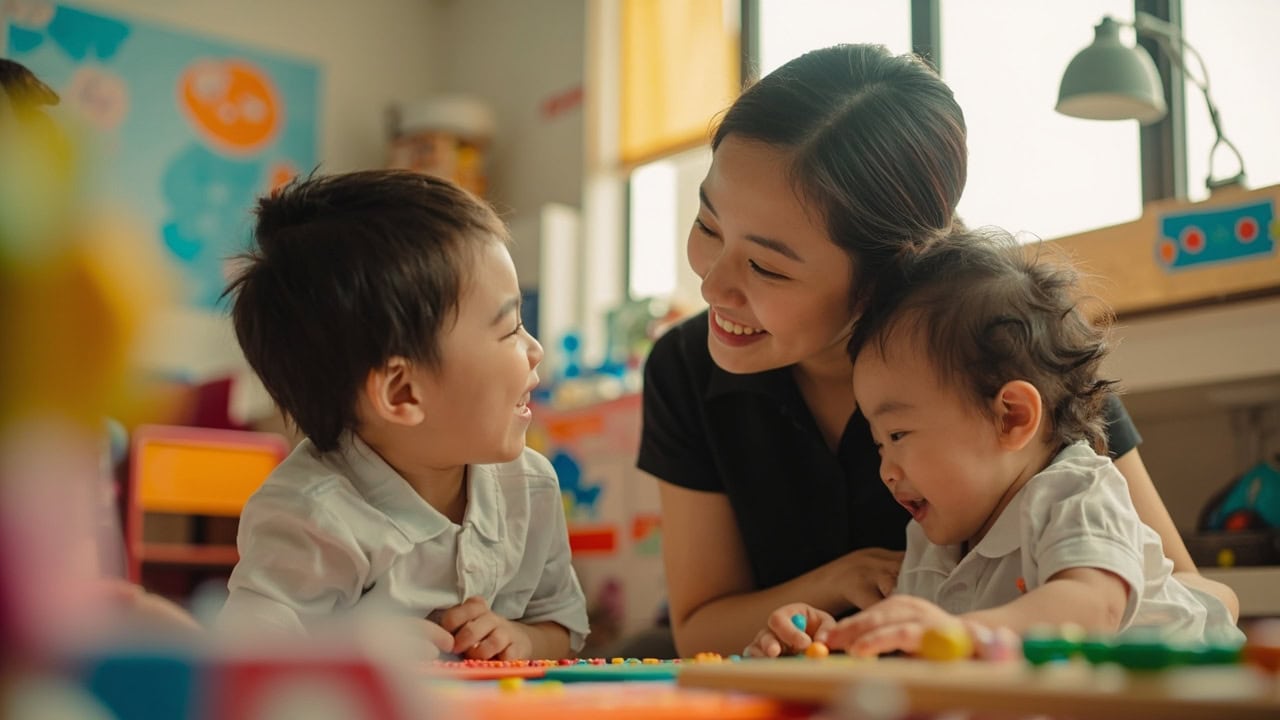
The Partnership That Transforms How Singapore Parents Choose Childcare
Choosing Childcare Means Entering a Relationship
EduNanny Singapore has learned something from watching families navigate the early years with more intention, more uncertainty, and more heart than most of us expect of ourselves before we become parents. And what we have come to believe, quietly and with growing conviction, is this: the quality of your child’s care does not rest on a decision you make once. It rests on a relationship you build over time.
The entrance into this relationship rarely announces itself with clarity. More often, it arrives as a vague unease. You have handed your child to someone new, someone qualified, someone vetted, and you feel the strange pull between gratitude and anxiety that defines early caregiving relationships.
You want to trust this person. You want to be warm and easy to work with. But you also want to know exactly what happened in every five-minute window of the day. You want transparency. You want reassurance. You want to feel like you are still the parent, even when you are not the one there.
This tension is not weakness. It is the honest cost of loving someone so completely that you cannot be everywhere at once. The question is not whether to feel this tension. The question is what to do with it.
The Difference Between a Contract and a Partnership
Here is what we have learned from families who have navigated this well: they do not try to eliminate the tension. They learn to work with it. They approach the caregiver relationship not as a contract to be managed but as a partnership to be cultivated.
A contract says: here are my expectations, meet them, and we are square. A partnership says: we are both invested in the same small person, and we will figure this out together. One is transactional. The other is relational. Children, who are exquisitely attuned to the emotional weather around them, know the difference long before they can speak it.
What Quality Childminding Looks Like in Singapore
Understanding the philosophy matters, but you also need clarity on what quality looks like in practice. Here are the markers that distinguish genuine partnership from professional performance.
Signs of a Genuinely Invested Caregiver
- She remembers small details about your child without prompting—their favourite song, their comfort object, the way they like to be held
- She shares observations proactively, not just in response to your questions
- She adapts her approach when you share preferences, and she remembers those adaptations
- She speaks about your child with warmth and specificity, not general professional pleasantries
- She asks questions about your child’s history, preferences, and rhythms at home
Signs of a Care Environment That Supports Partnership
Beyond the individual caregiver, the structure of care matters. Quality childminding in Singapore should offer:
- Appropriate ratios—attentiveness is not just a philosophy, it is a ratio. Small groups allow caregivers to truly know each child.
- Consistent caregivers—your child should not be cared for by a rotating cast of strangers. Continuity builds security.
- Transparent communication—you should have clear channels for updates, questions, and feedback. Trust is built through information.
- Professional support—caregivers who feel supported by their organisation show up better for your child.
For parents navigating childcare in Singapore, there are practical realities to consider. The Child Development Account (CDA) and Baby Bonus schemes can make quality care more accessible. Within the ECDA Childminding Pilot framework, fees are structured with affordability in mind. The partnership described here should not be a privilege available only to those with significant resources.
Building the Partnership: Daily Rituals and Honest Communication
So what does partnership actually look like, day to day, in the real hours of real Singapore lives?
The Handover Ritual
It begins at handover. Not the perfunctory exchange of bags and bottles, but the quality of attention you bring to those first minutes.
- How you greet your caregiver with genuine warmth
- How you speak about your child’s morning, their mood, their teething, their new word
- How you listen when your caregiver shares what happened during the afternoon
These are not administrative details. They are the currency of partnership. When you share what you observe, you are saying: I know my child, and I trust that you want to know them too. When you listen to what your caregiver shares, you are saying: I believe that what happens here matters, and I want to understand it. This is the first ritual of partnership, and it costs nothing but presence.
Communicating Your Needs Clearly
Partnership goes deeper than handover conversations. It lives in the way you communicate your needs, clearly and without apology. Many parents struggle here. There is a real hesitation to speak up, a worry that asking for something will seem like criticism, or that expressing a preference will create friction.
And yet the caregivers we work with say the same thing, almost universally: they want to know. They want to know what matters to the family. They want to be trusted enough to be told when something is not working, so they can adapt. What erodes trust is not honest feedback. What erodes trust is silence that festers into resentment on both sides.
The families who build the strongest caregiver relationships are not the ones who never have concerns. They are the ones who bring those concerns forward with respect and timing, who say what they need before it becomes what they resent.
Practical Principles for Honest Conversations
- Treat your caregiver as a professional who deserves clear expectations, not a mind reader who should instinctively know
- Frame concerns as shared observation rather than accusation
- Name specific things that are going well, not just what needs adjustment
- Speak as though your caregiver is on your side, because in the most meaningful sense, she is
- Give feedback before small issues become entrenched resentments
The caregivers we work with are consistently surprised at how well a direct, kind conversation can clear the air. They are rarely offended by honesty. They are far more troubled by uncertainty about what families actually need.
The Art of Appreciation
Partnership is not only about raising concerns. It is equally about recognition. When your caregiver does something that clearly benefits your child, name it. Tell her that you noticed. Tell her that it mattered to you. This is not flattery. It is acknowledgment of the real work she is doing.
Caregivers who feel valued show up differently than those who feel used. Your investment in that relationship, your acknowledgment of their work, your consistency in how you treat them—these things ripple outward in ways that your child will feel long before they can articulate what they feel.
The Freedom That Comes with Trust
Here is what many parents do not expect: this partnership does not diminish your role as a parent. It expands it.
When your child has a caregiver who knows them well, who responds to their cues with warmth and skill, who is genuinely invested in their development, something freeing happens. You are no longer the sole vessel of your child’s security. That weight distributes, gently, across two adults who trust each other.
Your child benefits from the caregiver-child bond, not despite the parent-child bond but alongside it. These are not competing attachments. They are complementary ones. A child who feels equally secure with the trusted adults in their life is a child with more emotional resources, more resilience, more capacity to explore and learn and grow.
This is the quiet truth that transforms how we think about childcare. It is not a question of who is doing the parenting. It is a question of how many reliable, loving, consistent adults are invested in a child’s wellbeing. The answer, when the partnership is working, is more than one.
Navigating the Real Complexity
There will be real conversations that require courage. There will be moments when your child comes home with a bruise and you need to understand what happened. There will be days when the routine shifts and you wish it had not. There will be times when the feeding approach you prefer is not the one your caregiver defaults to, and you need to talk about it without making her feel she has done something wrong.
These are not signs of a failing partnership. They are the ordinary texture of any relationship that involves two people caring deeply for the same small, irreplaceable life. What matters is not that these moments do not arise. What matters is that you have built enough trust, enough mutual respect, enough shared investment in your child’s wellbeing that you can navigate them together without the relationship fracturing.
Most parents underestimate themselves here. They imagine that they need to be perfect communicators, or that they need a caregiver who anticipates every need, or that the relationship must feel effortless to be working. None of this is true. What you need is consistency, care, and the willingness to show up honestly, again and again. The partnership is built through accumulated moments of honest exchange, not through one perfect conversation.
How EduNanny Singapore Approaches This Partnership
EduNanny Singapore has built its approach around this understanding of childcare as relationship, not transaction. As part of the ECDA Childminding Pilot, our framework is grounded in standards that prioritise your child’s safety, development, and emotional wellbeing.
We maintain small infant-to-caregiver ratios because we know that attentiveness requires structural support, not just good intentions. We offer both home-based and community-based pathways because families are not all the same, and the right fit matters more than the theoretical ideal. Our care blocks run Monday to Friday because we know the rhythm of working parents’ weeks, and we have designed around real life.
We provide communication tools and transparency measures, including clear channels for updates and feedback, because we believe you deserve to know what your child’s day looks like—not because trust is something we need to manufacture, but because trust is something we want to give you the conditions to build.
Supporting the Whole Caregiving Ecosystem
Part of what EduNanny offers is a framework that supports the entire caregiving ecosystem, including the caregivers themselves. A caregiver who feels respected, supported, and valued is a caregiver who can show up fully for your child.
Our support resources are designed to help with the real, daily questions that arise—the ones that do not fit neatly into a brochure. Questions that come to you at 9pm when you are wondering if what your child ate today was enough, or if the milestone they reached is on track, or whether you are being a good parent for needing the help you need. These are not concerns that belong in a FAQ. They are the texture of early parenthood, and we want to be present for them in ways that are genuinely useful.
Addressing Your Real Concerns
We would be doing you a disservice if we pretended that building this kind of partnership is always easy. There are real complexities here that deserve honest acknowledgment.
“Am I Being Disloyal to My Child By Needing Help?”
No. These feelings are not disloyalty. They are the honest cost of loving someone enough to need help raising them. Every parent in Singapore who returns to work, who has family commitments, who simply needs support—none of them are failing their children. They are doing what humans have always done: raising children within a community of caring adults.
“What If My Instincts Don’t Align With My Caregiver’s?”
Differences in approach are inevitable. What matters is whether those differences can be discussed. A good caregiver relationship has room for these conversations. You do not need to agree on everything. You need to be able to talk about your preferences without fear of judgment or defensiveness.
“What If I Can’t Communicate Well? What If I Make Things Awkward?”
You do not need to be a perfect communicator. You need to be willing to show up honestly. Most caregivers deeply appreciate parents who try. The intention matters. Even awkward honesty is better than silent resentment.
“How Do I Know If My Caregiver Is Genuinely Invested?”
Look for specificity. A genuinely invested caregiver will know your child’s particular rhythms, preferences, and recent developments. She will volunteer information, not just respond to questions. She will speak about your child as an individual, not as one of several interchangeable charges.
Your Next Step: Building Trust Incrementally
Trust is not a switch you flip. It is built slowly through consistent care, respect, and shared investment in your child’s wellbeing. In the early days, you may feel uncertain. That is normal. Trust grows when you observe your caregiver handling small moments well—the way she soothes your child, the attention she pays to details, the communication she provides without prompting. These accumulate into confidence. Give it time. Give yourself permission to observe before you judge. Give your caregiver room to show you who she is.
When you hand your child to your caregiver tomorrow morning, notice what you are doing. You are not transferring responsibility. You are sharing it. You are saying: I trust you with the person I love most in this world.
That is not a small thing to say. It is not a small thing to receive. And it is not a small thing to live up to, day after day, in the small hours of a child’s life where everything is happening for the first time.
EduNanny Singapore is here because we believe that trust can be earned, that care can be excellent, and that you, as a parent, do not have to choose between control and connection. You can have both. You can be present and let go. You can trust and verify. You can be the parent and have a partner in parenting.
And when that investment is made with intention, with respect, and with the kind of trust that is earned slowly through consistent care, the returns are not just better childcare. They are a child who is held well, by more than one pair of hands. They are a family that is supported, not replaced. They are a caregiver who is valued, not just used. And they are a parent who feels, perhaps for the first time in the overwhelming early years, that they are not doing this alone.
Explore how EduNanny Singapore can support your family.
Curious about how EduNanny approaches development-focused childminding in Singapore? Learn more about our philosophy and values, or get in touch to start a conversation about what your family needs.