Your Observation Is the Best Tool for Choosing Quality Childcare
You Already Have the Foundation
When I talk about learning to see quality, I am not talking about becoming an inspector. I am not asking you to walk into a childcare centre with a clipboard and a checklist.
What I am talking about is something far more human — something you already do every single day, perhaps without recognizing it as the sophisticated skill that it is.
Think about how you know your child is tired before they yawn. Think about how you can tell when they are hungry by the particular quality of their restlessness. Think about how you sense a change in their mood from across the room, before they have said a word.
This is not magic. This is months and years of close attention. This is sitting with your child, learning their particular language — the language of their body, their eyes, the way they hold themselves, the way they reach for you or turn away.
And here is the truth that most childcare marketing does not want you to know: these same skills — the ones that make you such a perceptive, attuned parent — can be applied to reading any environment where your child is cared for. You already have the foundation. What you need is permission to trust it, and a gentle framework to sharpen it.
What a Childcare Space Reveals Before Anyone Speaks
Let me take you into a childcare centre. Not any centre in particular — but the kind of place where quality is real, not performed. Walk in with me, and notice what is there before the tour guide speaks.
What It Sounds Like
First, there is the sound beneath the obvious noise of children playing. Listen for how adults speak to children. Is it hurried? Do you hear the rushed “not now, we’re doing something” tone that tells you the adults are managing a schedule more than a moment?
Or do you hear the unhurried voice — the voice that bends down to a child’s level, literally and figuratively, and responds to what the child is doing in the present tense, not the next-thing-on-the-list tense? You can hear warmth. It has a rhythm. It has patience at its centre.
What It Smells Like
Then there is the smell. It is not the smell of industrial cleaning products applied to cover other smells. It is not the smell of a place cleaned in a hurry at the end of the day. It is the smell of a place maintained throughout the day — of hands washed and surfaces refreshed, of a space that is loved because it is kept, not because it is occasionally deep-cleaned in a visible burst of effort.
What It Feels Like
And then there is the feel of it. Walk into a room and stand still for thirty seconds, not speaking, just being present. How does the room feel? Is it a room designed for adults to manage, or a room designed for children to inhabit?
You will feel whether the space invites a child in or simply tolerates them. You will feel whether the furniture is at the right height, whether there are corners that invite exploration, whether the light is harsh or gentle, whether there are soft places to land.
None of this requires expertise. It requires only the willingness to slow down and trust what you are already capable of perceiving.
Reading the People in the Room
Now let us move to the harder thing — because the space is one thing, but the people in the space are another, and that is where most parents feel most uncertain.
How do you read a caregiver without interrupting? You do it the way you would observe a stranger with a child on the bus. You do not need an introduction to read a relationship. You need only to watch with the eyes of a parent who has spent years learning what secure attachment looks like.
Look for How They Respond to Distress
Look at how the caregiver responds when a child approaches them — not when a child is smiling and easy and delightful. You can perform that interaction in thirty seconds for any visitor.
Look at what happens when a child is frustrated. When they are tired. When they are in the middle of something that is not going well.
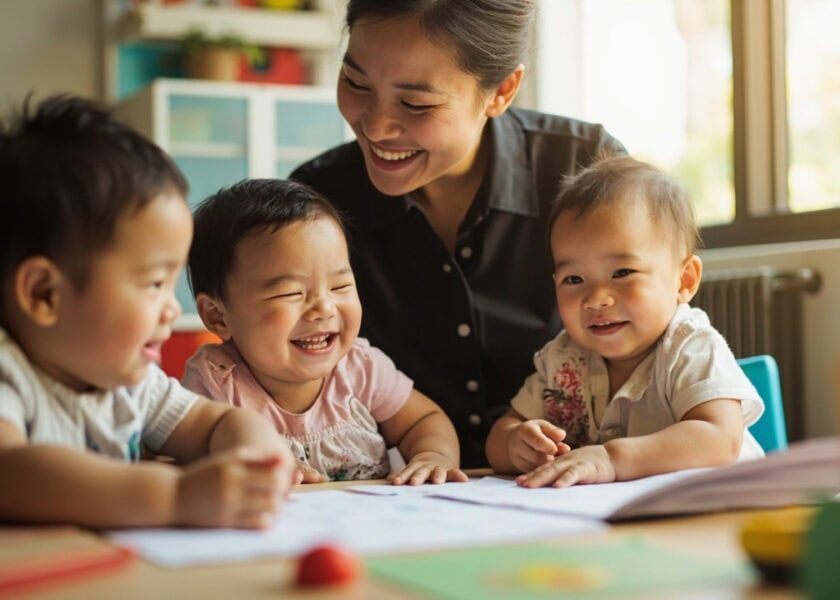
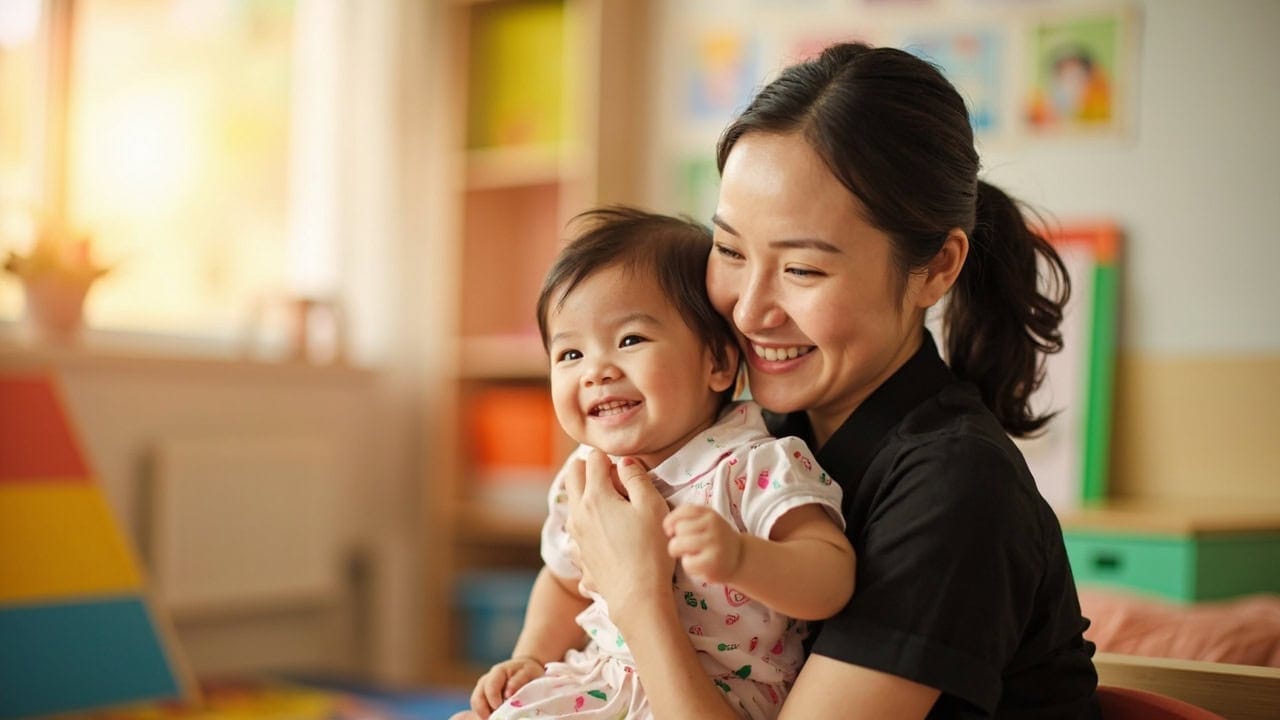
The caregiver who is truly present will respond with their whole body. They will not stay seated and gesture. They will not keep their hands occupied with something else. They will turn. They will reach. They will bend down and pick the child up, or sit with them, or simply be there in a way that communicates: I see you. I am with you. This moment is not too big for us.
What the Child’s Response Tells You
Look at the child’s response. This is the most honest indicator of all, because children cannot sustain performance the way adults can.
A child who runs to their caregiver when they are upset — who reaches for them without hesitation, who clings not with desperation but with the comfortable certainty that they will be held — this child is telling you everything you need to know about the relationship they have formed in that place.
The Details That Reveal True Attention
Watch how caregivers speak to each other about the children in their care. Do they know the children’s names? Do they speak about them with specificity — not “he was fussy this morning” but “he has been asking for the blue truck all week, he will be so happy when he sees it is out today”?
The second is intimate knowledge. The second tells you that these adults are paying attention to who these children are as individuals, not just managing their presence.
The Unguarded Moments
Every childcare centre will show you its best face during a tour. They will show you the activities they have prepared, the children who are engaged, the caregivers who are ready to demonstrate warmth and attentiveness. This is not dishonesty — it is simply human.
But quality cannot be performed continuously. It reveals itself in the moments when no one is watching.
Notice what the caregiver is doing when they think the visitor is looking at the children. Notice whether the warmth is consistent or whether it shifts depending on who is watching. Notice whether the caregiver responds to a child’s need immediately or whether they wait until they see you looking.
In a place where genuine care is present, you will see it in the small things:
- The caregiver who adjusts a blanket without being asked
- The caregiver who notices a child slowing down and gently suggests a rest before the child becomes overtired
- The caregiver who speaks softly to a child who has just woken up, giving them time to arrive in the room
These are not scripted moments. They are the natural overflow of someone who truly knows these children and is truly invested in their wellbeing.
The Three Gates: A Framework for Your First Visit
Here is a simple framework. Not a checklist. Not a scoring system. Just a way of organizing what you observe so that you leave with something meaningful, not just a feeling you cannot articulate.
I call it the Three Gates. You walk into any childcare centre and ask yourself three questions.
The First Gate: Does This Place Feel Like It Knows Children?
Not knows how to care for children in the abstract — knows children. The difference is whether the space is designed around a child’s developmental reality or around an adult’s administrative convenience.
You will feel this in the height of the furniture. In the availability of safe objects for mouthing and exploring. In whether the schedule serves the children or the children are expected to serve the schedule.
The Second Gate: Do the Caregivers Look Like They Are in Relationship With These Children?
Not performing care, but actually in relationship. This means they know names. They respond to needs. They interact with joy and patience.
You will see this in the way they move through the room, in the way a child seeks them out, in the way small conflicts are handled — not with impatience or force, but with the calm certainty of someone who has the child’s trust and is not afraid to use it.
The Third Gate: Do the Children Look Like They Belong Here?
Not like they are being managed. Not like they are waiting for something. Like they belong. Like this is a place that has become, in some meaningful way, theirs.
You will see this in their body language — relaxed, curious, engaged in their own play, not perpetually waiting for the next instruction. You will see it in whether they are playing with genuine absorption or simply filling time.
If you can answer these three questions honestly, you will have a clearer sense of a centre’s quality than most parents ever develop. And you will have done it using only the most reliable instrument available: your own trained perception.
What EduNanny Believes About Parents and Quality
EduNanny was built on a simple conviction: that Singapore parents deserve to be partners in their child’s care, not passengers in it. That means giving you the tools to evaluate what you see. That means building a centre where quality is visible because it is real, not because it has been polished for tours.
We are proud to be part of the ECDA Childminding Pilot — a recognition that home-based and community-based care pathways are not a compromise but a legitimate, high-quality option for families in Singapore.
Whether you choose a centre-based setting or a home-based pathway through EduNanny, you will find the same commitment to the ratios that matter: up to one to three infants in our care, because we know that the closeness of attention in those early years is not negotiable. We know that your child’s brain is building itself in ways that will echo through their entire life, and that the quality of care they receive in these years is not a luxury — it is the foundation.
Transparency by Design
Our caregivers are trained not just to be competent but to be readable. We want you to be able to see what we see. We want you to understand why a caregiver responds the way they do, why a particular routine exists, why your child’s day is structured in the way it is.
Transparency is not an accident. It is design. Because we believe that a parent who understands quality becomes a better partner in their child’s care.
Quality Care Must Be Accessible
We also know that quality care must be accessible. That is why our pilot fee structures are designed to be affordable, why CDA and Baby Bonus funds can be used to support your family’s arrangement, and why our care blocks run Monday through Friday — because we know the realities of Singapore family life and the pressures you navigate every day.
Staying Connected
For those moments when you need guidance, when you have a question at 8 p.m. after the day’s handover, when you want to understand what your child’s behaviour is telling you about their experience — EduNanny’s Thomas AI Chatbot is there. Not as a replacement for human connection, but as a bridge to it.
Trust What You See
You did not come to this decision lightly. You did not choose to return to work or to seek additional care for your child because you did not love them. You did it because life in Singapore asks so much of families, and because you know that your child deserves the best possible version of you — a version that may need support to show up fully.
That takes courage. That takes trust. And it deserves, more than anything, a childcare partner who sees your effort and honours it.
The uncertainty you felt standing in that first centre, the sense that you were not sure what you were looking for — that was not a sign of weakness. That was a sign that you cared enough to notice you did not have all the answers. And that noticing is the beginning of everything.
You learned to read your child’s cry. You learned to sense their hunger and their tiredness and their need for closeness. You learned to interpret their body language before they could speak, to calm them when they were upset, to celebrate with them when they discovered something new.
This is not a small thing. This is an extraordinary capacity for attuned observation, and it belongs to you.
It belongs to you in the childcare centre. It belongs to you at the playground and at the pediatrician’s office and in every unfamiliar space where your child’s wellbeing is on the line. You already have it — you have always had it.
A Few Things to Hold Onto
If you leave a tour feeling uncertain, that feeling is not a problem to solve — it is information to use. Ask yourself which of the Three Gates you could not answer clearly, and let that guide your next question or a second visit at a different time of day.
Ask to return unannounced. A centre that declines is telling you something. A centre that welcomes you back is showing you something. Quality that is real does not need to hide from observation.
And watch your child’s homecoming. Does your child return calm and settled, or agitated and dysregulated? Over time, a child’s behaviour after pick-up is one of the most honest reflections of their daily experience. A child who is consistently distressed after time at childcare may be telling you something the tour could never reveal.
Trust your gut and your senses. They are the same instrument. Marketing materials are designed to answer your questions. Your gut is designed to notice what the materials do not say. Pay attention to both, but know which one is more reliable.
So the next time you stand in a childcare centre — ours or anyone else’s — and you feel that quiet uncertainty, do not turn away from it. Turn toward it.
That uncertainty is your invitation to become the kind of parent who knows what they are seeing. And the kind of parent who knows what they are seeing is the kind of parent who chooses wisely, stays confidently, and builds a partnership with their child’s caregivers that is rooted in trust, not in blind faith.
We are here for that. We are here to be seen. And we are here because we believe that the best care in Singapore is not the care that looks good in a brochure — it is the care that reveals itself to anyone who takes the time to look.
You have the time. You have the eyes. You have been paying attention your whole life.
It is time to trust what you see.
Ready to visit a centre where quality reveals itself to anyone who looks? Book a tour with EduNanny and experience the kind of infant care that welcomes your most perceptive observation — because it has nothing to hide.