Will Your Child Know Where They Come From
The Question Singapore Parents Carry (But Don’t Always Know How to Name)
There is a question that many Singapore parents carry quietly, sometimes without even knowing how to name it. It surfaces at the hawker centre when your three-year-old responds to your grandmother in English instead of Cantonese. It surfaces at preschool when you realize your child knows more about their classmates’ festivals than their own. It surfaces in small moments, in the pause before you answer, in the wondering that happens when no one is asking you the question out loud.
The question is this: Will my child know where they come from?
Not in a historical sense. Not in a textbook sense. But in the way that settles into your bones. In the way that tells you who you are when the world asks you to explain yourself.
If you have felt this question stir inside you, I want you to know something right away. You are not overthinking this. You are not being overly sentimental. You are responding to something profoundly real, because the truth is that the early years of your child’s life are precisely the years when identity is being built — quietly and invisibly, in every room your child spends their time, in every voice they hear, in every language that surrounds them while they play.
What This Article Covers
- Why multicultural family life in Singapore creates both pride and quiet anxiety for parents
- How childcare has more influence on your child’s cultural identity than most parents realize
- What truly culturally nourishing care looks like (and how it differs from cultural exposure)
- Five practical signs to recognize whether a childcare setting is actively supporting your child’s heritage language and cultural roots
- How home-based childminding through the ECDA Childminding Pilot offers a different model
- What long-term confidence looks like for children who grow up rooted in their cultural identity
Singapore’s Beautiful Complexity and What It Means for Your Family
Singapore is one of the most culturally diverse cities on earth. We say this often, but I think we underestimate what it actually means for a family raising children here.
It means that from the moment your child is born, they are living inside a beautiful complexity. They may hear Mandarin at home and English at school. They may celebrate Hari Raya with one set of relatives and Chinese New Year with another. They may attend a preschool where Malay, Tamil, Cantonese, Hokkien, Teochew, and English weave in and out of the day.
This is not a challenge to manage. This is an inheritance to steward.
Your child is not just navigating multiple cultures. They are living them, absorbing them, and beginning to form their sense of self within this rich tapestry. The question is not whether your child will navigate a multicultural world. They will. The question is whether they will do so from a place of rootedness or from a place of confusion.
Whether they will carry multiple cultures the way a tree carries rings, each one adding strength and depth. Or whether they will feel somehow disconnected from all of them, belonging everywhere and nowhere at once.
The Truth About Childcare That Most Parents Haven’t Been Told
And this is where childcare enters the picture in a way that most parents have not been told to consider.
For the vast majority of Singapore families, childcare is not a supplementary arrangement. It is the second most influential environment in your child’s early life, second only to your own home.
If your child is in care for six, seven, eight hours a day, that environment is actively shaping who your child is becoming. It is either reinforcing what you are building at home, or it is quietly working in a different direction — neither intentionally harmful nor intentionally helpful, simply neutral.
Here is the insight that most parents have not been given: in the early years, there is no such thing as a neutral environment. Everything is either adding to your child’s sense of self, or subtracting from it.
We talk about ratios and curriculum. We talk about safety and food menus. We talk about whether the space looks bright and whether the teachers seem warm. These things matter. But we rarely talk about the cultural dimension of quality care, and this is the dimension that Singapore parents are increasingly realizing they cannot afford to ignore.
What Does Culturally Nourishing Care Actually Mean?
It means that when your child is in care, they are hearing their heritage language. Not as a formal lesson, not as a scheduled activity, but as a living part of the day. They hear it when the caregiver narrates what they are doing. They hear it in songs that carry the rhythms of home. They hear it in the way the caregiver greets them in the language your family speaks, not the language they assume you speak.
It means that cultural traditions are woven into the rhythm of the care day, not pasted on as decorations. That your child’s Chinese New Year is not just about red packets and ang bao in a craft activity, but about the smell of the kitchen at your grandmother’s house, the sounds of the reunion dinner, the feeling of being part of something that stretches back further than you can remember.
You are not asking for a language lesson. You are asking for your child to know who they are.
Children develop a foundational sense of identity between birth and age six. The neural pathways that govern self-understanding, cultural awareness, and language acquisition are being laid down right now, in the hours that you are at work, in the care arrangement you are trusting to hold your child. Your child is absorbing cultural belonging in ways they will not be able to tell you about for years, if ever. They are learning, in their bodies and their instincts, whether the world reflects them back or whether it asks them to leave part of themselves at the door.
Five Signs Your Childcare is Actively Supporting Your Child’s Cultural Identity
If you are currently researching childcare options or wondering whether your current arrangement is working with you or alongside you, here is a practical framework. These are not guarantees — parenting and childcare are human endeavors, and no arrangement is perfect. But they are guideposts that help you see whether care is designed with the full child in mind.
1. Listen to the Language Your Child Brings Home
Not just vocabulary, but attitude. Does your child come home interested in the languages they hear in care? Do they repeat words with curiosity rather than confusion? Or do they seem to treat their heritage language as something that belongs only at grandma’s house and nowhere else?
The language your child brings home is data. It tells you what is being absorbed, and what is being left behind.
2. Notice Whether Your Child’s Caregiver Asks About Your Family
Not in a form-filling way, but in a genuine way. Do they want to know which languages you speak at home? Do they ask about the festivals you celebrate? Do they ask about the foods your child loves?
A caregiver who understands cultural identity as part of their role will ask these questions, not because they are checking a box, but because they understand that knowing your family is how they care for your child.
3. Look for Cultural Immersion, Not Just Cultural Exposure
There is a difference. Cultural exposure is when a child makes a lantern in November and learns the word for it. Cultural immersion is when the caregiver speaks the heritage language while doing activities throughout the year, when traditions are part of the daily rhythm, when your child learns to be proud of where they come from in the same way they learn to tie their shoes or wash their hands before eating.
One is a lesson. The other is an identity.
4. Observe Whether Your Child Seems More Confident, Not Less, After Time in Care
Children who are being rooted by their care arrangements come home with a bounce in their step. They talk about what they learned — not in the sense of academic learning, but in the sense of discovering something about who they are.
Children whose care arrangements are culturally neutral, or worse, culturally dismissive, often come home quieter, less sure of themselves, carrying a vague sense that something is missing.
5. Ask the Hard Questions Directly
Ask your potential childcare provider how they handle heritage language development. Ask them what languages the caregivers speak. Ask them what cultural traditions are part of their daily practice. Ask them what they would do if your child responded to them in their heritage language.
Their answer will tell you everything.
How Home-Based Childminding Offers a Different Model
If you are exploring care arrangements that can genuinely support your child’s cultural identity, it is worth understanding how home-based childminding differs from centre-based care — not as a judgment of one over the other, but as a clarity about what each structure makes possible.
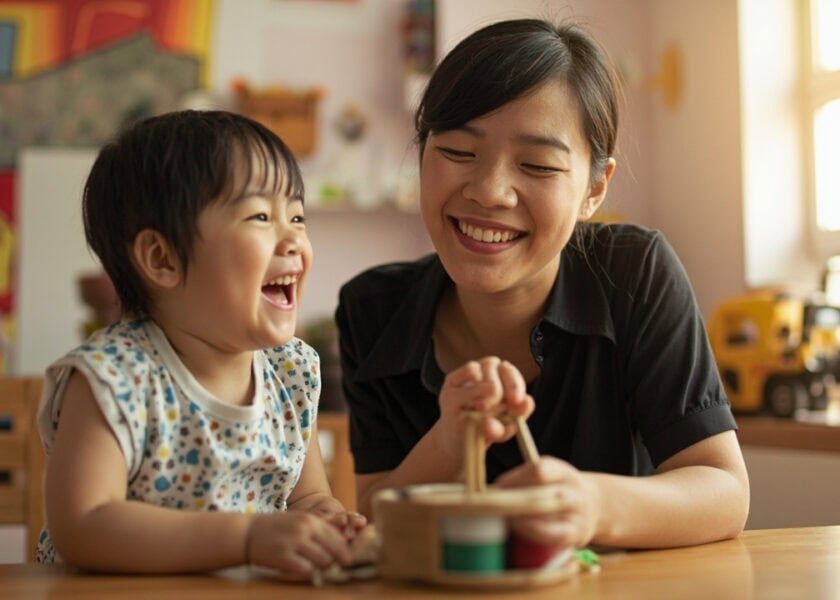
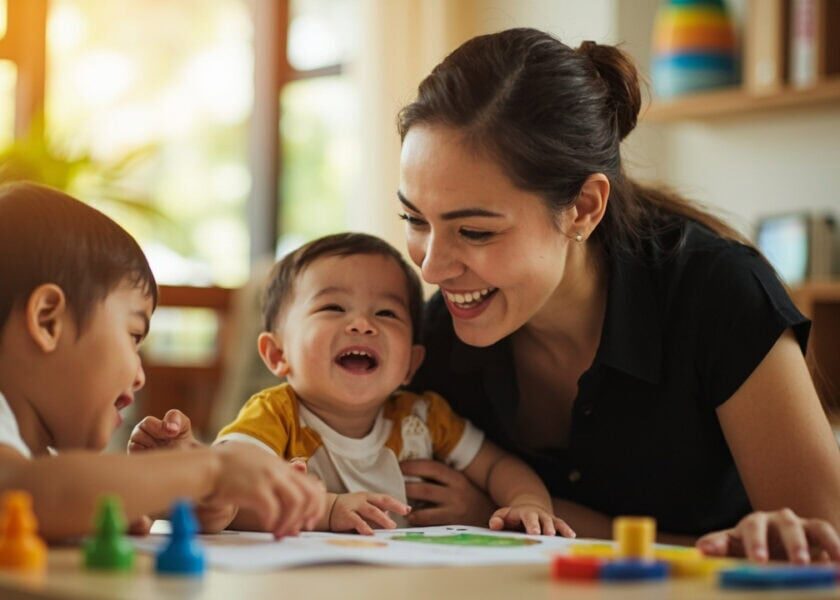
EduNanny, part of the ECDA Childminding Pilot, operates in this home-based model. With ratios of up to one to three infants, your child is not one of twelve or fifteen in a room. They are one of one, two, or three.
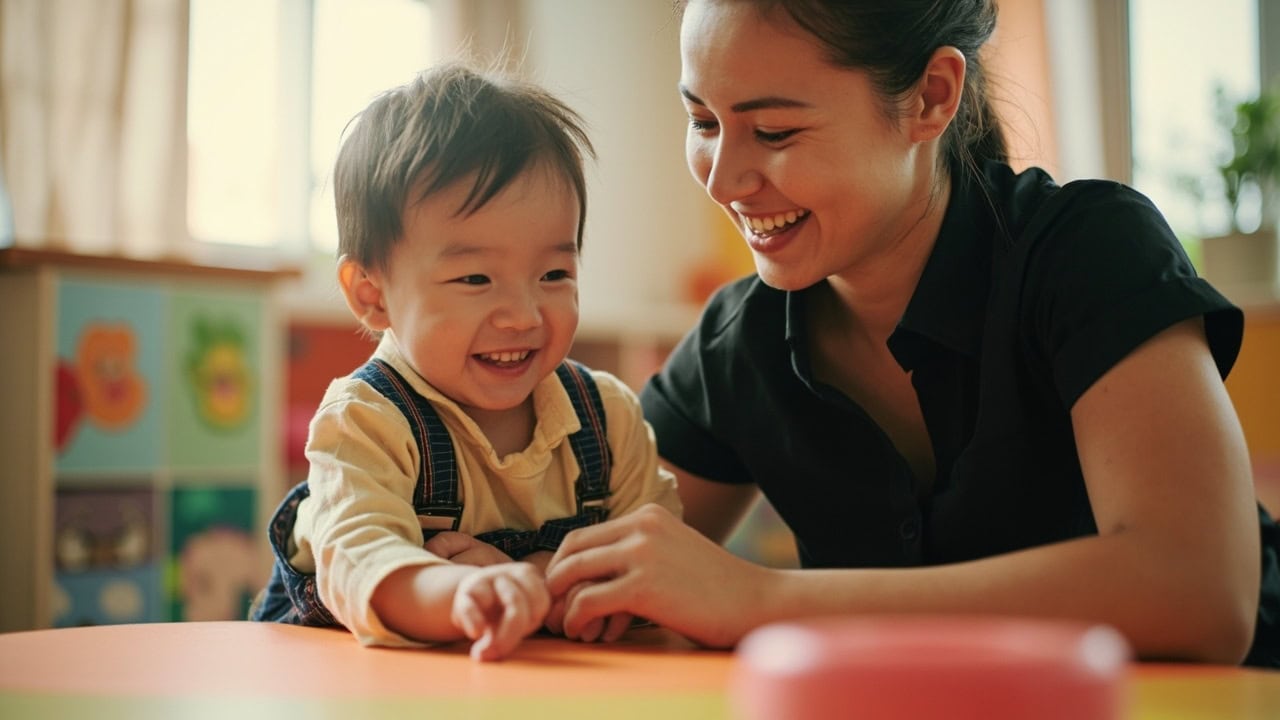
The caregiver knows your child’s name. Your child’s temperament. Your child’s favorite song. The way your child says good morning. The way your child’s face changes when they are tired.
This is not a feature you can add to a large centre. It is the fundamental structure of how care is designed.
When there are only one to three infants in a home environment, the caregiver can truly know each child. They can learn the languages your family speaks. They can adapt their daily routines to include the cultural practices that matter to you. They can communicate with you daily — not just through app updates, but through genuine conversations about your child’s day, your child’s growth, your child’s cultural development.
What Truly Attentive Caregivers Actually Do
In a model built on small ratios and genuine attentiveness, caregivers become partners in your child’s identity formation. They are the people who reinforce what you are building at home. They are the people who speak to your child in the language your grandmother would have wanted them to hear. They are the people who celebrate your festivals in ways that make your child feel proud and rooted.
Those who choose this path are choosing a vocation, not just a job. They are choosing to hold your child’s development in their hands. They are choosing to learn your family’s language, your family’s traditions, your family’s way of being. They are choosing to see your child as a whole person, not a slot to fill, not a checklist to complete.
Accessibility for Singapore Families
The pilot fee structures are designed to be accessible for Singapore families, and CDA and Baby Bonus funds can be used where applicable. The conversation about quality culturally nourishing care should not be a conversation about privilege. Every Singapore family deserves access to care that sees their whole child.
The pilot operates Monday through Friday, with care blocks designed for working families. In settings where transparency measures are in place, parents have the visibility they need to trust what they cannot always observe. In a world where parents are asked to release their children to people they do not know for hours they cannot see, transparency is not a luxury. It is a form of respect.
Addressing Your Real Concerns
“Am I asking for too much?”
No. You are asking for what your child deserves. You are not being overly demanding. You are being thoughtful. There is a difference.
“What if my current childcare is already good?”
If your current arrangement is warm and loving and your child is happy and safe, that is a gift you have given your family. We are not here to take that away. We are here to ask a more expansive question: what else could be happening? What else could care look like if it were designed with the full child in mind — the child who will grow up belonging to a specific cultural lineage in a multicultural city that needs people who know who they are?
The Long-Term Payoff: What Rooted Children Look Like
Children who develop strong cultural identity confidence in their early years carry that confidence forward into every aspect of their lives. They are bilingual or multilingual not because they were drilled, but because they absorbed multiple languages naturally — the way children are designed to absorb languages.
They navigate multicultural social settings with ease and curiosity, not anxiety or confusion. They have a solid sense of self that does not require them to choose between cultures or abandon parts of themselves to fit in.
They are, in the most real sense, equipped to thrive in the world that Singapore has built — a world where diversity is not a challenge to overcome but an inheritance to honor.
Children who know where they come from stand taller in the world. They do not flinch when asked about their background. They do not code-switch to erase parts of themselves. They carry their heritage languages like gifts they can open whenever they need them. They belong to something that stretches back further than they can remember, and they know it in their bones.
Singapore’s cultural diversity is not a challenge to survive. It is an inheritance to steward. And the way we steward it — in our hawker centres, in our family gatherings, in the small daily moments when we choose which language to speak, which song to sing, which story to tell — this is how our children learn who they are.
The Question Worth Carrying Into Every Childcare Visit
If you have not yet begun your childcare search, carry this question with you from the very first visit. Not just:
- Is this place safe?
- Are the teachers qualified?
But:
- Does this place know who my child is?
- Does this place know where my child comes from?
- Does this place believe that my child’s heritage language and cultural identity are worth investing in?
Ask those questions. And do not settle for answers that do not feel true.
Let Them Grow Somewhere They Can Breathe
If you are a parent who has felt the quiet anxiety described in this article, if you have wondered whether your childcare arrangement is helping or hurting your child’s sense of where they come from, I want you to know that your instinct is right.
You came into this world with roots. Your child is carrying those roots forward.
Let them grow somewhere they can breathe.
The conversation about culturally nourishing care is worth having. It is worth having with your partner, with your extended family, with the childcare providers you are considering, and with the community of parents who are navigating the same beautiful complexity you are.
If what you have read here resonates, consider reaching out to learn more about options like the ECDA Childminding Pilot and what home-based care with small ratios and culturally attuned caregivers can offer your family. Ask the questions that matter most to you.
You are not asking for too much. You are asking for what your child deserves. And that is always, always worth asking.
At EduNanny, we believe every child deserves care that sees them whole — their language, their heritage, their identity, and their potential. Learn more about us or get in touch to explore what thoughtful, culturally attuned childminding can look like for your family.