The Quiet Revolution of Sibling Bonds in Singapore Childcare
The Moment You Pick Up One Child and Find the Other Watching
There is a moment that happens quietly, in car parks and living rooms across Singapore, that most parents do not share with anyone. It is the moment you pick up one child from care and turn around to find the other watching. Not with jealousy, not exactly. Something more complicated. Something that lives in the space between love and longing, between rivalry and the fierce, tender pull of shared blood.
You see it most clearly when one child is in your arms and the other is still standing by the door. The older one, perhaps, who has learned to wait, who has learned to be patient because that is what older siblings do. But in that half-second before the smile breaks across their face, you see it. The flicker. The question they would never ask out loud. The one that sounds something like: am I still the one you came for?
This is the moment we want to talk about today. Not because it is dramatic, but because it is true. Because it is happening in Singapore homes right now, in families who have chosen childcare because they need it, because they trust it, because they believe it is good for their children. And it is. But it is also complicated, and we believe that the families who have trusted us deserve more than a simple answer to a complex question.
They deserve honesty. They deserve to be seen in all the beautiful, difficult, ordinary weight of raising siblings together. They deserve to understand how quality childcare can transform sibling dynamics from a source of anxiety into a foundation of resilience.
The Arithmetic of Raising Siblings in Singapore
Let us start with what Singapore parents already know but rarely say aloud. Raising multiple children in this city is an act of extraordinary division. Not of love, never of love, but of attention, of presence, of the quiet arithmetic that happens every single day.
Which child needs you more right now. Which milestone deserves to be witnessed. Which small grief, which scraped knee, which whispered confession deserves the full weight of your listening. Singapore parents with two, three, or four children carry this calculation in their bodies. It is not guilt, not the kind anyone would name. It is something quieter. A low hum of awareness that you cannot be everywhere at once, that every choice to be present in one moment is simultaneously a choice to be absent in another.
Singapore parents have already answered the question of whether childcare can help with their feet, with their enrollment forms, with their trust in something outside the family to hold what they cannot hold alone.
The real question, the one that keeps parents up at night, is something more specific: can one arrangement, one caregiver, one environment, truly serve two or more children at the same time without pulling them apart?
- Can siblings be in the same care and still be individuals?
- Can they share a space without learning to compete in that space?
- Can they grow up together and still become fully themselves?
We believe the answer is yes. But we believe it requires something more than supervision. It requires understanding.
The Myth and the Fuller Truth About Siblings in Shared Care
There is a myth about siblings in shared childcare that is comforting and simple and, we have come to believe, largely false. The myth goes like this: children in the same care arrangement will naturally keep each other company, will form a little alliance, will make the whole experience easier for everyone.
And sometimes, in the best moments, this is exactly what happens. You see it in the way two children at quality care settings seek each other out during free play, the way a younger child watches an older one and absorbs their language, their confidence, the way they move through a room. There is something beautiful in it. Something that feels like proof that sibling bonds are unbreakable, that shared blood creates its own architecture of love.
But this is not the whole picture. And we have learned that parents deserve the whole picture.
What Siblings Are Really Doing in Care
The fuller truth is that siblings in shared care are also doing something harder. They are learning to be seen in relation to each other. They are watching who gets picked up first, who gets the extra story at naptime, who the caregiver turns toward when the room is loud. They are comparing, sometimes consciously, sometimes in the bone-deep way that children absorb everything, the way attention is distributed, the way affection flows.
And when children are at different developmental stages, when one is still in the raw early months of infant care and the other has already moved into the verbal, social complexity of toddlerhood, the challenge deepens. Because what each child needs from a caregiver is not the same. What nurtures a six-month-old does not look like what nurtures a two-year-old. And yet they are in the same room, under the same gaze, shaped by the same hands.
This is where the real anxiety lives for Singapore parents. Not in whether their children will be loved, but in whether they will each be loved in the way that fits.
- Whether the arrangement that serves the baby will feel like it is leaving the older child behind
- Whether the toddler’s need for autonomy will be read as independence or as rejection
- Whether the baby, still so new, will develop an attachment that feels like it is crowding out space for the other
We know this anxiety because we have sat across from parents who carry it. And we have learned, slowly and carefully, that the answer to this anxiety is not a promise. It is a practice.
What Quality Childcare Actually Looks Like for Siblings
What separates quality care from adequate care, in the context of siblings, is not the presence of multiple children in one space. It is the intentionality of the environment and the people who hold that environment.
It is whether the caregiver sees each child as a complete individual with their own schedule, their own rhythms, their own way of experiencing the world, while also understanding the sibling unit as something alive, something that needs tending, something that can be a source of extraordinary resilience for both children.
The Architecture of Individual Attention
In EduNanny locations, part of the ECDA Childminding Pilot, we work with small ratios. Up to three infants for every caregiver in infant care settings, which means that every child is known, individually, in a way that larger settings simply cannot replicate.
This is not a marketing point. It is an architectural fact.
When a caregiver knows your child’s face as well as they know their own child’s face, when they can read the difference between a tired cry and a hungry cry, when they have held your child enough times to know exactly how they like to be comforted, something shifts. The comparison that siblings so naturally make, the silent calculation of who gets more attention, begins to quiet. Not because the children are not watching, but because what they are watching is consistency. Presence. The reliable experience of being known.
For siblings, this matters enormously. When both children are in a setting where each is seen clearly, where each is responded to with accuracy and care, the rivalry that thrives in uncertainty has less room to grow. Siblings begin to associate the shared space not with competition but with security. They learn, in the small way that children learn everything, that the room contains enough. That there is enough attention, enough affection, enough witnessing to go around.
When Siblings Become Each Other’s Anchor
But we also understand that siblings need more than parallel security. They need to be together in a way that means something.
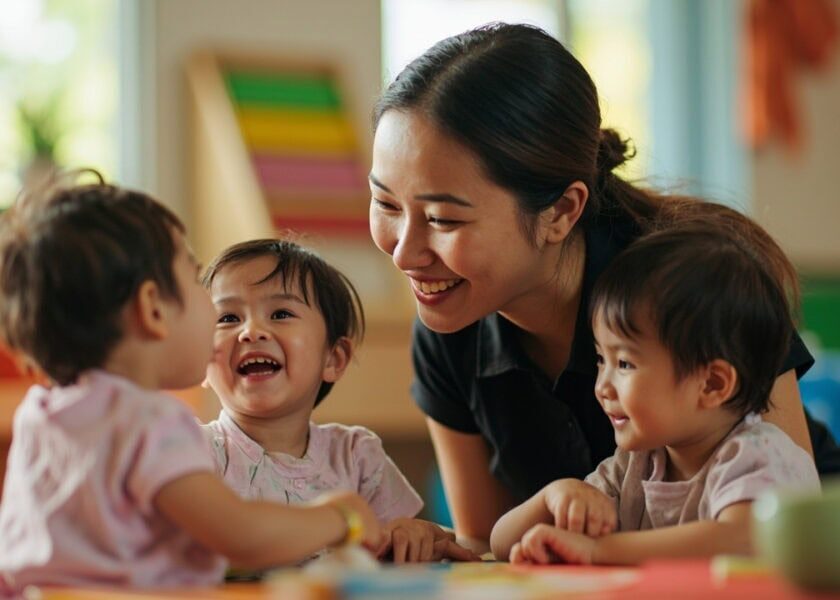
Here is something we have watched happen in our EduNanny settings that still moves us, even after years of this work. We have seen an older sibling, perhaps three or four years old, help a younger sibling navigate a new experience. The younger child is upset, new to the arrangement, unsure of the room. And the older one, who has already learned the rhythms of this space, who already trusts the caregiver, moves toward their brother or sister with a kind of quiet authority. Not because anyone told them to. Because something in the shared experience of care has taught them that they are a team. That the children in this room are not rivals but companions. That there is a role for them in holding this younger person through something difficult.
We have seen a two-year-old pat a baby’s back after the caregiver shows them how. We have seen four-year-olds include a toddler in their play with a patience that seems impossible for their age, until you realize that they have been practicing this patience in care, day after day, in an environment that has asked them to be part of something larger than themselves.
We have seen siblings in quality care develop what child development researchers call co-regulation: the ability to help each other manage big feelings, to be an anchor for each other when the world feels too loud or too new.
This is what quality care makes possible. Not just supervision of siblings, but the cultivation of sibling resilience. Not just keeping children in the same room, but building the conditions in which siblings become each other’s emotional resources.
Serving Children at Different Developmental Stages
How does a single arrangement serve children at different stages without inadvertently creating hierarchy, comparison, or uneven attachment? The answer lies in how we think about individual development within a shared environment.
Our caregivers, trained within the framework of the ECDA Childminding Pilot, understand that each child’s care plan is individual even when their environment is shared.
- The infant’s day looks different from the toddler’s day, not because they are separated, but because their needs are honored differently within the same space
- The baby has floor time, sensory play, responsive feeding and sleeping routines
- The older child has increasingly complex language engagement, social play facilitation, autonomy support
When a caregiver can hold both of these realities at once, something remarkable happens. The children stop being competitors for the same care. They become witnesses to each other’s growth. And that witnessing, that daily experience of watching your sibling learn something new, become something more, is one of the most powerful engines of sibling bond formation that we know of.
For families with significant age gaps, this understanding is especially vital. The parent who worries that their infant will pull the caregiver’s attention away from their preschooler can rest, not because we promise the impossible, but because we have built an arrangement where both children’s developmental needs are met in parallel.
- Where the older child’s growing independence is celebrated as a feature of the environment, not experienced as a subtraction of care
- Where the younger child’s vulnerability is held without diminishing the space available for the older child to be a big brother or sister
- Where “being the older one” becomes one of the most important developmental roles a child can inhabit
What We Do to Earn Your Trust
Singapore parents have told us, in our consultations and in the quiet moments after they have enrolled their children, that trust is what they need most. Not just trust that their children will be safe, though of course, safety is the non-negotiable foundation. Trust that their children will be understood. Trust that the person holding their child for eight or nine hours a day will see them clearly. Trust that the arrangement will not just manage their children but will help their children become who they are meant to be.
We have responded to this need with structural clarity:
- In EduNanny settings, communication is ongoing and transparent
- Where deployed, CCTV measures are in place because we believe parents deserve to know what happens in the hours they are not there
- We operate within the ECDA Childminding Pilot framework, which means our standards are not self-defined but externally verified
- Our caregiver ratios, our training requirements, our safety protocols—these are not suggestions. They are the architecture of the trust we are building with every family who walks through our doors
We have also built our communication structures around the understanding that parents need more than photographs of groups. Parents in our EduNanny pilot receive regular, individualized updates on each child. Not just photos of the group, though there are those too, but specific observations about each child’s day, their development, their moments of connection with their sibling.
We want you to know not just that your children were cared for, but how they were together. What they built. What they said to each other. How the caregiver saw them holding each other’s hands across the room, or heard the older one singing to the younger one during rest time.
These are not incidental moments. These are the moments that tell you the sibling bond is alive, is growing, is becoming the resilience factor that will carry both your children through the harder years ahead.
We also understand that modern parenting in Singapore is not just about the hours of care. It is about the hours in between. The questions that come up at dinner. The concerns that surface on weekends. The uncertainty about developmental milestones, about sibling dynamics at home, about whether what you are seeing in your children is normal or simply the ordinary friction of siblings learning to share a world. This is why we built support structures that extend beyond the hours of direct care—resources for the parent who wants to understand what they are seeing, who wants to ask the question at ten o’clock at night when the children are finally asleep and the thinking starts.
What to Look For When Choosing Childcare for Multiple Children
If you are evaluating childcare options for siblings in Singapore, here are the questions that matter most:
- Ratio matters. How many children are in the care of each caregiver? Smaller ratios mean more individualized attention for each child, which quiets the comparison dynamic siblings naturally engage in.
- Individual care plans. Does the arrangement serve children’s developmental needs individually while they share a space? Ask how the day looks different for a one-year-old versus a three-year-old in the same setting.
- Communication structures. Will you hear specifically about each child, not just the group? Sibling bond development is visible in small moments that need to be shared with you.
- Caregiver training. Does the team understand sibling dynamics as something to actively cultivate, not just manage? Ask how they handle moments of comparison or rivalry.
- Environment design. Does the space allow for both parallel play and together time? Siblings need to be secure as individuals before they can be fully present as companions.
Choosing What Your Children Deserve
Let us come back to that moment we opened with. The moment you pick up one child and find the other watching.
Here is what we have learned from the families who have trusted us over the years. When that moment comes, when you look at your older child standing by the door and you see something flicker in their face, the anxiety you feel is not a sign that you have made the wrong choice. It is a sign that you are paying attention. It is a sign that you understand what your children need from you, which is not perfection, not the impossible math of being everywhere at once, but presence. Accurate, responsive, individualized presence.
When your children come home from EduNanny and tell you about their day, when they mention their sibling without thinking it remarkable, when they ask for the caregiver who held them this morning, when they describe the game they played together in the way that only children who trust each other completely can describe it, you are seeing something happen that took time and intention to build.
You are seeing the sibling bond not as a given, not as an accident of birth, but as a relationship that was tended while you were not there. A bond that grew in the soil of a room where each child was seen, where each child was secure, where each child learned that they did not have to compete for what mattered.
What Siblings Carry Into the Future
We believe this matters beyond the immediate years. The sibling bond that is nurtured in quality childcare becomes something that carries children through the vulnerabilities of childhood and into the complexities of adolescence and beyond.
Siblings who have learned to be each other’s anchors, who have a shared history of being held together in a place of care, develop a resilience that researchers have documented again and again:
- They have someone who witnessed their childhood from the inside
- Someone who shares their origin story
- Someone who can be called upon in the hardest moments not because family obligation demands it but because the bond was real, was felt, was built in the ordinary hours of shared care
You cannot force siblings to love each other. You cannot manufacture the bond that will carry them through life. But you can create the conditions in which that bond is most likely to flourish.
- You can choose a setting where each child is known
- Where the caregiver understands the complexity of sibling dynamics
- Where your children are not just kept in the same room but are helped to find each other
- Where they build something together and become a team
And when you do that, something changes. The anxiety quiets. The watching at the door becomes something else. It becomes the moment a parent picks up one child and turns around to find the other smiling, not with longing but with trust. With the quiet knowledge that they are not separate. That whatever happens in the hours apart, they come back to each other. That the people in this car, in this home, in this family, belong together not just because they share a last name but because they have been built, carefully, thoughtfully, by the people who chose them and the places that held them.
That is what EduNanny Singapore is for. That is why we do this work. Not just to care for your children, but to care for the space between them. For the bond that will outlast everything else.
We would be honored to walk this path with you and your family.
Ready to explore what EduNanny can offer your family? Schedule a consultation with our team to discuss your children’s needs, ask your questions, and see how our approach to sibling care might be the right fit for your family.
Learn more about our approach to childcare or get in touch to begin the conversation.
#SiblingBond #SingaporeChildcare #ChildmindingSingapore #EduNannySG #MultiChildFamily