Beyond Guilt: How Singapore Families Are Redefining the Village
The Cultural Architecture and Emotional Reality
In Singapore, multigenerational family life is not a quirk. It is a cultural architecture. Grandparents here are not peripheral figures who visit on Sundays. They are central — with expectations, traditions, and a deep, genuine sense of responsibility for the children in their family.
When a grandmother in Jurong West tells her daughter that she will be the one to raise the baby while the daughter returns to work, she is not overstepping in her mind. She is completing a family story. She is doing what mothers and grandmothers have always done.
And when that daughter responds that she has found a professional childminder — someone trained and certified, someone who will give her child structured early development in a small, safe group — she is not rejecting her mother’s love. She is responding to a world that has changed. A world where both parents often work. A world where early childhood science has revealed how profoundly the first thousand days shape a child’s brain, language, and emotional foundations.
When Two Loves Pull in Different Directions
What happens is that parents feel caught. And that feeling of being caught is one of the loneliest experiences in modern parenthood.
There is guilt. Parents worry that saying no to a grandparent’s offer means rejecting their wisdom, their sacrifice, their identity as a family elder.
There is fear — fear of conflict, of disappointing people who have already given so much.
There is confusion, because the advice from one generation conflicts with the research from another, and parents are left standing in the middle, unsure whose map to follow.
And there is a quieter pain too: the sense that wanting something different from what your own parents had for you somehow makes you ungrateful, or modern, or cold.
Naming this is not an act of blame. It is an act of respect — for parents who carry this weight silently, and for grandparents who genuinely believe they are offering their best.
Redefining the Village
The question is not whether to include grandparents or to choose professional care. The question is how we redefine the village.
The village has always been real in Singapore. What we have not done enough is talk about how that village works when it contains both the grandmother who raised two children in the eighties and the trained childminder who understands infant neuroscience in the twenty-twenties.
Both of them love the same child. Both of them want what is best. And the real opportunity — the one that most families never get to see because they are too busy defending their choices — is that these two forces do not have to be rivals. They can be partners. But only if we are willing to have the conversation that most families avoid.
What Each Generation Needs to Hear
For grandparents, the need is dignity and belonging. They need to know that their role in this child’s life is not diminishing. That they are not being replaced or dismissed. That the years they spent raising their own children, the sacrifices they made, the love they poured in — none of that is being forgotten or deemed insufficient.
For many grandparents, their sense of purpose is wrapped up in being the ones who care for the next generation. To take that away without offering something in return is not just unkind. It is a failure to see them fully.
For parents, the need is agency and trust. They need to feel that the decisions they are making for their child — based on research, on their own instincts, on the realities of their lives — are respected even when they differ from tradition. They need their own parents to trust that they are capable, that they are not children anymore, that the world has changed and they are adapting to it in good faith.
And for the child — who is, after all, at the centre of all of this — the need is simple: safety, consistency, rich interaction, and love from every direction possible.
What a Three-Generation Arrangement Looks Like When It Works
It looks like a grandmother who still picks up her grandson every afternoon and takes him to the playground in the estate, because that is her ritual and it matters. It looks like a grandfather who teaches the child to use chopsticks the way his own father taught him, passing down something that no classroom can replicate.
It looks like the child growing up with a sense of where he comes from — with grandparents who know his mother’s childhood stories, who have photographs from decades ago, who speak to him in the dialect that connects him to a culture he would otherwise lose.
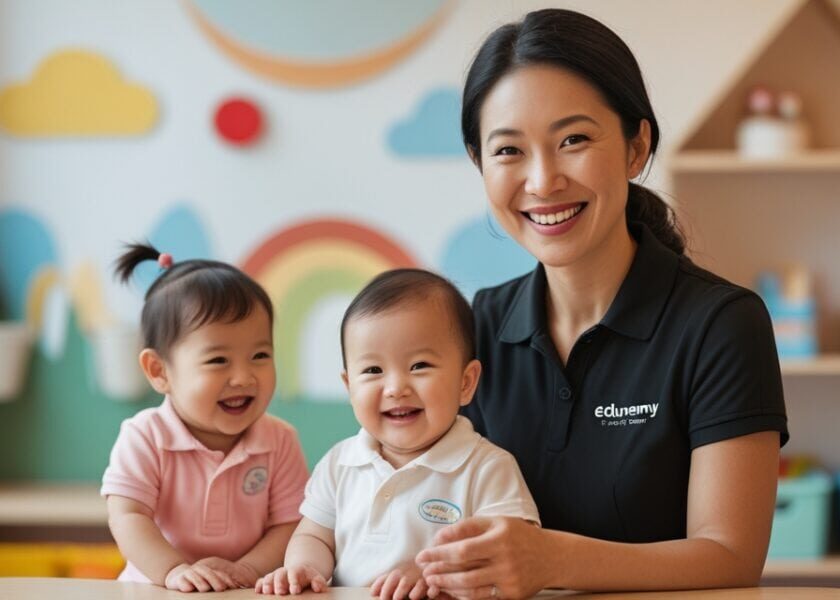
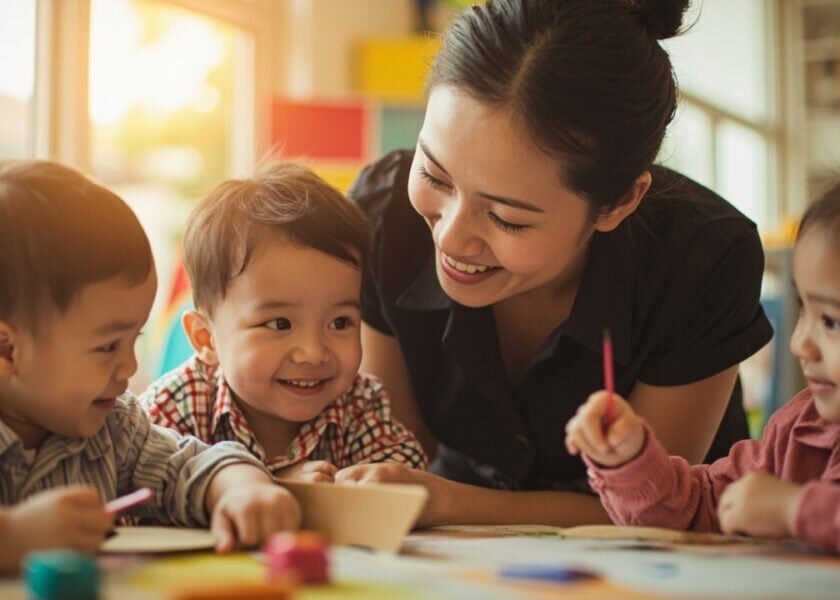
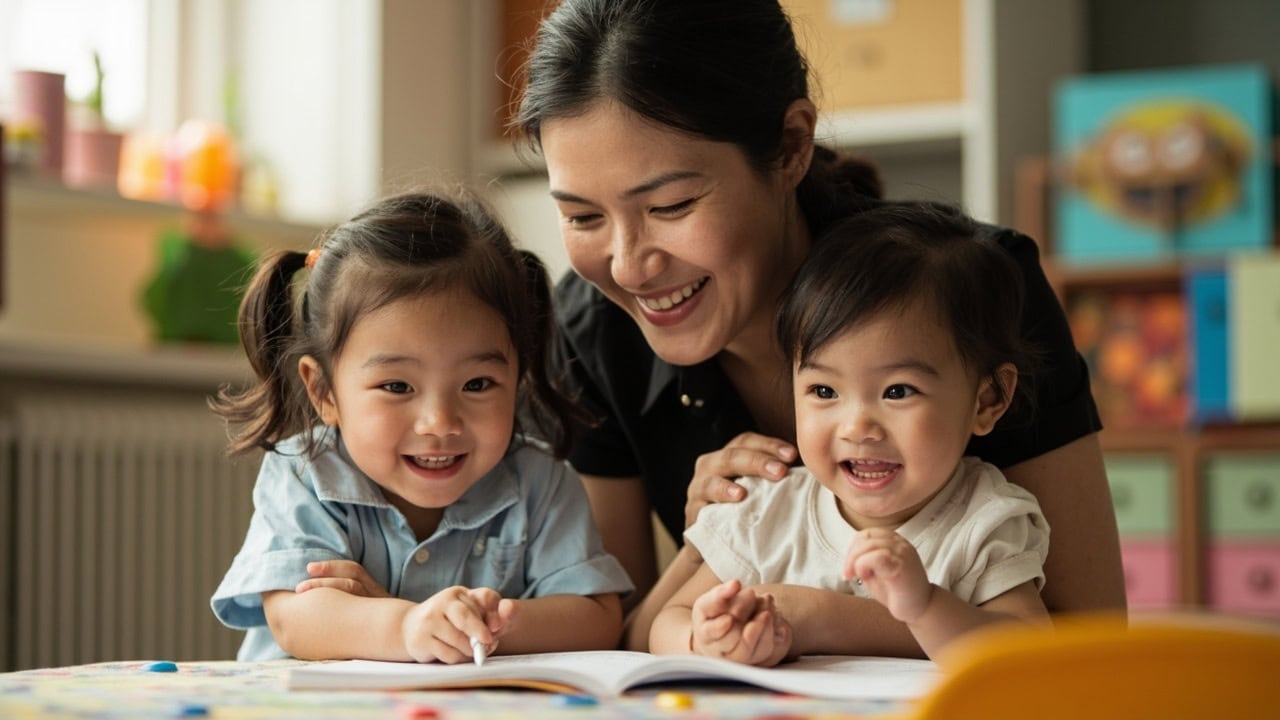
And alongside that, it looks like mornings in a home-based childminding environment where a trained caregiver, with no more than three infants in her care, engages in responsive, language-rich interaction. It looks like a child who has been carefully observed over weeks by someone trained in developmental milestones. It looks like parents who receive transparent updates — photographs, written notes, real-time information — and who can trust that the person caring for their child is not just loving, but knowledgeable.
Role Boundaries, Not Role Rejection
The role boundaries are not about cutting grandparents out. They are about being explicit about what each person does best.
Grandparents thrive in the spaces that require no training to do well. The spontaneous afternoon walk. The birthday treat. The singing of nursery rhymes in dialects that a child absorbs like music. The stories. The warmth. The sheer gift of time and attention that grandparents can give because they are retired, because they are unhurried, because this is what they have waited their whole lives to do.
Professional care thrives in the spaces that require structure, training, and consistency. The developmental activities designed around what infants actually need at each stage. The small ratios that mean every child is seen and responded to. The safety of a regulated environment with clear protocols. The communication systems that keep parents informed and involved even when they are at work.
When families define these roles clearly — not in a rigid contract, but in a genuine, kind conversation — something remarkable happens. Grandparents stop feeling sidelined because they are not being asked to step back from what matters most to them. Parents stop feeling like they are fighting a war on two fronts because the arrangement is clear and everyone has a valued place.
A Practical Framework for the Conversation
The conversation itself is an act of love. And it is one that Singapore parents are remarkably capable of having, once they are given permission and a framework for how to do it.
1. Have the Conversation Before You Need to Have It
Not in the middle of a crisis, not when feelings are raw, but in a calm moment when everyone can think clearly. Choose a time when the grandparents are rested, when you are not rushed, when the child is elsewhere and the whole focus can be on understanding each other.
2. Lead With What You Appreciate
Tell them what their involvement has meant to you. Tell them what you want for your child that is built on what they have already given. Grandparents who feel valued are far more open to hearing about new ideas. Grandparents who feel dismissed or replaced will dig in. The difference is almost entirely in how the conversation begins.
3. Be Specific About What You Are Asking For
“I want you to be involved” is too vague and leaves room for assumptions on both sides. “We would love for you to pick him up from childminding on Tuesdays and Thursdays and spend the afternoons together — that time with you is so important for him” is specific, warm, and it makes your grandparents’ role tangible and valued.
4. Explain the Why Behind Your Choices
You do not need to cite every research study. You can simply say, “We chose this because we felt our child would benefit from small-group care with someone trained in early development, especially in these first critical years.” That is honest, calm, and it gives grandparents something to understand rather than something to resist.
5. Listen
Genuinely listen to their concerns. Sometimes grandparents worry about things that are easy to address — they worry about being replaced, and a simple conversation about how much their role matters resolves that. Sometimes they worry about the cost, and that opens a door to talking about subsidies, CDA, Baby Bonus. Sometimes they worry because they do not understand what modern childminding actually looks like, and an invitation to visit the space, to meet the caregiver, to see for themselves — that changes everything.
6. Keep It as an Ongoing Dialogue
The families who navigate this most gracefully are the ones who treat it as an ongoing dialogue, not a one-time negotiation. They keep talking. They keep inviting grandparents in. They share photos and stories from the childminding setting. They make grandparents feel like insiders rather than observers.
What Quality Childminding Actually Looks Like
For parents who are considering professional childminding as part of their arrangement, it helps to know what you should actually be looking for. Quality childminding is not simply supervision. It is active, informed care.
- Small ratios are non-negotiable. An infant in a home with no more than two or three other children means genuine attention, not just oversight. Every cry is heard. Every developmental moment is noticed.
- Trained caregivers understand infant development — not as academics, but as practitioners who know what language-rich interaction looks like, who can spot when a child’s communication is on track, who create environments that support exploration and safety simultaneously.
- Transparent communication keeps parents in the loop. Photographs, written updates, notes about the child’s day — this is not an extra service, this is trust infrastructure. Parents need to know what is happening, and caregivers deserve to have their professionalism visible and respected.
- Consistency and routine matter enormously for infants. A reliable schedule, a familiar caregiver, a predictable environment — these are the foundations on which infants build security and, later, the confidence to explore.
How EduNanny Fits Into Your Family Village
EduNanny is part of the ECDA Childminding Pilot, operating within a framework designed to make quality childminding accessible and regulated. We offer home-based childminding as one pathway, alongside community and centre-based options. Our ratios are small — up to three infants, depending on the arrangement — because we believe that what infants need most is responsive, individual attention, not supervision at scale.
Our fees are structured within the pilot’s affordability parameters, and families can access available subsidies, use CDA funds, and apply Baby Bonus where applicable. Care is available in Monday to Friday blocks, designed around the realities of working parents.
Where our model includes transparency measures such as documented communication protocols, these are in place not as surveillance, but as trust infrastructure — because parents deserve to know what is happening with their children, and caregivers deserve to have their professionalism visible and respected.
We are not here to replace the village. We are here to be part of it.
We see our role as complementary. A child who spends mornings with a trained childminder, afternoons with doting grandparents, and evenings with parents — that child is receiving something extraordinary. Cultural rootedness and developmental richness. Unconditional love and informed, responsive care. The best of what previous generations offered and the best of what current research understands.
That is not a compromise. That is the goal.
For parents who have questions about development, feeding, sleep, or the thousand small concerns that arise at two in the morning, we offer a support resource built for the realities of modern Singapore parenting. It does not replace the judgment of a pediatrician or the warmth of a community. But it fills a gap that every parent knows intimately — the gap between needing an answer and having nowhere reliable to look.
Addressing Common Concerns
“Will my parents feel rejected if we choose professional care?”
This fear is real and valid. But rejection and redirection are not the same thing. When you approach this conversation with warmth, specificity, and a clear role for your parents, you are not pushing them away. You are inviting them into a different shape of involvement — one that may, in fact, be more sustainable and more enjoyable for everyone. Most grandparents, when they truly understand the arrangement and see themselves valued, are relieved to have clarity rather than confused about expectations.
“What if my parents refuse to accept our choice?”
This happens, and it is painful. But it is worth remembering that parents who refuse to accept any arrangement other than full primary caregiving are often operating from a place of fear — fear of irrelevance, fear of being forgotten, fear that their sacrifices are being dismissed. These fears can be addressed, but not if the conversation is about winning or losing. Sometimes the bravest thing a parent can do is hold their position calmly, repeatedly, and with compassion — and give their own parents time to adjust.
“Is home-based childminding actually safe and regulated?”
Within the ECDA Childminding Pilot, there are clear standards and frameworks that participating operators must meet. Home-based childminding is designed to offer small-group care in a domestic setting — which is precisely why ratios are kept low and why transparency measures are built in. When choosing any childcare arrangement, it is reasonable to ask about certifications, ratios, communication practices, and emergency protocols. Quality providers welcome these questions.
“How do we manage the logistics of a three-way arrangement?”
It helps to be explicit about the practical schedule. Who picks up from where? Who handles which days? What happens if a grandparent is unwell or a caregiver has an emergency? Building a childcare arrangement that works is not about perfection — it is about having enough structure that everyone knows the plan, and enough flexibility that unexpected changes can be managed. Families who do this best are the ones who keep talking, keep adjusting, and keep including everyone in the problem-solving.
What Singapore Families Are Building Together
Every child in Singapore is standing at the intersection of at least two worlds. The world their grandparents knew, and the world their parents are building. The world of family and the world of community. The world of tradition and the world of evidence-based practice.
These are not opposites. They are the two hands that have always held a child up — and the work of this generation is to learn how to hold them both at the same time.
The question my grandmother asked my father — the question that my mother asks me now about my own children — is not a question about childcare methods. It is a question about love. It is a question about legacy. It is a question about what kind of family we want to be.
And the answer, I believe, is this: we want to be the kind of family that gives every generation a role. The kind that teaches our children that love is not a finite resource that runs out when it is shared. The kind that shows them, through the way we navigate difficulty and difference, that the best outcomes emerge not from avoiding complexity but from meeting it with honesty and care.
The village is real. It has always been real. What we are learning now is how to build it with intention — with grandparents inside it, with professional care alongside it, with parents at the centre who have the courage to ask for what they truly need for their children, and the grace to make room for everyone else.
What Children Learn From Watching This
They learn that adults in their life can work together even when they are different. They learn that love can take many forms and that all of them are real. They learn that their family is both rooted in tradition and alive with adaptation.
They absorb, without ever being told, the emotional intelligence that comes from watching their parents navigate a difficult conversation with respect, clarity, and care.
And they gain something that no single childcare arrangement, however excellent, can give them alone: the full richness of three generations, each contributing what they do best.
Start the Conversation With Confidence
If you are a parent in Singapore navigating this tension right now, I want you to know: you are not wrong for wanting something different. You are not ungrateful for wanting quality care for your child. You are not alone in feeling caught between worlds.
The path forward is not about choosing between the people who love you. It is about being brave enough to have an honest conversation, specific enough to give everyone a clear role, and generous enough to make room for every generation in your child’s life.
We built EduNanny to be worthy of the trust Singapore families place in us. Not just trust that we will care for their children — though of course we will. Trust that we understand the full context of their lives. That we know a grandmother’s longing is real. That a father’s desire to give his child the best is not a rejection of his own parents but a continuation of the love they gave him.
If you are ready to explore what a complementary childcare arrangement could look like for your family — one that honours your parents and serves your child — we would welcome the conversation.
If you are considering home-based childminding in Singapore and want to understand how it could fit within your family’s childcare arrangement, we invite you to reach out and speak with our team. No pressure, no hard sell — just an honest conversation about what you need and whether we might be part of the solution.