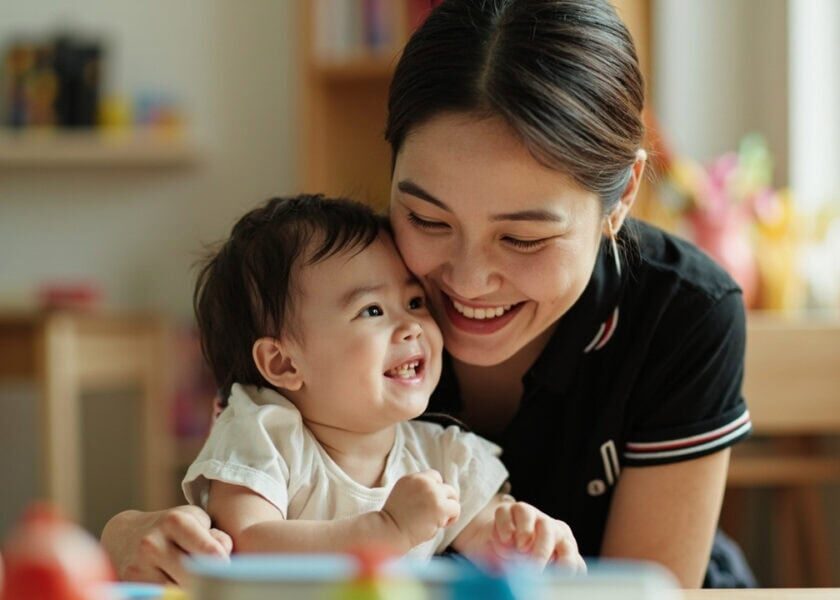
The Search for Childcare That Helps Your Child Feel Secure
The Moment Every Parent Knows
There is a moment, familiar to every parent who has placed their child into someone else’s arms at a doorway, that does not make sense to anyone who has not lived it.
You have kissed the soft place behind their ear where their hair begins. You have said the words that are meant to make everything okay. And then you turn and walk away, and some part of you walks out the door with them.
This is the most honest thing that can be said about early childcare in Singapore: that moment matters. Not because it is the beginning of a transition or the first step in a process, but because it is the place where two truths exist at once. Your child needs care. You love them. And for a few hours, you will not be the one providing either.
Every parent who has sat across a table from a childcare specialist, working through some of the most tender and uncertain seasons of their lives, eventually arrives at the same question—not asked in words, but asked in the pause before the answer, in the way a mother steadies her hands before she picks up her coffee.
Does my child feel loved when I am not there?
It is the right question. And it is the question that matters most.
Children Are Active Readers of Their World
Here is what years of working with families in Singapore have shown: children are not passive recipients of supervision. They are active readers of everything around them. Before they have language, before they can tell us what they see, they are already interpreting the world for meaning. And the world they read most carefully is the world of human response.
When a caregiver enters a room where a child is playing, the child notices:
- The speed of the approach
- The height from which they are regarded
- The sound of the voice that acknowledges them
A child as young as six months will turn differently toward a caregiver who moves with attentiveness than toward one who moves with mere efficiency. By twelve months, they have already begun to form opinions—not intellectual opinions, but bodily, felt opinions—about whether the adults around them are trustworthy. About whether the space they are in is safe. About whether they are likely to be responded to when they need something, or whether they will have to cry louder, reach further, work harder to be noticed.
This is not metaphor. This is the architecture of early human development, and it happens whether we are paying attention to it or not.
The Internal Working Model: What Children Build in the First Thousand Days
The psychologist John Bowlby, who gave us the foundational language of attachment theory, described what he called internal working models—the mental templates that children build from their earliest experiences of care.
These are not thoughts, exactly. They are more like the colour of the lens through which a child comes to understand themselves and their place in the world.
If a child experiences consistent, warm, responsive care, they develop an internal working model that says: I am worthy of attention. When I reach out, someone will be there. The world is a place where my needs matter.
If a child experiences inconsistent care, or care that is adequate but emotionally distant, the model shifts. It becomes: I am not sure if I matter. I must work to be noticed. The world is a place where I take care of myself.
The first thousand days of life—we have come to use that phrase often enough that it risks losing its weight—are not just about nutrition or stimulation or school readiness in the academic sense. They are about the fundamental story a child begins to tell themselves about what kind of person they are and what kind of world they have been born into.
What Quality Care Actually Says to Your Child
Quality childcare does not merely supervise your child. It speaks to them. Every day, in a thousand small interactions, it says something about who they are and whether they are loved.
- When a caregiver notices that a child prefers to hold a particular soft toy during meals, and quietly ensures that toy is within reach, the child registers this.
- When a caregiver sits at a child’s level during feeding rather than standing above them, the child feels seen.
- When a caregiver names what a child is feeling—not just managing behaviour but acknowledging the emotion itself—the child learns that their inner experience is legible and valid.
- When a caregiver responds to a child’s distress with consistency, with calm, with the same voice and touch each time, the child begins to build something precious: the expectation that comfort exists and can be found.
Children whose caregivers are warm, consistent, and emotionally attuned develop what researchers call secure base behaviour. They use their caregivers—not as permanent fixtures but as launching pads. They explore because they trust that someone is watching. They cry because they trust that someone will come. They venture into the world and return to it, again and again, building the confidence that will eventually carry them through school, through relationships, through all the uncharted territory of a full human life.
Quality care gives your child the ongoing experience of being responded to, being noticed, being known as a person rather than a task. This is what children take from care environments. Not the curriculum, not the toys, not even the learning activities, though those matter too. What children take is the felt sense of whether they are known or merely supervised.
And here is what matters most: this is not a lesser version of love. It is not a substitute for what parents give. It is love—experienced in a different context, communicated through a different relationship, but love nonetheless.
Finding Care That Truly Knows Your Child
You are not choosing between your love and their wellbeing. You are making a decision that millions of parents in Singapore and across the world make every year, not because they do not love their children enough to stay home, but because life is complex. Because families need income. Because some children thrive in the social environments of quality care. Because parents are human beings with their own needs and callings.
Your child can be deeply, genuinely loved in your absence by people who are qualified to provide exactly what they need. The question is whether you can find environments where that love is communicated in ways your child will understand and internalize as security.
You know what this sounds like when you hear it. But you also know how you experience the search for childcare. You think of the forms, the tours, the ratio numbers, the questions you cannot quite figure out how to ask. You think: how do I actually find this for my child? How do I know what my child will feel, not just what the centre looks like on a Tuesday morning when everything is at its best?
Questions to Ask When Visiting a Childcare Setting
- Do the caregivers sit at the child’s level, or do they remain standing above?
- How do the caregivers respond when a child is upset? Is it consistent?
- Do the children seem at ease, or are they performing compliance?
- Can the caregiver tell you about individual children’s preferences and temperaments?
- Is there genuine warmth in the room, or just professional competence?
What to Look for in Infant Care
- Caregiver-to-child ratio: Lower ratios allow for more individual attention and attunement.
- Consistency of caregiver: Babies need predictable relationships to build security.
- Emotional responsiveness: Warmth and consistency shape internal working models.
- Communication with parents: Transparency builds trust and connection to your child’s day.
- Home-like environment: Smaller settings often allow for more individual attention.
Adjustment takes time. It is normal for children to need several weeks to settle into a new care arrangement. What matters is the trajectory—are they gradually becoming more comfortable, more trusting? If you see regression that persists or deep distress that does not ease, that is a conversation to have with the caregiver and, if needed, with a developmental specialist.
EduNanny by BUTLER: A Different Approach to Childminding in Singapore
Singapore parents have genuine options: centre-based care, family-run programmes, government pathways, and home-based arrangements. Each has its own character and strengths. What EduNanny has chosen to focus on—what makes it distinctive—is the depth of attention it brings to the individual child’s felt experience.
In EduNanny’s home-based childminding model, ratios are kept deliberately small. One to three, at most, in infant care. This is not an accident or a limitation. It is a design choice built on what developmental psychology tells us about how children form attachments and build security.
When an infant or toddler is in a home environment with a dedicated caregiver, they are not lost in a group. They are known. The caregiver learns their rhythms, their preferences, the particular sound of their cry when they are tired versus hungry versus frustrated. This is not something that can be scaled up without losing something essential.
EduNanny’s caregivers are part of a structured programme supported by the ECDA Childminding Pilot, which means they receive training, oversight, and access to resources that uphold quality standards. This is not a casual arrangement. It is a professional pathway that treats childminding as the skilled, meaningful work it is—because it is.
Making Quality Care Accessible
For families concerned about cost—and Singapore parents are right to be concerned, because raising children here is not inexpensive—the pilot fee structures are designed to be accessible. CDA and Baby Bonus funds can be used, which means the financial logistics of quality care are not as daunting as they might otherwise be. Monday to Friday care arrangements offer the predictability that working parents need.
Communication: Staying Connected to Your Child’s Day
When your child is in care, you need to know what is happening—not in the surveillance sense, though transparency measures including CCTV where deployed do offer parents a window into the day, but in the relational sense. You need to know that the caregiver sees your child as a person, not a task, and that they can tell you about your child’s day in a way that reflects genuine attention. EduNanny builds this communication into its model, because parents deserve to feel connected to their child’s care experience, not shut out from it.
Support for Parents: Meet Thomas
EduNanny includes Thomas, an AI chatbot developed to support parents through the constant low-grade churn of questions, concerns, second-guessing, and uncertainty that comes with early parenthood. Is this normal? What should I do about this? Is the childminder doing this right? Is my child ready for that milestone?
Thomas is not a substitute for human guidance, but it is a resource—available when questions arise at 9 p.m. after a long day, when you cannot sleep, when you need something more than Google and less than a crisis line. It is one small way that EduNanny has thought about the whole picture of what parents need.
What You Are Looking For Is Real
You have already made the hardest part of this decision: you love your child. Now you are looking for the rest. And what you are looking for is real. It is findable. It is the love your child understands, and it is waiting for them.
When a child is in quality care, they learn something profound. They learn that love is not only in the home. They learn that their parents chose this, which means their parents trusted this, which means the world is a place where people can be trusted. They learn that they are not just a child their parents love, but a child who is worthy of love wherever they go.
Every child in Singapore who experiences quality care—who is responded to with warmth, who is known by name, who learns that their emotions are valid and their needs matter—is a child who has been given something that cannot be measured on any test or reported on any developmental milestone. They have been given the experience of being secure. And secure children grow into curious learners, into resilient adults, into people who can love and be loved because they have been loved.
Your Next Step
If you are a parent in Singapore researching infant care or childminding, you are not looking for a service. You are looking for a relationship—a qualified, trained, genuinely caring adult who will know your child, respond to them, and love them well while you are apart.
EduNanny exists because Singapore parents deserve to make this choice with confidence, not just hope. They deserve environments where their children are not just supervised but cherished. They deserve caregivers who understand that the work they do with a child’s heart is as important as the work they do with a child’s mind.
If this resonates with you—if you are ready to explore what home-based childminding can offer your family—reach out to EduNanny to learn more about their ECDA-supported childminding programme.
Your child’s security is not diminished by quality care. It is supported by it. And you are allowed to trust that.
You may also find these related articles helpful:
- Understanding Attachment in the First 1000 Days
- Questions to Ask Before Choosing Infant Care in Singapore
- Home-Based vs Centre-Based Care: What Singapore Parents Need to Know
Learn more about EduNanny by BUTLER and their approach to thoughtful, development-oriented childminding in Singapore.