The Childcare Question Singapore Parents Should Actually Be Asking
“`html
The Question Every Parent Carries
You are not simply choosing where your child will spend their days. You are choosing, in some fundamental way, who will help you understand who your child is becoming.
You are choosing a place that will witness the first stirrings of personality, the earliest signals of curiosity, the first signs of what makes your particular child unlike any other. And that is a responsibility so profound that it deserves more than a checklist. It deserves a philosophy.
The question underneath all the practical considerations is something deeper and more vulnerable:
Who is my child becoming while I am not in the room?
Quality childcare must answer this—not just for parents, but alongside them. The answer does not come from square footage or impressive-sounding programmes. It comes from attention. From the deliberate, trained, unhurried attention of caregivers who understand that every child is a story in progress, and that the early chapters matter more than we have ever allowed ourselves to acknowledge.
What Neuroscience Tells Us
In those first thousand days, the architecture of a human being is being built with extraordinary speed. Neural connections are forming at a rate that will never be replicated. The brain is not merely growing—it is being wired for curiosity or caution, for persistence or withdrawal, for the belief that effort leads to growth or the belief that ability is fixed and failure is final.
These are not predetermined outcomes. They are being shaped, quietly and constantly, by the quality of observation, response, and environment that surrounds a young child. And for most children in Singapore, that environment—between infancy and the start of formal schooling—is a childcare setting.
What separates a childcare setting that merely fills time from one that actively participates in shaping who a child is becoming?
Filling Time Versus Revealing a Child’s Emerging Self
There is a distinction worth making clearly, because it separates quality care from the many options available to families across Singapore.
A Childcare That Fills Time
This model operates on input: here is the activity, here is the schedule, here is the routine. The child moves through the day, participates in age-appropriate tasks, and returns home having been occupied.
This is not nothing. Occupation provides security, socialisation, and the basic rhythms that young children need. But it is not the same as discovery.
A Childcare That Reveals a Child’s Emerging Self
This model begins with observation—not as background activity, but as its primary methodology.
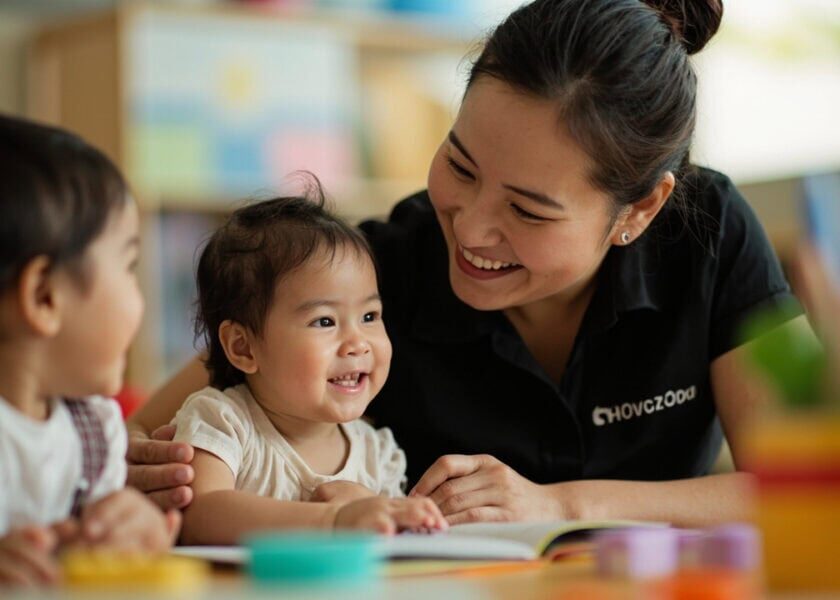
Trained caregivers in quality settings watch. They notice which toys a child returns to consistently, which ones they pass without interest. They observe what makes a child’s face light up, what draws their attention away from distraction, what happens in the moments when frustration gives way to the particular satisfaction of trying again.
They listen to the questions children ask when they think no one is listening. They notice who a child chooses to sit beside, how they respond to a peer in distress, whether they seek help or attempt to solve problems independently.
This is not intuition. This is trained developmental observation, and it is the foundation of everything that follows.
What Happens When a Caregiver Notices
When a caregiver in a quality setting notices that a child is showing sustained interest in how things fit together, they do not simply note it and move on. They create conditions that allow that interest to deepen.
They introduce materials that extend the exploration. They ask questions that scaffold the thinking. They give the child time—crucially, time that a rushed or overcrowded environment cannot provide—to return to the work of figuring something out.
And in doing so, they are not just caring for a child. They are beginning to understand, alongside the parents, who this particular human being is.
Where Individual Potential First Becomes Visible
When quality observation is prioritised, caregivers learn to read signals across several domains simultaneously.
Curiosity
The child who approaches the world with open interest—who touches, tastes, examines, and explores without excessive fear—this disposition is visible early, and it responds to encouragement. In a setting where curiosity is noticed and rewarded with response and new material to explore, it strengthens. In a setting where curiosity is inconvenient or must be managed, it can quiet.
Persistence
The child who does not immediately succeed at stacking blocks and does not abandon the effort—who tries, fails, adjusts, tries again, and finally achieves with visible satisfaction—this is not a personality trait that appears from nowhere. It is being shaped by every experience in which persistence was met with patient encouragement or left to wither unattended.
Social Attunement
The child who notices another child’s distress, who pauses in play to offer comfort or share a toy, who watches the faces of caregivers for cues—this child is developing the capacity for empathy and social intelligence that will shape every relationship they ever have. In a quality childcare setting, these moments are not dismissed as insignificant. They are named, modelled, and reinforced.
Creativity and Problem-Solving
These emerge in the spaces between planned activities—in the moments when a child uses a cardboard box as a spaceship, when they solve a puzzle by approaching it sideways rather than as intended, when they improvise a solution that no one taught them.
These are not indicators of future artistic genius alone. They are indicators of flexible thinking, of the ability to see possibility where others see obstacle. And they are visible early, if anyone is watching.
The Whole Picture
What trained caregivers in quality settings do is learn to see across all these domains simultaneously, to understand that no single observation is sufficient, and to build over time a picture of the child as a whole.
This picture becomes invaluable to parents. It is the beginning of understanding your own child—not as a category, not as a list of developmental milestones met or missed, but as a particular person with particular strengths, particular sensitivities, and particular potential waiting to be discovered.
What Singapore Parents Should Look For
Singapore parents face a particular challenge. The childcare landscape here is vast and varied—from large centres with comprehensive curricula to smaller home-based arrangements. Here is what the research and experience suggest you should actually be looking for:
Observation as Methodology, Not Afterthought
Ask how caregivers spend their time when children are playing freely. Is someone watching? Not supervising for safety alone, but genuinely observing? The best childcare settings understand that free play is not “downtime”—it is when children reveal themselves most clearly.
Reasonable Ratios That Allow Genuine Attention
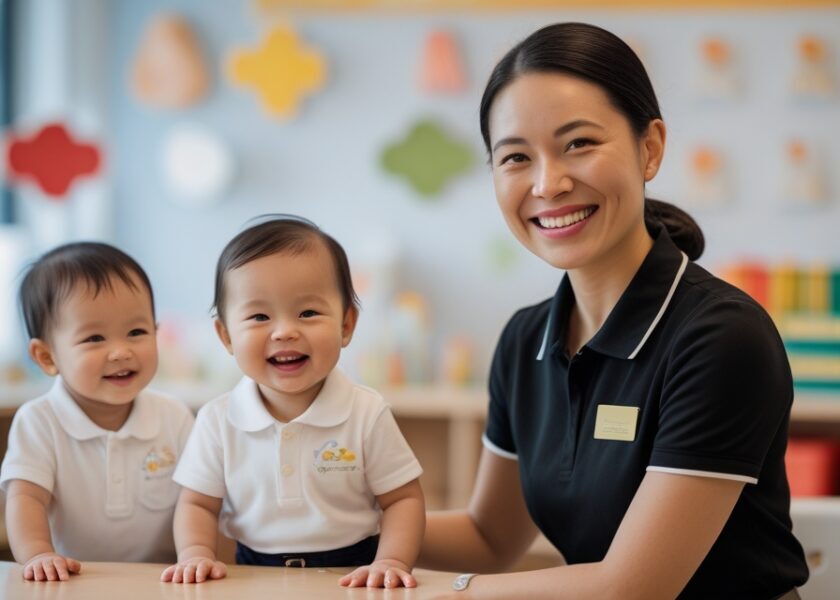
In infant care especially, the number of children per caregiver matters enormously. When ratios are stretched thin, attention becomes necessarily divided. When ratios allow intimacy—up to one caregiver for every three infants in quality settings—something becomes visible that cannot be seen when the attention is spread too wide.
Communication as Partnership
The best childcare settings do not treat parents as recipients of daily summaries. They communicate in ways that make parents partners in observation. They share not just what happened (“she had a good day”) but what was noticed (“she spent forty minutes today working on how to fit the larger blocks into the smaller container—she kept trying different angles. It was fascinating to watch her persistence”).
Environment as Third Teacher
In quality settings, the physical environment is thoughtfully designed—not overwhelming with stimuli, but arranged to invite exploration and discovery. Materials are accessible, age-appropriate, and changed based on what caregivers observe about children’s emerging interests.
Trained, Not Just Tasked
Caregivers in quality settings are not simply executing routines. They are trained to notice developmental signals, to understand what they are seeing, and to respond in ways that scaffold learning. This training matters—and the time to apply it matters equally.
Will My Child Be Just Another Number?
In quality settings with reasonable ratios, the answer is no. When a caregiver has time to truly observe, your child cannot be a number. They are seen, known, and understood as an individual.
Is Developmental Intentionality Just Marketing?
It depends on the setting. Ask specifically: How do caregivers spend their observation time? What training have they received in child development? How are ratios structured? What does communication with parents look like in practice? The answers will reveal whether observation is methodology or merely claimed.
Can We Actually Afford Quality Care?
Affordability is real, and it matters. Quality care should not be a privilege available only to those with unlimited resources. The best programmes integrate CDA and Baby Bonus usability so that intentional childcare is genuinely within reach for Singapore families.
How EduNanny Was Built for This Purpose
EduNanny Singapore was built on exactly this understanding. As part of the ECDA Childminding Pilot, EduNanny represents a deliberate choice to approach childcare not as logistics but as development—not as supervision but as partnership.
What the Pilot Offers
The pilot offers pathways designed to meet families where they are, whether through home-based arrangements or connections to community and centre-based settings, with the flexibility and affordability that Singapore families need and deserve.
Care blocks run Monday through Friday, providing the consistency that young children require for security and development. Pilot fee structures have been designed with accessibility in mind, integrating CDA and Baby Bonus usability so that quality care is genuinely within reach.
Beyond the Structures
But beyond the structures—which matter, and which are carefully considered—EduNanny’s approach is defined by its people.
The caregivers who work within this framework are not simply childcare workers executing routines. They are trained observers, equipped to notice the developmental signals that tell a story about each child’s emerging self.
They understand that at infant ratios of up to one to three, the intimacy of observation that becomes possible is not a luxury—it is a necessity. In an environment with fewer children per caregiver, there is time. And in that time, something becomes visible that cannot be seen when ratios are stretched thin and attention is necessarily divided.
The EduNanny Difference in Practice
Parents across Singapore are discovering what this looks like:
- A childcare arrangement where communication is not a periodic report but an ongoing dialogue.
- Where transparency means that parents are partners in observation rather than recipients of daily summaries.
- Where in settings where CCTV measures have been deployed, there is nothing to hide because there is only care to offer.
This is the EduNanny difference. It is not a slogan. It is a design principle.
The Choice That Matters Most
When you choose childcare for your infant or your young child, you are not choosing a service. You are choosing an environment that will shape, in ways both visible and invisible, who your child comes to understand themselves to be.
You are choosing whether your child will be seen—truly seen, in their particularity, in their emerging strengths, in the specific way they light up when something captures their interest.
You are choosing whether the hours you cannot witness will be hours of mere occupation, or hours of active discovery.
This is not a small thing. It is the most important thing.
The hours your child spends in childcare are not neutral hours. They are hours that contribute to who your child is becoming. And that means the question of what kind of environment that is—filled with mere occupation or active discovery—genuinely matters.
So the choice you make—thoughtfully, carefully, with all the weight of parental love behind it—is not an act of worry. It is not anxiety management or guilt mitigation or the outsourcing of a responsibility you wish you could keep closer.
It is an act of faith. Faith that the right environment can help your child discover who they are. Faith that observation and attention and intentional care can make a real difference in how a young human being comes to understand their own potential.
Faith that by choosing a setting built on the principle that every child has a unique emerging self worth understanding, you are giving your child something that no checklist can capture and no curriculum can guarantee:
The experience of being seen, known, and valued for exactly who they are.
EduNanny Singapore is built for this purpose. Not simply to care for your child, but to help you understand them. Not simply to occupy their days, but to participate in the extraordinary unfolding of who they are becoming. To be the place where your child’s story continues, in the best possible way, even when you are not in the room.
We understand the weight of what you are entrusting to us. We do not take it lightly.
The caregivers in our network are trained to observe, to notice, to create conditions where your child’s unique strengths can emerge. They have the time and the attention to see what lights up your child’s face—and to nurture that light.
If you are exploring childcare options in Singapore, we invite you to learn more about how EduNanny approaches infant care and childminding. Not as a service to be purchased, but as a partnership to be entered into.
Because that is what the best childcare does. That is what EduNanny is here to do.
And that is the quiet, profound, irreplaceable work of childminding in Singapore—work that matters more than we can easily say, and work that EduNanny is proud to carry forward, one observed moment at a time, for every child and every family who entrusts them with this most precious responsibility.
If you are ready to explore what quality, intentional childminding looks like for your family, we welcome the conversation. Because your child’s story deserves to be seen—and we would be honoured to help you understand it.
Discover how EduNanny approaches intentional childminding for Singapore families, or learn more about our approach.
“`