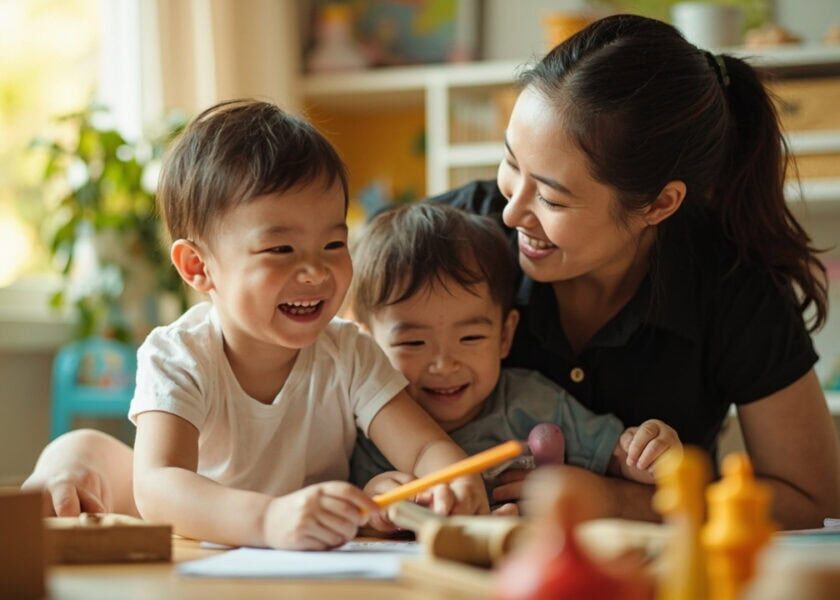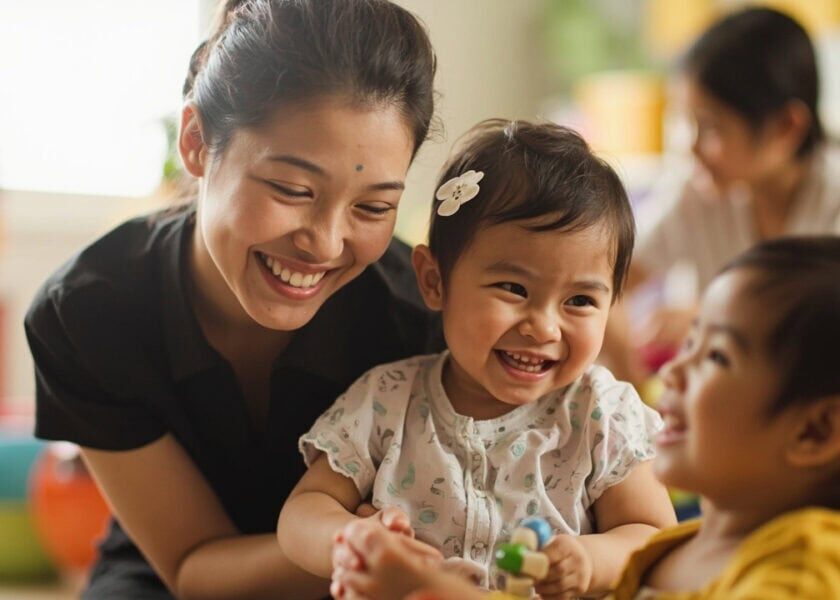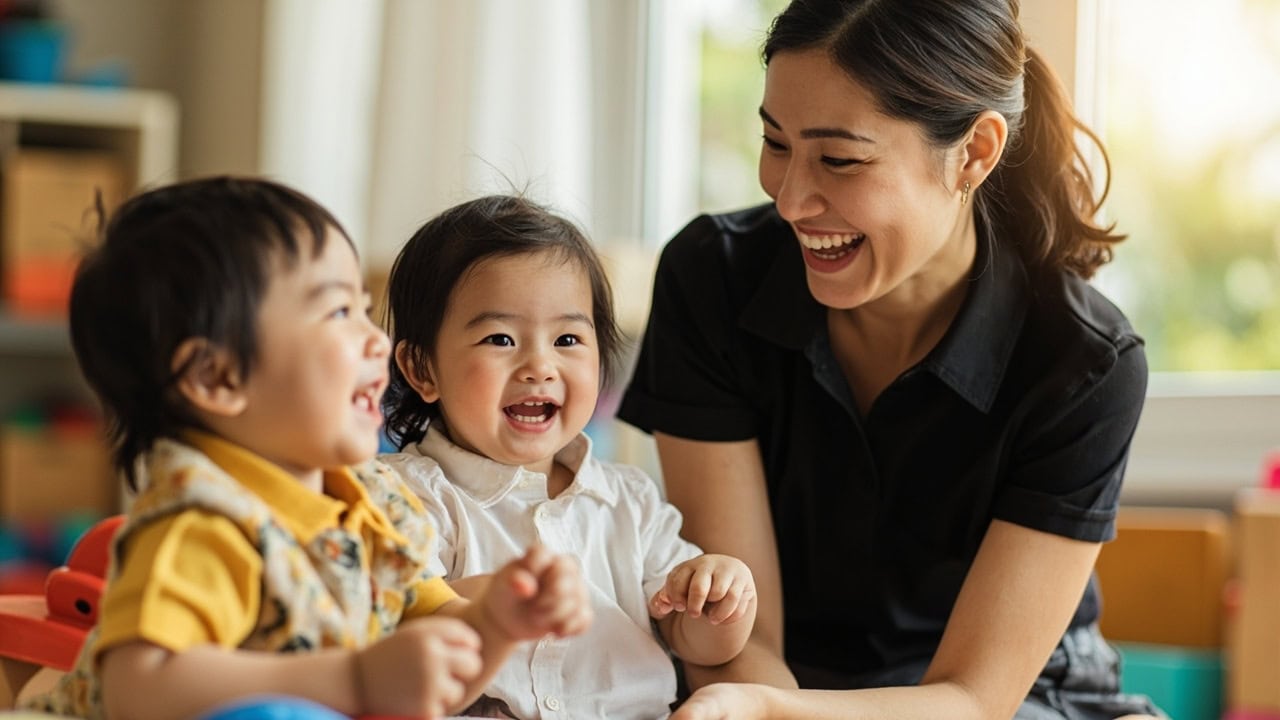
The Hidden Hours: What Your Child Experiences in Quality Childcare
The Hours You Cannot See: Understanding What Your Child Experiences in Quality Childcare
There is a moment after drop-off that most parents in Singapore know intimately. You are walking back to your car, waiting for the train, or standing in the office carpark with your coffee going cold in your hand. And you find yourself wondering—not with anxiety exactly, but with a particular kind of wondering—what is happening right now, in this room, in this hour, to the person you love most in the world.
You cannot see it. You cannot hear it. You handed your child over with trust and good intentions, and now you must simply wait. There is no app for this. There is no camera that captures what matters most.
And the truth is, even if someone described the next eight or nine hours to you in perfect detail, it would still be incomplete. Because what happens in quality childcare happens in a language that children live before they can speak it—a language of sensation, of emotion, of small moments that accumulate before any child can say, “This is what I learned today” or “This is how I felt.”
The wondering you feel is not a flaw in you. It is the most natural thing in the world. It is a parent loving a child they cannot observe.
But the wondering also points to something important that all parents sense, even when they cannot articulate it: that the hours of childcare are not merely hours of supervision. They are hours of becoming. Hours in which your child’s inner world—their sense of safety, their trust in others, their curiosity about the world—is being quietly and profoundly shaped.
This is what we want to explore together. Not the schedules and activities that parents can easily observe on a centre tour, but the world your child actually lives in during those hours—the world that no camera fully captures and no evening debrief can fully describe. Because that world is where your child’s future is being built, one small moment at a time.
What Your Child Experiences in Quality Childcare
- Sensory safety first: Children enter new environments through their senses—warmth, light, sound, texture. Quality childcare environments communicate safety before any word is spoken.
- Pattern-based trust: Children learn reliability through consistent daily rhythms—the same caregiver greeting them, predictable transitions, needs met before they become distress.
- Emotional architecture: Every interaction builds the child’s inner foundations: persistence, self-worth, emotional regulation, and the belief that they are capable and worthy of care.
- Social discovery: Through small encounters with other children, toddlers learn empathy, sharing, and their own power to affect others’ feelings.
- The reunion tells: How your child emerges at pickup—open, settled, running to you—reveals whether those hidden hours were good for them.
Through Your Child’s Eyes: The Sensory World of Quality Childcare
When a child enters a quality childcare environment, they enter it first through their senses. Long before they understand the concept of a classroom or a caregiver, they feel the temperature of the room, the texture beneath their feet, the quality of the light. They smell the space—whether it smells of harsh cleaning products that sting, or of warmth, of wood, of something alive. They hear the sounds: the murmur of other children, the specific tone of an adult’s voice when they speak at a child’s level, the clatter of a spoon on a bowl at snack time.
These sensory details are not background. For a young child, they are the foreground. They are how the world arrives.
In a thoughtfully designed childcare environment, these sensory inputs communicate safety before any word is spoken. The space feels unhurried. The materials are natural and within reach. The sounds are varied but not overwhelming. The light is warm. A child may not have the language to say any of this, but their body knows. Their nervous system responds. And slowly, hour by hour and day by day, their body begins to understand: this is a place where I can rest.
Safety Is a Feeling, Not a Concept
Warmth is perhaps the most essential sensory experience of all. But warmth for a young child is not only physical temperature. It is the warmth of being held when they are upset. It is the warmth of a caregiver who bends down to their level before speaking. It is the warmth of being greeted by name—not as one of many, but as one specific child who is known. When a child feels warm, they feel safe enough to explore.
For a young child, safety is not an abstract concept. It is a felt experience in the body. It is the knowledge that the same person will be here tomorrow, and the day after, and the day after that. It is the recognition that when something is hard or frightening or overwhelming, someone will respond—not perfectly, not immediately, but with presence, with patience, and with the understanding that the child’s distress is real.
Children perceive safety through patterns. They notice that the caregiver comes when they cry, even if not instantly. They notice that hunger is met before it becomes desperation. They notice that when they are frustrated, the adult does not become frustrated in return. They notice that transitions—moving from play to snack, from snack to nap—are handled with consistency, with calm, with enough warning that they can prepare.
These patterns are invisible to parents who are not there to witness them. But they are not invisible to the child. The child is learning, every single day, what the world is like. Whether it is reliable. Whether people keep their promises. Whether the adults in charge have enough patience and enough love to meet them where they are.
This is why the first days of childcare matter so much—not because of what is taught, but because of what is felt. When a child cries at drop-off and a caregiver responds with genuine comfort rather than mere management, something is being communicated that goes far beyond the immediate moment. The child is learning: when I am afraid, this place does not abandon me. When I am struggling, I am not alone.
This is not something that happens in a single day. It is a trust journey, measured in weeks and months. There will be difficult drop-offs. There will be tears. But underneath those tears, if the environment is consistent and warm, something is taking root. The child begins to carry a quiet knowledge: I have been here before. This place knows me. I will be okay.
And then one morning, without announcement or explanation, the child steps through the door and something has shifted. They look for their caregiver. They see their friends. They move toward the block corner or the book nook or the window where the light comes through. They have arrived, not just physically, but emotionally. This is their place.
That moment—that silent, unremarkable, transformative moment—is what quality childcare makes possible.
The Inner Life: What Your Child Is Really Learning
Within this felt safety, something extraordinary begins to unfold: the child’s inner life begins to expand.
We do not always think of young children as having rich inner lives. We think of them as reactive, impulsive, driven by immediate need. And it is true that their inner worlds are not yet organized by language or reflection. But they are real. They are deep. And they are more sensitive to experience than we sometimes imagine.
A two-year-old in a quality childcare environment is not simply being entertained. She is noticing. She is processing. She is building the foundations of a self that will carry forward into school, into relationships, into the way she meets the world.
Consider a morning in which a toddler discovers that she can stack three blocks before they topple. She does not yet have the word for “persistence” or “pride” or “capability.” But she feels something. She feels the effort. She feels the collapse. She feels herself trying again. And when the tower finally stands—and she turns to see if anyone noticed—the caregiver’s face meets hers with a recognition that says everything: I saw that. You did that. You are someone who can do hard things.
That moment, that small and unremarkable moment, is a brick in the foundation of the self.
Or consider the toddler who is struggling with big emotions—fury at a toy that was taken, grief at a parent who left, confusion at a transition that came too fast. In a quality childcare environment, that child is not left alone with those feelings. A caregiver sits near. A voice names what is happening: “You are feeling so angry. That was your truck.” A small hand is offered, not forced. Time is given. And slowly, the storm passes.
The child learns: these feelings are not too big for this world. Someone can sit with me in the storm. The storm ends. I am still okay.
This is emotional regulation in its earliest form. Not control. Not suppression. But the experience of having feelings that are witnessed, held, and eventually soothed. The child who carries this experience into her relationships, into her classrooms, into her adult life, is a child who learned it here, in these hours, in this space.
There is also the quieter discovery of belonging. The child who realizes that there are other children here, and that some of them are interesting, and that sharing a book or a ride on the tricycle or a moment of parallel play can feel good. The child who learns, through small and sometimes frustrating social encounters, that other people have feelings too. That a pushed child is sad. That a kind word helps. That they have some power to make the world better or harder for the people around them.
All of this is happening beneath the surface of the day. It is not scheduled. It is not assessed. But it is there, in every interaction, every moment of conflict and resolution, every small choice a child makes in the company of others.
The Caregiver’s Presence: Attention That Shapes a Child
We speak often about what caregivers do—their training, their qualifications, their methodology. And these things matter enormously. But what matters most is harder to quantify: the quality of their presence.
A caregiver in a quality childcare environment is not simply managing a group of children. She is paying attention. She is reading the room—not in the metaphorical sense, but in the literal one. She notices when a usually chatty child has gone quiet. She notices when a child who always runs to the door at drop-off is hesitating today. She notices the child who keeps returning to the same book, and wonders what it is about that story that speaks to her.
This kind of attention is not a technique. It is a disposition. It is a way of seeing children as full people—complicated, unique, worthy of careful notice.
When a trained caregiver responds to a child’s needs, she is drawing on more than instinct. She has learned to understand child development—not as a checklist, but as a map of what children typically need at different ages and stages. She knows that a twelve-month-old and a twenty-four-month-old and a thirty-six-month-old have profoundly different needs, different fears, different capacities for comfort and connection. She adjusts. She adapts. She meets each child as they are.
In a well-designed model, this responsiveness is supported by intentional structures: small ratios that allow for genuine attention, consistency of caregivers so that children are not constantly orienting to new faces, and ongoing training that deepens the caregiver’s ability to read and serve each child’s inner experience.
This is not about surveillance. It is not about documenting every moment. It is about creating the conditions in which real attention is possible.
The Reunion: What Quality Childcare Looks Like in Practice
There is a moment at the end of the day that parents often describe, though they may not know how to interpret it. The child emerges from childcare and runs—runs—to them. Not with the frantic energy of distress, but with the open, unguarded joy of reunion. She reaches up to be held. She babbles about her day, or buries her face in your neck, or points at the car and says, “Go, go, go.” And in that moment, something is being communicated that goes beyond words.
What is being communicated is this: I was okay. I had a good day. This place was good to me. I am glad to see you, and I am glad to go home.
This is not always the case. Some children emerge quietly, needing time to transition. Some emerge in tears. Some need to be carried and held for a while before they can engage with the world again. All of these responses are information. They tell you something about how your child experienced the day, what their inner world looked like in those hours, and where they are in their trust journey.
But when a child emerges in that open, settled way—when she carries home a quiet confidence rather than a hidden weariness, when she has stories to tell even if they are fragmentary, when she waves goodbye to her caregiver with genuine warmth—you can trust something. You can trust that the world she lived in today was a world that was good for her.
What Quality Childminding Looks Like
For parents navigating childcare options in Singapore, it helps to know what quality looks like in practice—not just in brochures, but in the daily rhythms that shape your child’s inner world.
Quality childminding is built on several key elements that work together:
- Consistency of care: The same familiar faces, day after day. Your child learns to trust not just the space, but the people in it.
- Small ratios: Fewer children means more individual attention. Caregivers can notice, respond, and connect—not just manage.
- Unhurried rhythms: Transitions that give children time to adjust. Meals and rest that follow natural patterns, not rigid schedules.
- Warm, natural environments: Spaces that feel like home, with natural materials, soft lighting, and materials within reach.
- Responsive interaction: Caregivers who tune in to each child’s signals—hunger, fatigue, frustration, curiosity—and respond with presence rather than prescription.
- Respect for the child’s inner world: Seeing behavior as communication. Understanding that tantrums are not defiance but overwhelm. Meeting each child as an individual.
These elements are not luxuries. They are the conditions that allow a child’s inner architecture to build—security, curiosity, emotional resilience, the growing belief: I am capable. I am worthy of care. I can trust this world.
Questions Parents Ask: Honest Answers
Parents in Singapore face real pressures—dual-income households, long commutes, demanding careers—and they carry real questions about childcare. These concerns deserve honest answers, not reassurance.
“How will I know what my child is experiencing all day?”
You will not know everything, and that is okay. What you can observe is the evidence that accumulates over time. Does your child settle more easily into mornings? Does pickup feel warm rather than frantic? Does your child mention their caregiver or friends? Does their evening behavior suggest a day that was engaging rather than depleting? These signs, gathered over weeks, tell you more than any daily report ever could.
“Will my child feel abandoned or anxious?”
Some anxiety at drop-off is normal—and actually healthy. It means your child has attached to you. What matters is how the environment responds. A quality caregiver will not dismiss your child’s tears or rush them through the transition. They will offer genuine comfort and patient presence. Over time, your child’s anxiety will transform into trust—not because you stopped caring, but because the environment earned it.
“Is my child just being babysat, or actually developing?”
The distinction matters. Supervision alone is not enough. Quality childcare is not about worksheets or flashcard drills. It is about the kind of development that happens when a child feels safe enough to explore, curious enough to try, and supported enough to fail and try again. The tower of blocks that finally stands. The friend who shared a toy. The big feeling that was named and soothed. These are the milestones that matter.
“Can I trust the caregivers with my child?”
Trust is built on evidence. Ask about training—not just certifications, but ongoing development. Ask about ratios—how many children per caregiver? Ask about consistency—will the same person care for your child each day? Ask what communication looks like—not just photos, but genuine transparency about how your child’s day unfolds. The answers to these questions will tell you whether this is a place that earns trust, or simply asks for it.
Questions to Ask When Choosing Childcare in Singapore
- Visit more than once. First impressions can be polished. Return for a second visit, perhaps at a different time of day. Observe how children move through the space. Notice how caregivers speak to children—at their level, with patience, naming what they see.
- Ask about caregiver consistency. Will your child have a primary caregiver who stays the same week after week? Or will they face new faces regularly? Consistency is not a luxury—it is the foundation of trust.
- Notice the sensory environment. What does the space feel like? Is it warm, unhurried, natural? Or cold, institutional, overwhelming? Trust your instincts. You are reading it the same way your child will.
- Ask about ratios. How many children per caregiver? For infants, lower ratios mean more responsive care. For toddlers, ratios still matter enormously for individual attention.
- Observe the children. Are they engaged, curious, at ease? Or stressed, overstimulated, withdrawn? The children’s behavior tells you everything about the quality of the environment.
- Ask how they handle difficult moments. When a child is upset, what happens? You want a response that honors your child’s feelings, not one that minimizes or ignores them.
- Trust the reunion. After your child begins care, pay attention to how they emerge at pickup. That moment carries information. Trust it.
How EduNanny Singapore Approaches Your Child’s Inner World
EduNanny Singapore was built with a particular understanding at its center: that the early years are not a waiting period. They are a building period. And the world that is built in those years—the architecture of trust, of curiosity, of emotional resilience, of the belief that I am capable and I am loved—carries forward into everything that follows.
As part of the ECDA Childminding Pilot, developed by BUTLER, EduNanny offers pathways designed to meet the real needs of Singapore families. Whether you are considering home-based care or centre-based environments, the approach is shaped by the same commitment: to the child’s inner world, their sense of safety, their growing confidence, their experience of being known.
Small ratios allow for genuine responsiveness. Consistent caregivers build the trust that cannot be rushed. Communication and transparency measures—including CCTV where deployed—offer parents the reassurance they need, not as a substitute for trust, but as a bridge between the world of the childcare and the world of the family.
Throughout, the focus remains on the child—not as a developmental outcome to be measured, but as a person with an inner life, a unique temperament, a particular way of seeing and feeling and experiencing the world. Every EduNanny-trained caregiver is not only qualified in child development and safety protocols. She is trained to pay attention. To notice. To respond to what is really there, beneath the behavior, beneath the words, in the quiet interior of the child she is privileged to serve.
Trusting the Process: The Gift You Give When You Choose Well
For parents navigating the realities of modern Singapore life—balancing careers, family, and the desire to give their children the best possible start—these are not small considerations. They are everything.
The childcare you choose is not just a logistics solution. It is a world your child will live in. It is hours that will shape who they become.
And so the question is not only whether the childcare is safe and reliable and convenient. The question is: What world is my child living in? Is it a world where they feel warm? Is it a world where they feel seen? Is it a world where they are learning, through the accumulation of small moments, that they are capable, and curious, and worthy of care?
If the answer to those questions is yes—if you have chosen thoughtfully, if you have found a place with warm and trained caregivers, with consistent relationships, with the ratios and structures that allow for real attention—then you have given your child something extraordinary. You have given them the gift of a world in which they can grow.
The next time you find yourself in that moment after drop-off—that moment of wondering, of curiosity, of love that cannot yet see what it wants to see—let that wondering become something else. Not anxiety. But trust.
Trust in the process. Trust in the caregiver who greeted your child this morning by name. Trust in the small, quiet world being built, one block tower at a time, one story at a time, one gentle response to a fallen heart at a time.
Your child is there. And in that place, in those hours, something is growing. Something that will come home with them at the end of the day—not in words they can yet say, but in the way they run to you with open arms. In the way they settle into the evening, content and curious and sure. In the quiet confidence that cannot be taught but can only be grown, day by day, in a world that was good for them.
That is what quality childcare makes possible. That is what EduNanny Singapore exists to provide. And that is what your child carries forward—not just into tomorrow, but into the life they are only beginning to build.
Ready to Learn More About EduNanny Singapore?
If you are researching infant care or childminding options for your family, we invite you to explore what EduNanny offers. Our pathways—both home-based and centre-based—are designed with your child’s inner world at the centre. Small ratios. Consistent caregivers. Warm, responsive environments where your child can feel safe, be known, and grow.
Learn more about who we are or connect with our team to discuss what quality childminding could mean for your family. Because the world your child lives in during those hours matters. It is the world where their future is being quietly and profoundly built.