The Invisible Curriculum Your Child Is Learning at Childcare
The Invisible Curriculum
How will your child feel when you leave? How will your child feel in the hours that follow, in a place you cannot see, surrounded by people you are still learning to trust?
Does your child feel safe — or merely supervised?
Does your child feel like they belong — or like a visitor in someone else’s world?
This is the invisible curriculum. And it is the most important education your child will ever receive.
We live in a society that prepares extraordinarily well for what can be measured. We enroll toddlers in enrichment classes before they are two. We track developmental milestones with apps on our phones. We compare. We research. We plan.
All of this comes from a place of love — a fierce and tender desire to give our children every possible advantage.
But here is what we rarely talk about: the emotional readiness curriculum. The curriculum that has no workbook, no assessment, no report card. The curriculum your child is learning every single day in the hours they spend away from you.
It lives in the quality of the attention they receive. In the consistency of the presence around them. In the felt sense of whether this place, these people, this space is genuinely safe.
You cannot see this curriculum. But your child is living it. And its effects will outlast every worksheet, every flashcard, every alphabet song.
What Neuroscience Tells Us
When we speak of attachment, we are speaking of something fundamental.
Deep in your child’s developing brain, a system is being built that will determine not just how your child relates to others in these early years — but how your child relates to challenge, to conflict, to learning, to intimacy, to failure, to the entire uncertain landscape of human experience.
This system is called the attachment system. And it is activated every time your child feels separated from you — every morning drop-off, every long afternoon, every moment your child looks for your face in a crowd and you are not there.
The First Years Speak in Biology, Not Words
In the earliest years, this system does not yet have words. It speaks only in biology — in heart rate, in cortisol levels, in the way a child’s body holds tension or releases it. In the way a child can be soothed — or cannot be soothed. In the way a child runs to the caregiver at pick-up, or hangs back. In the way a child sleeps that night, or doesn’t.
This is not sentiment. This is neuroscience.
When a child is in an environment where they feel genuinely secure, their nervous system can do what it was designed to do: explore, learn, play, grow.
When a child is in an environment where they feel anxious or unsafe, their nervous system does something else entirely. It protects. It guards. It shuts down the systems of curiosity and connection and turns its full attention to survival.
The quality of that care is not a detail. It is architecture. It is the architecture of your child’s internal world.
What Genuine Emotional Care Looks Like
This is why the work of a childminder or infant caregiver is not merely a matter of supervision. It is the work of holding emotional space.
It is the work of noticing, in real time, the micro-signals of a child’s inner state:
- The slight tension in the shoulders when a new toy is introduced
- The way a child tests whether the caregiver will respond if they cry
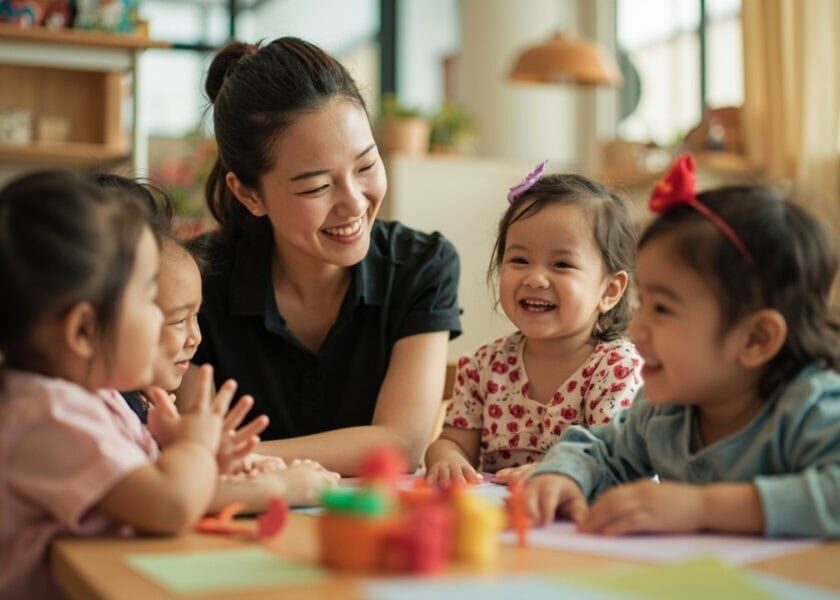
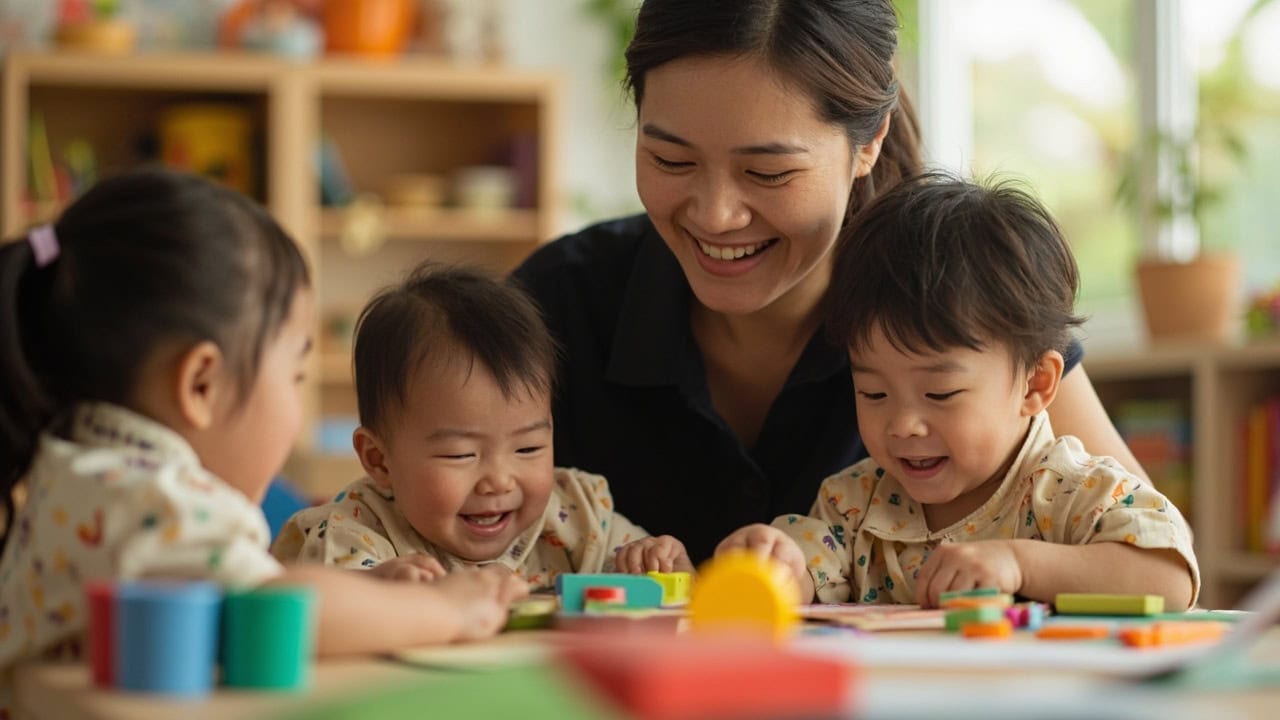
- The moment when a child who has been clinging finally releases and wanders toward the play kitchen, glancing back once, then twice, and then not looking back at all — because looking back is no longer necessary
This is the work. And it requires something that cannot be mandated by regulation or replicated by a checklist.
Trained Eyes, Not Just Watchful Eyes
It requires a caregiver who understands that a child who is quiet is not necessarily a child who is fine.
It requires a caregiver who knows that the child who hits is often the child who is frightened.
It requires a caregiver who can read the difference between a child who is playing and a child who is performing — between a child who is comfortable and a child who is managing.
This is the difference between a child who is watched and a child who is known.
The Evening Reunion: Reading the Signs
There will come an afternoon when you pick up your child and you will notice something. Something small.
Maybe your child runs to you differently than you expected. Maybe your child lingers near the caregiver before leaving, waving with genuine warmth — not because they want to leave, but because leaving is easy now.
Maybe your child falls asleep in the car without the usual resistance. Or tells you something about their day that surprises you — a detail they volunteered without prompting.
Or maybe it is something quieter. Maybe your child is simply peaceful. Calm. Open. Free.
This is what the evening reunion looks like when a child has felt genuinely secure during the hours apart.
Signs Your Child Is Coming Home Flourishing
- A child who feels they belong at childcare does not arrive home depleted
- A child who feels they belong does not need to process anxiety all evening
- A child who feels they belong has spent their day building, not defending
- A child who feels they belong can play with abandon, sleep with ease, and attach with confidence
This is the diagnostic window that no app can give you and no inspection report can guarantee. You will know, in your body, when your child is coming home flourishing.
Why This Shapes Your Child’s Future
The emotional foundations that allow a child to feel safe away from their parents are the same foundations that allow a child to sit in a classroom, to raise their hand, to try something hard, to not know the answer and not fall apart.
School readiness is not about knowing colors and shapes.
School readiness is about having a secure base from which to venture. And that base is built in the earliest years — in the quality of the care your child receives when you are not there to provide it.
The Singapore Reality
We live in a society that asks a great deal of its children academically. That asks them to perform, to achieve, to compete. And we want the best for our children.
But we cannot give our children the capacity to thrive academically if we have not first given them the capacity to feel safe emotionally.
These foundations are not separate. They are sequential. The emotional base must come first.
Questions Worth Asking Before You Choose
So when you are choosing childcare — whether for an infant who is still learning what safety feels like, or a toddler who is discovering the world through new eyes — know this:
You are not just choosing a service. You are choosing an emotional environment.
You are choosing a felt experience that your child will carry into every future relationship, every future classroom, every future moment of uncertainty.
Before you sign any contract, consider asking not just about curriculum and ratios, but about how caregivers respond to emotional moments:
- What happens when my child cries at drop-off?
- How do caregivers help children who are struggling to connect with the group?
- Can you describe a moment when a child went from anxious to relaxed?
- How do you help a child who is always watching but not playing?
The answers to these questions will tell you more than any brochure.
How EduNanny Approaches Emotional Care
At EduNanny, our caregivers are trained to see not just the child in front of them, but the child beneath the behavior. Not just what the child is doing, but what the child is feeling.
We are part of the ECDA Childminding Pilot, and we believe that every Singapore family deserves access to care that sees their child fully, not just safely.
What Our Approach Looks Like
- Our caregivers work in both home-based and centre-based pathways, with ratios that allow for genuine attention — because you cannot see a child’s inner world if you are managing six other children at the same time
- Our care runs Monday through Friday, in structured blocks that give families the consistency children need to build their sense of security
- Pilot fee structures, the ability to use the Child Development Account and Baby Bonus funds — these are not peripheral details. They are how we make sure that emotional excellence in care is not a privilege reserved for those who can pay premium rates
- Where deployed, our communication practices and CCTV measures give parents a window into their child’s day — not because we believe in surveillance, but because we believe that a parent who can see what their child is experiencing is a parent who can participate in that experience
Every child in Singapore deserves a secure beginning.
Common Questions Answered
“How do I know my child is actually okay during the day?”
You cannot see every moment. No parent can. But you can learn to read the signs at home — the evening reunion tells its own story. And you can look for a care arrangement that prioritizes communication and transparency, so the gap between your world and your child’s world is not any larger than it needs to be.
“Isn’t academic preparation just as important?”
Of course your child will learn letters, numbers, and concepts. That will happen. But the emotional foundations that allow learning to take root — curiosity, resilience, the willingness to try and fail — come first. A child whose nervous system is stuck in protection mode cannot learn. You must build the base before you build the house.
“Can home-based care really provide enough socialisation?”
Quality socialisation is not about quantity of peers. It is about the quality of attention and the safety of the environment. In a small, consistent group with a trained caregiver, children learn to relate, to share, to negotiate, to feel the security that allows them to reach out rather than protect.
“What if my child has a hard time adjusting?”
Difficulty adjusting is not a sign that childcare is wrong for your child. It is a sign that your child’s attachment system is working exactly as it should. What matters is how the caregiver responds to that difficulty. A child who is met with patience, warmth, and consistency will gradually learn that the world away from you is also safe.
Begin a Conversation
You are not wrong to want more than safety. You are not wrong to want belonging. You are not wrong to want your child to feel, in their bones, that this place is good, that these people are good, that this is a world they can trust.
This is not a luxury. This is what your child needs to become the person they are meant to be.
The curriculum your child is learning at childcare is invisible. There are no workbooks. There are no grades. There is only the slow, profound work of a nervous system learning whether the world is safe, whether other people are reliable, whether they can venture out and know they will be welcomed back.
If you are exploring infant care or childminding options in Singapore, we invite you to speak with our team. Tell us about your child, your family, your hopes and concerns.
Let us show you what care looks like when it is designed around your child’s emotional experience — not just their schedule.
Because your child’s feelings matter. And so does yours.
Begin a conversation with EduNanny today.
At EduNanny, we believe the right start shapes everything that follows. Learn more about how we approach childcare in Singapore or meet our team.