Finishing Each Other’s Sentences: How Singapore Families Bridge the Childcare Generation Gap
The Question at the Dinner Table: Navigating Grandparent Expectations in Singapore Childcare
There is a moment, familiar to almost every Singapore parent, that arrives without warning. It comes over a weekend dinner, or during a Wednesday afternoon phone call, or in the pause after you mention what you have decided about childcare.
A parent—your own mother, your father-in-law—asks a question with the weight of something larger behind it.
Why? Why that arrangement? Why not simply leave it to us?
The question is not hostile. You know that. But it sits in your chest like something heavier than its words, because you understand what it is really asking.
It is asking whether what you are doing is enough. Whether you trust them. Whether you think their way was wrong.
And so begins a silence that many Singapore parents learn to carry alone.
This is not a story about generational conflict. It is a story about the distance between two kinds of love—and about the extraordinary, quiet work it takes to close that distance in the name of a child both generations would do anything to protect.
Singapore’s Multigenerational Family Landscape
Singapore is, in ways that are both beautiful and complicated, a multigenerational society. The infrastructure of family here runs deep. Grandparents raised the parents. The parents raise the children. And for a long time, that passing down felt natural—tied together by geography, by culture, by the simple fact that in Singapore, family has never been optional.
It has been survival. It has been identity.
But something has shifted, and it is not small.
The Singapore that grandparents remember is not the Singapore that parents are raising children in today. The safety landscape has changed. The pace of development research has changed. The expectations placed on schools, on children, on parents themselves—everything has moved.
A generation ago, childcare meant someone you knew, someone nearby, someone who would feed your child rice porridge and keep them safe. That was the job. That was enough.
And it was. It truly was.
The grandparents watching their grandchildren today built something remarkable with the knowledge they had. They navigated illness and financial pressure and the sheer relentlessness of raising children in a city that was still figuring out what it wanted to be. They made decisions without Google, without parenting forums, without the weight of a hundred expert voices telling them there might be a better way.
They parented from instinct, from love, from the fierce conviction that their children would be okay.
That is not a small thing. That is everything.
What Today’s Parents Know Differently
But today’s parents—you, lying awake at night wondering if you are making the right choice—you are not ignoring what your parents did. You are building on it. You are standing in the place they made for you and asking, with everything you have learned about brain development and emotional security and the first thousand days, what more can we offer?
Not because what came before was wrong. Because you now know more.
We live in a time of extraordinary knowledge about early childhood. Decades of research have shown us how profoundly the earliest years shape a child’s neural architecture, their emotional regulation, their sense of security and self. The first thousand days are not a marketing phrase. They are a developmental reality.
A child’s brain at two is twice as active as an adult’s, building connections rapidly, laying the foundation for everything that comes after. Language acquisition, social confidence, the ability to manage big feelings, the readiness to learn—all of it is being constructed in the spaces we create for them before they can even tell us what they need.
This knowledge has transformed what we understand good infant care to be. It is not just supervision. It is not just feeding and sleeping and diaper changes. It is responsive interaction. It is attuned caregiving. It is the quality of attention a child receives in the moments when no one else is watching.
And here is the ache that no one quite talks about: that knowledge feels, sometimes, like it is pulling you away from the people you love most.
You respect your mother. You revere what your parents built. And yet you have chosen something they do not fully understand—something that asks them to step back in a way that feels, to them, like a door closing.
The loneliness of that is real. It is not dramatic. It does not announce itself. It is the quiet, persistent feeling of being misunderstood by your own family in the most important work of your life.
Parenthood is relentless in its loneliness. Not because families are absent—Singapore families are among the most present in the world—but because the decisions feel so uniquely yours. You Google in the dark. You read in the quiet hours. You second-guess in the shower. And the people who love you most are sometimes the ones you feel least able to talk to, because their love is so intertwined with their expectations that the two become impossible to separate.
What Quality Infant Care Actually Looks Like
When we think about what makes childcare genuinely excellent, we have learned that it cannot begin and end with the child alone. A child does not grow in isolation. A child grows within a family, and a family is an ecosystem of relationships, histories, expectations, and love.
The grandmother who wants to be involved is not a complication to be managed. The grandfather who wishes things were simpler is not resistance to be overcome. They are part of the village. They have always been part of the village.
Quality infant care in these critical early years means several things:
- Responsive caregiving: Attunement to a baby’s cues—what they need, when they need it, how they communicate before words arrive
- Warm, consistent attachment: A caregiver who becomes a familiar, trusted presence the child can turn to
- Safe, explorative environments: Spaces where infants can grow, discover, and develop at their own pace
- Language-rich interaction: Talking, singing, reading—building neural pathways through everyday connection
- Small, manageable ratios: Where every child is known, not just supervised
These are not luxuries. These are the foundations of the person your child will become.
Building Trust Across Generations
Here is what we have learned from working with Singapore families: the answer to the question why that arrangement? is inseparable from another question entirely.
Can my parents understand this? Can they trust this? Can they feel like they are still part of their grandchild’s life in a way that matters?
And that is precisely why thoughtful, family-centered childcare must be built not around the parent-child dyad alone, but around the whole family system.
Grandparents care about this. They care about it desperately. Their concern about modern childcare arrangements is not rooted in stubbornness or resistance to change. It is rooted in the same love that made them sleepless and fierce when their own children were small.
They want their grandchildren safe. They want them loved. They want them to grow up strong.
The difference is not the love. The difference is the knowledge—the way that love is expressed through an understanding of what infants actually need in these critical, formative years.
When grandparents see that—when they see their grandchild being held with intention, spoken to with warmth, nurtured in a way that reflects everything they wished they had known—they do not feel replaced. They feel reassured. They feel like the circle is widening, not closing.
That is what family alignment looks like when it works. It is not everyone agreeing on the same approach. It is everyone recognizing that the people around this child—all of them—are reaching toward the same thing.
EduNanny’s Family-Centered Approach
EduNanny by BUTLER is part of the ECDA Childminding Pilot, and that matters not simply as a credential but as a philosophy. The pilot reflects something we believe deeply: that childcare in Singapore should be flexible enough to fit real families, not the other way around.
We offer pathways to quality care that acknowledge how Singapore families actually work:
- Home-based childminding: Care within the familiar warmth of a home environment, where an infant’s world remains small, personal, and safe
- Community and centre-based care: Structured, quality environments with small group ratios—where every child is known, not just supervised
These are not just service features. They are answers to the questions Singapore parents are actually asking:
- Can my child be safe?
- Can they be known?
- Can they be in a place that feels like care and not just custody?
We welcome the conversation with grandparents. We keep it open, ongoing, and honest. Through regular updates, through communication practices that ensure parents—and yes, grandparents who are involved in a child’s care—are never left guessing, through the kind of transparency that builds trust slowly and then holds it steady.
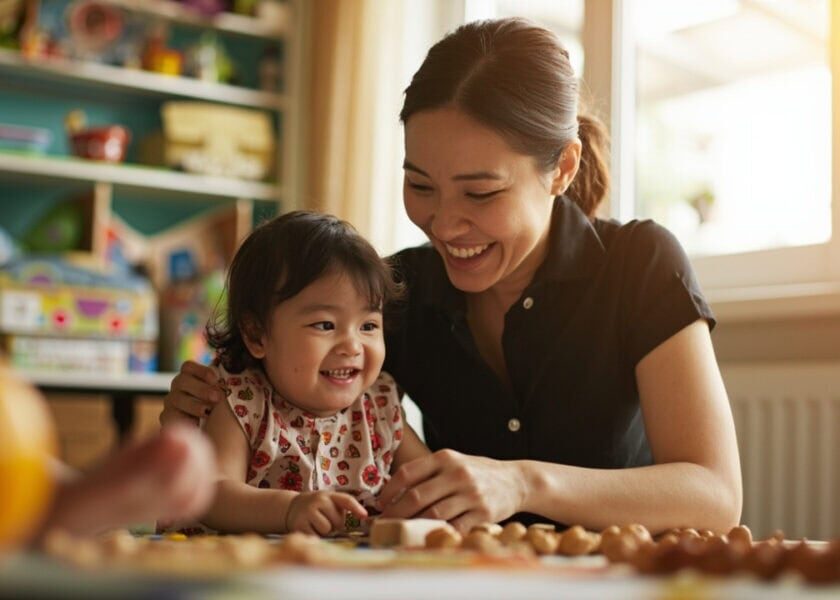
Where CCTV measures are deployed, they are not surveillance. They are window. They are the quiet assurance that lets a grandmother halfway across the city breathe easier because she can see her grandchild laughing at something on the mat.
That is not a gimmick. That is what it looks like when you take the whole family seriously.
Questions Parents Often Ask
Will my parents feel pushed out?
Our approach keeps grandparents as part of the village. Communication, transparency, and involvement where families want it—not as policy, but as practice.
How do I explain this to my mother?
By showing, not just telling. When grandparents see the care their grandchildren receive—the warmth, the attention, the intentionality—they often find their concerns softening into trust.
Is this really better than what my parents did?
It is different, not better. It is the same love expressed through different knowledge. Your parents gave you everything they had. You are doing the same.
Making It Work for Your Budget
Let us be honest about what this actually costs. Singapore parents are not naive. You know that quality care has a price, and you have likely done the math. You have weighed the figures against your household budget, against your CPF savings, against the Baby Bonus that is sitting there waiting to be used well.
You have thought about whether you can afford this and whether you can afford not to.
Monday to Friday care blocks are structured around how Singapore families actually work—the rhythm of a working week, the commute, the school runs, the meetings that run long, the deadlines that do not bend. We did not design our schedule around an ideal. We designed it around the real.
Practical Guidance for Choosing Infant Care in Singapore
If you are researching childcare options, here is what matters most:
- Visit the space. See where your child will spend their days. Notice the light, the warmth, the ratio of caregivers to children. Trust what you feel when you walk in.
- Ask about caregiver training. Not just certifications on paper, but how caregivers are supported, supervised, and developed. Ask how they handle crying, feeding, sleep transitions—the real moments of infant care.
- Notice communication practices. How will you know what happened during the day? How can you reach someone if you have a question? Look for practices that invite you in, not systems that keep you at a distance.
- Consider the whole family. The best childcare arrangement is one your whole family can eventually understand and trust—not because everyone agrees, but because everyone sees the love behind it.
- Trust your gut. You know your child. You know your family. The right choice will feel like it holds complexity rather than erasing it.
Continuing a Sentence, Not Starting Over
So let us return, one last time, to that question. The one at the dinner table. The one that sounds like it is about childcare and is actually about something older, something deeper, something that has to do with the way love travels across generations without always arriving in a language the other person understands.
The answer is not that modern parents know better than their parents. The answer is not that grandparents are out of touch.
The answer is that both generations are reaching for the same child with the same impossible love, and what is needed is not compromise—it is translation. It is the willingness to take what each generation knows and hold it side by side, not as opposition, but as complement.
When you choose childcare thoughtfully, you are not rejecting what your parents did. You are doing what they did. You are loving your child with everything you have, in the language of today, with the knowledge that is yours to carry forward.
You are building on the foundation they laid. You are finishing a sentence they started.
EduNanny was built for this moment in Singapore family life. Not to replace the village, but to strengthen it. Not to choose between generations, but to hold both. Not to promise that childcare is simple, but to walk alongside families through the complexity with honesty, warmth, and the kind of care that a child can feel in the way a caregiver kneels down to meet their eyes.
The family you are raising your children in is not broken. It is evolving. And evolution, in a family, looks not like revolution but like conversation—ongoing, imperfect, deeply loving.
We are here for that conversation. We are here for your child. And we are here for the whole family that loves them.
Ready to Learn More?
If this article resonates with where you are right now, we would be glad to continue the conversation. Reach out to EduNanny to explore what thoughtful, family-centered infant care can look like for your family. You can also learn more about who we are and the approach we take to childcare in Singapore.