The Hours That Shape Your Child: Inside Quality Childcare in Singapore
“`html
The Invisible Hours: What Your Child’s Day Actually Looks Like in Quality Childcare
There is a moment every working parent in Singapore knows by heart. It happens at the doorway, the gate, the threshold of the school or the home. Your child looks up at you with that particular expression — not quite worry, not quite trust, something in between that lives in the space where their world is about to become two worlds instead of one. And then you leave.
You walk away, or you drive to work, or you open your laptop, and for the rest of the morning, there is a whole life happening for your child that you cannot see, cannot hear, cannot reach. You are not there for it. That is the reality. And it is, for most parents, the quietest and most persistent ache of modern working life.
Today we want to take you somewhere you cannot go — into the hours between drop-off and pickup, into the world your child lives when you are not in the room. Not from the perspective of the caregiver, though we will meet them. Not from the perspective of your anxiety, though we know that anxiety well. But from the only perspective that truly measures whether childcare is working: your child’s experience. What they feel. What they discover. Who they become in those hours.
The quality of your child’s childcare is not measured by the checklist you carry as a parent. It is measured by what your child carries in their body, in their behaviour, in the way they meet you at the end of the day. That is the honest measure. And once you understand why, everything about how you choose, how you trust, and how you feel about those hours apart begins to change.
What Quality Childcare Really Means
- The morning goodbye does not end your bond with your child — it begins a new kind of connection that quality childcare extends rather than replaces.
- Quality childcare is measured by your child’s inner experience, not by certificates on walls.
- Children who feel secure develop differently, building executive function and emotional regulation that serves them throughout their lives.
- The caregiver-child relationship is a secondary attachment that supports your parental bond — think of it as scaffolding around a growing building.
- You can learn to read your child’s evening signals, because their tiredness, their openness, their behaviour at pickup tells you whether the day was genuinely good for them.
Where Everything Is Decided: The Morning Transition
Let us begin with the morning, because the morning is where everything is decided.
Imagine — from the inside now — what it is to be two, or three, or four years old, and to understand that the person you are most secure with is about to disappear behind a door. You may not have the words for it yet. But your body knows. Your nervous system is wired, as every child’s is, to measure safety in the presence of your attachment figure and to feel the gentle alarm of separation.
This is not weakness. This is the most ancient and intelligent system in the human body — the attachment system — the same system that kept your child’s ancestors alive.
The Difference Between Receiving and Supervising
What happens next, in those first minutes of a childcare day, determines everything that follows. A childcare arrangement that merely supervises is different from one that truly holds a child.
A child who arrives at a place where the caregiver understands this — where they are not simply greeting the child but actively receiving the child’s emotional state — that child has the experience of having a hand extended to them at the moment they need it most.
The caregiver bends down. Not down to the child’s height as a gesture, but down into the child’s inner world. They read the tension in the shoulders, the grip of the hand, the way the child turns back. They do not rush. They do not reassure with words the child cannot yet process. They offer presence. Steady, warm, confident presence. They say with their body: you are safe here. I have got this.
The Secure Base: What It Means and Why It Changes Everything
In quality childcare, that secure base is offered not once but hundreds of times, by the same consistent caregiver, until the child’s nervous system begins to learn a new truth: other adults can hold me too. The world outside my family is not threatening. I can venture out and come back whole.
This is where we want to be very clear: the secondary attachment your child forms with a trained, attuned caregiver does not replace your bond with your child. It supplements it. It extends it. It is like the scaffolding around a growing building — it does not become the building, but without it, the building cannot stand safely while it is being constructed.
Your child carries your relationship with them into those childcare hours. And quality care, care that truly understands the child’s inner world, does not compete with that. It honours it. It protects it. It gives your child the emotional security to grow.
After the Goodbye: The Discovery Hours
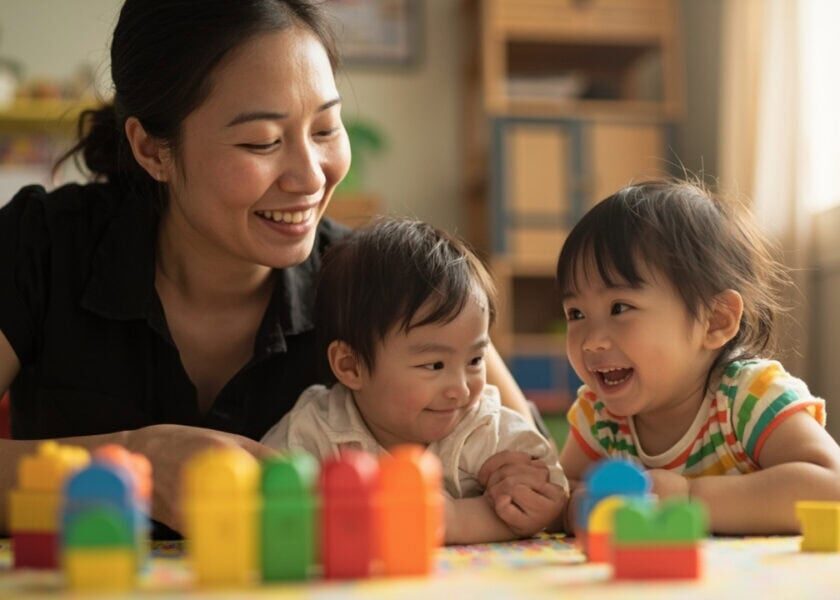
Once the child has been received — once the goodbye has been negotiated with care and the child’s inner alarm has been soothed — something remarkable begins. The child looks around. And what they see depends entirely on what is available to them.
In a secure, well-prepared environment — whether it is a home-based setting or a community or centre-based programme — the child begins to notice things. Objects at their level. Sounds that intrigue rather than startle. Space that invites movement. The environment itself becomes a kind of conversation with the child, saying: this place knows you are here. There is something here for you to discover.
What Quality Discovery Actually Looks Like
This is what quality childcare looks like from the inside: not a schedule of activities imposed on a child, but a landscape of discovery that the child moves through at their own pace, in their own time, guided by a caregiver who is watching not for compliance but for absorption. For that moment when a child’s eyes go wide and something inside them says: I did not know this was possible. I did not know I could do this.
This is what happens when a child is in an environment with up to one to three infants per caregiver, where the ratios allow for genuine attention. It is not a luxury. It is the basic condition that allows a child to feel held while they explore, rather than supervised while they wait.
The difference between those two states — held and supervised — is the difference between a child who develops confidence and a child who simply survives the day.
The Neuroscience of Secure Exploration
The discovery hours are not filler between the anxiety of morning and the relief of pickup. They are, in many ways, the most important hours of the childcare day. They are where language expands because someone is narrating what the child is doing with warmth and accuracy. They are where motor skills sharpen because the environment is safe enough to fall and try again. They are where social intelligence begins — where a child learns that another person has a face, has feelings, has responses, and that the world contains more than just family.
A child who is engaged in meaningful discovery, who is genuinely absorbed in the world around them, is a child whose nervous system is regulated. Their cortisol levels — the stress hormone that spikes during separation — naturally begin to come down. Their prefrontal cortex, the part of the brain responsible for decision-making, for impulse control, for future planning, begins to come online and strengthen.
The secure discovery that happens in quality childcare hours literally builds the architecture of the child’s capacity to manage their own emotions, to focus, to persist, to learn. Executive function, which is one of the most powerful predictors of lifelong success and wellbeing, is not taught. It is built, brick by brick, in moments of safe exploration with attentive, responsive adults.
Children who feel secure in their early childcare environments demonstrate greater resilience, stronger social bonds, higher academic attainment, and better emotional regulation in adolescence and adulthood. The childcare hours are not a pause in your child’s development. They are an active engine of it.
What Your Child Carries Home
What does your child carry home? You pick them up at the end of the day. They come to you, or they hesitate, or they run in the other direction. Their face tells you something. Their body tells you something. And as a parent, you are reading these signals with an intensity that no one else can match — but sometimes, without a framework, you are reading them wrong. You are filling in the gaps with anxiety instead of understanding.
The Evening Signals: How to Read Them
A child who comes home from a day in quality childcare, even if that morning goodbye was hard, will show you something in their body. They will be more regulated, not less. They may be tired — discovery is exhausting work — but the tiredness will be the tiredness of a full mind, not the exhaustion of a stressed one.
They will be more available to you in the evening, not less. They will want to tell you things, or show you things, or simply be in the same room as you without needing you to be performing for them. They will, in the language of their age, communicate something that their words cannot yet say: I was okay. I was really okay.
A child who comes home flat, or clingy in a way that feels desperate rather than warm, or who shows a pattern of resistance to going back the next morning that intensifies rather than eases — that child is telling you something important. Their behaviour is communication, and quality childcare is not just about what happens during the hours. It is about reading that communication and responding to it.
The Partnership Between Parent and Caregiver
When your child’s caregiver can tell you, with specificity and care, what your child’s morning was like — not just that they were fine, but what they were curious about, how they navigated a moment of frustration, what made them laugh — you gain something invaluable. You gain the ability to read your own child better, because you now have two sets of eyes on their development instead of one.
You are not guessing. You are not projecting your anxiety onto their behaviour. You are being given a window, through the caregiver’s observation and the tools we use to keep you informed throughout the day, into the world your child is living.
Singapore Parents: The Real Weight and Real Support
For families in Singapore, this matters more than we sometimes acknowledge. Singapore parents carry a particular weight. You are navigating some of the most demanding work cultures in the world while raising children in a city where the cost of living is high, the expectations are steep, and the village that our parents once had is, for many of us, across a sea or a highway.
You are doing something that human beings were not designed to do alone, and you are doing it with extraordinary grace and determination. The least that quality childcare can offer you is not just a safe pair of hands, but a genuine partnership in understanding your children.
Accessibility and the ECDA Childminding Pilot
For many families, the fear that quality infant care is something reserved for those who can afford significant private expense is a real and painful barrier. The ECDA Childminding Pilot fee structures, the usability of CDA and Baby Bonus funds, the Monday to Friday care blocks that align with working life — these are not afterthoughts. They are deliberate design choices made by people who understand that care should not require a family to choose between financial stability and the wellbeing of their child.
We believe that every child in Singapore deserves to be known, not just supervised. And we believe that families deserve to access that without navigating impossible cost structures.
The Question You Carry But May Not Ask
There is a question many parents reading this carry but have not quite been able to articulate. It is not really about the childcare. It is not really about the caregiver, or the ratios, or the curriculum. It is about this: Am I failing my child by being away from them?
Let us speak to that directly. You are not failing your child. What you are doing — going to work, providing for your family, building a life in this city, navigating the extraordinary demands of modern parenthood — is an act of love.
The question is not whether your child needs you. Of course your child needs you. Every child needs their parents. But the question is what kind of world you build around your child when you are not in the room. And the answer to that question is not determined by whether you are present in every moment. It is determined by whether the adults who are present with your child in your absence are people who will love them, notice them, and hold their inner world with the same care you would.
A child does not need a single superhuman parent who is present for every moment. A child needs a consistent, warm, responsive environment in which their inner life is seen and valued. That environment can include, and is enriched by, caregivers who are trained, attuned, and committed to the child’s full experience.
Your child is not divided by your absence. Your child is expanded by it — expanded into a world where other caring adults are reflecting back to them that they are worthy of attention, that their feelings matter, that they can explore and return safely. This is not a compromise. This is a genuine gift that you are giving your child, if you choose the right environment for it.
The Caregivers Who Hold Your Child’s Inner World
When we talk about quality infant care and childminding in Singapore, we are ultimately talking about the people who spend their days in the presence of our most vulnerable, most precious, most rapidly developing human beings. We want to say something about the dignity of that work, because it is not always treated with the dignity it deserves.
What Great Caregivers Actually Do
The best caregivers — the ones your child will remember, the ones whose presence in their early months and years will shape the adults they become — these caregivers are not simply performing tasks. They are not ticking boxes. They are doing what any great teacher, any great healer, any great guide does.
They are paying attention. They are noticing the micro-expressions, the shifts in tone, the way a child’s play changes when they are processing something difficult. They are holding space for the full emotional range of a young human being — the joy and the frustration, the curiosity and the fear, the need for independence and the need for comfort — simultaneously, in real time, with patience that must be renewed every single morning.
This is exhausting. It is also sacred.
What the ECDA Childminding Pilot Understands
The ECDA Childminding Pilot is built on the understanding that small ratios — up to one to three infants — are not a luxury but a necessity for this kind of work. It is built on the understanding that home-based pathways and community or centre-based options give families the flexibility to choose what fits their lives, because no two families are the same, no two children are the same, and the architecture of care should flex to meet them rather than forcing them to conform to it.
Small ratios are what allow a caregiver to truly attune. Genuine attunement requires knowing one child deeply, not managing several children superficially. This is why the ECDA framework prioritises ratios that make connection possible.
How to Choose Quality Childcare in Singapore
If you are researching infant care and childminding options in Singapore, here is a framework grounded in what we have shared about a child’s inner experience. These are the questions that matter most, and the signs that distinguish quality care from mere supervision.
Questions to Ask Yourself
- When you pick up your child, what do you see in their body? Are they regulated, available, tired in a good way? Or flat, desperate, resistant?
- Can the caregiver describe your child’s day with specificity? Not “they were fine” but “they were fascinated by the texture of the sand” or “they struggled with sharing a toy but resolved it by themselves.”
- Does the environment feel like it was designed for children? Objects at their level, space to move, things to discover — not just adult furniture with child-sized chairs.
- Is the caregiver consistent? Same face, same voice, same presence every day. Young children cannot build secure bases with rotating cast members.
- What are the ratios? The ECDA Childminding Pilot sets ratios of up to one to three infants for a reason. Genuine attunement requires small numbers.
Supervision Versus Quality Care: A Comparison
| Supervision Model | Quality Care Model |
|---|---|
| Child is watched over, managed, kept safe | Child is received, seen, held emotionally |
| Activities are scheduled and imposed | Environment invites exploration at child’s pace |
| Children learn to comply | Children learn to discover |
| Caregiver manages group | Caregiver attunes to individual |
| Child survives the day | Child builds capacity for life |
The EduNanny Approach: Designed Around Your Child
EduNanny started from a simple, powerful question: what would it look like if childcare were designed around the child’s inner experience, from the ground up? Not around the parent’s checklist, not around institutional efficiency, not around what looks good on a brochure, but around the quiet, profound truth that every child deserves to be known — to have their inner world seen, held, and nurtured by the adults in their life, including the ones who are not their parents.
That question led us to the ECDA Childminding Pilot. It led us to home-based pathways and community and centre-based options, because we know that the geography of family life in Singapore is varied and that care must meet families where they are. It led us to small ratios, because you cannot attune to a child’s inner world when you are managing six or seven at once.
It led us to rigorous caregiver training, because attentiveness is not instinct alone — it is a skill, a discipline, a practice that must be learned and supported. It led us to communication tools that give parents real insight into their child’s day — not curated photographs, but genuine transparency about what their child is experiencing, because we believe you deserve to know, and because we believe that knowledge is the foundation of trust.
Thomas: Extending the Conversation
Our AI companion, Thomas, is there as a bridge — a way of extending the conversation between parent and caregiver, of helping you process what you are seeing at home, of answering the small, pressing questions that arise at seven in the evening when your child has done something that left you wondering what happened in the day. Parenting is relentless. It should not have to be unsupported. Thomas holds space for the questions that do not fit into any other conversation.
The Promise in That Expression at the Doorway
Let us return to where we began. To that moment at the doorway. Your child looking up at you. That expression that is not quite worry and not quite trust.
Here is what we have learned from watching thousands of those moments, from speaking with parents across Singapore, from standing alongside caregivers who pour themselves into the work of receiving and releasing children every single morning and afternoon. That moment at the doorway is not a failure of childcare. It is proof of how much your child loves you.
And the care that waits on the other side of that doorway — the care that is patient enough to receive your child’s full emotional self, warm enough to hold them while they settle, skilled enough to help them discover and grow, and transparent enough to bring you into that world — that care is not competing with your love. It is amplifying it. It is extending the reach of your care into hours when you cannot be there, by placing your child in the presence of people who understand that they are not just caring for a child. They are caring for someone’s entire world.
That is what EduNanny is. That is what the ECDA Childminding Pilot represents. That is the promise we make to every family who trusts us: that the hours between hello and goodbye will be hours of discovery, of security, of being truly known.
You cannot be in the room. But your child can still feel, every single day, that they are held. And that is not a small thing. That is everything.
Curious about how EduNanny approaches childcare? Learn more about our story and our team, or reach out to speak with us directly about home-based and centre-based care options that put your child’s inner experience first.
“`