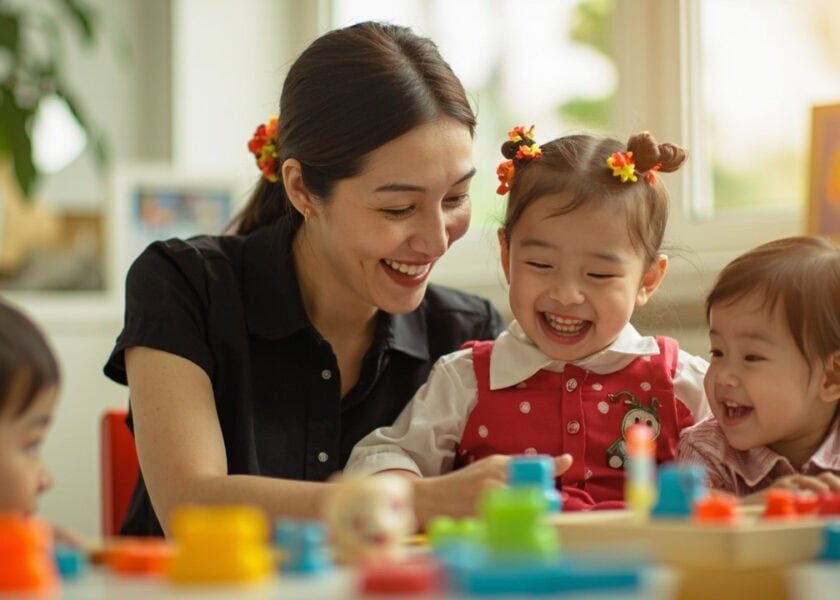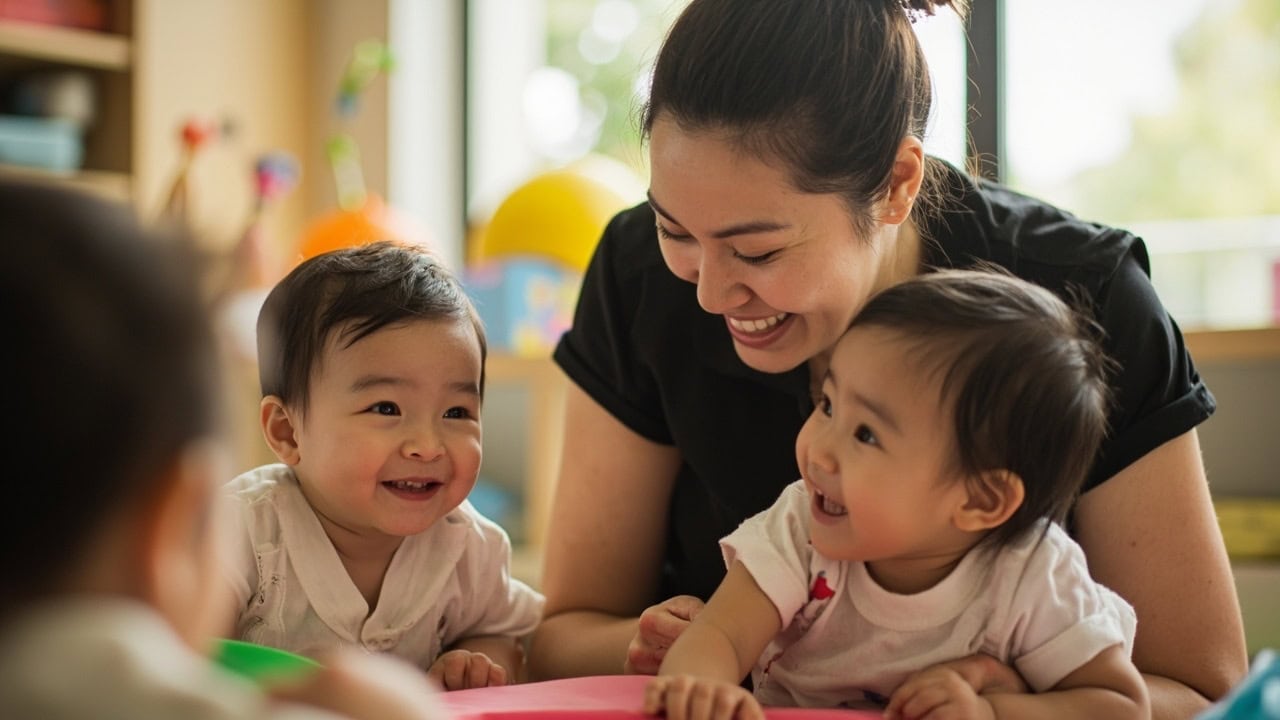
Building the Partnership That Closes the Information Gap
The Information Gap Every Parent Feels
After years of working alongside Singapore families, we have come to understand something important: the anxiety you feel after drop-off is rarely about the quality of care you have chosen. It runs deeper than that. It is about the information gap—the silence between what you know and what is actually happening in your child’s day.
It is about not being there when your child laughs at a new joke, struggles with a puzzle, or reaches for comfort from someone other than you. It is about the fear that you are becoming peripheral to your own child’s daily life—that a version of family life is unfolding without you.
This fear is not irrational. It is, in fact, perfectly rational. Because the truth is, information and presence matter—not because children cannot thrive without their parents in the room every moment, they clearly can—but because parents matter to themselves. You are not just raising a child. You are also living your own life as a parent, and that life has texture and meaning when you feel connected to what your child is experiencing.
The question, then, is not whether to delegate care. The question is: what kind of delegation preserves that connection? What kind of partnership transforms the information gap into something else entirely—a space where you remain present even while apart, where your child’s caregiver becomes not a replacement for you, but an extension of the relationship you are building together?
Supervision versus Partnership: A Critical Distinction
This is where most conversations about childcare stop short. They talk about finding someone trustworthy, about vetting caregivers, about the qualities that make a good childcare provider. And those things matter—absolutely. But they are the beginning, not the destination. They describe the foundation of a building, not the life that happens inside it.
What matters is the daily practice of partnership. Not trust as a destination—not the relief you feel when you finally believe your child is in good hands—but trust as a living process. The daily rituals, the communication rhythms, the observation-sharing practices, the co-regulation strategies that, over time, transform a childcare arrangement into something more like a genuine co-parenting relationship.
Supervision is watching a child. Partnership is sharing the child’s development. One is passive; the other is active. One keeps a child safe; the other helps a child grow.
The Daily Partnership Framework: How It Works in Practice
The Handover: Your Most Important Communication Ritual
It begins with the handover. Most families experience handover as a brief transaction—a few words exchanged at the door, a note passed over, a verbal update as you are already walking toward the car. This is understandable. Mornings in Singapore are rushed, and no one wants to linger at the threshold when there are MRTs to catch and deadlines to meet.
But the handover is actually the most important communication ritual of the day, and it deserves to be treated as such. When a caregiver and a parent take five minutes to sit together, review what happened overnight, share observations about the child’s mood and energy, and align on priorities for the day ahead—that is not a luxury. That is the architecture of partnership. That is where the day’s collaboration begins.
In a genuine partnership, the morning handover is not one-directional. It is not just the caregiver reporting to the parent. It is a two-way exchange:
- The parent shares what happened at home—how the child slept, what they ate for breakfast, whether they seemed anxious or excited about the day, what they reached at the park yesterday.
- The caregiver listens, absorbs, and adjusts the day’s plan accordingly.
- The child watches this exchange and understands, even before they have the words for it, that these two adults are on the same team. That home and care are not separate worlds but part of the same ecosystem.
Observation-Sharing: The Gold You Cannot Afford to Miss
Between handovers, throughout the day, your child’s caregiver is noticing things. They are noticing that your child uses their right hand more when they are focused but switches to their left when they are relaxed. They are noticing that appetite changes when teething, that sleep patterns shift after a particularly active morning, that your child has started using a new word to express frustration instead of crying.
These observations are gold. They are the raw material of your understanding of your own child. In a genuine partnership, they do not stay with the caregiver. They are translated, shared, discussed.
At EduNanny Singapore, our caregivers are trained not just to care for children but to observe them—systematically, attentively, with the eye of someone who understands child development. These observations are then translated into communication that parents can receive, engage with, and act upon. This might come through a midday update, a photo with a note about what the child was exploring, or a brief message about a moment of breakthrough or struggle.
Co-Regulation: A Two-Way Street Between Adults
There is also co-regulation. This is a concept from developmental psychology that describes the process by which a caregiver helps a child manage their emotional state. When a child is overwhelmed, the caregiver does not simply tell them to calm down. They model calm, offer physical comfort, and help the child name and process what they are feeling. They co-regulate.
Here is what most people do not realize: co-regulation is not only something that happens between a caregiver and a child. It is also something that happens between caregivers and parents.
- Your child’s caregiver is not just managing your child’s emotions in the moment. They are teaching your child emotional regulation strategies that you need to know about, so that you can reinforce them at home.
- You, as a parent, are managing your own emotional experience of separation, of delegation, of not being in the room—and your caregiver needs to understand that, too.
Co-regulation is a two-way street between the adults who share responsibility for a child’s emotional world.
What does this look like in practice? It might look like a caregiver sending you a message in the middle of the day—not a status update, but a question. A question about how your child responds to transitions at home, whether they have been fighting sleep recently, what your bedtime routine looks like. The caregiver is not just sharing information. They are asking for your input, inviting you into the process, treating you as a partner rather than a client.
Or it might look like a conversation at the end of the day where the caregiver says, “I noticed something interesting today. Your child got frustrated when the tower fell, but instead of crying, they looked at me and said ‘try again.’ I wonder if you’ve been hearing that phrase at home.” And suddenly you realize that your child is importing the language of persistence from your home into their care environment, and your caregiver is noticing it, and together you are building a shared vocabulary for your child’s development.
The Shared Language That Grows Over Time
This shared language is one of the most beautiful outcomes of genuine partnership. Over months and years, families and their caregivers develop a common way of talking about the child’s progress, challenges, quirks, and joys. This language becomes a bridge.
It allows you to talk about your child with someone who sees parts of their life you cannot see, and it allows your caregiver to understand your child in the context of your family, your values, and your hopes for them.
The caregiver becomes, in the truest sense, a second pair of eyes. Not a replacement for your parental vision, but an extension of it. Someone who notices patterns you miss because you are too close, too invested, too emotionally entangled. Someone who can tell you, gently, “I think your child is going through a language explosion. Let’s see if you notice the same words at home.” Someone who sees your child in a different context and can help you understand who they are becoming in the world outside your presence.
What Quality Childminding Looks Like in Singapore
Let us be practical for a moment, because this is Singapore, and we are a practical people. All of this—the partnership rituals, the observation sharing, the co-regulation strategies, the shared language—sounds beautiful in theory. But how does it actually work? What are the structures that make it possible?
For families in Singapore, quality childminding is supported by the ECDA Childminding Pilot, a government-supported initiative that recognizes the importance of professional, structured care for young children. This pilot reflects what we have always believed: that professional, structured childminding is not a compromise. It is a choice that can serve children and families extremely well, when it is done with intention, with rigor, and with genuine partnership at its core.
Making Quality Care Accessible
For families in the pilot, fee structures are designed to be accessible. Many families find that the Community Development Council subsidies, combined with the ability to use the Child Development Account and Baby Bonus funds, make quality childminding more affordable than they expected.
For families who need flexibility, there are both home-based and centre-based pathways, depending on what suits your family’s rhythm and your child’s needs.
Why Ratios Matter
With up to one to three infants in care, your child receives the attention and attunement they deserve. This is not a numbers game. It is about the capacity to notice, to respond, to share, to partner. In a room with fewer children, every observation matters more. Every interaction can be deeper. Every moment of breakthrough can be captured and communicated.
Transparency as a Foundation for Trust
When it comes to communication, transparency builds trust, and trust builds partnership. Where CCTV measures are deployed, families have access to them—not because anyone is suspicious, but because visibility matters. The more you know about your child’s day, the more you can participate in it, even from a distance.
Addressing Common Concerns
Every parent who walks through our doors carries questions. These are the ones we hear most often.
“Will I lose connection with my child?”
You will not. What changes is the nature of that connection—not its depth, but its architecture. Through daily partnership rituals, you remain woven into your child’s life through the hours of separation. When your child falls asleep at nap time, you know. When they eat something new, you know. When they have a breakthrough in motor development or language or social play, you know. You are not an outsider looking in. You are a partner, working alongside your child’s caregiver, building something together.
“Will my child feel abandoned or confused by multiple caregivers?”
A child who knows that their parent and their caregiver are talking about them, noticing the same things, reinforcing the same strategies, speaking the same language—that child is receiving something profound. They are receiving the message that they matter to more than one person. That the adults in their life are collaborating on their behalf. That they are held by a network of attention, not just by one pair of hands.
This actually strengthens attachment security. Children who see their parents and caregivers as a coordinated team develop a more robust understanding of relationships and trust.
“Is this just for families who can’t afford to have a parent stay home?”
This is not about necessity. It is about what children actually need to thrive. Children grow best when they have multiple responsive adults in their lives, all of whom are paying attention, all of whom are communicating, all of whom are aligned. This is not a compromise born of economic reality. It is an intentional choice to build a support system that serves your child better than you could alone, because it multiplies the attention, the expertise, and the love that surrounds them.
“Will the partnership feel artificial or transactional?”
It will not. Over time, the partnership deepens beyond structures and systems. What begins as a structured communication framework becomes something more organic:
- You find yourself texting your caregiver about a question that came up at home, and receiving a thoughtful response that helps you understand your child’s behavior differently.
- Your caregiver starts to anticipate your child’s needs before they arise, because they have been paying attention long enough to know the patterns.
- You begin to trust not just that your child is safe, but that their development is being observed, documented, and shared with you in a way that enriches your own relationship with them.
Reframing Delegation: What It Really Means
Delegation is not separation. It is not a failure of parenting or a necessary compromise. It is intentional partnership architecture. It is the deliberate construction of a support system that serves your child better than you could alone, because it multiplies the attention, the expertise, and the love that surrounds them.
The daily rituals, the observation-sharing, the co-regulation, the shared language—these are not extras. They are the architecture of a new kind of parenting. A parenting that is honest about the complexity of modern life, that does not pretend parents can do it all alone, that instead builds a framework of genuine collaboration so that children can thrive in a world where parents work, where families are busy, where the demands of life do not stop just because a child needs care.
Because here is what we know, after all these years of walking alongside Singapore families: you are not less of a parent for being at work. You are not less connected for being apart. You are not peripheral to your child’s life just because you cannot be present for every moment.
You are a partner. And your partnership matters more than your presence ever could.
Questions to Ask When Choosing Infant Care in Singapore
If you are researching infant care and childminding options, here are the questions worth asking:
- How is the handover structured? Is it a brief transaction, or a genuine two-way exchange where you share what’s happening at home and receive meaningful observations about your child’s day?
- What does observation-sharing look like between handovers? Are there midday updates, developmental notes, moments of breakthrough documented and communicated?
- How does the caregiver approach co-regulation? Do they teach emotional regulation strategies that you can reinforce at home? Do they ask about your child’s patterns, preferences, and responses to transitions?
- Is there a shared developmental language? Over time, do you and your caregiver develop common ways of talking about your child’s progress, challenges, and growth?
- What are the ratios? How many infants or toddlers per caregiver? Lower ratios mean more attention, more observation, more depth.
- How does the service support parental involvement? Are you kept informed, or are you included as a partner in goal-setting and progress tracking?
A Partnership Worth Building
We know that parenting in Singapore is complex. The costs are real. The pressures are real. The tension between wanting to be present for your child and needing to work, to contribute, to build a sustainable life for your family—that tension does not disappear just because you have found good childcare.
But what can change is how that tension feels. What can change is the experience of separation. What can change is the information gap, the anxiety, the fear of becoming peripheral to your child’s daily life.
EduNanny Singapore exists to change that experience. Not to replace parental involvement, but to extend it. Not to watch your child, but to share their development with you. Not to be an infrastructure service you use, but a developmental partner who walks alongside you.
We believe that every family in Singapore deserves access to this kind of partnership. That is why we have built our approach around daily co-regulation, trained our caregivers in systematic observation, and structured our communication systems to keep parents included—not just informed.
We offer to be the partner you deserve in raising your child. To be the second pair of eyes that notices what you cannot see. To be the daily communication that closes the information gap. To be the co-regulator who works with you, across environments, to build your child’s emotional world.
We offer, in short, to take your child seriously. To pay attention to them. To see them as the complete, complex, extraordinary person they are becoming. And to make sure that you see them too—even from a distance, even across the hours of separation, even in the middle of your workday, when you cannot be in the room.
Ready to explore what daily partnership looks like for your family? Learn more about EduNanny Singapore’s infant care and childminding services, and discover how we support Singapore families through the ECDA Childminding Pilot. You can also read more about our approach or get in touch with our team.