Why Your Gut Feeling Matters When Choosing Childcare in Singapore
That Feeling in the Pit of Your Stomach: Why Your Instincts About Childcare Are Smarter Than You Think
There is a moment, familiar to every parent who has walked through the doors of a childcare centre in Singapore, when the research should have ended but the certainty has not arrived.
You have done the homework. You have read the reviews, compared the caregiver ratios, checked the licensing, weighed the fees. You have spoken to other parents, asked the right questions, walked through corridors with clipboards in hand or smartphones ready to take notes.
And yet, standing in that unfamiliar room with its bright walls and miniature furniture and the soft hum of a place that will hold your child for the better part of their earliest years, something does not quite settle inside you.
You find yourself wondering: Is this nervousness normal? Am I overthinking this? What am I supposed to be feeling right now?
You are not overthinking it. You are not being difficult or unreasonable or too cautious. What you are experiencing in that moment is something far more useful than anxiety. It is perception. It is your mind doing exactly what it is designed to do: taking in information from the environment, from the people, from the quality of light in a room and the way a caregiver turns toward a child, and translating that stream of sensory data into something you can feel. Something you can trust.
The question is not whether your senses are reliable. The question is whether anyone has ever told you they are worth listening to.
- Your hesitations during a childcare visit are not irrational anxiety—they are legitimate data your nervous system is collecting
- Environments communicate quality through details—sound, smell, light, spatial arrangement, and emotional tone tell you something real
- Children cannot pretend to feel safe—observing how existing children inhabit a space is one of the most honest indicators of care quality
- You already know what to look for—this article is about helping you trust what you already sense
What We Know About Early Childhood—and What Gets Lost in the Knowing
We live in an age that has given parents more information about early childhood development than any generation before us. We know about brain architecture and sensitive periods and the importance of responsive caregiving in ways that would have seemed like specialist knowledge just two decades ago. Singapore has invested heavily in parental education, in early intervention programmes, in the infrastructure of support for families with young children. This is genuinely good news. Knowledge matters. Research matters. The more we understand about how children grow, the better we can care for them.
But there is a subtle cost to all this information, and it shows up most clearly in the moment of decision. When parents walk into a childcare for the first time, they are often carrying an invisible checklist so long and so detailed that it crowds out the very capacity they most need in that moment: the ability to simply notice what is in front of them.
The checklist tells them what they should be looking for. The ratio of caregivers to infants. The curriculum on paper. The food menus and the sleep schedules and the emergency protocols. These things matter—we are not suggesting they do not. But they are not the whole story, and when they become the only story, something important gets lost. The parent who walks in with a mental scorecard walks out having collected data about a place without necessarily having perceived what the place is actually like to inhabit.
Here is what we want to say to you, as parents navigating this decision: the research you have done has prepared you for this visit in ways you may not yet recognise. Your education has sharpened your senses. It has given you a reference point against which to measure what you encounter. When something feels warm and right in a space, you now have the vocabulary to understand why. When something feels slightly off, you have the background to trust that the feeling is not irrational.
Your education as a parent has made you a more perceptive evaluator, not a more nervous one. Those two things are often confused, but they are not the same.
What You Actually Perceive When You Walk Through the Door
Consider, for a moment, what you actually perceive when you enter a room. Not what you think you should be evaluating, but what your senses are registering before conscious thought has time to intervene.
Temperature and Physical Comfort
You perceive temperature. Whether the space is too cold or too warm, whether there is a draft near the door or a pocket of chill in a corner where a child might sit. A childcare where the air conditioning is blasting directly onto a sleeping infant, or where a corner of the room remains unheated on a cool afternoon, is communicating something about attention to detail.
The Character of Sound
You perceive sound. Not just the volume, though that matters, but the character of the noise. Is there a restless, chaotic energy in the way children are audible in another room, or does the sound carry a different quality? Are the voices of caregivers present and engaged, or is there a silence that suggests children are being managed rather than accompanied?
When you hear a child cry, how long does it take before a response comes, and what is the nature of that response? Is there a shift in tone, a slowing of activity, a direct and unhurried attention? These are not trivial details. They are the texture of a day in that place.
Smell as an Honest Indicator
You perceive smell. This one makes some parents feel embarrassed to admit, as though noticing an unpleasant odour in a childcare is somehow judgmental. It is neither. Smell is one of the most primal and reliable indicators of hygiene, of attention, of whether the people running a space are taking basic care of it.
A centre that smells of damp or stale food or unwashed surfaces is telling you something true about its standards of cleanliness. A space that smells clean and warm and alive is communicating care in a language that needs no translation. In Singapore’s humid climate, where mould and mildew can establish themselves quickly, the smell of a childcare space is an honest measure of whether daily maintenance is happening as it should.
Light and Spatial Design
You perceive the quality of light and the arrangement of space. Is the room designed around the adults who work there, or around the children who inhabit it? Are the shelves at a height where a toddler can reach and choose? Is there space to move, to crawl, to spread out on the floor? Are the materials accessible and inviting, or locked away behind glass doors?
These observations are not aesthetic preferences. They are indicators of whether the environment has been designed with genuine understanding of who uses it.
The Emotional Tone You Cannot Name—but Cannot Miss
And you perceive something else, something harder to name but impossible to miss. You perceive the emotional tone of a place. The way the adults move through the space. Whether they seem hurried or settled, stressed or calm, present or performing. Whether the children in the room look comfortable in their own skin, whether they are engaged or withdrawn, whether they move through the environment with a sense of security or with a wariness that suggests they have learned to be careful.
This last perception is the one that parents most often override in themselves. They sense it, sit with it for a moment, and then reason their way out of it. Surely, they think, I cannot make a decision based on a feeling. What if I am projecting? What if I am simply tired or anxious?
But here is what years of listening to parents have taught us: that feeling is not projection. That discomfort is not anxiety. That when a parent walks into a space and something does not feel right, something genuinely is not right. The parent may not yet have the language to articulate what they are perceiving. They may not be able to point to a specific incident. But their nervous system is doing exactly what nervous systems are designed to do. It is reading the room. It is evaluating safety.
The question worth asking is not whether you should trust your instincts. The question is whether you have been given permission to act on them.
What Quality Infant Care Actually Looks Like
Before you can evaluate what you are sensing, it helps to have a framework for what quality actually means in the context of infant and childminding care. Not the textbook definition, but the felt reality of it.
The Foundation of Responsive Caregiving
Research on early childhood development tells us that the first thousand days of a child’s life are not simply a phase to be managed until formal schooling begins. They are the foundation upon which everything else is built. Not in an anxious, pressure-laden sense of school readiness, where children are measured against developmental milestones as though childhood were a race. But in a quieter, deeper sense.
The child who has been held consistently by responsive caregivers, who has learned that the world contains people who will answer when they call, who has experienced safety as a felt reality rather than an abstract concept—that child carries that experience forward into every relationship and every challenge that follows. This is what quality infant care makes possible. Not the production of extraordinary children, but the nurturing of children who feel fundamentally secure.
The Difference Between Adequate and Genuine
There is a difference between care that is technically adequate and care that is genuinely warm. Both may pass regulatory checks. Both may have reasonable ratios and clean premises. But they feel completely different to a child, and you can perceive the difference the moment you walk into the room.
In technically adequate care, tasks are completed. Children are fed, changed, stimulated, kept safe. But the emotional quality of the interaction is somewhat distant. Caregivers are professional, even kind, but there is an efficiency to their movements, a slight detachment that suggests they are managing a workload rather than building a relationship.
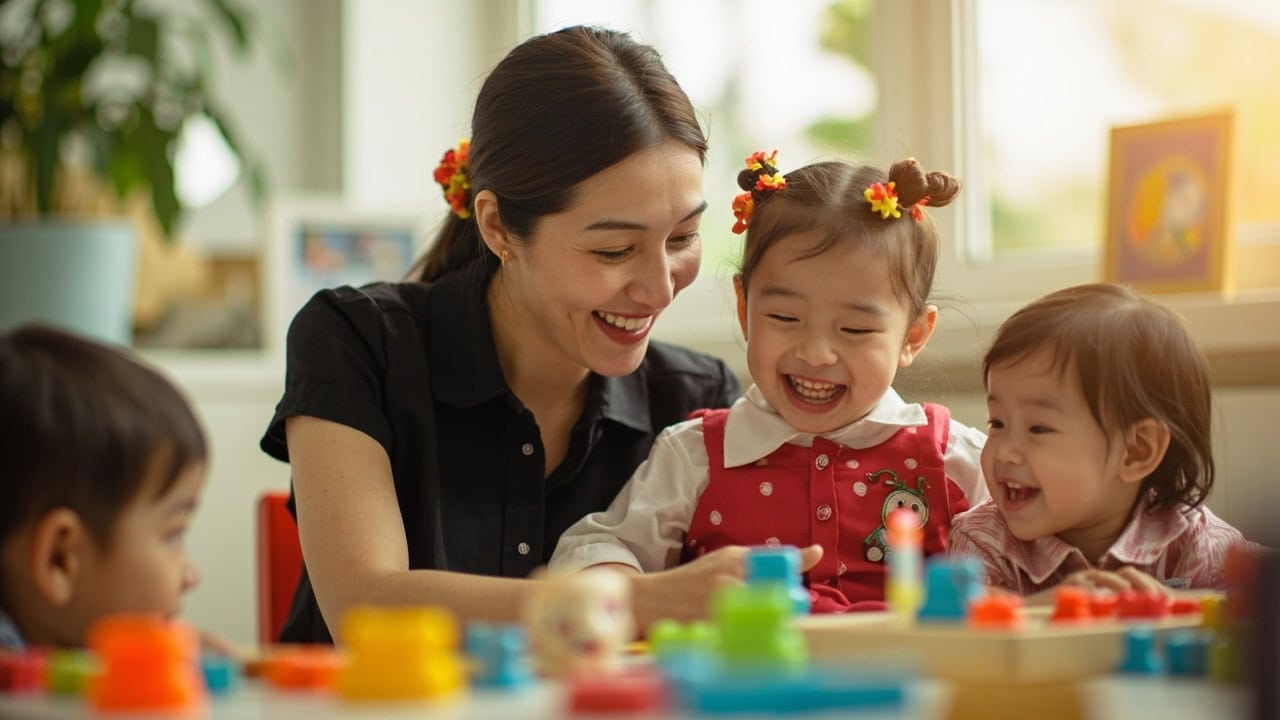
In genuinely warm care, there is a different quality of attention. You see it in the way a caregiver kneels to speak with a toddler at eye level rather than bending down from standing. You hear it in the tone of voice that slows and softens when a child is distressed. You feel it in the unhurried quality of the environment, where there is space for small moments of connection between meals and activities and transitions.
Why Ratios Matter Beyond the Numbers
In Singapore, licensing requirements specify minimum caregiver-to-child ratios for different age groups. These exist for good reason. But ratios on paper do not capture what they feel like in practice.
In a room where a caregiver is responsible for fewer children, there is more room for attention. More space for responsiveness. More capacity to notice the small shifts in mood and need that larger groups make invisible. When a caregiver can truly attend to three infants rather than six, they have time to notice when one is becoming overtired before the crying starts, to respond to a reaching hand, to engage in the back-and-forth of early communication that builds neural pathways.
When you visit a childcare and see a caregiver kneeling to speak with a toddler at eye level, or lifting an infant with unhurried hands, you are seeing what adequate time and genuine attention look like. You are perceiving the ratio in action.
How to Visit Childcare with Confidence and Trust Your Perception
There is a question that parents often carry but rarely voice: What if I am wrong? What if I walk away from a place that seemed fine and something goes wrong? What if I choose a centre based on a feeling and that feeling was misleading?
This fear is understandable. But the fear of being wrong is not unique to parents choosing childcare. It is the fear that accompanies every significant decision made under uncertainty. And the answer to uncertainty is not paralysis. It is attention.
Before You Arrive
- Complete your background research—ratios, licensing, basic policies—so this information is not crowding your attention during the visit
- Approach the visit with the intention to notice, not just to evaluate
- Remind yourself that you are a capable evaluator whose perceptions carry real information
What to Observe During the Visit
- How caregivers interact with children: Are they at eye level? Is their tone warm and unhurried? Do they respond promptly to children’s communication?
- How children move through the space: Are they comfortable, engaged, and at ease? Do they seek out caregivers for comfort or connection?
- Environmental quality: Is the space clean, warm, and well-lit? Are materials accessible to children at appropriate heights?
- Sensory details: What does the space smell like? What is the character of the ambient sound? Is there a quality of calm or chaos?
- Caregiver demeanour: Do the adults seem settled and present, or hurried and stressed? Are they interacting with each other as well as with children?
Questions to Ask Yourself After the Visit
- Did I feel comfortable in this space, or did something feel slightly off?
- Were the children I observed genuinely at ease, or performing for adults?
- Could I imagine my own child here, happy and secure?
- What specific observations am I carrying away from this visit?
- Am I dismissing a hesitation because I feel I should, or is there a rational reason for my concern?
Distinguishing Genuine Unease from Ordinary Nervousness
The parent who visits multiple spaces, who pays attention to what they perceive in each one, who allows themselves to feel the difference between a space that resonates and a space that does not, is doing something profoundly rational. They are gathering data that no checklist can capture.
If during a visit you sense that something is not quite right—a caregiver who seems stressed, children who seem subdued, an environment that feels cold despite warm colours on the wall—do not talk yourself out of that feeling. Instead, try to get more specific about what you are noticing. Ask yourself: What exactly am I perceiving? Is it something I can name? Is it a sound, a smell, a quality of interaction?
Sometimes, giving language to a perception helps you evaluate whether it is a genuine concern or a projection. But even if you cannot name it, that does not mean it is not real. It may mean that your conscious mind has not yet caught up with what your nervous system already knows.
The EduNanny Approach: Designing for Perception
EduNanny was founded on a conviction that sits at the heart of everything we do: that parents are not passive recipients of expert advice, but active participants in the assessment of care quality. We did not build our service around the assumption that families need to be told what is best for their children. We built it around the belief that when families are given the right information, the right environment, and the right support, they are extraordinarily good at knowing what they need.
This conviction shapes how we design our visits. When you come to see an EduNanny home or community space, we do not walk you through a presentation. We invite you to be present. To notice. To bring your full attention to the room and the people in it. We want you to feel the quality of the space before we ask you to think about it. Because the feeling matters, and you already know how to read it.
Training for the Relational Dimension
Our caregivers are trained not only in the practical dimensions of infant and child care, but in the relational dimension. They understand that a child in their first thousand days is not simply developing physically or cognitively, though those things matter. The child is developing a sense of the world as a place that is safe or uncertain, welcoming or hostile, worthy of trust or requiring constant vigilance.
The caregiver who understands this does not simply keep a child fed and clean and entertained. They create an emotional environment of consistency, warmth, and genuine responsiveness. You can feel the difference between that environment and one where care is technically adequate but emotionally distant. You perceive it the moment you walk in the door.
Transparency as a Foundation of Trust
We place importance on transparency. Where CCTV measures are deployed, families have access. Where daily updates are promised, they are delivered. Where communication channels are open, they remain open. We do not offer these things as features or selling points, though we understand that they provide reassurance.
We offer them because they reflect a deeper commitment: that you should never have to wonder what your child’s day looks like when you are not there to see it. That the trust required to leave your child in someone else’s care should be built on a foundation of genuine visibility, not on hope.
What You Will Notice When You Visit
When you visit an EduNanny space, we want you to notice the children already in our care. Not because we have staged something for your benefit, but because they are living there. They are not performing for visitors. They are simply being themselves in the space they know as their daily world.
Are they comfortable? Are they engaged? Do they move through the space with ease? Do they look to the adults around them with something that resembles trust? These are the most honest indicators of quality that any visit can offer. Children cannot pretend to feel safe the way adults sometimes can.
The Search That Ends in Trust
There is a version of the childcare search that treats parents as consumers making a purchase. A version that reduces the decision to features and fees and proximity to home or office. That version is not wrong, exactly. These practical considerations matter. But they are not the whole story, and they are not the most important part.
The more important question is not what a childcare offers on paper. It is what it feels like to inhabit. What it communicates to a child who will spend thousands of hours there in the most formative period of their life. What it communicates to a parent who must leave each morning carrying the weight of trust.
You already know how to answer that question. You have always known. Somewhere between the research and the visits and the conversations with people who have walked this path before you, you developed a capacity to read a space and its people. You may not have trusted that capacity fully. You may have talked yourself out of hesitations, or talked yourself into reassurance when the evidence was mixed. But the capacity is there. It has been refined by everything you have learned and everything you have felt.
Trust it.
Trust the way a room feels when you walk in. Trust the quality of attention you observe in the caregivers. Trust the children you see moving through the space, comfortable in their own skin. Trust the feeling that settles in your chest when you find yourself imagining your child there, happy and secure.
This is not naivety. This is intelligence. The kind of intelligence that cannot be captured in a rating system or a review platform. The kind that belongs to you, as a parent, in the fullness of your knowledge and your perception and your love for the child you are trying to care for in the best way you know how.
EduNanny exists to honour that intelligence. To give it a place to land. To be the kind of care that your instincts recognise as worthy of your trust, because it is the kind of care that takes your child seriously, that takes your role seriously, and that understands what is truly at stake in these early, precious, unrepeatable years.
You are not looking for perfection. No one is. You are looking for a place where your child will be seen, and held, and responded to with warmth and consistency. You are looking for caregivers who will be partners with you in the long, rewarding work of raising a human being.
You know what that looks like. You know what it feels like. And when you find it, you will trust yourself enough to know.
We look forward to walking this path with you.
Experience what thoughtful, development-oriented childcare feels like. Visit an EduNanny community space in Singapore and let your instincts guide you. We welcome questions, we encourage observation, and we trust you to know what feels right.
#SingaporeChildcare #InfantCareSingapore #ChildminderSingapore #QualityChildcare #EarlyChildhoodDevelopment