Beyond Gratitude: How Singapore Families Are Building Better Villages
Quick Summary: Navigating Grandparent Care and Professional Childminding in Singapore
- The tension is real: Wanting professional, developmental care for your child does not mean you are ungrateful for your parents’ help.
- Singapore runs on multigenerational childcare: Grandparents are central to how most Singapore families function—and that is worth honouring.
- Gratitude and concern can coexist: You can revere what your parents give while recognizing that what they give was shaped by a different time and different knowledge.
- Professional care completes the village: It is an addition to family care, not a replacement for it.
- The families who navigate this well: Are the ones who make deliberate, conscious choices about the shape of their village—and communicate those choices with honesty and love.
Understanding the Real Tension Behind Your Feelings
In Singapore, multigenerational childcare is not an exception—it is the rule. It is woven into our housing policies, our work cultures, our assumptions about what families do. Grandparents here are not peripheral figures in a child’s early life. They are central. They are the reason many families can manage dual incomes, the reason childcare costs do not consume an entire salary, the reason young children know how to speak Hokkien alongside English, the reason Lunar New Year feels like a celebration with real stakes.
The contribution is immense, ongoing, and rarely acknowledged with the fullness it deserves.
But here is what many Singapore parents feel but cannot find the language for: gratitude and concern can coexist. Love for your parents and desire for something additional for your child can live in the same heart without one canceling the other.
The Philosophical Difference
Grandparents raised children in a world where survival was the baseline and enrichment was a luxury. Their parenting was shaped by scarcity, by different medical knowledge, by the lived experience of raising children in an era when Singapore itself was still becoming Singapore.
The wisdom they carry is real. It is earned. It is rooted in decades of watching children grow and fail and succeed and find their way. But it is also shaped by a time when developmental psychology was in its infancy, when attachment theory was not yet common language, when the importance of the first thousand days was not the subject of government campaigns and parenting podcasts.
Your parents raised you with love and the best knowledge they had. The question you are asking is not whether they loved you. The question you are asking is whether your child deserves something that incorporates newer understanding alongside that love.
The Consistency Question
When a child moves between two or three care environments—grandparent home, parental home, perhaps a helper in between—the rhythms of their day shift with each transition. Routines become recommendations. Feeding schedules become approximations. Screen time boundaries become negotiable.
You understand why. You cannot micromanage your mother-in-law’s television habits or dictate the texture of your child’s lunch when she is with your parents. But you notice. You notice that the child who sleeps beautifully at your place naps erratically at the grandparents. You notice that foods you have carefully introduced are offered before they are ready. You notice the small erosions.
They do matter. Not catastrophically, but cumulatively. And the not-knowing is its own weight.
The Conversation You Are Afraid to Have
You do not want to hurt your parents. You do not want to imply that their care is inadequate. You do not want to be ungrateful, or Western, or condescending. You do not want to explain that you have been reading about developmental milestones and responsive caregiving and you would like your child to be in an environment where those principles are present—not because your parents are bad people, but because your parents were not trained for this, and training matters.
You do not say any of this. You swallow it. You find a way to make do. And the way you make do is by living with a low-grade, persistent sense that you are not fully giving your child what you believe they need.
This tension is not a character flaw or a sign of excessive anxiety. It is evidence that you are paying attention. It is evidence that you care about the full picture of your child’s development, not just the immediate logistics of who is watching them while you are at work.
The question is not whether to act on this feeling. The question is how to act on it without breaking something precious in the process.
The Reframe That Changes Everything
Professional care is not a replacement for grandparent care. It is not a verdict on your parents’ worth. It is not a betrayal of the village. It is an addition to the village.
When you add something to a system, you do not diminish what was already there. You create more. You create a richer, more varied, more resilient environment for your child to grow in.
What Grandparents Give That No Professional Can Replicate
They give history. They give a sense of belonging to something larger than the nuclear family. They give intergenerational bonds that ground a child in the narrative of their own family. When your child sits on your grandmother’s lap and listens to her speak in a language you yourself have half-forgotten, something is happening that cannot be scheduled or replicated or outsourced.
This is irreplaceable. No one is arguing otherwise.
What Professional Care Gives That Grandparents Cannot Always Provide Alone
Consistent routines built on developmental understanding. Language-rich interactions intentionally designed to support communication. Sensory experiences mapped to developmental stages. A ratio of caregivers to children that allows for genuine responsiveness—for noticing the small things: the half-second hesitation before a reach, the subtle shift in mood, the moment a skill is about to emerge and encouragement could make the difference.
This is not about replacing what grandparents do. This is about adding what grandparents cannot do alone. And that is not a criticism. It is an acknowledgment that no one person, no one relationship, is designed to meet every need of a developing child.
That is why we have villages. That is why the phrase “it takes a village” has survived for so long across so many cultures. It takes a village precisely because a village is not one thing. It is many things, working together.
What Quality Childminding Actually Looks Like
When families ask what separates professional childminding from other forms of care, the answer is not complicated—but it requires understanding what developing children actually need.
Developmentally-Informed Attention
Quality childminding is built on understanding child development as a discipline, not just as good intentions. This means caregivers who recognize the difference between supervising a child and actually noticing them. It means understanding why the first thousand days matter, why attachment shapes so much of what follows, why the small moments—the way a caregiver responds to a babble, the patience in a transition, the attunement in a routine—are not small at all.
Consistent, Predictable Environments
Children thrive on routines they can predict and trust. Not rigid schedules that squeeze the life out of a day, but consistent rhythms that help them feel secure. When care is delivered in a home environment—warm, unhurried, consistent—children have the safety to explore, to grow, to test boundaries knowing that someone is truly paying attention.
Intentional Sensory and Language Experiences
Every interaction in a quality childminding setting is an opportunity for development. The way food is introduced, how language is modeled, what sensory experiences are offered and when—they all matter. This is not about overstimulation or structured curricula for infants. It is about attunement: understanding where a child is developmentally and creating an environment that meets them there.
Small Group Ratios That Allow for Real Responsiveness
A caregiver who can truly notice your child is worth more than a caregiver who is watching three children at once while managing a hundred other things. Attention is not a luxury in the first years of life. It is a necessity. When ratios are kept small, caregivers can be present in the way that shapes security and trust.
Addressing Your Real Concerns
“Will choosing professional care mean my parents feel rejected?”
It depends entirely on how you frame it. The families who navigate this well are not the ones who choose between grandparents and professional care. They are the ones who make a deliberate, conscious choice about the shape of their village and communicate it with honesty and love.
When framed as abundance rather than replacement—as building something together rather than choosing sides—the conversation shifts. You are not saying your parents are not enough. You are saying your child deserves more than one source of care, just as they deserve more than one language, more than one story before bed, more than one person who loves them.
“My parents already help so much. How can I justify the cost of professional care?”
This is worth sitting with honestly. The cost of professional care is real. But so is the cost of inconsistent routines, of developmental opportunities missed, of a child whose sense of security is shaped by too many transitions. The question is not whether professional care is free. The question is whether it serves your child in ways that matter—and for many Singapore families, the answer is yes.
Additionally, subsidies like CDA and Baby Bonus are designed to make this more accessible. The financial math may be more manageable than you assume.
“I do not want to seem ungrateful or Western or like I am criticizing my parents.”
You are not being ungrateful. You are being honest. You are not being Western. You are being a parent who cares about development. You are not criticizing your parents. You are recognizing that love and training are different things, and that your child deserves both.
Many grandparents in Singapore feel the gap themselves. They raised their children in a different world and they know it. They see the new research, they hear the new language, they watch their own grandchildren navigate a Singapore that is faster, more complex, more demanding than the one they grew up in. And quietly, privately, they wonder whether they are enough.
Professional care answers that question—not by saying no, but by saying: let us add what we can to what you have already given.
“What if my parents are hurt by this conversation?”
They might be. That possibility does not go away by avoiding the conversation—it just means you carry the tension alone. The conversation you are avoiding is the one that could change everything. Not in a dramatic, life-overhauling way. In a quiet, Tuesday-morning way.
It begins with honesty. It begins with sitting across from your partner, or your parents, and saying: here is what I believe our child needs, and here is how I think we can build a family strategy that gives it to them. It does not require your parents to agree with every choice you make. It does not require them to stop caring for your child. It requires them to understand that professional care is not a verdict. It is an addition.
Building Your Family Childcare Strategy
The families who navigate this well do not leave it to chance. They do not hope that everyone will just figure it out. They create alignment. They negotiate roles. They build a family childcare strategy the same way they would build any other important plan—with intention, with communication, with the understanding that the goal is not to protect anyone’s feelings but to serve the child in the middle of all of this.
Start With What Your Parents Do Beautifully
Name it. Write it down. Grandparents give history, intergenerational bonds, a sense of family narrative that no professional can replicate. Your child will carry these gifts their entire lives. When grandparents are not exhausted by full-time childcare—when they can show up as grandparents instead of reluctant caregivers—they have the energy to play and tell stories and spoil and be present. That is a different relationship. It is a better one.
Identify Where You Need Something Additional
Be specific. Is it consistency in routines? Developmental intentionality? Language-rich interactions? Sensory experiences mapped to stages? Knowing what you actually need helps you evaluate whether a service can deliver it.
Have the Conversation With Love and Clarity
You do not need your parents to understand everything you have read or every principle you believe in. You need them to understand that you are building something for your child, and that they are part of what you are building—not in spite of the professional care, but alongside it.
Look for Partners, Not Replacements
Any professional care you choose should see itself as part of your village, not the whole village. It should welcome your attention, your questions, your involvement. Trust is built through transparency. Wherever services include communication tools, transparency measures, or CCTV access, they should offer them without hesitation. You should know what your child’s day looks like. You should be able to ask and receive an honest answer.
EduNanny Singapore: Completing the Village
EduNanny was designed for families like yours—for families who came to us not because they did not trust their parents, but because they wanted more for their children than one stream of care could provide. We were designed for the grandparents who, when honestly consulted, often want the same thing.
We participate in the ECDA Childminding Pilot, which means our care operates within a framework that prioritizes your child’s safety, development, and wellbeing as its central concern. This is not a checklist approach—it is a philosophy made operational.
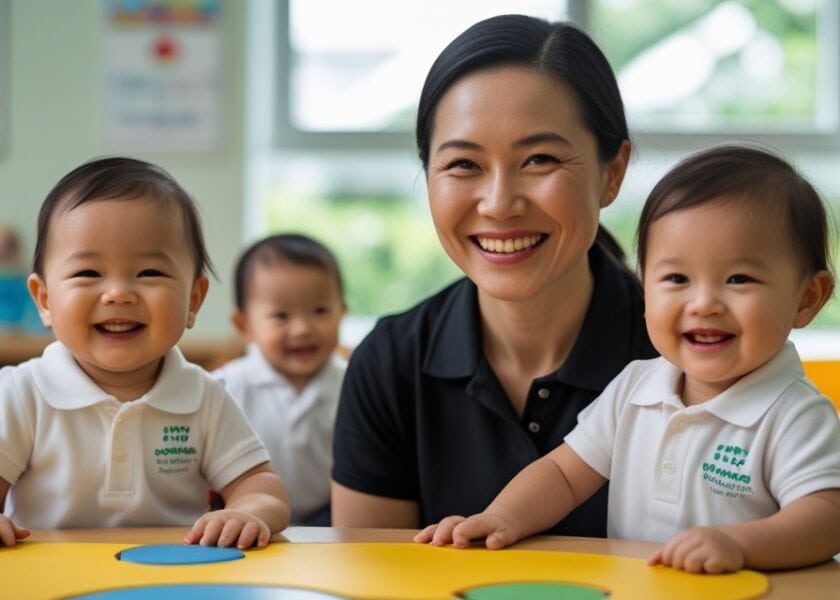
Our home-based care model means your child grows in an environment designed to feel like home—warm, consistent, unhurried—while receiving the structured support that a home setting allows us to provide. We maintain ratios of up to one to three infants in our care, because we believe that attention is not a luxury but a necessity in the first years of life.
We are part of your village. We are not the village. We are the part of the village that brings training, that brings structure, that brings the specific kind of intentional care that comes from understanding child development not just as a practice but as a discipline.
We know that cost is a genuine consideration, not an abstraction. Our pilot fee structures are designed to be accessible to families across Singapore, and we actively support the use of available subsidies—CDA and Baby Bonus—to make professional care a viable option rather than a privileged one.
Our care operates Monday through Friday, in structured blocks that align with the realities of working parents in Singapore. We built our model around the rhythm of a real family week.
And because we know that trust is built through transparency, wherever our services include communication tools, transparency measures, or CCTV access, we offer them without hesitation. This is not a luxury. This is the minimum standard of respect for a family entrusting their child to someone else’s care. We do not hide. We welcome your attention.
If you are considering how professional childminding might fit into your family’s village, we welcome the conversation.
A Note to the Parent Carrying This Alone
You have been reading parenting content and feeling vaguely guilty for wanting more than what your parents provide. You have been telling yourself that you should be grateful, that children do not need everything, that your own childhood was fine even though it looked nothing like what the research now recommends. You have been sitting in the space between what you know and what you feel allowed to ask for.
I want you to know that you do not have to stay there.
You are allowed to want more for your child. You are allowed to seek professional care without that choice meaning anything about your parents’ love or your own ingratitude. You are allowed to build the village that serves your child, not the village that soothes your guilt or protects your parents’ feelings.
The child in the middle of this deserves a parent who is honest about what they need, and a family that supports that honesty rather than suppresses it.
You are also allowed to love your parents more fiercely than ever as they grow into their role as grandparents. Some of the most beautiful grandparent-grandchild relationships exist in families where professional care exists alongside grandparent involvement, not in spite of it. Grandparents who are not exhausted by full-time childcare, who can show up as grandparents instead of reluctant caregivers—that is a different relationship. It is a better one. It is the relationship your child deserves with their grandparents. And it is available to you, if you are brave enough to build the architecture that makes it possible.
Begin the conversation. Singapore family life is complex. Multigenerational dynamics are layered. The love everyone feels for your child is real and sometimes incompatible in its expressions. Navigating that complexity is the work of a thoughtful, intentional family—and it is worth every difficult conversation, every boundary drawn with care, every moment of clarity that comes from naming what you actually need.
You have been preparing for this without knowing it—every time you read an article, every time you hesitated before speaking, every time you chose to stay quiet because the conversation felt too hard. You have been building the clarity that this conversation requires.
Bring your family. Bring your questions. Bring the conversation you have been avoiding. We are ready to build together.
Curious about how EduNanny fits into Singapore’s childcare landscape? Learn more about our approach or explore our services.