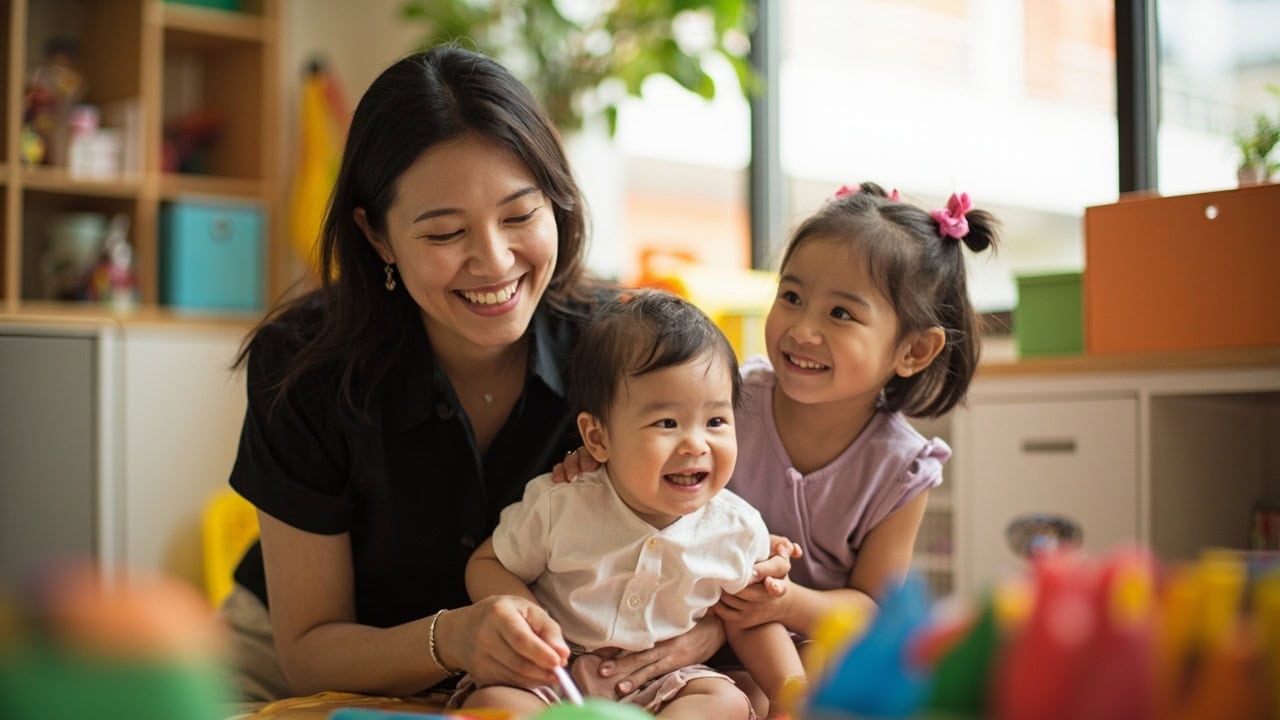
The Unseen Hours That Shape Your Child’s Tomorrow
Quick Summary: Why the Unseen Hours Matter
Before we go deeper, here is what this article is really about:
- When you walk away from your child each morning, something rich and formative is beginning—not ending
- Quality childcare environments offer developmental experiences that are genuinely difficult to replicate at home
- The social-emotional work your child does among peers is foundational to empathy, resilience, and the capacity for relationship
- The brain develops most rapidly in the years before formal school—and it is built through thousands of hours of responsive, attuned interaction
- Understanding what happens in those unseen hours transforms your relationship with childcare from one of delegation to genuine partnership
If you take nothing else from this article, let it be this: your child is becoming someone in those hours you are not there. And the kind of childcare you choose can make those unseen hours worth knowing about.
What Your Child Is Actually Doing
Consider, for a moment, what it means to be two or three years old in a room full of other children. Not as a logistical challenge, but as an existential one.
You are small. You are still learning what your own emotions are, let alone what they mean. And around you, other small humans are having their own emotions, at the same time, in the same space. The child across from you wants the same truck you want. The child beside you is tired and crying, and you do not yet understand why that sound makes you feel afraid.
Every day, in the ordinary course of childcare, your child is doing sophisticated work: learning to be a person among other persons. This is what developmental scientists call social-emotional learning, and it happens with an intensity and frequency in quality childcare environments that is genuinely difficult to replicate at home.
In a group setting, with trained caregivers who understand what they are witnessing, children practice the full range of human negotiation:
- They learn that other people have wants that differ from theirs
- They learn that frustration is survivable
- They learn that when they cannot yet speak the words they need, there are other ways to be understood
- They learn, over hundreds of small interactions, that they are separate from others but connected to them
That is not a small thing. That is the foundation of empathy, of resilience, of the capacity to be in relationship. And it happens largely in the unseen hours—in the moments between pickups, in the ordinary minutes of the childcare day, in the small dramas that your child may not have the words to tell you about when you ask, “What did you do today?” and they say, with perfect honesty, “I played.”
Beyond Play: The Discoveries Being Made
They discovered something. They discovered that when they dropped the block, it made a sound, and then they dropped it again to see if it would make the same sound. They discovered that if they moved closer to another child, that child might move away or might lean in closer too. They discovered that there is a feeling inside them that gets bigger when they are hungry or tired, and that sometimes a kind adult can help that feeling get smaller again.
These are not trivial discoveries. These are the building blocks of how your child understands the world, and themselves, and other people.
The brain develops most rapidly in the years before formal school. This is not a marketing claim. It is decades of developmental research. But the implications of this fact are often misunderstood.
People imagine that rapid brain development means rapid learning of facts, early reading, accelerated milestones. And sometimes it looks like that. But more often, what rapid brain development looks like in a young child is something quieter and more profound:
- The wiring of emotional response systems
- The construction of the capacity to focus attention
- The ability to resist impulse
- The feeling of safety in new situations
- The recovery from disappointment
These capacities are not born in children. They are built, through thousands of hours of experience, in environments that are responsive and consistent and attuned to the child’s internal states.
What Quality Childcare Looks Like
When a caregiver sits beside a frustrated child and names what they are feeling—”You worked so hard on that tower and it fell. That feels disappointing, doesn’t it?”—that is not just comforting. That is the slow, patient work of teaching your child that their inner world has structure, that their emotions make sense, that they can be known and understood even when they cannot yet articulate what they are experiencing.
Supervision is ensuring a child is safe, fed, and physically cared for. That is necessary. It is also not enough. What children need, and what quality childcare provides, is something closer to attentive presence.
An adult who is watching not just for what the child does, but for what they are trying to do, what they are struggling with, what they are curious about, what makes them light up and what makes them withdraw. A caregiver who notices the pattern in the child’s behavior—noticing, perhaps, that the child always becomes dysregulated around transitions, or that they are working through a phase of needing to test boundaries, or that they have become particularly interested in how things fit inside other things.
This kind of observation is not casual. It is trained. It is the professional skill of the educator, applied to the smallest and most formative of human beings.
The Difference Between Being Supervised and Being Known
When your child is in an environment where this kind of observation is happening, where trained adults are genuinely watching and responding to your child’s internal experience, they are not just being cared for. They are being known.
And being known, I believe, is one of the deepest needs of human beings at any age. For a young child, who is still figuring out who they are, being known by a competent and caring adult is not a luxury. It is a developmental necessity. It tells the child:
- You are real
- Your feelings matter
- You are worth paying attention to
- You belong
Slowly, over days and weeks and months, your child is building something inside themselves. They are building the knowledge that the world is not only what they can see from their own small perspective. They are building the knowledge that other people are real, have inner lives, can be trusted, can be sought out for comfort or for collaboration. They are building the knowledge that they themselves are capable—of solving problems, of recovering from setbacks, of navigating social complexity, of learning.
Speaking to the Feeling You Carry
I want to speak directly to the feeling that I suspect many of you carry, even if you do not always name it.
The feeling is not distrust. You have done your research. You have visited the centre, met the caregivers, asked your questions, checked the credentials. You made a decision. And intellectually, you are confident in that decision.
But emotionally, there is a quiet persistence in the uncertainty. You dropped your child off this morning, and part of you wonders, throughout the day, what they are experiencing. Whether they are happy. Whether they are lonely. Whether they are learning anything, or just waiting. Whether the people caring for them truly see them—truly see your child, with all their particular quirks and fears and wonders.
This is not an irrational feeling. It is the most rational feeling in the world. You love your child, and love always wants to know. To witness. To be present for the moments that matter.
There is a gap—a small but persistent gap—between your intellectual confidence in your choice and your emotional connection to what is actually happening during the day.
What I Want to Offer You
Not false reassurance. I am not going to tell you that everything is fine and you should simply trust.
I want to offer you something more valuable than that. I want to offer you understanding.
Because the unseen hours are not as unseen as you think. Not if you are in the right environment. Not if the people caring for your child are trained not only to provide care, but to observe, to document, to communicate.
When a childcare provider invests in the technology and the practices to share what they see—when there are systems for documentation, for transparency, for regular and meaningful communication about your child’s day—not because parents demand it, but because the providers themselves believe that you have a right to understand what is happening with your child, then the unseen hours become something different.
They become visible.
Not fully, of course. Your child will still have experiences that are theirs alone, that they may never have the words to tell you about. But you will begin to see the shape of their day. You will begin to understand the themes and patterns. You will learn what they are curious about, who they enjoy playing with, what makes them laugh, how they are growing.
And this changes something. It changes the quality of the conversations you have with your child. It changes the quality of your own peace of mind. And it changes the relationship between your family and the childcare environment—from one of delegation, of handing over and hoping, to one of genuine partnership.
How EduNanny Approaches the Unseen Hours
This is the philosophy that shapes how EduNanny by BUTLER approaches infant care and childminding in Singapore.
We believe that parents deserve more than the assurance that their child is safe. They deserve to understand what their child is experiencing, growing, and becoming. And we believe that children deserve more than supervision. They deserve to be known.
This is why EduNanny participates in the ECDA Childminding Pilot—a programme that recognizes the importance of professional, trained, regulated childminding for Singapore’s youngest children and their families. The pilot creates pathways for both home-based and centre-based care, giving families options that suit their circumstances and preferences, while maintaining standards that protect children’s wellbeing and development.
With ratios of up to one to three in infant care, our caregivers can truly attend to each child—not just their physical needs, but their emotional states, their developmental rhythms, their individual ways of being in the world.
Making Quality Care Accessible
We believe that this kind of care should be accessible. Within the pilot fee structures, with support mechanisms like CDA and Baby Bonus usability, we work to remove barriers that might prevent families from accessing the quality of care their children deserve.
Monday through Friday, across Singapore, families are finding in EduNanny a childcare partner who takes seriously the responsibility of being present for the unseen hours.
Transparency as Trust-Building
And because we know that trust is built through transparency, we have implemented communication measures designed to keep you connected to your child’s day.
Where CCTV systems are deployed, they are not surveillance for its own sake—they are tools that create accountability and peace of mind, for you and for our caregivers alike. But more importantly, we invest in the daily practices of observation and communication: the notes, the conversations, the photographs, the small reports that help you see the arc of your child’s experience.
We do this because we know that the unseen hours matter. And because we believe that when parents understand what is happening in those hours, something shifts. The anxiety does not disappear—love always has an edge of worry—but it becomes smaller. It becomes manageable. And in its place, something else grows: a quiet pride in watching your child become a person, and a confidence that you have found people who are helping them do that well.
What to Look for in Infant Care
If you are researching childcare options in Singapore, here are some questions worth asking—not because you need all the answers before you choose, but because asking them will help you understand what kind of environment you are considering:
- How do caregivers observe and document children’s development? Look for evidence of intentional observation—not just casual watching, but trained professional attention to patterns, interests, and developmental rhythms.
- What are the caregiver-to-child ratios? In infant care, smaller ratios allow for genuine attunement. The ECDA Childminding Pilot allows ratios of up to 1:3 for infants.
- How do caregivers respond to emotional distress? Listen for language that names emotions and validates experiences. “You feel frustrated because the puzzle piece won’t fit” matters more than “Don’t worry, it’s fine.”
- What does communication with parents look like? The right environment should feel like a partnership, not a transaction. Ask how they share what your child is experiencing during the day.
- How do they support social learning among peers? Peer interaction in the early years is not incidental—it is foundational. Good environments facilitate, but do not over-manage, these interactions.
- What training do caregivers have? Look for professional training in child development, not just certification in first aid. The ability to read a child’s internal state is a learned skill.
Choosing with Confidence
You will never have complete certainty. That is not failure—it is parenthood. But you can choose an environment where the unseen hours are worth knowing about. Where trained adults are paying attention. Where your child is not just supervised, but seen.
And you can choose a provider who believes that you have a right to understand what is happening with your child during those hours—not as a concession to anxious parents, but as a genuine expression of what quality care means.
A Different Frame
There is a way of thinking about childcare that frames it as a compromise—a necessary but imperfect arrangement, a thing we do because we must.
And I understand that feeling. There is something in all of us that wishes we could be there for every moment.
But I want to suggest a different frame. The hours your child spends in quality childcare are not lost hours. They are not gaps in your relationship with your child. They are extensions of it. They are hours in which your child is practicing the skills they will need to be in the world—social skills, emotional skills, the skills of curiosity and resilience and collaboration. They are hours in which your child is growing in ways that complement what you are doing at home.
And they are hours that, when you are in the right childcare environment, you can begin to understand and appreciate, not as an absence, but as a presence.
Your child is becoming someone, in those hours you are not there. They are becoming a person who negotiates, who imagines, who persists, who recovers, who connects.
And now, perhaps, you can see that more clearly. Not just who they are when you pick them up, but who they are becoming, hour by hour, in the unseen world of their day.
Begin to See What Your Child Is Becoming
That is the gift of understanding. And that is what we invite you to find at EduNanny by BUTLER.
Not just a childcare provider. A partner in seeing your child. A place where the unseen hours are worth knowing about, because what happens in them is worth knowing.
Because your child is worth knowing.
And because the work they are doing, in those quiet, ordinary, extraordinary hours, is some of the most important work of their entire life.
At EduNanny by BUTLER, we believe that when you walk away each morning, something meaningful is beginning. We invite you to discover what that looks like—with trained caregivers who truly see your child, communication that brings the unseen hours into view, and a genuine partnership in your child’s development.
Whether you are exploring infant care or childminding options, learn more about our approach or get in touch with our team to start a conversation about what care looks like for your family.