Teaching Your Child Their Heritage Language Is an Act of Love
“`html
The Fear Is Real—And It Deserves an Honest Answer
Walk into any parent group in Singapore, mention the words mother tongue, and watch how the energy in the room changes. The conversation becomes more careful, more personal. Parents speak in lower voices when they admit that they worry. That they feel guilty. That they wonder if they are failing their children in ways that cannot be undone.
The fear is specific and it is shared: that their child will grow up able to speak a language but never truly at home in it. Knowing facts about a culture but feeling no living connection to it. Becoming, in the most painful sense, a stranger to their own heritage.
This fear is not irrational. It is a rational response to a very real tension that exists at the heart of raising children in Singapore today.
On one side, the world opens wide—English fluency, global opportunity, access to the best schools and the best careers. On the other side, something older and more fragile waits: the language that grandparents speak, the customs that bind a family across generations, the cultural code that tells a child who they are and where they come from.
The tragedy is not that parents must choose between these two worlds. The tragedy is that they have been made to feel that they must.
Language Instruction Versus Language Immersion
Here is what quality childcare can offer that it has rarely been positioned to offer: the conditions for genuine language immersion to happen. Not as a replacement for family, but as a partnership with it. Not as a threat to cultural identity, but as one of its most powerful allies.
Consider what actually shapes a child’s relationship to language in the early years. It is not flashcards. It is not structured lessons. It is the sheer volume of authentic, emotionally meaningful language exposure that happens in the context of trusted relationships.
A child learns language most powerfully not because someone is teaching it, but because someone is speaking it, daily, with love, with patience, with the full human weight of genuine communication.
When a caregiver sings a Hokkien nursery rhyme because it is part of the morning routine, when they tell a Malay folk story because the afternoon feels like a story-telling kind of afternoon, when they sit with a child and eat nasi lemak and explain, in Malay, why this dish matters—not as a lesson, but as an offering—the child absorbs far more than vocabulary. They absorb the feeling of being at home in a language.
| Language Instruction | Language Immersion |
|---|---|
| Teaches children to pass examinations | Teaches children to live inside a language |
| Transactional by nature | Transformational by nature |
| Limited to designated lesson times | Woven throughout daily life |
| Focuses on vocabulary and grammar rules | Focuses on meaning, emotion, and belonging |
| Heritage language as a subject to study | Heritage language as a living presence to inhabit |
How Quality Childcare Creates Cultural Identity
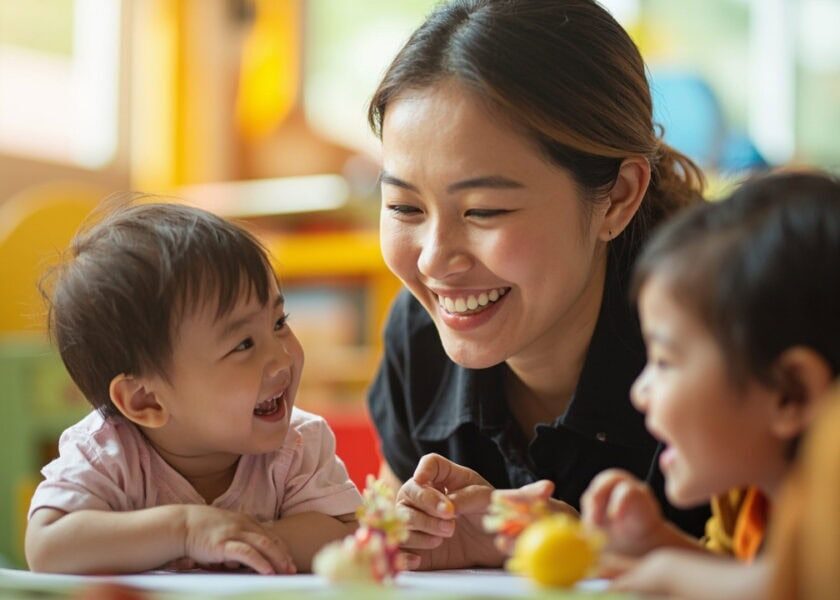
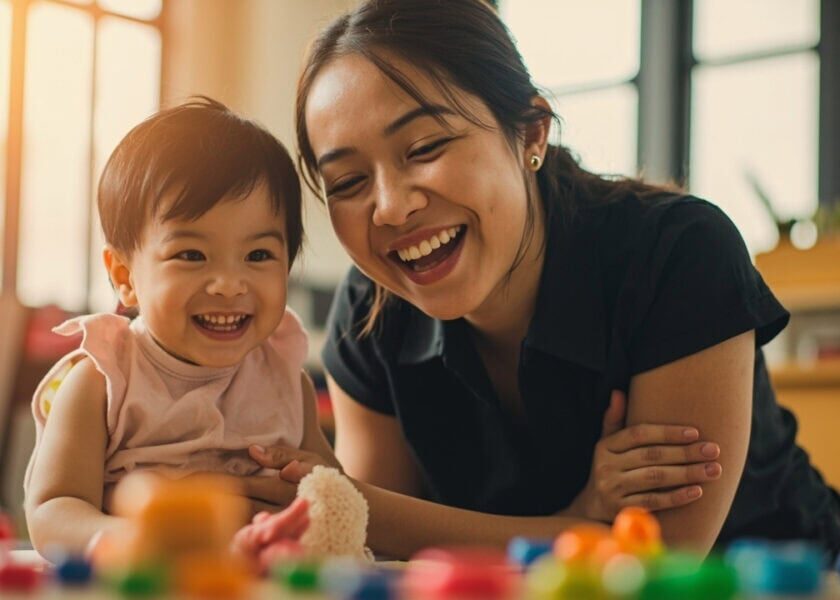
When a caregiver and a child spend years together, speaking together, eating together, living together, something irreplaceable takes root. The caregiver becomes a language model, a cultural storyteller, a bridge between the family’s heritage and the child’s developing sense of self.
The language that flows between them is not performative. It is not scripted. It is the ordinary, beautiful, chaotic language of daily life—asking for water, describing the rain, laughing about something silly, comforting a skinned knee.
In that flow, heritage language stops being something that happens in a classroom and starts being something that lives in the body, in the heart, in the child’s sense of what is natural and true.
Heritage language development happens in the ordinary moments that make up a child’s day:
- Morning greetings in the child’s home language, as naturally as breathing
- Song time with nursery rhymes that grandmother might recognize
- Storytelling that weaves in cultural traditions without making them a lesson
- Meal preparation with food that carries meaning and memory
- Play where the language flows without pressure or correction
- Comfort offered in the language of emotional safety
Parents who have found quality childcare partnerships often describe the same transformation. They notice their child code-switching naturally, dropping into mother tongue when speaking to a grandparent, then seamlessly returning to English with a parent. They notice their child humming songs they have never explicitly taught them. They notice their child asking questions about cultural traditions, not because they were taught to ask, but because the traditions have become part of the texture of their daily life.
Most importantly, they notice their child seems comfortable in both worlds—not torn between them, not performing either one, but genuinely at home in both.
Cultural Rootedness Supports School Readiness
Singapore parents are not wrong to care about school readiness. But the conversation about school readiness has been too narrow for too long. It has focused almost exclusively on literacy and numeracy, on the cognitive skills that will help a child pass examinations.
What it has largely missed is the role that emotional security plays in academic flourishing.
A child who feels uncertain about who they are, who carries the quiet weight of cultural disconnection, who has learned to see their heritage as something separate from their “real” life—this child is carrying a burden that will show up in unexpected ways. In anxiety. In disengagement. In a subtle but persistent sense that something fundamental is missing.
Conversely, a child who feels genuinely rooted in their cultural identity carries something entirely different. They carry the security of knowing who they are. They carry the confidence that comes from belonging fully to a family, a history, a community.
Research in child development consistently shows that emotional security is not separate from academic achievement—it is foundational to it. Children who feel secure learn more readily. Children who feel seen and valued for who they are engage more deeply. Children who do not have to split their identity into competing halves bring their full selves to the learning process.
When we support a child’s relationship to their mother tongue, we are not simply teaching them another language. We are giving them a piece of their psychological foundation.
What to Look for in a Childcare Partner
If heritage language development is a priority for your family, here are questions worth asking:
- How does the caregiver approach daily language use? Is heritage language woven naturally throughout the day, or limited to specific lesson times?
- What is the caregiver’s understanding of your cultural priorities? Have they taken time to learn what matters to your family?
- How sustained is the relationship? Will your child have the same primary caregiver over months and years, or will there be frequent transitions?
- How do they incorporate cultural activities—songs, stories, food, traditions—into ordinary daily life?
- What is the group size and caregiver-to-child ratio? Smaller ratios create more space for meaningful language interaction.
Common Concerns Parents Raise
“Will my child lose their heritage language if I return to work?”
Your child’s heritage language development does not have to depend solely on the hours you are physically present. When your childcare partner reinforces the same language, the same songs, the same cultural rhythms you use at home, your child receives multiple, reinforcing sources of heritage language each day. This is not a loss—it is an expansion of your child’s linguistic world.
“What if my child’s caregiver doesn’t share my cultural background?”
Heritage language development is not about the caregiver sharing your ethnicity. It is about the caregiver understanding and respecting the cultural context you want for your child, and being willing to create those conditions daily. The most important factor is not cultural matching—it is commitment to the partnership and the consistency that comes from sustained relationships over months and years.
“My child already goes to a childcare centre. Is this still relevant?”
Absolutely. The principles of immersion, sustained relationships, and emotionally meaningful language exposure apply regardless of the childcare setting. What EduNanny offers is a particular model—one-to-one or small-group care in a home environment—that creates exceptional conditions for these principles to take root.
The EduNanny Approach
EduNanny Singapore understands this. Not as a slogan, not as a marketing angle, but as a deep commitment to what childcare can be at its best.
In a city where parents are juggling demanding careers, navigating complex educational landscapes, and wrestling with the kinds of quiet fears we have been discussing, EduNanny exists as a partner—someone who sees childcare not as supervision, but as a profound responsibility. The kind of work that shapes who a child becomes.
This is why EduNanny operates as part of the ECDA Childminding Pilot, a government-backed initiative that recognizes home-based and community-based childcare as a legitimate, valuable, and necessary part of Singapore’s childcare ecosystem. The pilot is built on the understanding that some children thrive in the warmth and intimacy of a home environment.
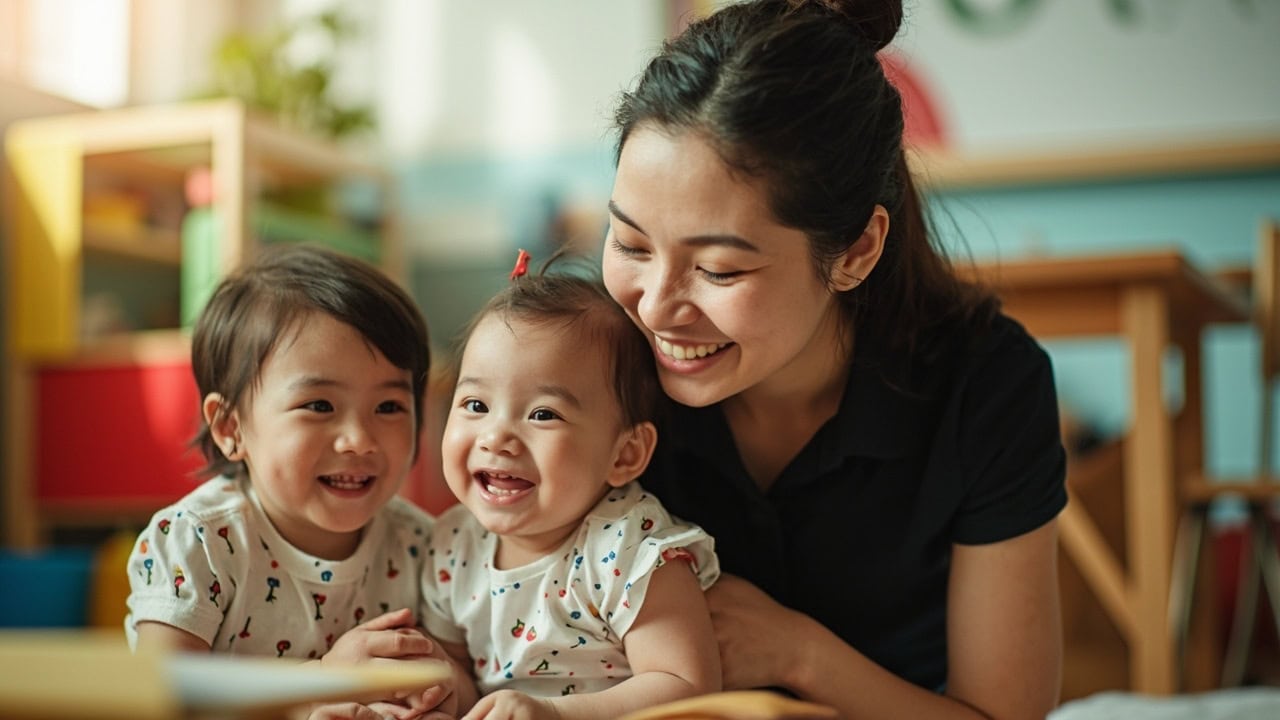
Sustained, one-to-one or small-group care—up to one-to-three for infants—creates conditions for the kind of deep relational language modeling we have been discussing.
EduNanny’s caregivers are not babysitters. They are partners in the most important work a family does: raising a child who knows who they are and where they come from, and who is ready—fully ready—to step into the world ahead of them.
- Care across Monday to Friday, in blocks that work with the rhythms of working families
- Pilot fee structures designed to be accessible, to remove cost as a barrier to quality
- Child Development Account and Baby Bonus fund options available—because every Singapore child deserves the chance to grow up with genuine cultural confidence
- Communication practices that allow parents to feel connected to their child’s daily life
Beyond the structures and the policies, EduNanny’s answer to modern parents is fundamentally relational. It is the answer of someone who will sing your child the songs your mother sang to you, who will tell your child the stories your grandmother told, who will create the conditions in which your child’s heritage language is not a subject to be studied but a living presence to be inhabited.
Your Child Can Belong to Multiple Worlds
There is one more thing worth saying, and it is perhaps the most important thing of all.
When we talk about heritage language and cultural identity in childcare, we are ultimately talking about love. We are talking about the love a parent feels when they hear their child respond to a grandparent in fluent Tamil. We are talking about the love a grandmother pours into the Teochew songs she sings, hoping her granddaughter will carry them forward. We are talking about the love that lives inside a family’s language, their food, their stories, their daily rituals—the accumulated love of generations, made tangible in the things they have passed down.
Parents, you are not failing. You are doing something extraordinarily difficult in an extraordinarily complex time. The world your children are growing up in is different from the one you grew up in. The pressures you face are real. The choices you have to make are not easy.
But the fear you carry about your child’s cultural identity is not a sign of weakness or outdated thinking. It is a sign of love. And it is a love that deserves to be supported, not dismissed.
Your child does not have to lose anything. Not their language. Not their culture. Not their roots. They can have everything—English fluency and mother tongue fluency, global opportunity and cultural rootedness, a future full of possibility and a heritage that grounds them in who they are.
That is the promise of quality childcare. That is the work that EduNanny Singapore is proud to do. And that is the future we want for every family in this city: children who are whole, children who are secure, children who know exactly where they come from and feel ready to go anywhere.
If this article resonates with the hopes and fears you carry for your child, we invite you to take the next step. Speak with our team about how EduNanny can become your partner in raising a child who belongs fully to multiple worlds.
Your child’s heritage is not a burden to preserve. It is a gift to live. Let us help you give that gift.
EduNanny Singapore is a trusted, development-focused childcare and childminding service. Learn more about us or visit edunanny.com to explore how we support families across Singapore.
“`