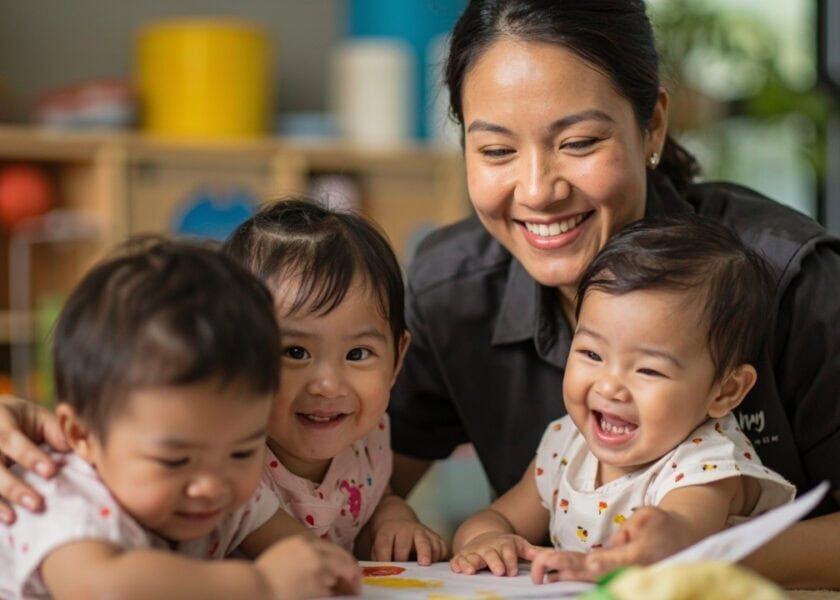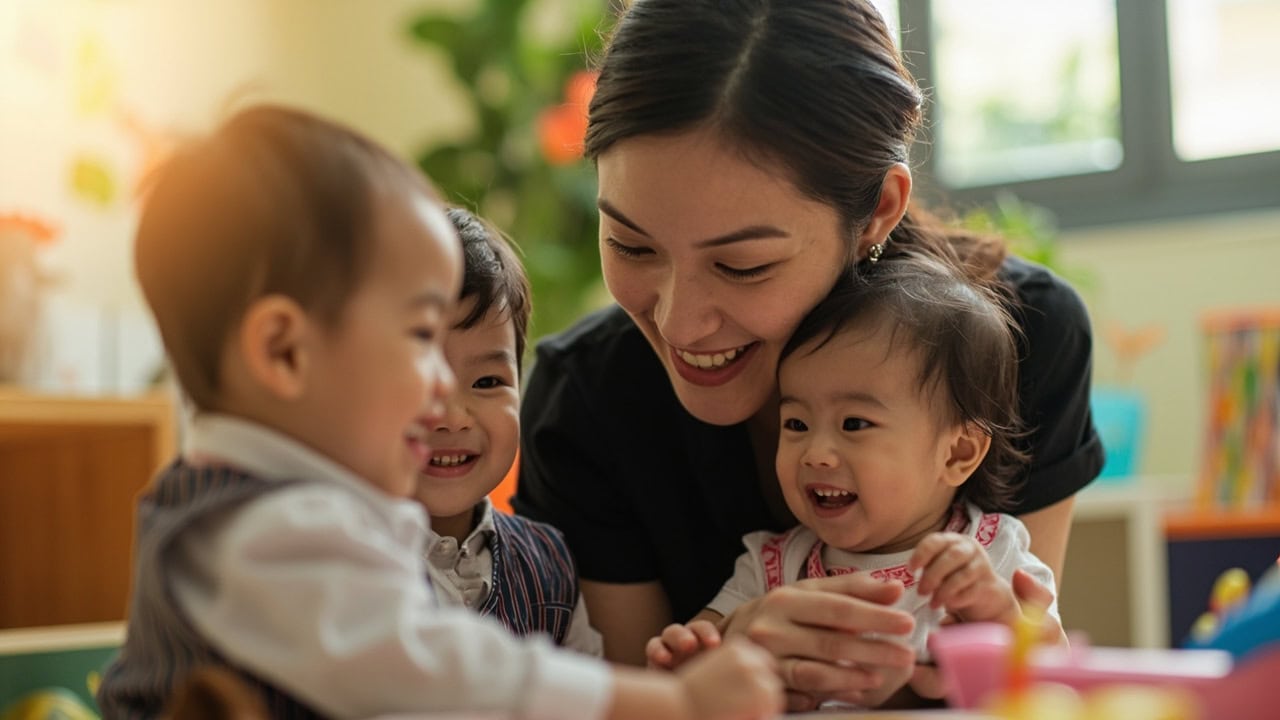
Beyond the Gate: The Hidden Social Curriculum Your Child Is Learning in Childcare
The Morning Goodbye: What Quality Childcare Is Actually Teaching Your Child
There is a moment, I suspect, that most parents in Singapore know well. It happens at the gate of a childcare centre, or at the doorstep where a trusted caregiver is waiting. You kiss your child’s forehead. You say the words you always say — I’ll be back soon. I love you. Be good. — and then you leave.
And in the hours that follow, while you are in meetings, on the MRT, at your desk, in the middle of a conversation with someone who has no idea what is happening inside your chest, there is a question that quietly runs beneath the surface of your day.
Is my child okay right now? Not just safe, but okay. Growing. Learning. Becoming someone who is okay.
This is not doubt in your choice. Most parents who bring their children to quality childcare have thought carefully about that decision, have weighed the evidence, and have trusted their instinct. This is something else. This is the natural, tender curiosity of a parent who loves their child and cannot be in two places at once.
This is the question that quality childcare has never fully answered for parents — because the answer lives in a place that is hard to see, hard to measure, and hard to put into words at a birthday party or a check-in meeting. Until now.
The Invisible Curriculum: What Happens Beneath the Surface
When parents evaluate childcare, they look for things that can be observed: Is the space clean? Is the ratio safe? Do the children seem happy? Are there activities? Are they learning their colours, their numbers, their letters?
These are not wrong things to notice. They matter. But they represent the surface of what is actually happening — the part that is easy to photograph and share and explain at a tour.
Beneath that surface, in every quality childcare setting that takes its work seriously, there is another curriculum running. It does not appear on lesson plans. It does not generate progress reports that fit neatly into a parent app. It is the curriculum of becoming human in relation to other humans — and it may be the most important thing your child is learning during the hours you are apart.
The Social World in Miniature
Consider what it takes for a young child to be in a room with other children. Not just near them, but with them. Sharing a space. Navigating the reality that someone else has a toy, a feeling, a want that is different from theirs.
In the earliest years, this is not natural. It is learned. It is learned through hundreds of small moments:
- The time a caregiver helped a toddler name the feeling behind the grabbing
- The afternoon a teacher modelled how to wait and how to ask
- The morning a group of three-year-olds figured out that they could build something together if they talked about what each of them wanted to do
And here is what is remarkable: it cannot be built in a lecture. You cannot tell a two-year-old about empathy and expect them to understand it. Emotional and social competence is learned through lived experience, through guided practice in real relationships with real consequences and real comfort.
It is learned when a caregiver sits beside a child who has just fallen apart over a broken block and says, “I see you are so sad about that.” It is learned when children are helped to use their words instead of their hands, not once, but a hundred times, until the pattern begins to shift.
This is not a criticism of home. It is simply a recognition that social development requires social contexts, and the childcare environment creates one of such richness that it would be a shame to waste it.
Recognising the Evidence at Home
I want to slow down here and make this concrete, because it matters that parents can recognise this work when it is happening — even if they are not there to see it.
When your child comes home from childcare and tells you about a friend, that is not small talk. That is social mapping. Your child is building a mental model of the social world — who belongs to it, how it works, what it means to have a friend.
When your child has a tantrum at home and, in the aftermath, says “I was so angry” or “That made me feel sad,” that is emotional vocabulary — and the likelihood is that a significant portion of that vocabulary was built not in your living room, but in the guided, intentional environment of quality childcare, where caregivers name feelings as a matter of practice, every single day.
When your child negotiates, when they defer, when they stand up for themselves, when they notice that another child is upset and pause to offer a toy — these are not random acts of good behaviour. These are skills. They are being practised, reinforced, and woven into your child’s character during those hours you are not there.
And when you see them at home, what you are witnessing is the evidence of invisible work.
This is the curriculum beneath the surface. It is not the same curriculum that appears in learning outcomes and activity photos. It is the curriculum of the heart and the self — the one that will determine not just how your child performs in school, but how they move through the world.
Why These Skills Matter More Than You Think
Primary One readiness is a topic that generates considerable anxiety in Singapore. Parents worry about academic preparedness — Can my child read? Can they count? Can they sit still? And these are not unreasonable concerns.
But the research, and the experience of every seasoned educator, will tell you that the competencies most predictive of a smooth transition to Primary One are not academic. They are social and emotional.
The Skills That Actually Prepare Your Child for Primary One
A child who is ready — not just surviving, but ready — is one who:
- Can manage their own big feelings
- Can recover quickly from disappointment
- Knows how to ask for help
- Can read the social cues of a classroom
- Understands the basic architecture of taking turns and listening and being part of a group
These are the competencies that quality childcare builds systematically, through the architecture of daily routines, the quality of caregiver modelling, the structure of guided play, and the unpredictable, invaluable experience of peer relationships.
Why Home Alone Cannot Fully Provide This
Because social-emotional development requires something that is genuinely difficult to manufacture in isolation: real social complexity.
In a home environment, a child is typically the centre of a carefully managed social world. Adults adapt to them. Siblings may be present, but the dynamics are different. Playdates offer glimpses, but they are intermittent, not structural.
Quality childcare provides a consistent, structured social environment where children must learn to exist as part of a group — where their individual wants exist alongside the wants of others, where conflict is inevitable and necessary, and where trained caregivers guide each moment of friction toward growth rather than frustration.
The caregiver is not merely supervising. They are a social-emotional guide — a living model of how to regulate, how to speak kindly, how to navigate conflict, and how to be in relationship. Children learn emotional intelligence not primarily from being told what to do, but from watching adults who know how to be with themselves and with others. This is the deepest curriculum of all, and it lives in the person, not the program.
What Quality Childminding Looks Like in Practice
You may be wondering: how do I know if my child is in a place where this deeper curriculum is running? Here is what to look for, in concrete terms.
| What You Might See or Hear | What It Actually Means |
|---|---|
| Caregivers regularly name emotions aloud | Children are building emotional vocabulary |
| Teachers narrate children’s feelings during conflict | Children are learning that feelings are understandable and manageable |
| Your child mentions friends by name | Social mapping is underway |
| Routines are predictable but flexible | Children are learning security and adaptability |
| Your child can articulate what happened at childcare | Processing and language skills are growing |
What Play Looks Like in Quality Care
In quality childcare, play is never just play. It is the vehicle through which all learning happens. When children build with blocks, they are learning patience, spatial reasoning, and how to negotiate shared visions. When they engage in pretend play, they are practising perspective-taking, emotional expression, and social roles.
When caregivers observe and guide play — not directing, but thoughtfully intervening when needed — children receive the scaffolding they need to stretch their skills just beyond what they could manage alone. This is what developmental psychologists call the “zone of proximal development” — and it is where growth happens.
A Note for Parents Considering Infant Care
If your child is still in infancy, there are a few things worth knowing now.
- The foundations are laid early. Emotional and social intelligence begins developing from birth. The caregiver-child relationship in those first years sets the template for all future relationships.
- Responsive care matters enormously. In quality infant care, caregivers attune to each baby’s cues — hunger, tiredness, curiosity, distress — and respond consistently. This is where trust begins.
- Small ratios are crucial for infants. The fewer babies per caregiver, the more attuned and responsive that care can be. This is not a luxury; it is a developmental necessity.
The Truth About Childcare: A Reframe
There is a tendency, in how we talk about childcare, to frame it as a compromise. Parents are working, so children go to childcare. It is a necessary arrangement, a practical solution to a logistical problem.
And while there is truth to the logistics, this framing does a profound disservice to what childcare actually is — and what it can be.
Childcare, at its best, is not a compromise. It is a community. It is a place where children learn to be human alongside other humans, guided by adults who take that responsibility seriously. It is a place where the quiet, essential work of emotional and social development happens not despite the hours that parents are away, but through them.
Those hours provide something that parents, however devoted, cannot provide alone: the social world in miniature, the practice ground for being a person in relation to others.
When you bring your child to quality childcare, you are not leaving them in a waiting room for life. You are placing them in a place of growth.
Parents want to know what is happening during the hours they are apart from their child. Not because they do not trust, but because they love — and love wants to be present even when it cannot be physically present.
Quality childcare understands this. When parents feel they can trust what they cannot see, something changes. The morning goodbye becomes easier. The question that quietly runs beneath the surface — Is my child okay? Is my child growing? — begins to find its answer in evidence and experience, not anxiety.
EduNanny Singapore: Where the Deeper Curriculum Runs Intentionally
For parents seeking a childcare pathway in Singapore that takes this deeper curriculum seriously — one that sees the child not as someone to be watched, but as someone to be shaped — understanding what to look for in a provider matters.
EduNanny Singapore operates within the ECDA Childminding Pilot — a national initiative designed to offer Singapore families childcare options that are flexible, accessible, and grounded in defined quality standards. For parents, this structure carries practical significance: care is available at fee levels that support family budgets, and CDA and Baby Bonus funds can be utilised. Care blocks run Monday to Friday, aligned with the rhythms of working family life, with pathways available through home-based, community, and centre-based settings depending on what suits your family best.
Beyond logistics, the pilot framework signals something important: that childcare is being taken seriously as a developmental institution, not merely as a childcare service. Operating within this structure means accountability and oversight reinforce quality. It means that the curriculum we have described — the invisible, essential curriculum of emotional and social development — is not optional or accidental. It is built into the expectation.
EduNanny by BUTLER brings to this work a professional stance aligned with everything we have been describing: every hour a child spends in care is an hour of development. There is no such thing as passive childcare — only childcare that is intentional, and childcare that is not. This philosophy shapes hiring, training, daily practice, and the culture of every setting.
Closing: What You Are Actually Enabling
The next time you say goodbye in the morning, I want you to know what you are enabling. You are not enabling absence. You are enabling the building of a person — a person who is learning, right now:
- How to feel and how to name what they feel
- How to be with others
- How to recover when things go wrong
- How to try again
- How to be part of something larger than themselves
That is not small. That is everything.
When you choose a childcare pathway that takes this deeper curriculum seriously, you are choosing a partner in the work that matters most — helping your child become ready for the world, and ready for themselves.
And I hope that after reading this, the hours apart feel a little less invisible, and a little more full of meaning — because they are.
#ChildcareSingapore #InfantCare #SocialEmotionalLearning #PrimaryOneReadiness #EduNannySG