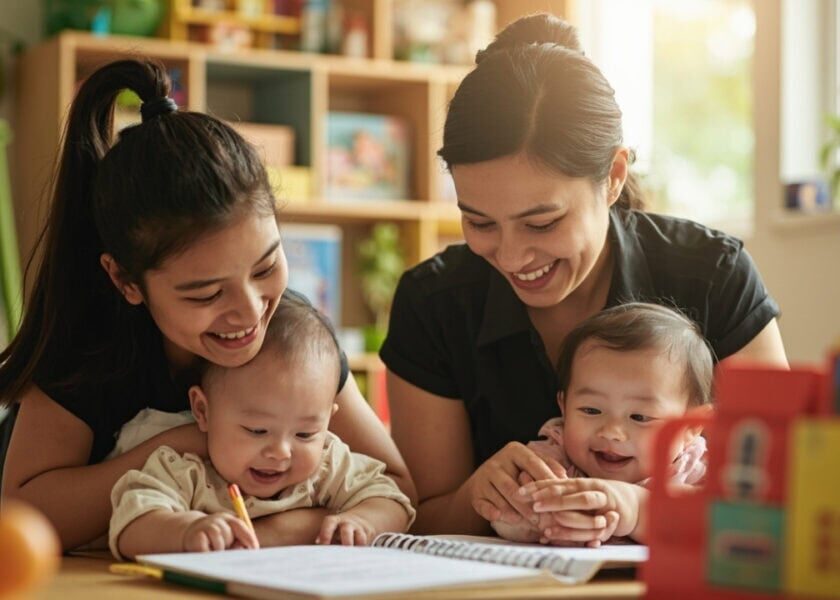
Your Readiness as a Parent Deserves Attention Before Childcare
What Readiness Actually Means
Most childcare content will tell you about your child’s readiness. Whether your two-year-old can separate from you without tears. Whether they are toilet trained. Whether their language development is on track for group social interaction. These are real and valid considerations—and they deserve attention.
But they are not the whole story. They are not even, I would argue, the most important part.
What almost no childcare content tells you is this: your readiness matters as its own category. Not as something to suppress in service of being strong for your child. Not as a distraction from assessing your child. But as a genuine, valid dimension of the decision—one that deserves attention, reflection, and respect.
Most Singapore parents are so focused on whether their child is ready that they never pause to ask whether they themselves are ready. Not ready in the sense of having sorted out logistics or arranged the finances, though those matter too.
I mean ready in the deeper sense—ready to trust a partner in your child’s care. Ready to feel peace rather than dread when you drop them off. Ready to believe that you are handing your child to someone who will see them the way you see them.
That readiness is not weakness. It is not softness. It is the most sophisticated form of parental judgment you possess.
The Fantasy of Perfect Childcare
Think about what it means to be ready to trust a partner. It means you have moved past the fantasy of perfect childcare—the imaginary place where every diaper is changed within seconds, every cry is soothed before it peaks, every interaction is calibrated exactly to your child’s needs.
You have accepted that good childcare is human childcare, and that genuine human childcare involves real relationship, real communication, and real collaboration between the people who love your child most.
It means you have stopped waiting to feel completely certain, because you have recognised that certainty is not the marker of a good decision. The marker of a good decision is alignment—the sense that the people involved, the choices made, the path forward all feel like they belong to you. Not because you have no doubts, but because your doubts are the kind you can hold rather than the kind that keep you stuck.
This is what readiness actually feels like. Not the absence of anxiety, but the presence of trust.
The Three Dimensions of Readiness
Readiness is not a single milestone. It is an alignment across three dimensions that must move together, even if they do not move in perfect sync.
1. Your Child’s Readiness
Child readiness is not just about developmental markers. It is about your child’s felt sense of security in the world. Can they tolerate some uncertainty without feeling abandoned? Can they be curious in the presence of strangers, rather than simply afraid?
These are subtle questions without crisp answers, but they are worth sitting with.
2. Your Readiness as a Parent
Your readiness is not about whether you feel ready to stop being needed by your child. It is about whether you feel ready to expand your role—to become not just the primary caregiver but the primary advocate, the primary collaborator, the primary voice in your child’s care.
Are you ready to build a relationship with your child’s caregiver based on mutual respect and genuine communication? Are you ready to hold your child’s experience at childcare alongside your own, without either collapsing into the other?
3. Your Family’s Readiness
This is the one most often overlooked because it is the most systemic. Your family’s readiness is about whether the rhythms of your life can accommodate a new structure without collapsing under the strain.
- Do you have the bandwidth to manage the transition window, which will require extra patience and presence from everyone?
- Do you have the logistical support to manage drop-off and pickup in a way that does not add unnecessary stress?
- Are the other adults in your household aligned in their expectations and their willingness to adapt?
When these three dimensions begin to align, something shifts. The anxiety does not disappear entirely—it softens. It becomes the kind of normal nervousness that accompanies any meaningful change, rather than the kind of dread that signals misalignment.
Signs Families Often Miss
Readiness does not always announce itself with fanfare. It does not always look the way you imagine it will look.
Many parents imagine that readiness will feel like confidence—that they will suddenly know exactly what they are doing and feel no hesitation about doing it. But that is not what readiness feels like.
Readiness feels like acceptance. It feels like a quiet willingness to move forward even without guarantees, because the alternative—staying frozen, staying uncertain, staying in the limbo of not-yet—has begun to feel more costly than the risk of moving.
Here are three signs that a family is genuinely ready for this chapter, even when they cannot yet articulate why.
Sign One: Your Child’s Curiosity About Others
You have started to notice your child’s curiosity about other children. Not just parallel play, but genuine interest in what other children are doing, how they respond, whether they are similar or different.
This is not a developmental milestone you can put on a chart. It is a shift in orientation—a widening of your child’s social world that signals they are beginning to want more than immediate family can offer.
When you see that look in your child’s eyes—the one that says I am interested in the world beyond you—that is a sign.
Sign Two: You Can Imagine It as Positive
You have begun to imagine the experience as potentially positive rather than only as a loss to grieve.
This does not mean you are ready to stop missing your child when you are apart from them. That grief, when it comes, is often profound and should not be bypassed or minimised.
But somewhere alongside that grief, there is a flicker of something else. A sense that your child might flourish in this new environment. That they might come home fuller somehow, with more stories, more skills, more of the world inside them.
Sign Three: You Feel Ready for Your Own Life to Expand
This is the sign that most parents miss entirely: you have begun to feel ready for your own life to expand again.
Not because you do not love your child, and not because you are impatient to be away from them, but because you sense that the season of deep immersion in early parenting is naturally giving way to something that includes more—more of your own identity, more of your own work, more of the person you were before and the person you are becoming.
This is not a betrayal of motherhood or fatherhood. This is their natural evolution. And when you feel that opening happening inside you, that is a sign that the family as a system is preparing to include new rhythms and new partners.
These are not checklists. They are not three steps to readiness. They are simply windows you can look through to see what is actually happening beneath the anxiety.
What Quality Childminding Looks Like
Understanding readiness is only half the picture. The other half is knowing what to look for when you begin evaluating your options. Because alignment—true alignment—requires that both you and your chosen partner are moving in the same direction.
The Ratios Matter
One of the most concrete indicators of quality is the ratio of caregivers to children. In infant care especially, smaller numbers mean more responsive attention.
Up to three infants per caregiver allows for the kind of individualised attention that matters in those early weeks. Your child needs someone who will remember that they prefer the blue cup, that they find large groups overwhelming, that they are working through a developmental leap right now that has made them more clingy than usual.
Those details matter. They are not luxuries. They are the substance of genuine care.
Communication as Partnership
You need more than periodic updates and generic photographs. You need to know what your child’s day looked like—not just that they ate and slept, but how they seemed, what made them light up, where they struggled.
You need communication that treats you as a partner rather than a client. Transparency measures, including where families request it, access to see the environment your child is in—not because surveillance is parenting, but because informed parents are better partners in their child’s care.
The Transition as Relationship, Not Test
The early weeks of enrolment are not a test to pass but a relationship to build. Quality childminding means walking alongside your family through the transition with patience, with transparency, and with genuine partnership.
The Transition Window: What to Expect
When you enrol your child in childcare, there will be a period of adjustment. This is true whether your child is eighteen months old or three years old, whether they have been in another care arrangement before or this is their first time, whether the transition is smooth or rocky.
The transition window is not a red flag. It is not evidence that you chose wrong. It is simply what happens when a child begins to form a new attachment, when a family begins to live a new rhythm, when everyone involved is learning the shape of a new normal.
During this window, your child may:
- Cry at drop-off
- Come home more clingy than usual
- Be more tired than expected
- Have big emotions over small things
- Sleep or eat differently
This is not dysfunction. This is adaptation. Their nervous system is processing the biggest change in their young lives, and it needs time and safety to do that.
What matters during this window is not that you fix it or accelerate it, but that you stay steady. That you trust the process. That you resist the urge to pull them out at the first sign of difficulty, because difficulty is not the same as damage.
Your child is learning that the world is safe, that new people can be trusted, that you always come back. These are not lessons that can be rushed. They unfold in their own time, and your role is to provide the stable container within which they can unfold.
When You Are Ready to Move Forward
If you are still sitting with that question, still wondering whether now is the time, still feeling the weight of external timelines pressing against your own uncertain instinct—know this: you are not wrong to feel uncertain. Uncertainty is the appropriate response to a decision this important.
The question you are asking—whether you are ready—is not the wrong question. But you may have been trying to answer it alone, without a framework for what readiness actually means, without anyone naming the dimensions that matter most.
That softening you have been waiting for. That quiet sense that you could do this, that you want to do this, that the alternative no longer feels more costly than the risk. That is your answer. Not a fanfare. Not a Eureka moment. Just a quiet knowing.
At EduNanny, we believe that childminding is a calling, not just a career. That the early years are not just a phase to be survived but a foundation to be honoured. That parents and caregivers are not adversaries in some efficiency economy but partners in the slow, sacred work of raising a human being.
We are here for families across Singapore—from the east to the west, from HDB flats to landed properties, from first-time parents to families welcoming their second or third child. Our model is designed to meet you where you are: home-based care that brings the caregiver into your environment, community-based care that gives your child the richness of peer interaction, and centre-based programs where appropriate.
We do not believe that one size fits all. We believe that good childcare is the right fit for your specific child, your specific family, your specific season.
If you are ready to explore what this looks like for your family, we would be glad to hear from you.
EduNanny is part of the ECDA Childminding Pilot and provides infant care and childminding services for families across Singapore. Learn more about our approach.