The Hidden Design in Your Child’s Childcare Day
What Your Child Is Actually Doing at Quality Childcare
There is a moment, perhaps just after you kiss your child goodbye at the door, when the question arrives. Not with anxiety alone, but with something deeper. Curiosity. A quiet, honest wondering: What is my child doing right now?
You hand your baby over and walk toward the MRT, toward the office, toward the meeting that begins in twenty minutes. In the hours that follow, you receive a photograph, perhaps a short update — napped well, ate with enthusiasm, played nicely — and these glimpses become a kind of lifeline. They tether you to your child’s day.
But they are glimpses. They do not show you what is being built, moment by moment, in the space between breakfast and rest time, in the conversation at the sensory table, in the way your child learns that their actions have consequences, that other children have feelings, that the world has a rhythm they can begin to trust.
This article takes you inside those hours — not with the language of a brochure, but with the eye of someone who has watched a toddler discover that stacking blocks higher and higher is not just play, but a lesson in gravity, persistence, and the sheer joy of building something that did not exist five minutes ago.
Here is what you need to know:
- Every routine activity — handwashing, mealtimes, transitions — carries intentional learning design
- Sensory and motor development happens naturally through play, not separate from it
- Language grows through warm, responsive conversation with caregivers and peers
- Social-emotional skills are learned through real peer interactions, not instruction
- Predictable rhythm gives your child the security from which freedom can actually grow
- The caregiver is a curriculum designer, not merely a supervisor
In quality childcare, the hours apart are not hours lost. They are hours intentionally designed for your child’s development.
Where Every Day Begins: The Morning Transition
Morning arrival is one of the most underestimated moments in early childhood education. When a child walks through the door — or is carried in, still blinking from the car seat — they are not simply arriving somewhere. They are crossing a bridge. And the quality of that bridge determines everything that follows.
At EduNanny, the morning transition is designed with intention. There are no hurried handovers. Instead, there are a few quiet minutes where the caregiver receives your child into the space, where the exchange of information is warm and two-way, where your child sees that the adult on the other side of the threshold is someone trusted — someone who knows their name, someone who noticed the small red scratch on their cheek and asked about it gently.
This is not sentiment. This is pedagogy. A child who transitions well begins the day regulated. A child who begins the day regulated learns.
Behind that door, the caregiver has already prepared the environment — arranged the morning activity, greeted your child by name, offered the particular cup they like and placed it at the particular seat that feels like theirs. This is the first lesson of the day: you belong here, and this place knows you.
Sensory-Motor Learning: The Body as the Learning
Consider the sensory table — a shallow basin of water, perhaps with a few drops of food colouring, some plastic measuring cups, a small funnel. You might look at this and see a mess waiting to happen. You might see a child having fun.
But watch a little longer.
That child is learning volume. They are learning empty and full, more and less. They are developing the fine motor control in their hands that will later help them hold a pencil. They are experimenting with cause and effect — tip the cup too fast and everything spills; pour slowly and something satisfying happens.
They are building the neural pathways that connect sensation to understanding. They are doing mathematics. They are doing science. They are doing it with their whole body, the way young children must, because the body is not a vehicle carrying the brain to learning. The body is the learning.
This is sensory-motor development at work, and at quality childcare it is woven through the day — not as an add-on activity or a special Friday program, but as a natural quality of the environment and the caregiver’s response.
- During handwashing: warm, running, bubbles, rinse, done — language meets sensation
- During mealtimes: holding a spoon, feeling the texture of rice between fingers, learning that hunger has a name
- During outdoor time: the body learning to balance, to fall, to get up again — an education in resilience that no storybook delivers the way a scraped knee and a steady voice does
When you receive a photo of your child at the water table, you are actually looking at a carefully prepared learning moment. You are looking at the beginning of scientific thinking.
Language and Social-Emotional Learning: How Minds and Hearts Grow Together
Language development is one of the most powerful threads running through the childcare day — and one of the easiest to underestimate from the outside.
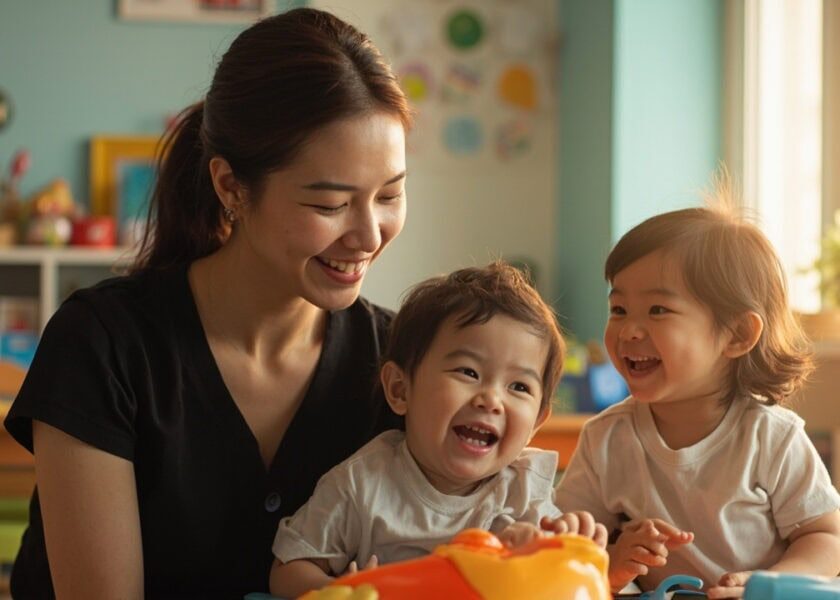
When a caregiver sits beside a child during snack time and says, not in baby talk but in warm, rich, full sentences — You chose the apple slices today. They are cold and crisp. Can you hear how they crunch? — that is not small talk. That is language building.
That caregiver is naming, describing, expanding. The child who hears a hundred sentences a day in a language-rich environment develops a vocabulary, a syntax, a relationship with language that forms the foundation for all future communication, including reading.
And it is not only the caregivers. It is the peers.
- When two toddlers negotiate over a toy truck
- When a three-year-old tells a companion you can’t have that one, I am using it
- When a younger child points and an older child says that’s a dog, it says woof
This is social language, and it is some of the most powerful language learning a child can experience. The peer group is a language environment as much as a social one.
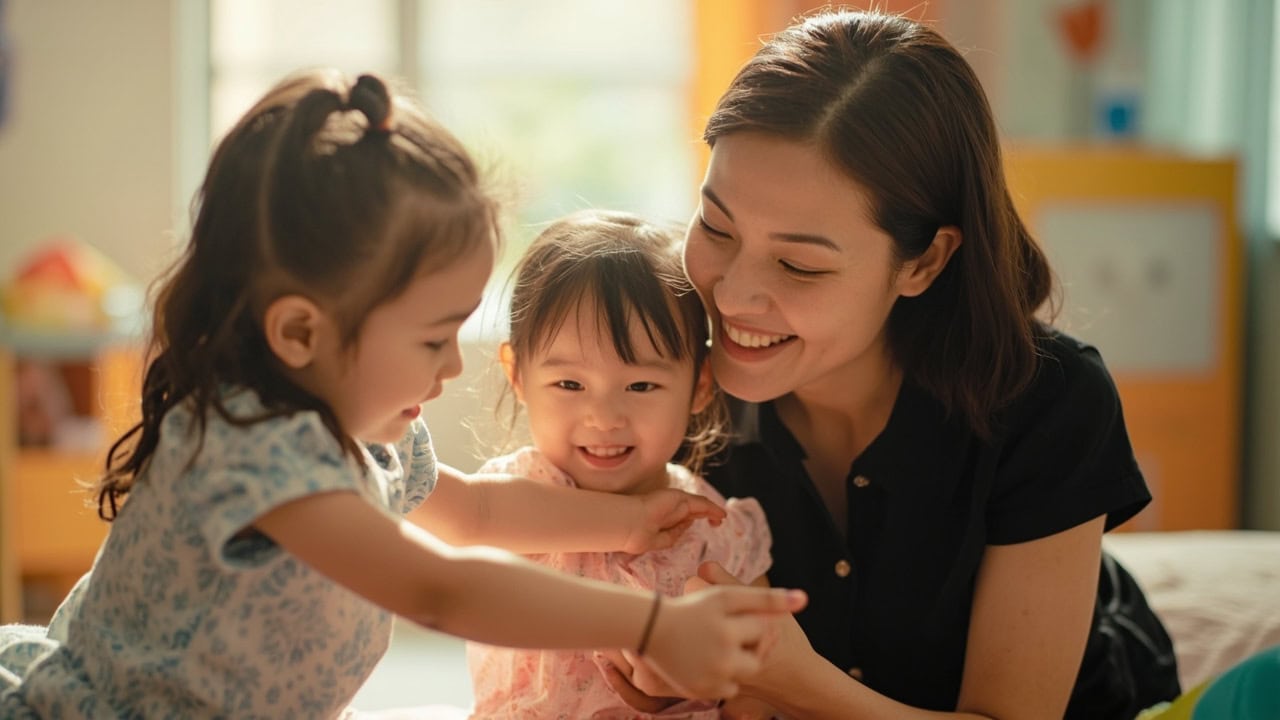
When your child plays alongside another child — not necessarily with them, not yet cooperatively, but alongside — they are learning something no amount of individual attention can teach. They are learning that other people have intentions. That those intentions sometimes conflict with their own. That sharing is hard and wonderful and worth trying. That when another child cries, they might feel something too.
Social-emotional learning happens in the friction of group life. It happens when a caregiver narrates what is happening — I see you both want the red truck. That is hard. Let us think about what we can do — and in doing so, teaches children the vocabulary of emotion and negotiation before they can even articulate those feelings themselves.
It happens in the moment a toddler offers a cracker to another toddler not because anyone told them to, but because they have seen kindness modelled and it felt good and now they are trying it on, the way they try on everything, like a coat they are not yet sure fits.
The peer environment offers not just a place where children are supervised while their parents work, but a small society in which children learn to be human.
The Power of Rhythm: Why Predictability Serves Freedom
Young children do not experience time the way adults do. They live in the present — fully, bodily, intensely. And yet their nervous systems are profoundly helped by something that adults often dismiss as rigidity: predictability.
A child who knows that after the activity comes snack, and after snack comes a story, and after the story comes rest, is a child who is not spending energy on anxiety and uncertainty. They are free.
The day has a rhythm — a sequence of activity and rest, of energy and quiet, of challenge and comfort — that is planned not to suppress the spontaneity children need, but to give them the security from which spontaneity can actually grow.
Structure is not the opposite of freedom. For a young child, structure is its condition.
This rhythm is not rigid. It is responsive. If a group of children is deeply engaged in a block-building session and the scheduled transition is approaching, a skilled caregiver will extend the moment — will let the play reach its natural conclusion rather than interrupting it. The rhythm serves the child, not the clock.
Parents sometimes worry that too much structure will make their child rigid or anxious in new situations. The opposite is closer to the truth. A child who has known reliable rhythm, who has learned that transitions happen and are survivable and often wonderful, develops what educators call regulatory capacity — the ability to move through change without falling apart.
That is not a small thing. That is one of the most valuable gifts a childcare experience can give a child — and consequently, a family.
The Caregiver: The Curriculum Designer in the Room
The caregivers themselves are not incidental to this picture. They are the picture.
A caregiver at quality childcare is not a supervisor. A supervisor watches to make sure nothing goes wrong. A caregiver designs experiences, reads cues, adapts the moment in real time, holds a crying child with one arm while quietly redirecting a dispute with the other, and does all of this with the kind of professional skill that comes from training, experience, and genuine vocation.
The caregiver is the curriculum designer in the room. Everything described above — the sensory table, the language-rich interactions, the rhythm of the day, the social mediation, the morning transition — it all depends on a skilled adult who understands child development deeply enough to make decisions in the moment that serve each child’s individual needs.
That is not something that can be reduced to a checklist. It is professional judgment exercised with care.
EduNanny operates within the framework of the ECDA Childminding Pilot, which reflects Singapore’s commitment to quality in early childhood education — standards that emphasise not just safety and ratio compliance, but the quality of interaction, the responsiveness of care, the intentionality of the learning environment. For Singapore families, this means Monday to Friday care blocks offer the regularity that working parents need, with community care and Baby Bonus schemes available through relevant pathways, and fees structured to be accessible within the pilot framework.
Building Trust: What Quality Childcare Looks Like in Practice
Parents often ask: how do I know I can trust this? How do I know what is actually happening behind that door?
Trust is never just a feeling. It is also a system.
Quality childcare implements communication and transparency measures — including CCTV deployment where applicable — so that parents are not asked to operate on faith alone. You can see the room. You can see the caregivers. You can see the way your child moves through the day.
When the caregiver sends you that update — when you receive a photo of your child at the art table — you will know what you are looking at. You will know it is documentation of a small, intentional lesson in colour, texture, and the pride of making something that did not exist before.
If you are researching childcare options in Singapore, here are the questions that matter most:
- How does the morning transition work? Look for intentional handover rituals, not hurried exchanges.
- What does a typical day look like? Quality care has rhythm — predictable sequences that children can learn to anticipate.
- How do caregivers interact with children? Watch for language-rich responses, not just directive language. Are they narrating, expanding, and connecting?
- What is the ratio? Fewer children per caregiver means more individual attention and language exposure.
- How is play treated? If play is seen as the vehicle for learning, not separate from it, you are in the right place.
- What training do caregivers have? Professional development and understanding of child development should be visible in their practice.
The Hours Apart Are Not Hours Lost
No childcare programme, however excellent, replaces a parent’s presence. No caregiver, however skilled, is you.
The hours your child spends in quality childcare are not a substitute for your love. They are an extension of it.
You chose this arrangement not because you wanted to be apart from your child but because you wanted to build a life in which your child could thrive — a life that includes your work, your contribution, your own growth as a person. And your child’s care needed to be worthy of that love.
What quality childcare offers is this: the assurance that the hours apart are not hours lost. That while you are doing what you need to do — and what you do matters, do not let anyone make you feel otherwise — your child is in a place designed not merely to keep them safe, but to help them grow.
That every hand-washing moment is a language lesson. That every peer interaction is a social education. That every transition, every routine, every carefully prepared sensory experience is a brick in a structure that is being built inside your child, right now, during the hours you cannot see.
That structure will not be visible for years. But it will be there.
And one day — when your child walks into their first day of primary school and navigates the social complexity of a new classroom, when they persist at a problem instead of giving up, when they have the language to say I am feeling frustrated and I need help — you will know that the foundation was laid not only at home, in those precious hours you had with them, but also in this place, during this time, in the designed and intentional hours of their quality childcare day.
The question you asked at the door this morning — What is my child doing right now? — deserves an answer that goes beyond a photograph.
Your child is learning. Actively, intentionally, beautifully learning.
And you are part of that. You chose it. You built it. You trusted it.
That is not something to feel guilty about. That is something to feel proud of.
EduNanny Singapore walks this path with families — not as a service you hire, but as a partner you trust. And we take that trust seriously, every single day, from the moment the door opens in the morning to the moment your child is handed back into your arms at the end of the afternoon — tired, full, changed a little, growing always, and ready to go home with you.
If you are ready to learn more about how EduNanny Singapore designs each hour of your child’s day, we invite you to reach out and start a conversation.
To learn more about who we are and the standards we hold ourselves to, visit our About page. Or explore our homepage to see how EduNanny approaches quality childminding for Singapore families.