What Your Infant Caregiver Teaches You About Your Child
The Gap Every Working Parent Knows
The instinct to understand your child is not new. Parents have always watched their children, always wondered what was happening behind those shifting eyes. But in Singapore, where the pace is relentless and the days are structured around obligations, that instinct often has nowhere to go.
You watch your child at the end of the day—but you are watching someone who is tired, who has been in someone else’s care, who is performing the rituals of reunion rather than showing you the unguarded hours in between.
And so you do what you can. You ask questions. You scroll through photos on the app. You read the daily update, if there is one, and you feel grateful for it. It is information. It is something. It matters.
But here is what years of working alongside parents in Singapore have taught us: information is not the same as understanding. Updates are not the same as observation. And a report at the end of the day is not the same as developing the skill to read your child in the moment—on your own, with growing confidence and clarity.
Observation Is a Skill, Not a Gift
There is a quiet assumption that some parents are naturally better at reading their children than others. That intuition is innate. That if you feel uncertain, you simply lack whatever quality confident parents seem to possess.
This assumption is wrong.
Observation is not passive. It is not simply being in the same room and looking. Observation is an active practice—a way of attending to the world that takes intention, language, and crucially, modeling.
And modeling is where quality infant care makes its deepest contribution.
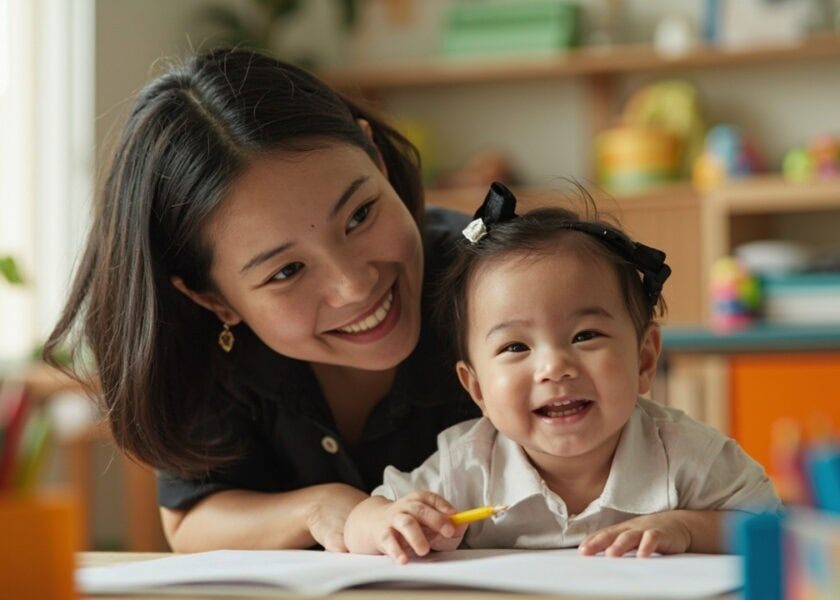
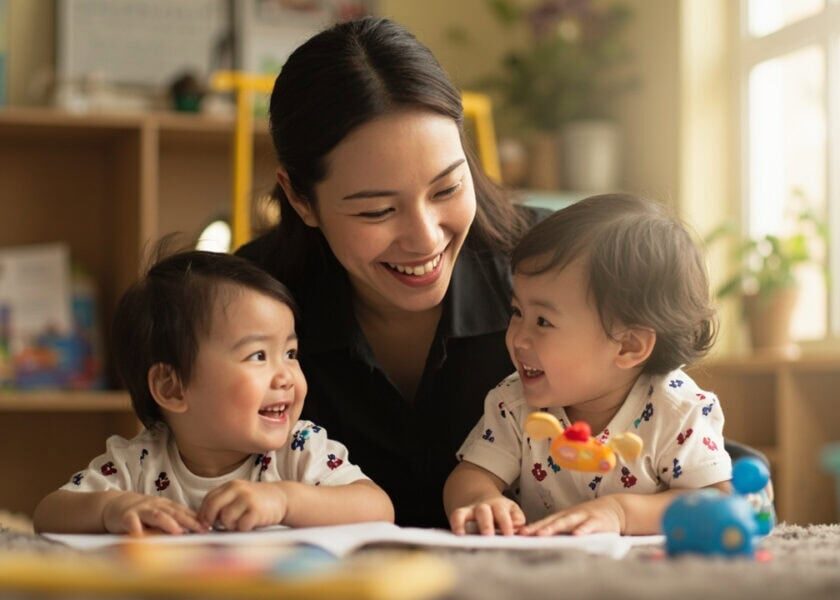
When you enroll your child in care with trained observers, something quietly begins. At pickup, your caregiver tells you about the morning. But she does not just tell you what happened. She tells you how your child responded. She notices the moment your child’s face changed when a new toy was introduced. She tells you that yesterday, your child reached for comfort, but today, your child reached for independence. She notices the difference. She has the language for it.
This language begins to enter your vocabulary. Not as a lecture, not as a debrief, but as a conversation between two people who are both watching the same child. Slowly, without your realizing it, you begin to see what she sees.
A few weeks pass. You pick up your child and you notice something: a slight tightness around the eyes, a different quality of exhaustion. You think about what your caregiver mentioned last week about teething—how it affects sleep, how it changes a child’s threshold for frustration.
And suddenly, tonight’s meltdown is not a mystery. It is information you can read. It is your child, and you are understanding why.
This is the beginning. The first moment you realize that something has shifted. You are not just receiving updates anymore. You are beginning to develop your own eye.
What Changes in Your Evenings
The frantic question-and-answer session of dinner and bathtime and stories becomes something else. You are still tired. You still have to cook, to clean, to manage the logistics of a household. But you are also carrying something new.
You are carrying the language of your child’s day. You are asking better questions. Not “how was your day?”—which no child under three can answer meaningfully—but “tell me about the blocks. Were they the big ones or the small ones? What did you build?”
And because your child cannot yet construct long narratives, you fill in the gaps with the observations you have been given. You know about the blocks. You know about the moment your child shared a toy. You know about the new sound they made when they discovered they could bang the spoon on the tray.
This is not just conversation. This is attunement. This is your child feeling—perhaps for the first time in a way they can sense—that you know them. Not a vague, parental knowing, but a specific, daily knowing.
Children are exquisitely sensitive to whether they are being seen. When you meet your child with real observation, with the language that comes from paying attention, they feel it. They lean in. They share more. They trust more.
The relationship deepens not because you love them more, but because you understand them more—and they know the difference.
Once the lens of observation is given to you, you cannot unsee it. You carry it home. You carry it into the evenings, into the weekends, into the years that follow. You begin to notice your child’s cues with growing precision:
- The way their hand reaches for their ear before a yawn
- The way their voice changes pitch when they are genuinely delighted versus when they are performing delight
- The way their body orients toward you or away from you when they are overwhelmed
- The subtle shift in energy that signals hunger before hunger becomes meltdown
- The difference between tired-cranky and frustrated-cranky
You learn to read these signals because someone taught you what to look for. Because someone showed you that the signals are there—that the language is always speaking, if you know how to listen.
What Quality Infant Care Actually Looks Like
Many childcare centres offer daily updates. Photos. Brief notes on meals and naps. This is valuable. Parents deserve to know what happened in their child’s day.
But reports tell you what happened. They do not teach you to see.
The difference matters enormously. A report says: “Aria played with the blocks today.” An observation says: “Aria tried to build a tower three times today. The first two times, she knocked it down herself. The third time, she asked me to knock it down so she could start again. That’s new—she wanted the ritual of destruction.”
That second version gives you something to work with. It gives you language. It gives you entry points for questions. It teaches you what to look for.
This is what distinguishes quality care from adequate care. Not the number of photos, not the length of updates, but whether the communication is designed to grow your capacity as an observer—or merely to inform you.
In Singapore, the Early Childhood Development Agency (ECDA) launched the Childminding Pilot to expand options for families with infants and toddlers. Providers in this pilot are committed to specific standards of care, training, and oversight—because the youngest children need more than supervision. They need attentive, trained care that recognizes and responds to individual needs.
Here is what to look for, and why it matters:
- Appropriate ratios: For infants, a maximum of one caregiver to three children ensures attention is not diluted. When ratios are higher, observation becomes impossible.
- Trained caregivers: Caregivers trained in reading infant cues, documenting developmental milestones, and communicating not just what happened but what it meant.
- Meaningful communication: Daily updates that serve a purpose beyond compliance—updates designed to help parents understand, not just know.
- Partnership orientation: The caregiver relationship is not transactional. It is a partnership where both parties are watching the same child and learning from each other.
Quality care can exist in both home-based and centre-based settings. Home-based care offers a smaller, more intimate environment. Centre-based care offers structure and peer interaction. The right choice depends on your child, your family, and your needs. What matters most is not the setting but the quality of observation within it.
EduNanny’s Approach to Infant Care in Singapore
We are part of the ECDA Childminding Pilot, which means we are committed to the standards and oversight that comes with that designation. We offer both home-based and centre-based pathways, because families are different and needs are different.
Our ratios are carefully maintained—up to one to three for infants—because attention cannot be diluted. Our fees are structured to be accessible within the pilot framework. CDA and Baby Bonus are usable, because we want quality care to be accessible.
But here is what cannot be captured in a list of features: the culture of observation that defines how we work.
The training our caregivers receive is not just about safety protocols or curriculum delivery. It is about reading infant cues. It is about documenting developmental milestones with precision. It is about communicating with parents not just what happened, but what it meant.
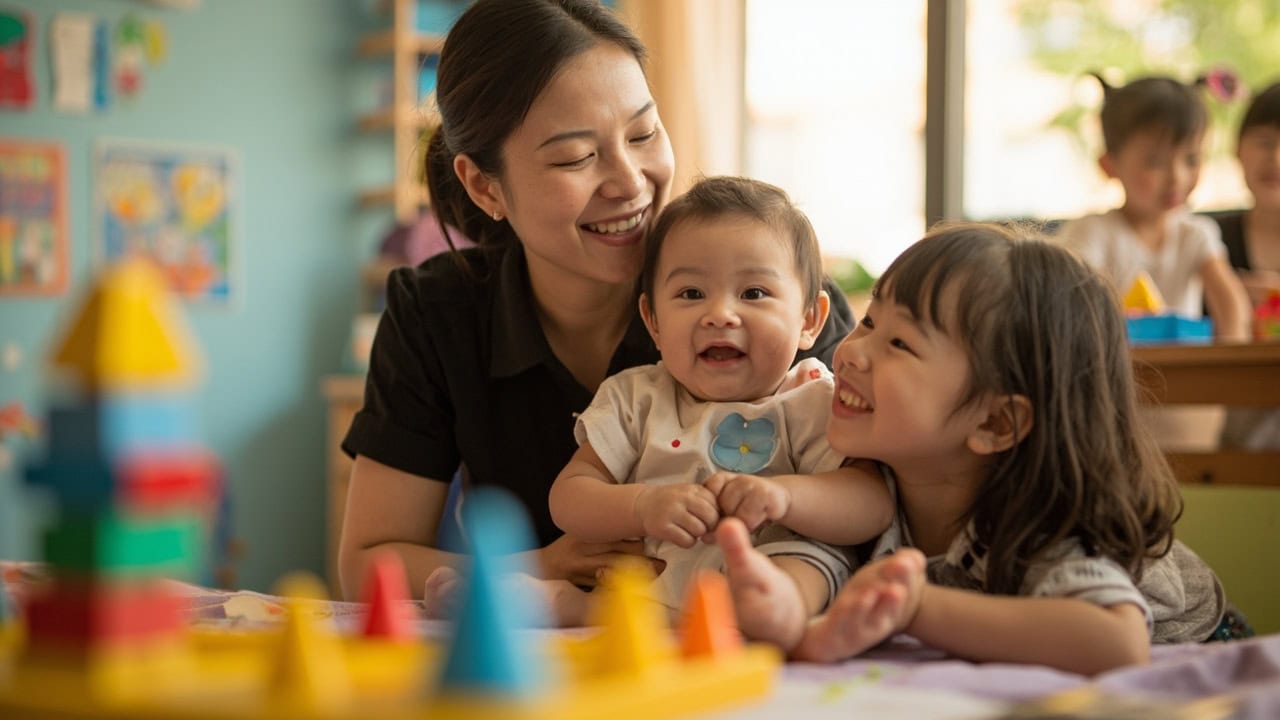
The caregiver is not a replacement for you. The caregiver is an extension of your attention, a model for your observation, a partner in your child’s development—and yours.
Questions to Ask When Choosing Infant Care
If you are researching infant care or childminding in Singapore, these questions will help you distinguish quality from adequacy:
- Ask about caregiver training. Not just certifications, but specific training in observation and communication. How do caregivers document development? What language do they use when describing a child’s day?
- Observe the pickup conversation. If you can, linger at pickup. Watch how caregivers speak to other parents. Are they describing behavior or just reporting activities?
- Notice the ratios. For infants, one to three is the standard for quality attention. Anything higher should raise questions.
- Ask what happens if your child is upset. How does the caregiver respond? What is the approach to soothing and understanding, rather than just managing?
- Trust your instincts. You are learning to observe. If something feels off during a visit, pay attention to that feeling. Your growing observational skill is already working.
Common Parent Concerns
“Am I failing my child by putting them in care?”
No. This is the condition of modern parenting in Singapore. You are not less devoted because you were not present for every hour. What matters is not whether your child is in care, but what kind of care they are in.
“How do I know if the caregiver is really observing?”
Ask questions at pickup. Not just “how was their day?” but “what was their mood like this morning?” “Did you notice anything new?” “How did they respond when…” A caregiver trained in observation will have answers that reveal process, not just outcomes.
“Will this actually help me become a better parent?”
The observation skills you develop through quality childcare are not temporary. They compound. They grow with your child. When your child is two, you can read their frustration. When they are four, you can read their social anxiety. When they are six and starting school, you can read the signs of struggle before anyone else sees it.
The eye you develop in those early years becomes a permanent part of your parenting toolkit—a gift that keeps giving, a skill that shapes your relationship with your child for the rest of your lives.
The Quiet Education
This is the quiet education that no one told you would come with infant care. You enrolled your child because you needed support. Because you needed someone to care for them while you worked, because Singapore demands that parents work, because the system requires it and there is no shame in it—only reality.
You needed a place where your child would be safe, and warm, and stimulated, and loved.
And all of that is true. That is the foundation.
But what happens on top of that foundation, when the care is exceptional, when the caregivers are trained in observation, when the communication is genuine and consistent—what happens is something more. You become a more capable parent. Not because we told you what to do, but because we showed you how to see.
So let us return to that moment. The pickup. The end of a long day. You walk in, and your child runs to you, or clings quietly, or shows you something they made with that particular pride that means they want you to see.
And you look at them, and you see.
You see the slight fatigue around their eyes. You see the way they are holding themselves differently than yesterday. You see the new confidence in how they move, or the new hesitation, or the new obsession with something small that has become enormous in their world.
And you know. Not because someone told you. Not because you read it in a report. But because your eyes have learned.
The skill that turns love into understanding. The skill that turns a parent into a partner in their child’s life, not just a visitor to it.
You already love your child. That was never the question. The question was whether you had the tools to know them in the way your heart was asking for.
And the answer, if you let us walk alongside you, is yes.
Begin the Conversation
If you are researching infant care or childminding in Singapore, we invite you to learn more about what EduNanny offers. Not as a list of features to compare, but as a relationship to consider—a partnership designed to support your child and, quietly, to support you.
Reach out to us. Visit. Ask questions. Watch how we speak about the children in our care. See for yourself what it looks like when observation becomes a practice, a language, and a gift.
You deserve more than survival. You deserve to feel capable, confident, connected. You deserve to walk into a room with your child and know—with a bone-deep certainty—that you understand what is happening in their mind and heart.
That is what we believe in. That is what we are here for.
To learn more about our approach, read about EduNanny or get in touch to schedule a visit.