What Your Child Is Quietly Learning About Emotional Intelligence
What Relational Intelligence Actually Means
There is a moment every parent in Singapore knows. You pull up outside the childcare centre, and your child—who just weeks ago screamed at the gates, who you had to pry off your hip with both hands—now turns to look at you. There is something different in their face. They are not anxious anymore. They look at the caregiver waiting at the door, and they go. They walk toward her, and they go.
You stand there in the car park, and you feel something you did not expect. Pride, yes. But also something more complicated. You feel the strange, tender ache of watching your child not need you in exactly the way they used to. And somewhere beneath that, a question you may not have ever said aloud: what is my child becoming in the hours I am not there?
That question is not small. It is the question that keeps Singapore parents awake at night. It is the question that sits behind every drop-off, every reassurance you give yourself that this is the right choice, every time you pick your child up and search their face for signs of damage or distress.
You have been told, in a thousand indirect ways, that what happens in your absence matters. And so you worry. You wonder if the hours you spend at work are hours your child is somehow losing—losing connection, losing warmth, losing the relationship that matters most.
I want to tell you something that I believe with my whole professional being, and that I hope will settle something in you as well. Your child is not losing anything in those hours. Your child is building something. Something vital. Something that you, as their parent, could not give them alone even if you wanted to. And the place where this happens—the right place, the quality place—is where your child’s relational intelligence is quietly, profoundly taking shape.
What it looks like in a toddler
Relational intelligence is not a term you will find in most parenting books, and that is a shame. We talk so much about cognitive development, about language milestones and motor skills and school readiness. But the capacity to understand other people, to manage your own emotional world, to feel safe entering a room full of strangers and come out having made a friend—this is a skill. It has a name. It develops through specific experiences, in specific kinds of environments, during specific windows of early childhood.
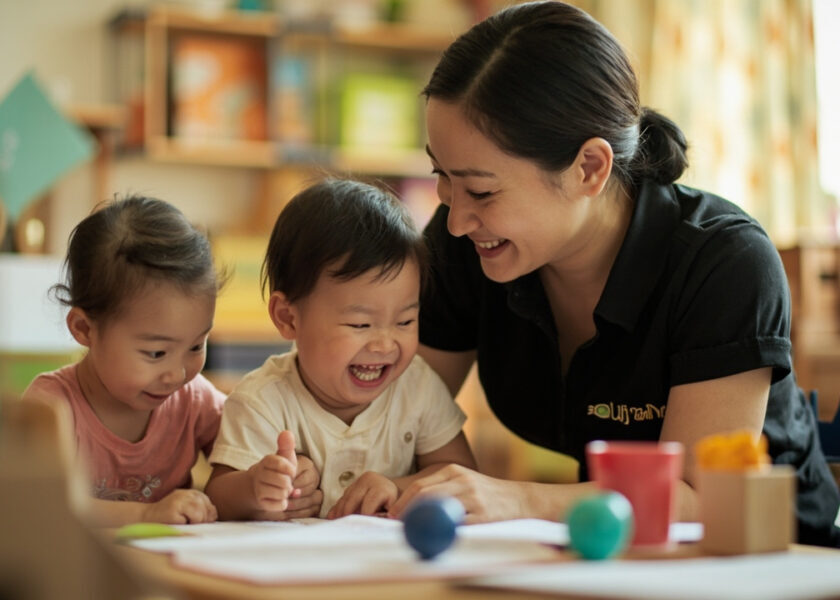
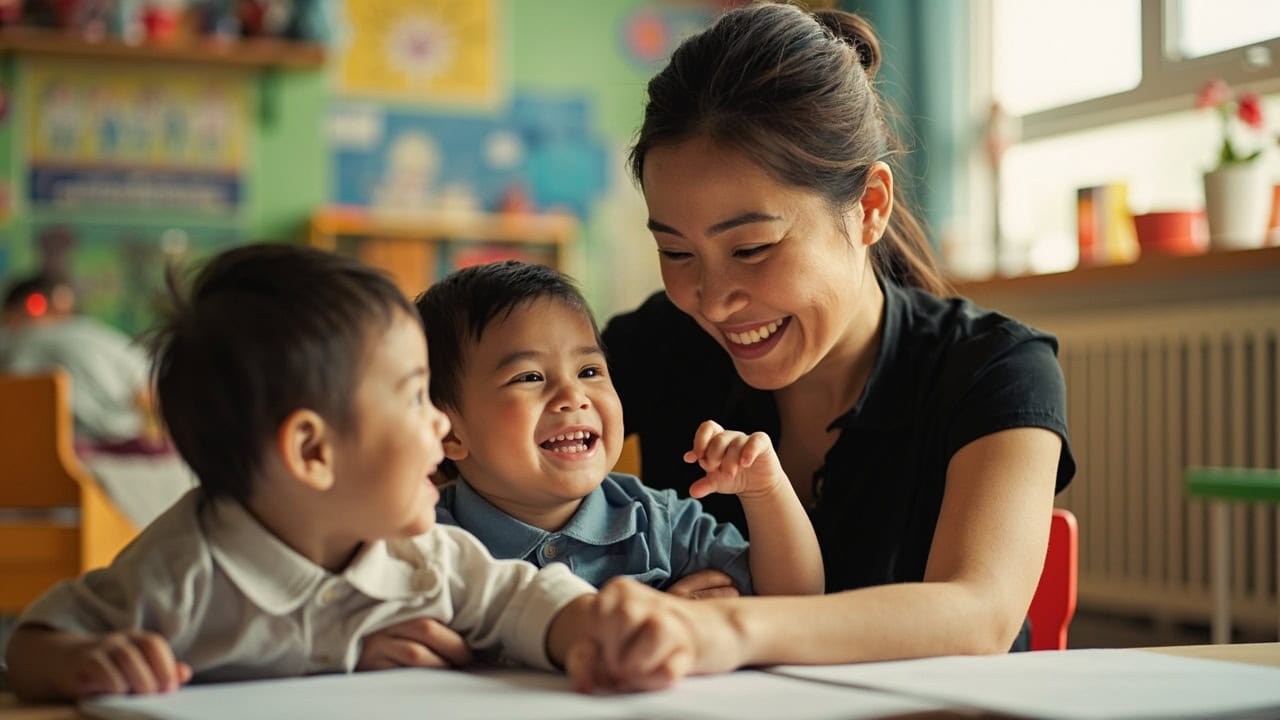
A child who can notice that another child is upset. Who does not yet have the words for this, but who notices—the softening of the face, the change in voice. And who responds, not perfectly, but genuinely. A toy offered. A hand placed gently on a shoulder.
This is not instinct. This is learned. It is learned in environments where children see adults do this, where they are helped to notice and named and guided through it. Where a caregiver might say, “Siti looks sad. Her eyes are wet. Let’s see if we can help her feel better.”
This is emotional vocabulary. This is the beginning of empathy. And it is happening in quality childcare settings, quietly, every day.
The Invisible Curriculum in Quality Childcare
Now here is what most parents fear, and I want to name it plainly because it deserves that. You fear that your child’s heart is a fixed vessel, and that the hours you spend apart are leaking something essential out of it. You fear that another adult, however kind, cannot hold your child’s emotional world the way you can. You fear being replaced—not consciously, not foolishly, but in the deep places where parenthood lives. You fear that your child will look at the caregiver and need her the way they need you.
Here is the truth that quality childcare teaches us, and that the research confirms: this fear is based on a misunderstanding of how children form healthy attachments.
The foundation: trust built through reliable response
Secure attachment is not about one person. It is about consistency, responsiveness, and warmth. A child can be securely attached to more than one adult. In fact, children who are given the gift of multiple caring relationships in their early years tend to be more flexible, not less. They learn that the world contains people who can be trusted. They learn that care is not a finite resource that runs out when shared.
Your infant, at fifteen months, is learning something enormous. They are learning that when they cry, someone comes. Not always the same someone. But someone. This is the foundation of trust. Not the specific face, but the reliability of the response.
In a setting with a one-to-three infant ratio, this is possible. Your child is not lost in a group. They are known. The caregiver knows their rhythms, their preferences, the particular sound they make when they are tired versus hungry. This knowledge does not replace yours—it complements it. It means your child has a web of understanding around them, not just a single thread.
Conflict as a classroom
Now watch what happens when that same child, now two and a half, encounters a conflict. A peer has taken their toy.
In a quality setting, the caregiver does not immediately fix it. They move close. They name what is happening. “I see Mei Mei is holding that truck and Kai wants to play with it too. This is hard.” They stay. They hold the space. They do not solve the problem for the children, but they prevent it from escalating into something scary.
And slowly, over months, the children begin to do this for each other. They learn, through repetition, through the witness of caring adults, that conflict is not the end of a relationship. That feelings can be large and still be survived. That there are words for what they are feeling, and those words make the feelings smaller, manageable, human.
The scaffolding of emotional intelligence
When a caregiver says, “Adi is working so hard to fit those shapes in the box. That red one is tricky! You’re feeling frustrated because it keeps falling out. Let’s try together”—this is not small talk. This is the scaffolding of emotional intelligence.
This is a child learning that their feelings have names, that frustration is survivable, that an adult can help without taking over. And it happens hundreds of times in a year, in a quality setting, with a caregiver who has the time and the training to do it well.
The child who runs to their caregiver is not betraying you. They are showing you that they have learned something you wanted them to learn: how to trust a wider world.
What Quality Care Gives Your Child
Let me tell you what this looks like in practice, because this is not theory. This is what happens in a well-staffed, well-designed infant and toddler environment, when the ratios are right and the caregivers are trained and the culture is one of warmth and intentionality.
When we speak about relational intelligence, we are speaking, ultimately, about the adults who make it possible. These are not babysitters. They are not stopgaps. They are professionals who have chosen to do one of the most important and undervalued jobs in our society: to stand in the place of care for other people’s children, day after day, with patience and attention and love.
The training they receive is not incidental—it shapes how they hold a crying infant, how they mediate a tussle over blocks, how they narrate a child’s experience back to them so that the child begins to understand their own inner world.
Their warmth is not a bonus. It is the product. Their patience is not a personality trait. It is a skill, cultivated through training and supported through reasonable ratios and a culture that values what they do.
At EduNanny, this understanding shapes everything. The caregivers are not interchangeable parts. They are the curriculum. They are the ones who translate relational intelligence from a concept into an experience your child lives every day.
Addressing Singapore Parents’ Real Concerns
You may be wondering whether the kind of care I am describing is something only certain families can access, something that exists in aspirational pamphlets but not in real Singapore. I want to address this directly, because it matters.
Accessibility
EduNanny operates within the ECDA Childminding Pilot, and this is significant. It means the model is designed not just for excellence, but for accessibility. The pilot fee structures are within reach for families across Singapore. There are pathways available—home-based care and community or centre-based options—because families are not all the same, and neither are their needs.
CDA and Baby Bonus funds can be used, which means the government has already recognised that this kind of quality care is not a luxury but a public good.
Communication and transparency
Communication is a priority. In the settings where EduNanny operates, transparency is not an afterthought—it is part of the contract with families. Parents receive regular updates, meaningful updates, not just photos of smiling children but genuine windows into what their child is experiencing, who they are playing with, what skills are emerging.
Where CCTV measures are deployed, they are deployed not as surveillance, but as trust infrastructure—evidence that there is nothing to hide, and that the door, metaphorically, is always open.
Reliable schedules and ratios
The care blocks run Monday to Friday, because Singapore parents need predictable, reliable schedules to build their lives around. And the ratios—for infants, up to one to three—are built into the model precisely because this kind of relational depth cannot happen in crowded rooms where children are merely supervised. It happens when children are known. When there is time, and attention, and the quiet spaciousness that allows a caregiver to notice the child who is starting to get frustrated before the frustration becomes a meltdown.
What to Look For When Choosing Infant Care in Singapore
If you are beginning to research your options, here are the questions that matter most:
- What are the infant-to-caregiver ratios? For infants, one-to-three is ideal. Anything higher makes individual responsiveness difficult to maintain consistently.
- How do caregivers respond to distress? Ask them to describe a recent moment when a child was upset. Listen for language that validates the feeling and offers co-regulation, not just distraction.
- How do they handle conflict between children? You want to hear words like “name,” “hold space,” “stay close,” “help them find words.” You do not want to hear that conflicts are “resolved quickly” by adult intervention.
- What does communication look like? Will you receive genuine updates about your child’s day, their relationships, their emerging skills? Or only photos and log sheets?
- What training do caregivers receive? Look for settings where training is ongoing, not a one-time qualification.
- Are CDA and Baby Bonus funds accepted? If a programme is quality-focused and accessible, they typically are.
Your Child Is Becoming Someone Who Knows How to Be in the World
So let me bring this back to you, the parent in the car park.
You dropped your child off this morning, and your child went willingly. They may have looked back at you—children always do, even the most confident ones—but they did not need you to come with them. They walked toward something they trusted.
And here is what I want you to know: that trust is not a failure of your bond. It is an expansion of it. Your child is learning that they can love more than one person, trust more than one person, belong to more than one place. This is not a threat to your relationship with them. This is the relationship you wanted for them—the ability to engage with the world without fear, to approach strangers with cautious optimism, to believe that the world contains people who will catch them.
When your child starts primary school, they will walk into a room full of twenty-five other children. They will need to read social cues. They will need to manage disappointment and exclusion and the thousand small hurts of childhood social life. They will need to know that an adult can help without solving everything, that another child can be both a competitor and a friend, that feelings are manageable and relationships are repairable.
This is not something you can teach them alone, in the hours you have together at home. It is not something a screen can teach them. It is something they learn by doing—by practicing, by failing, by trying again. By being in a group of peers, with a caregiver who creates the conditions for safe experimentation with human connection.
The question you asked yourself in the car park—”what is my child becoming in the hours I am not there?“—has an answer now.
Your child is becoming someone who knows how to be in the world. Someone with the emotional vocabulary to name what they feel, the social confidence to approach what they fear, the relational intelligence to build the bonds that make a life worth living.
The caregiver at the door? She is not your replacement. She is your partner. She is widening the circle of safe people in your child’s life. She is holding a piece of your child’s heart while you do what you need to do, and she is holding it carefully, and she is giving it back to you, over and over, a little stronger each time.
Your child is building relational intelligence right now, in the hours you are apart. And if you have chosen well—if you have found a place with the right ratios, the right training, the right culture of warmth and intentionality—then your child is building it in good hands.
That is what EduNanny is here for. That is why this work matters. And that is the truth I hope you will carry with you, not as reassurance, but as knowledge: your child is exactly where they need to be, and they are becoming exactly who they are meant to become.
Begin the Conversation
If you are ready to explore what quality, relationship-centred infant care looks like for your family, we invite you to reach out. Our team is happy to walk you through the options available under the ECDA Childminding Pilot, including how CDA and Baby Bonus funds can be used, and what our ratios and communication practices look like in practice.
We know you are asking the right questions. Let us help you find the right answers.
Ready to learn more? Get in touch with EduNanny today.
You can also learn more about who we are and the standards we hold ourselves to, or visit our homepage to explore what EduNanny offers for Singapore families.