The Sensory Motor Skills Your Child Needs Before Primary One
What School Readiness Actually Means
When a child learns to climb, to balance, to pour water from one cup to another, to squeeze clay, to push a toy cart up a ramp and watch it roll down—what is happening?
You might say they are playing. You might say they are exploring. And you would be right. But beneath that play, something far more essential is taking place. Their brains are building the architecture for learning itself.
This is not a claim made lightly. Decades of developmental research have converged on a truth that remains surprisingly absent from most conversations about school readiness: sensory-motor development is the primary predictor of a child’s readiness for formal learning.
Consider what is actually required for a child to thrive in a Primary One classroom. They must sit upright with proper posture. They must track text across a page with their eyes while coordinating hand movements to write. They must filter background noise—the hum of the air conditioning, the shuffling of chairs, the murmur of classmates—and focus on the teacher’s voice. They must regulate their emotional responses when frustrated, tired, or overstimulated.
They must process visual, auditory, tactile, and proprioceptive information simultaneously, all while attempting to learn. Each of these capacities depends on a sensory-motor system that has been properly developed. Not trained. Not drilled. Developed—through thousands of hours of movement, exploration, and sensory experience in the years before Primary One.
Studies following children through their early years and into Primary One consistently show that motor skills predict academic performance more reliably than early academic knowledge itself. A meta-analysis published in Early Education and Development found moderate to strong correlations between fine motor skills and academic achievement across literacy and numeracy domains. Research from Learning and Individual Differences similarly demonstrated that visual-motor integration in preschool significantly predicted reading and math performance in the early primary years.
Why does this relationship exist? The explanation lies in how the brain develops. Motor and cognitive development are not separate systems—they are deeply interconnected. When a child practices reaching for and grasping objects, they are simultaneously developing the neural pathways that will later support hand-eye coordination for writing. When a child climbs and balances, they are building the core strength and postural control needed to sit upright at a desk. When a child engages in sensory play, they are training their nervous system to process and integrate the flood of information that a classroom environment provides.
A child who enters Primary One with strong sensory-motor foundations tends to navigate the physical and social demands of school with greater ease. This frees cognitive resources for actual learning. A child who enters without these foundations may have the intellectual capacity to succeed but find themselves constantly fighting against a body that has not been properly prepared.
The Five Foundations of School Readiness
When researchers talk about sensory-motor development, they are referring to a cluster of interrelated capacities that work together to support learning:
Sensory Integration
The ability of the nervous system to receive, organize, and respond to sensory input from the environment. A child with well-developed sensory integration can filter irrelevant background stimuli and focus on what matters—like the teacher’s voice in a noisy classroom.
Motor Coordination
The ability to plan and execute movements smoothly and efficiently. This includes both gross motor skills (running, climbing, jumping) and fine motor skills (grasping, manipulating objects, eventually writing).
Body Awareness
Also known as proprioception—the sense that tells a child where their body parts are without looking at them. This is what allows a child to navigate a crowded classroom without bumping into furniture, or to place their hands correctly on a pencil.
Physical Confidence
The emotional and psychological comfort in one’s own body that allows a child to take on new physical challenges without anxiety. This confidence is built through successful physical experiences over time.
Self-Regulation
The capacity to manage one’s own emotional and physiological responses to stimuli. This is closely tied to sensory integration—a child whose nervous system is overwhelmed cannot easily regulate their emotional state.
These are not soft concepts. They are the concrete, measurable foundations upon which all academic learning eventually sits.
How Quality Childcare Builds These Foundations
So what does quality childcare do that creates this readiness? It does not happen by accident. It happens through intention—through a curriculum that understands the body as the first and most essential teacher, and through daily experiences that seem, on the surface, like simple play, but are in fact sophisticated learning opportunities.
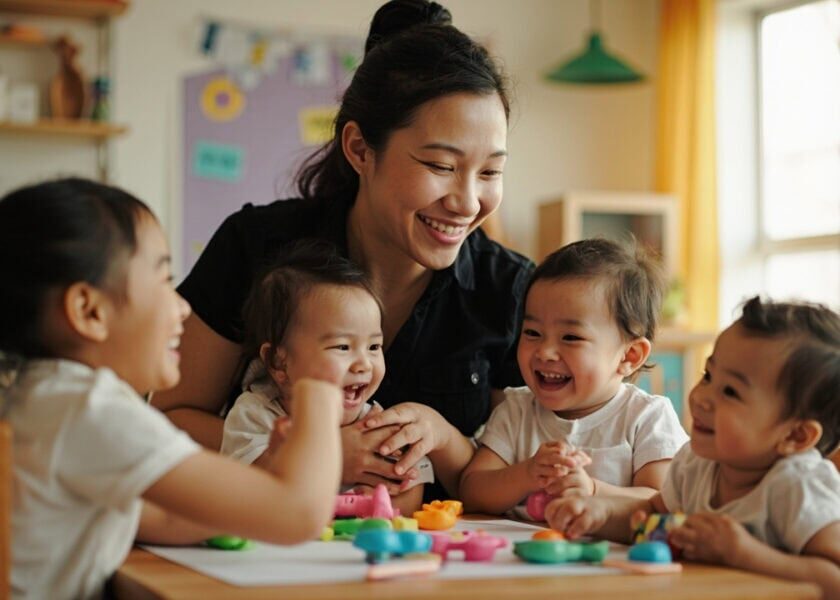
Consider a morning in a quality childcare environment. The children are not seated at desks. They are moving. They are climbing structures that challenge their balance and strengthen their proprioception. They are crawling through tunnels that provide deep pressure input to their nervous systems, helping to organize sensory responses. They are playing in sandpits and water tables, experiencing textures that train their tactile systems to discriminate between different sensations. They are engaged in arts activities that require grip, pinch, and coordination—building the fine motor skills that will later enable them to hold a pencil.
None of this feels like work to the child. It feels like fun. But the brain is busy building neural pathways that will serve every future learning task.
When evaluating childcare options, look at the children. Look at how they move. Look at the physical environment:
- Is there space for gross motor play—both indoors and outdoors?
- Are there opportunities for sensory exploration—textures, sounds, movements, pressures?
- Is the environment designed to engage the body as well as the mind?
- Are children given freedom to climb, run, jump, and explore, or are they expected to sit still for extended periods?
- Are there materials for sensory play—playdough, sand, water, textured objects?
- Are fine motor activities woven throughout the day, not confined to a single station?
These are not luxuries. They are the curriculum that builds school readiness. And you have every right to ask about them.
A Tale of Two Children
Let me paint a picture with two children entering Primary One at age seven.
Child A has been enrolled in academic enrichment since age three—phonics, mathematics, creative writing, Mandarin tuition. By P1, they may read fluently and know their numbers well.
Child B has spent these years in quality childcare with a rich curriculum built around movement, sensory exploration, and physical play. By P1, they may not be as far ahead academically.
But watch them both in the classroom.
Child A sits at their desk, eager to learn but quickly fatigued. Their hand tires easily when writing. They are distracted by the hum of the air conditioning and the movement of their classmates. They find it hard to sit still for extended periods. When the academic edge fades—as it often does when curriculum catches up—their confidence fades with it.
Child B settles into their seat with ease. Their posture is natural, their core strong. When they write, their hand moves smoothly across the page. When the teacher speaks, they can focus because their auditory system has been trained to filter background noise. When the room becomes noisy, they do not panic. They regulate. They navigate the physical and social demands of school with a groundedness that comes from having spent their early years learning to inhabit and trust their body.
This is not about one child being smarter than the other. This is about one child being physically ready to learn.
EduNanny: Built on This Understanding
For parents in Singapore navigating the practical realities of return to work and the need for reliable, trustworthy childcare, there is a path that aligns with everything shared here about sensory-motor development and school readiness.
EduNanny by BUTLER operates within the ECDA Childminding Pilot, a government-supported initiative designed to give parents access to high-quality, flexible, and affordable childcare options. What makes this approach distinctive is its alignment with sensory-motor development principles.
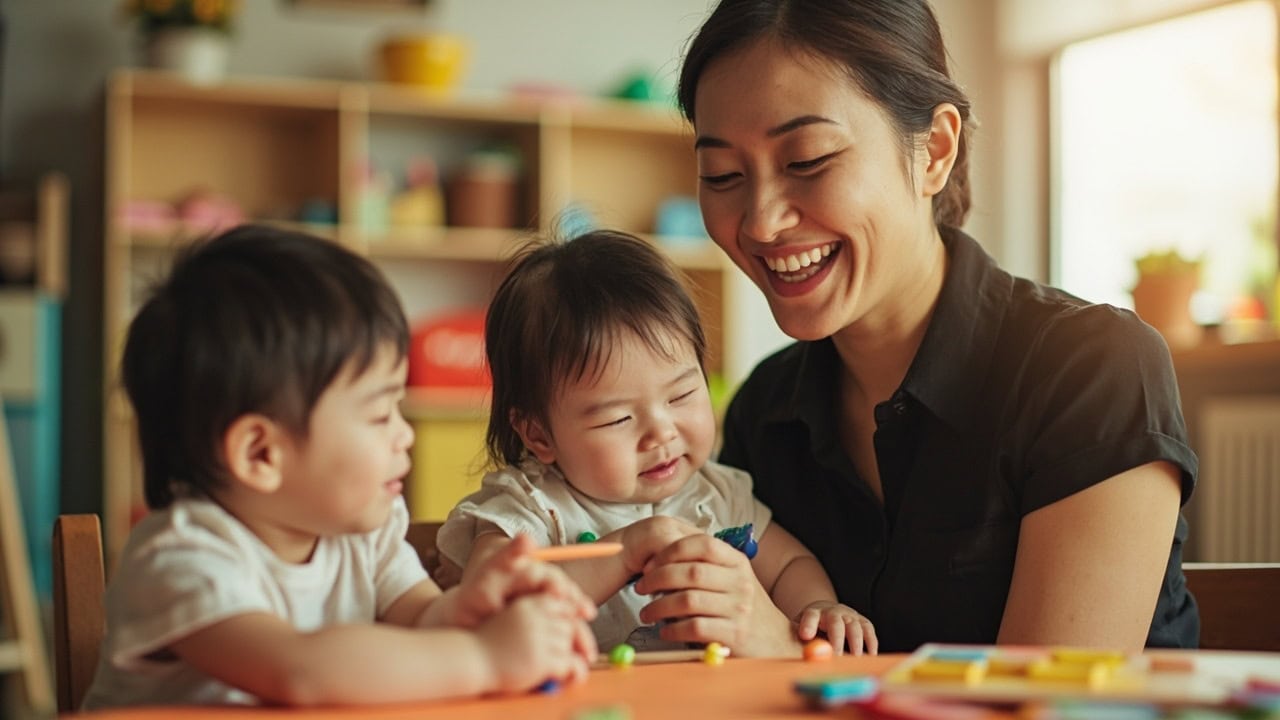
When you choose a childminder through EduNanny, you are choosing a caregiver who is trained and supported to understand your child’s developmental needs. You are choosing an environment—often in a home setting or within community-based arrangements—that can offer something centre-based care sometimes struggles to provide: individualized attention and the ability to follow your child’s natural rhythms of activity and rest.
Infant care ratios within the pilot are designed to ensure that each child receives meaningful engagement. With smaller groups and higher caregiver-to-child ratios, children have more opportunities for sensory experiences, for guided movement, for the kind of focused interaction that builds both physical and emotional foundations.
The practicalities matter too. Care blocks are structured around the working week—Monday to Friday—with flexibility to suit your family’s schedule. Fees are structured to be affordable within the pilot framework, and many families find that their Child Development Account and Baby Bonus schemes can be applied meaningfully. This is a thoughtfully designed option for Singapore families who want quality without compromise.
Because trust is foundational to any parent-caregiver relationship, transparency measures are in place. Communication is prioritized, and many arrangements include CCTV access, allowing you to stay connected to your child’s day without disruption. These are not gimmicks. They are acknowledgments that modern parents need visibility and confidence—and deserve both.
Your School Readiness Checklist
As you visit childcare options, use this checklist to assess whether the environment will support your child’s sensory-motor development:
- Daily outdoor play or gross motor time — builds balance, coordination, core strength, and proprioception
- Sensory play materials accessible daily — supports tactile development and sensory integration
- Fine motor activities woven throughout the day — prepares hand muscles and visual-motor skills for writing
- Freedom to move and explore, not just sit — respects the body’s need for movement in healthy development
- Caregiver-to-child ratios that allow individual attention — ensures your child’s developmental needs are observed and supported
- Caregivers trained in child development — ensures intentional programming that builds readiness
Ask questions. Observe. Trust your instincts. You know your child better than anyone—and you are now equipped with a framework for understanding what truly builds school readiness.
The Gift You Are Giving
In a few years, your child will walk into a Primary One classroom for the first time. There will be forty other children. There will be noise, movement, expectations. There will be a teacher at the front of the room. There will be books and whiteboards and the particular energy of formal education beginning.
Your child will sit in their chair. They will open their notebook. They will listen.
When that moment comes, you will want them to be ready—not just academically, but fully. Bodily. Physically. You will want them to have the posture to sit upright, the focus to listen, the sensory integration to filter the noise, the motor skills to write, the emotional regulation to navigate the social world of the classroom. You will want them to feel confident in their body because their body has been prepared.
This readiness is not something you can purchase in a flash card set or a phonics programme. It is something that is built, day by day, through movement and play and sensory experience. Through a caregiver who understands the importance of letting a child climb and crawl and pour and squeeze and explore. Through an environment that values the body as the first teacher.
When you choose childcare through this lens—through the understanding that sensory-motor development is the true foundation of school readiness—you are choosing a philosophy. You are choosing to trust the wisdom of development, to believe that the body knows how to prepare the brain for learning, and to give your child the gift of a readiness that is real, grounded, and lasting.
The body knows. And when we listen to the body, we give our children everything they need.
At EduNanny by BUTLER, this understanding is at the heart of everything we do—not as a shortcut to Primary One, but as a commitment to laying the physical foundation that makes all future learning possible. One child. One movement. One day at a time.
That is how we move toward Primary One. Not with anxiety, but with confidence. Not with flashcards, but with foundation. Not with pressure, but with trust.
If you are ready to learn more about how EduNanny can support your child’s school readiness journey, we welcome the opportunity to speak with you. Because the best time to build this foundation is now—and you do not have to build it alone.