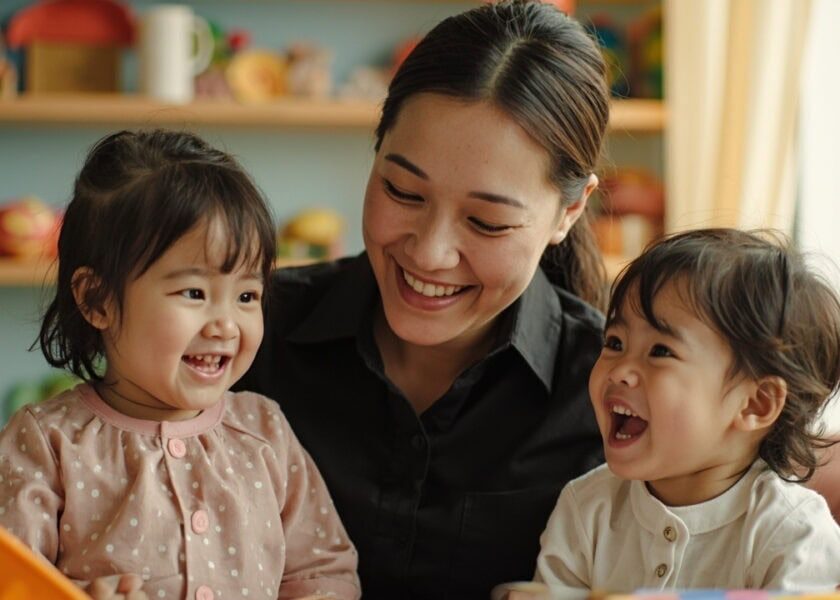
What Really Happens During Your Child’s First Week at EduNanny
The First Goodbye Is Hard. Let Us Show You What Happens Next.
There is a particular moment, experienced by every parent who chooses formal childcare, that stays with them longer than they expect. It happens at the doorway. At the threshold between your arms and someone else’s care.
Your child is watching you. You are watching your child. Somewhere in that exchange is everything you feel about the trust you are being asked to place in a person you have known for perhaps a week. A month at most.
This moment is not dramatic in the way that life-changing moments are sometimes described. It is quiet. It is small. But it carries the weight of every decision you have made about who will care for the person you love most in the world.
You need to know that what you are feeling is not weakness. It is not overprotection. It is the appropriate response to a profound act of trust. And it is the beginning of something that, when done well, becomes one of the most important partnerships of your family’s life.
What the First Week at EduNanny Is Really Like
Here is what we have learned guiding hundreds of families through this exact moment: the first week is not a test to survive. It is a foundation to build on.
- Day 1 begins with an unhurried arrival—no forced separation, no hidden timers. The caregiver builds a picture of your child through conversation and observation.
- After you leave, the caregiver focuses entirely on reading your child’s signals: how they express distress, what calms them, when they begin to settle.
- By Day 3, the caregiver understands your child’s rhythms—sleep patterns, feeding responses, what makes them laugh, how they transition between states.
- You receive specific daily communication: what your child ate, how they slept, moments of engagement, and honest updates about difficult moments.
- By the end of the week, the foundation of a genuine relationship between caregiver and child is visible—not assumed, but earned through attentive presence.
When you walk through our doors—whether at one of our community-based locations or through our home-based pathways—you are not simply handing your child to a stranger. You are beginning a carefully designed process of observation, communication, and adaptation that we have spent years refining specifically for the children and families of Singapore.
The First Morning: Arrival Without Pressure
On the first morning, what you will find is not a rushed handoff. There is time built into the arrival process—not as an accident or as a luxury, but as a deliberate choice.
When you bring your child to us, you will have the opportunity to walk through the space together. To sit with the caregiver who will be responsible for your child’s care. To let your child explore, if they are curious, or to simply hold them close until they feel safe enough to look around.
There is no expectation that adaptation happens instantly. There is no hidden timer that starts the moment you cross the threshold.
The caregiver will speak with you. Not a checklist conversation, but a real exchange about your child:
- What their morning was like
- Whether they slept well
- What their favorite comfort object is, if they have one
- What tends to calm them when they are upset
These questions are not bureaucratic. They are the beginning of a picture that the caregiver starts building from the moment your child arrives. Because a child who feels seen is a child who can begin to relax.
You will notice, if you stay for the early minutes, that the caregiver does not try to take your child from you before your child is ready. There is no forced separation. There is invitation. There is patience. There is the quiet confidence of someone who has done this many times and who knows that the goal is not speed, but trust.
After You Leave: Reading the Signals
When you leave—and we want to be honest with you here, because we believe in honesty above all else—there will likely be tears. Your child’s tears. Perhaps your own.
This is not a failure of preparation. It is not evidence that something is wrong. It is the appropriate response of a child who loves you and who does not yet understand that you will return.
Observation Without Distraction
What happens after you leave is where the design of our approach becomes visible. The first hours at EduNanny are dedicated entirely to observation. Your child’s caregiver is not multitasking. There are no more than three infants in our direct care at any time, and often fewer, which means that the person responsible for your child has the space to notice what needs noticing.
The caregiver observes:
- How does your child respond when they realize you are not returning immediately?
- What is the pattern of their distress? Does it peak quickly and subside? Does it build slowly?
- Does distress express itself through crying, or through withdrawal, or through a fierce need to be held?
These are not warning signs to be managed. They are data. They are the caregiver’s first real information about your child’s unique temperament, their coping style, their way of being in the world.
Why Day Two Can Sometimes Be Harder Than Day One
The adaptation process is not linear. On the first day, your child may be too overwhelmed by the newness to fully express their distress. By the second day, when the novelty has worn off and the reality of the separation has set in, the true adjustment begins.
This is why we never judge a child’s first day in isolation. We look at the arc. We track the pattern over the full first week, and sometimes the first two weeks, before we draw conclusions about how the adaptation is progressing.
Regression and Clinginess: What They Actually Mean
There will be regression. A child who was sleeping through the night may wake more frequently. A child who was eating well may refuse food. A child who was gaining independence in play may suddenly become clingy.
These regressions are not evidence of damage. They are the body’s way of processing stress. When children are adapting to something significant, they often retreat to earlier, more secure patterns—not because they are going backwards, but because they are conserving energy for the work of adaptation.
This is normal. It is expected. And it typically resolves within a week or two as the child gains confidence in the new environment.
There will also be clinginess at pickup. Your child may rush to you with the strongest need to be held, and they may not want to let go for some time. This is not a sign that the day was bad. This is a sign that your child has a secure attachment to you and knows, without doubt, that you are their safe base.
What you want to watch for over time is whether the intensity of the pickup distress decreases across the week. Whether your child begins to wave goodbye more easily. Whether they start to show some curiosity about the caregiver as they leave. These are the signs that adaptation is progressing.
Communication and Rhythm: The Two Tools of Comfort
Communication with you during these early days is not a courtesy. It is a commitment.
You will hear from us on the first day. Not a generic message. A specific one:
- What did your child eat? How much?
- How did they respond to the food?
- How was their mood during the morning?
- Did they sleep? For how long?
- What seemed to comfort them?
- Were there moments of genuine laughter or engagement, or is the child still too overwhelmed for that?
We know that the not-knowing is often harder than the knowing. Even when the news is that your child cried for twenty minutes after you left, knowing it is better than imagining it. And knowing how the caregiver responded, and how your child recovered, gives you something that imagination cannot: a real picture of the care your child is receiving.
The Role of Daily Rhythm
Young children find security not in excitement but in predictability. The same sequence of events, in roughly the same order, creates a sense of control in an environment where they are often overwhelmed by newness.
This is why our caregivers follow consistent routines—not rigidly, but reliably. The same time for meals. The same time for rest. The same general arc of morning to afternoon.
When a child can predict what comes next, they expend less energy on anxiety and more on the actual work of playing, learning, and growing. When a child knows that rest comes after play, and food comes after rest, and a parent comes after that, the day becomes navigable. The child can relax into the pattern rather than bracing for the unknown. And that relaxation is the state in which real development happens.
How Caregivers Are Prepared for Your Child
Before your child begins, the caregiver receives information about your child’s history, preferences, temperament, and any particular needs you have shared with us. They are not entering the first morning cold. They have been given the context to understand what your child has already experienced, what comforts them, what challenges them.
Our caregivers are part of the ECDA Childminding Pilot, which means they have met rigorous standards for early childhood education and care. The requirements for entry, the ongoing training, and the supervision structures are designed to ensure that when we place a caregiver with your child, you are placing your child with someone who has the knowledge, the disposition, and the support to do this work well.
Adjustment Pain vs. Quality Failure: Knowing the Difference
There will be moments in the first week when you doubt your choice. When you come home and your child seems clingier than usual, or sleeps differently, or cries more easily, and you wonder if this was the right decision.
These doubts are normal. They are the voice of a parent’s love, and they should not be dismissed.
But here is what we ask you to do with those doubts: bring them to us. Tell us what you are seeing. Ask us what we are seeing. Let us walk you through the data we have been collecting—the patterns, the rhythms, the small moments of progress that may be invisible from home but are visible in the way your child is beginning to engage with the caregiver, with the space, with the other children.
The difference between adjustment pain and quality failure is something we can help you identify:
| Adjustment Pain | Quality Failure |
|---|---|
| Worst in the first few days, gradually lessening | Does not improve over time |
| Accompanied by moments of genuine engagement | Caregiver does not seem to know your child |
| Communication is consistent and specific | Communication stops coming |
| Child shows signs of forming attachment | No attachment to the environment develops |
| Resolves within one to two weeks | Persistent concerns that go unaddressed |
If you ever see signs like those in the right column, we want to hear about them. They are not part of a healthy adjustment and we take them seriously.
Speaking to the Guilt
We want to acknowledge something that many parents feel but do not say: the guilt of the first week. The sense that you are failing your child by not being the one who holds them through every difficult moment.
The guilt is understandable. But it is not accurate.
You are not failing your child by returning to work. You are not abandoning them by trusting someone else with their care. You are making a choice—one of many difficult choices—to provide for your family in the way that your family needs to be provided for. And you are doing so with extraordinary care in selecting the environment your child will enter.
That is not abandonment. That is love expressed through action.
The children who struggle most in early childcare are not the ones whose parents left them. They are the ones whose parents left them without knowing what would happen next. Without connection to the caregivers. Without visibility into the day. Without the reassurance that comes from honest, specific communication about how their child is doing.
This is why the first week at EduNanny is designed the way it is. Not to make the transition easy—because it will not always be easy—but to make it transparent. To make you a participant in your child’s adaptation rather than a bystander to it. To ensure that from the moment you walk through our doors, you are held in this process as carefully as your child is.
The First Goodbye Is Hard. Let It Also Be the Beginning.
Every partnership begins somewhere. There is always a first chapter, and it is rarely the most polished. It is the time when trust is not assumed but earned. When reliability is demonstrated through repeated action rather than promised in advance.
The first week at EduNanny is that first chapter. It is where we show you what we mean when we say your child is in good hands. It is where the caregiver begins to understand your child as a full person—with preferences and fears and joys and stubbornness and curiosity—rather than a name on a form. It is where you begin to see us not as a service you have hired, but as partners in your child’s care.
This is why the first week matters so much. Not because it is a trial period, though it is also that. But because it is the foundation on which everything else is built. The trust that will carry you through sick days and holidays and the ordinary routines of the weeks and months ahead.
EduNanny was founded on the belief that raising children in Singapore should not require choosing between quality and affordability. Our pilot fee structures are designed to make thoughtful, development-oriented care accessible to families across the island. CDA and Baby Bonus funds can be used to support the cost. Monday through Friday care blocks are structured to meet the real schedules of real working families.
We designed this first week the way we did because we believe that parents deserve to see the care their children receive. Not through polished marketing materials. But through the observable, specific, daily evidence of attentive presence.
You will see it in the communication that arrives at the end of every day. In the caregiver who remembers that your child does not like their left ear touched. In the way the afternoon routine unfolds with the same reliable rhythm your child is learning to expect. In the honest answers you receive when you ask how the day went. In the way your child begins, by the end of the first week, to show signs of recognizing the caregiver, of feeling something that is not quite trust yet but is beginning to be.
If you are researching infant care or childminding in Singapore and wondering whether there is an approach to the first week that holds both your child and you with the seriousness this transition deserves, we invite you to take the next step.
Schedule a conversation with us. Ask the questions that are on your mind—about our caregivers, our observation practices, our communication protocols, and our fees. We would rather answer your questions honestly than have you wonder in the dark.
The first goodbye is hard. Let us make sure it is also the beginning of something worth trusting.
EduNanny is a development-oriented childminding and childcare service for families in Singapore. Learn more about our approach.