How Singapore Parents Can Find Childcare That Honors Their Family’s Legacy
The Weight of Inheritance: Understanding What You Carry
Every family in Singapore carries something precious. Not just genetic inheritance, though that matters. Not just family traditions, though those matter too. What you carry is something deeper—a way of being in the world, a set of values about what matters, a philosophy about how children should be loved and raised and prepared for life.
These values came from somewhere. They came from your parents, your grandparents, the generations that preceded you. They came from a culture that shaped the way a household runs, the way meals are shared, the way children are spoken to, the way rest and play and discipline find their place in a day’s rhythm.
In Singapore, this inheritance is extraordinarily rich. You may come from traditions of respect, diligence, and the collective good. From customs of community raising, where children belong to the village as much as to the family. From practices of extended family involvement, of ceremony and story and the passing down of dharma. From Eurasian heritage, Peranakan culture, and so many other threads that weave together into the fabric of who we are as a people.
Singapore is not one culture. It is a confluence of many, and each family carries their own piece of that confluence forward.
And so when you become a parent, you are not starting from zero. You are stepping into a lineage. Your child is not just your child—they are the next link in a chain that stretches back through generations, and forward into generations yet to come. This is not a burden. It is a gift. But it is also a weight, because with that inheritance comes expectation, and with expectation comes the fear that you might somehow betray it.
What Heritage Actually Teaches Us About Children
Here is what we have learned, after years of walking alongside Singapore families as they make these decisions: the fear of betrayal is real, but it is often misplaced. The question is not whether you are being faithful to your heritage. The question is what your heritage actually teaches you about love, about care, about what children need to become strong and whole.
Because when you look closely at what your parents and grandparents valued, you find something remarkable. They valued children who were secure. Children who were loved. Children who were given the time and attention to grow into themselves. They valued families that were stable, traditions that were passed down, a sense of belonging that came from knowing where you came from.
These are not modern ideas that clash with tradition. These are the deepest, oldest ideas that tradition itself contains.
What modern childcare philosophy—particularly the kind grounded in developmental science—tells you is this: children thrive when they have secure attachments, when they are observed and understood, when their individual needs are met with consistency and warmth.
Does this sound foreign to you? Does this sound like something your grandmother would reject? Or does it sound like exactly what your grandmother was trying to give you, in her own way, with the tools and knowledge she had?
The tension between heritage and modernity is often not the contradiction it appears to be. It is a difference in method, not in ends. Your parents wanted your child to be safe, loved, and raised well. You want your child to be safe, loved, and raised well. The question is not whether you agree on the goal. The question is whether you can find a form of care that embodies your shared values in a context that is appropriate for the world your child is growing into.
Knowing What You Truly Value
And this is where the real work begins—not the work of choosing childcare, exactly, but the work of knowing yourself. Of knowing what you truly value, beneath the noise of family expectations and cultural norms and the voices that tell you what you should want.
Because here is a truth that many parents in Singapore have learned the hard way: you cannot make this decision well if you do not first know what matters most to you. Not what your mother thinks should matter. Not what the forums say matters. Not what looks impressive or what feels safe or what everyone else is doing. What actually, genuinely matters to you and your family.
For some families, it is language. They want their child to grow up speaking their mother tongue fluently, not just learning it as a second language. They want Mandarin or Malay or Tamil or Hokkien or Cantonese to be a living presence in their child’s life, not just a subject in school. They want their child to understand the jokes their grandparents tell, to feel the poetry in the words their ancestors spoke.
For other families, it is food. They want their child to eat what they ate as children, to know the taste of home, to grow up with meals that carry memory and meaning. They want feeding time to be a cultural experience, not just nutrition delivered efficiently.
For still others, it is rhythm. It is the pace of the day. The balance between rest and activity, between structure and freedom, between the way your culture teaches children to be both independent and connected. Some families come from traditions that value stillness, that see the child at rest as a child learning. Others come from traditions that value interaction, that see the child engaged with others as a child growing. Neither is wrong. But knowing which one belongs to your family is essential to finding the right fit.
This is what we mean when we talk about cultural alignment. It is not about finding childcare that superficially mimics your culture. It is about finding childcare whose underlying philosophy, whose daily rhythms and communication patterns and view of the child, resonates with the values your family holds most deeply. It is about finding a place where your child can be themselves, not someone else’s idea of what a child should be.
Navigating the Expectations of Those You Love
We know what you are thinking. This sounds beautiful in theory, but in practice, it is complicated. Because even if you know what you value, even if you find a childcare arrangement that seems to align with your family’s culture, there are the others to consider. The grandparents. The in-laws. The extended family who may have very different ideas about what is appropriate, what is respectful, what is right.
This is perhaps the most delicate part of the whole negotiation. Because the people who hold these expectations are not strangers. They are the people you love most. They raised you. They want the best for your child, even when what they believe is best differs from what you believe is best. And the thought of disappointing them—of making a choice that feels right to you but wrong to them—is genuinely painful.
We want to be honest with you here. There is no magic solution that will make everyone agree. If you are waiting for an argument so perfect that your mother-in-law will immediately understand and support your decision, you may wait a very long time. Family dynamics are older than logic. They are shaped by history and habit and wounds and hopes that no rational conversation can fully reach.
But here is what we can tell you. In our experience, families that navigate this well do so not by winning an argument, but by changing the conversation. They do not try to prove that their parents are wrong. They try to show them something new.
- They invite their parents into the process, not as decision-makers, but as witnesses
- They share what they are learning, what they are seeing, what their child is experiencing
- They create moments where a grandparent can see the care in action, can see their grandchild thriving, and can begin to trust what their own child has already trusted
This is not manipulation. It is not a trick. It is simply the recognition that people believe what they see, and that love for a grandchild is a powerful force that can soften even the strongest convictions.
Over time, many grandparents who were initially skeptical become some of the strongest advocates for the childcare arrangement their children chose—not because they were convinced by arguments, but because they saw with their own eyes that their grandchild was happy, was growing, was loved.
And if this does not happen? If despite your best efforts, your parents or in-laws cannot come to accept your choice? Then you face a harder truth: you cannot control their response. You can only control your own integrity in the decision. And that integrity means choosing what you genuinely believe is best for your child, communicating it with respect and love, and trusting that time and evidence will do the rest.
What Quality Childcare Looks Like in Practice
Knowing what you value and navigating family expectations is one thing. Finding actual care that embodies your values is another. And in Singapore, the options can feel overwhelming, the pathways unclear, the difference between one arrangement and another difficult to assess.
So what should you look for? What does quality actually mean when you are entrusting someone with your child’s earliest years?
Trust and Transparency
First, there is the question of trust—the practical kind, not the abstract kind. How do you know what happens when you are not in the room? How do you stay connected to your child’s day? Quality care addresses this through communication and transparency measures that allow parents to have confidence in what their child is experiencing throughout the day.
The Environment
Second, consider the space. Children need environments that are safe, clean, and designed with their development in mind. But they also need spaces that feel warm—where they can explore, rest, eat, and play in ways that reflect a caring philosophy. The physical environment tells you a great deal about the philosophy behind the care.
The People
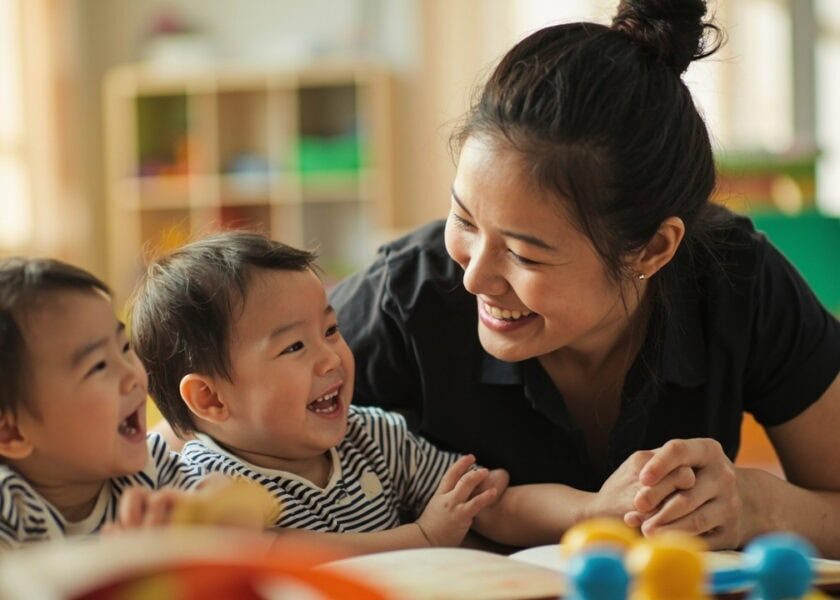
Third, and most importantly, look at the caregivers themselves. Quality care means caregivers who are attuned to children—who notice when a child is tired, hungry, frustrated, or content, and who respond with consistency and warmth. It means caregivers who see your child as an individual, not just as one among many. It means people who communicate with parents honestly and respectfully, sharing both the bright moments and the challenging ones.
Caregiver Ratios
Fourth, consider caregiver ratios. In infant care especially, the number of caregivers relative to children makes a real difference. Smaller ratios mean more individual attention, more responsiveness, more opportunity for the kind of attuned care that supports healthy development. This is not a luxury—it is a fundamental indicator of whether your child will be truly seen.
How EduNanny Approaches Family Partnership
This is where EduNanny enters the picture—not as the only answer, but as one answer that reflects a genuine understanding of what Singapore families are actually looking for.
EduNanny is part of the ECDA Childminding Pilot, which means it operates within a framework designed to make quality childcare more accessible to Singapore families. The pilot offers both home-based and centre-based pathways, depending on what fits your family’s circumstances and preferences.
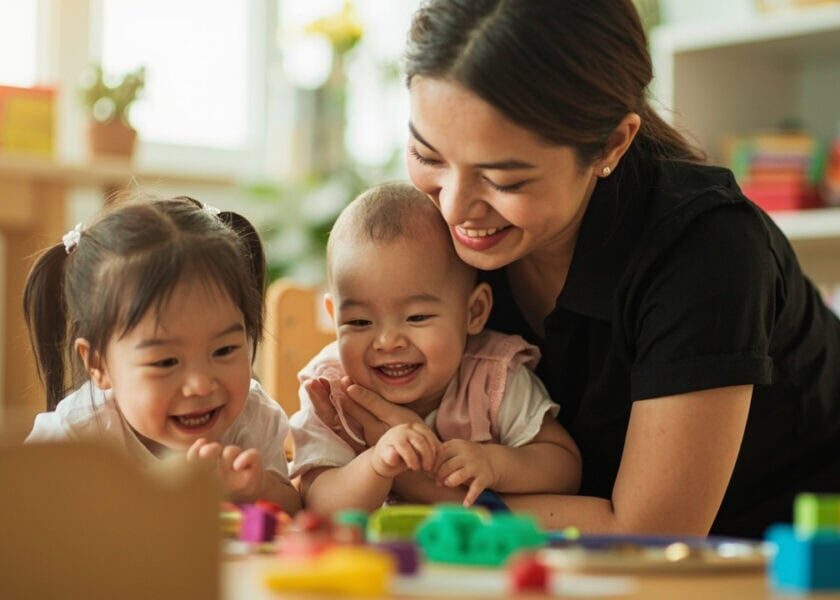
Home-based care means your child is looked after in a familiar environment, with a smaller ratio of caregivers to children—sometimes with ratios as attentive as one caregiver to three infants, depending on the arrangement. Centre-based care offers a different kind of environment, one with its own community of children and its own rhythms. Neither pathway is inherently better. What matters is which one aligns with what your family values most.
Within the pilot structure, there is also a focus on affordability. Fee structures are designed to be accessible, and for families eligible for the Child Development Account and Baby Bonus schemes, these resources can often be applied directly, which helps reduce the financial weight of quality care.
EduNanny also addresses transparency through communication measures that keep parents informed about their child’s day. In some deployments, additional visibility provisions allow parents to stay connected to what is happening when they are not there.
Because the kind of cultural alignment we have been talking about cannot exist without this foundation of trust. If you do not trust that your child is safe, if you do not trust that your values will be respected, then the philosophical alignment becomes irrelevant. You will be too anxious to notice whether the care reflects your family’s spirit. Trust and cultural fit are not separate concerns. They are two aspects of the same thing—the desire for care that feels right in every dimension.
EduNanny also includes Thomas, an AI-powered chatbot designed to support parents through the childcare journey. Not just before you enrol, but throughout—answering questions about development, about feeding and sleep, about how to talk to your child about their day, about how to navigate the conversations with your own parents that we have been discussing.
Thomas is not a replacement for human guidance. It is an extension of it. A resource that is available when you need it, in the moments between appointments and pickups, when a question comes to you and you need an answer that feels thoughtful and informed.
This reflects something we believe deeply: that good childcare is not just about what happens in the hours your child is in care. It is about the entire ecosystem of support around your family. The information you receive, the confidence you build, the knowledge you accumulate—these all shape the decisions you make and the peace you feel.
A Path Forward
We know the search is hard. We know the expectations are heavy. We know there are days when you are not sure you are making the right choice, when you wonder whether someone else would judge you differently, when you carry the weight of everyone else’s opinions on top of your own.
But here is what we also know: you are doing this out of love. Every Singapore parent we have met, every family we have walked alongside, is doing the very best they can with what they have. And that matters. That matters more than any checklist, any comparison, any cultural norm.
If you find yourself wondering whether choosing quality childcare means betraying your parents—let us be clear: it does not. Choosing care that truly supports your child’s development is not a rejection of your heritage. It is an expression of it. Because your heritage, your culture, your family—they did not give you life so that you could freeze it in amber. They gave you life so that you could live it, so that you could grow, so that you could carry forward what matters and let go of what no longer serves.
The values your grandparents held were not the practices they used. The practices were the tools of their time. The values—the love, the security, the desire for their children to flourish—those are the permanent things. When you choose childcare that reflects those permanent things, when you find a place that shares your family’s soul even if it uses different methods, you are not abandoning your heritage. You are fulfilling its deepest purpose.
To find out whether a childcare arrangement truly aligns with your family’s culture, the best approach is simple: ask questions, visit, observe. Notice how caregivers speak to children, how meals are shared, how the day’s rhythm feels. Does the environment reflect warmth? Do caregivers seem attuned to individual children? Does the communication feel respectful and transparent? Does the philosophy seem to honour what children need to grow into secure, capable people?
Cultural alignment is not about checklists. It is about resonance—whether this place feels like it understands who you are and what you value.
EduNanny Singapore exists because we believe Singapore families deserve childcare that sees them—truly sees them. Not just their children, but their values, their heritage, their hopes, their fears. We believe you deserve care that feels like home, that feels like an extension of who you are, that helps your child grow into themselves without losing connection to where they came from.
This is not a small vision. But it is the right one. And we are here, ready to walk this path with you, as you make the choices that will shape the next generation of your family.
The inheritance you pass on when you choose with intention, with clarity, with love—that is the most important inheritance of all. And it begins with a single step: knowing what you truly value, and trusting yourself to find the care that matches it.
You are not alone in this. You never were.
If you are ready to explore what cultural alignment in childcare looks like for your family, we invite you to connect with us. Every family’s journey is different, and we are here to listen before we offer any answers. You are also welcome to learn more about EduNanny and what we stand for as you consider your next steps.