The Architecture of Grandparent Childcare Partnership
The Architecture of Grandparent-Childcare Partnership
We design almost everything in our children’s lives. We choose their schools, their enrichment classes, the apps on their tablets. We read the labels on their milk. We debate the research on screen time until midnight.
But when it comes to the role our parents play in raising our children, we leave it to chance. We hope they understand. We hope they respect our choices. We brace ourselves for the comments, the contradictions, the quiet friction. And then we wonder why we feel so tired — not just physically, but emotionally — even when our parents are helping us.
That exhaustion is not a failure of love. It is a signal. It is your mind telling you that love alone is not a childcare plan.
The Two-Family Reality
Consider two Singapore families. Both have working parents. Both have grandparents actively involved in childcare.
In the first family, no one has ever really had a conversation about how they want childcare to work. The unspoken assumptions pile up like unread messages. The grandparents operate on instinct and memory. The parents operate on research and anxiety. Every day, small differences accumulate — a feeding practice, a sleep method, a way of responding to a child’s frustration.
Nobody is wrong. But nobody is aligned.
The child, who has no framework for understanding why grandma says one thing and mama says another, lives in a subtle state of inconsistency that creates low-grade stress — even when no one is upset. The parents feel like they are constantly correcting, which feels like criticism. The grandparents feel like they are never enough, which feels like rejection.
In the second family, something different is happening. Not because they have more resources, or because their grandparents are unusually open-minded, but because they made a choice. They sat down — not in a single defining conversation, but across several honest discussions — and talked about what they needed and why. They explained the research without weaponizing it. They asked their parents what they needed to feel valued and respected.
They made space for the things that grandparents do uniquely well — the cultural stories, the language, the unconditional comfort, the way only a grandparent can make a child feel like the centre of the universe — and they made clear space for professional care to handle the things that require specialized knowledge and consistency.
They did not treat their parents as competitors. They treated them as partners with a specific, defined role. And they designed that role together.
The Key Differences at a Glance
| Default Grandparent Care | Designed Childcare Partnership |
|---|---|
| Assumptions go unspoken | Roles are discussed and clarified |
| Love is expected to bridge gaps | Communication bridges gaps |
| Grandparents carry full-time burden | Grandparents have joyful, defined roles |
| Tension accumulates silently | Misalignments are addressed with warmth |
| Parents feel like they are correcting constantly | Parents have professional support during work hours |
| Grandparent-grandchild bond under strain | Grandparent-grandchild bond protected and deepened |
Understanding the Generational Parenting Gap
I want to be clear about something that is not always comfortable to say out loud: involving grandparents in childcare in Singapore is not really a choice for most families. It is an inheritance. It is woven into how our families have worked for generations, and into how our systems are structured.
Singapore has one of the highest rates of multigenerational living in the world. Even in families where grandparents have their own homes, the expectation of involvement is deeply embedded. Grandparents here are not occasional babysitters. In very real economic, logistical, and cultural terms, they are the backbone of Singapore’s informal childcare infrastructure.
And they are extraordinary for it. The dedication of Singapore grandparents — the early mornings, the physical stamina, the cultural continuity they pass down, the love that has no conditions — this is not something to be managed or minimized. It is a gift. It is the reason many Singapore families can function at all in a world where both parents work, where the cost of living demands dual incomes, where the nearest affordable centre-based infant care has a waitlist that stretches past your child’s second birthday.
We begin here. With respect. With full acknowledgment that the grandparent generation in Singapore has given more than our systems have ever adequately recognized.
Why the Gap Exists
Here is the other truth we need to face: the world our parents raised us in and the world we are raising our children in are not the same world. And that is not a criticism of our parents — it is simply reality.
What we know now about infant brain development, about the science of attachment, about the long-term impact of the first thousand days, is qualitatively different from what was understood even fifteen years ago. Our parents raised us with the best intentions and the best knowledge they had. And we are raising our children with the best intentions and the best knowledge we have.
But when those two worlds collide in the same living room at 8 a.m., something has to give.
The generational parenting gap is not about who is right and who is wrong. It is about the fact that the expectations, the methods, and the goals of parenting have evolved, and that evolution does not pause for family dinners.
Our parents may not understand why we are so particular about paced bottle feeding, or why we have an opinion about how we carry a newborn, or why we are reading parenting books with underlines and margin notes — the same books they never needed.
When that gap shows up in daily childcare, it can feel like disrespect. Often, it is simply a difference in information.
The question is not whether our parents are capable of loving our children. They are. The question is whether love, in the absence of shared understanding, is enough to meet the developmental needs of the child in front of us. And for most parents wrestling with this question, the honest answer is: sometimes. Not always. And not always in the ways that matter most.
What Quality Childminding Actually Looks Like
Let me be unflinching here, because this is the part that most parenting conversations sidestep: there are moments when the gap between generational practice and developmental best practice is not a matter of style or preference. There are moments when it is a matter of what your child actually needs to develop well, consistently, and safely.
And in those moments, love — however sincere, however abundant — is not sufficient.
This is not about perfection. Parenting does not require perfection. Children are resilient, and they do not need flawless caregivers. What they need is good enough care, delivered with consistency and attunement. What they need is a caregiver who can read their cues, respond to their needs, and create a stable emotional environment.
The First Thousand Days: Why It Matters
You have probably heard the phrase “first thousand days.” I want to tell you why it matters — not as a slogan, but as a biological reality.
In the first three years of life, a child’s brain forms more than one million new neural connections every second. The architecture of that development is shaped by the quality of experiences and relationships the child encounters.
The synaptic pathways that govern emotional regulation, language acquisition, and cognitive flexibility are being built during these years, and they are being built by the interactions the child has with the people who care for them. When a child is consistently responded to with sensitivity and warmth, those pathways strengthen. When a child is in an environment of unpredictability, conflicting signals, or chronic stress — even low-grade stress, the kind that comes from living in two worlds that do not quite agree — some of those pathways do not develop as robustly.
Research on early childhood development tells us that the quality of the caregiving relationship in the early years — not just the presence of a caregiver, but the quality of responsiveness and attunement — has measurable, lasting effects on a child’s sense of security, their capacity for self-regulation, and their ability to form healthy relationships throughout their lives.
I am not saying this to frighten you. I am saying it because I believe you deserve to understand what is at stake. Singapore parents are some of the most invested, most research-literate parents in the world. When you know better, you do better — not out of guilt, but out of love that is big enough to ask hard questions.
Boundary-Setting Without Breaking Bonds
I know there are parents in this room — or reading, watching — who feel a knot form in their stomach when they think about setting boundaries with grandparents. In Singapore, challenging a parent’s approach to grandchildren can feel like the most disloyal thing you can do. There is a cultural weight here that I do not want to underestimate.
But I also want to say this: boundary-setting is not rejection. It is not disrespect. And it is not the same as saying your parents did a bad job. Boundary-setting is simply the act of being clear about what you need and why. And when it is done with warmth — and that is non-negotiable — it is one of the most respectful things you can do for a relationship.
A Practical Example
Suppose you want your child to be spoken to in a certain way when they are frustrated — calm, encouraging, specific. And your father tends to speak in a way that, while affectionate, can be dismissive.
“Don’t cry, already.”
“So what, bigger problem also nothing.”
You could let it go and seethe quietly. You could correct your child in front of your father, which humiliates everyone. Or you could find a moment — a calm, unhurried moment, not in the heat of the moment — and say something like:
“Papa, I know you are so good with him. I want to ask you something, and I hope you know it comes from trust. When he is upset, I find that he calms down faster when we name what he is feeling. Would you be open to trying that with him? I really think it would help.”
That is not a confrontation. That is an invitation. And it is built on the most important ingredient in any grandparent partnership: the assumption that your parents want to succeed. They do. They did not come into this arrangement wanting to do it wrong. They came into it wanting to help, wanting to be close, wanting to be needed.
When you frame your needs as an opportunity for them to be even more wonderful, rather than a correction of what they have been doing wrong, you change the entire dynamic.
This is what I mean by bridging the generational gap with warmth. It is not about winning an argument. It is about building a bridge that lets everyone cross over to the other side together.
The Childcare Ecosystem: A Better Model
The goal is not to replace grandparents. The goal is to create a childcare ecosystem where grandparents can be grandparents — fully, joyfully, without the impossible burden of being everything — and where professional care handles what professional care does best, so that the grandparent relationship is protected, preserved, and allowed to be what it was always meant to be.
Think about what this means for the grandparent-grandchild bond.
When grandparents are the sole, full-time caregivers, the relationship can become stressful. They are tired. They are carrying a weight they did not expect. They are being held to standards they never signed up for. And the child, who absorbs everything, begins to associate grandma not just with love but with inconsistency, with contradiction, with the tension in the room. Over time, the very relationship you were trying to protect becomes the one that suffers most.
But when grandparents have a defined, joyful role — Sunday afternoons, school pickups on Wednesday, the bedtime story in Mandarin or dialect that mama and papa cannot quite replicate — then the bond deepens naturally. Grandparents become a source of cultural richness and unconditional warmth, not a source of daily friction.
Children are remarkably good at understanding that different people have different roles. They know that grandpa is for stories and grandma is for baking. They know that their caregiver is for learning and play. And they know, most importantly, that mama and papa are the centre — the ones who hold everything together.
That is the village that people talk about. But the village I am describing is not accidental. It is not the default village of obligation and assumption. It is a village that has been designed, carefully, with each person’s role clear and valued.
How EduNanny Fits Into This Architecture
Everything I have described so far is a philosophy. And a philosophy without a pathway is just a feeling. So let me be practical about where EduNanny Singapore fits into this architecture — not as a replacement for family, but as an intentional partner within it.
EduNanny Singapore operates as part of the ECDA Childminding Pilot, which means it is embedded within Singapore’s national framework for infant and child care. This is not a small thing. It means the programme is aligned with regulatory standards, supported by a system that understands Singapore’s specific childcare landscape, and operating with the accountability and oversight that parents need to feel genuinely secure.
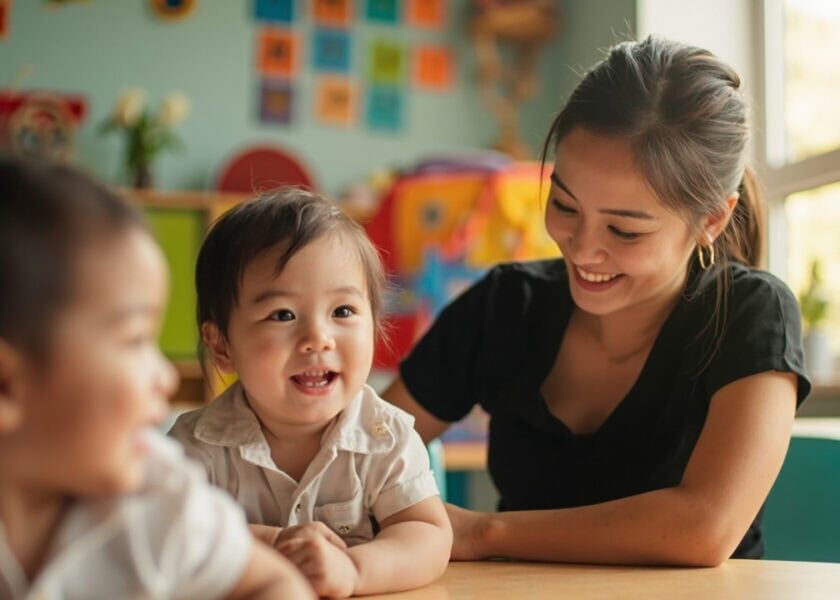
The model is designed around what research tells us about infant care quality: small ratios, attentive caregiving, consistent routines, and environments that are safe, responsive, and developmentally appropriate.
In the EduNanny programme, infant ratios are maintained at a carefully considered level — up to one to three in infant care settings — which means that every child receives a quality of attention that is simply not possible in larger group settings. When a caregiver is responsible for one to three infants, she notices. She notices the shift in mood before the cry. She notices the developmental milestone that happens between Tuesday and Wednesday. She notices the small things, and the small things, as any parent knows, are never small.
Addressing Common Concerns
For many parents, the idea of leaving their infant with someone outside the family is one of the most emotionally difficult decisions they will ever make. It is not just a logistical decision. It is a psychological one.
It touches on your sense of your own adequacy as a parent. It touches on your fear of being judged. And it touches on something deeper — the ancient mammalian instinct that says my child is safest with my kin.
I want to honor that instinct. It is real, and it is not wrong. But I also want to expand it, because the research on this is consistent and clear: what protects children is not genetic proximity but caregiving quality. And caregiving quality is something that can be learned, practiced, and sustained by anyone who is trained, supported, and genuinely committed to the child’s wellbeing.
EduNanny does not recruit caregivers who happen to be available. It selects and trains caregivers who understand infant development, who are skilled in responsive caregiving, and who are supported by a system that does not leave them isolated. When caregivers are well-trained and well-supported, they do not feel like strangers. They feel like an extension of your family — a trusted partner in the care of your child, not an outsider you have to manage.
We live in a time where trust must be earned and verified. EduNanny has measures in place that reflect this reality. Communication tools and observation measures give parents insight into their child’s day. These are not surveillance mechanisms. They are bridges. They are the thing that allows a parent at a 2 p.m. meeting to receive a photo and feel their shoulders drop half an inch. They are the thing that allows a grandmother to understand, when she visits on the weekend, what the child has been learning — so that the conversation about childcare becomes collaborative rather than competitive.
On affordability: emotional peace and financial peace are not separate things for Singapore parents. They are deeply connected. When parents are anxious about childcare costs, that anxiety enters the home. It affects sleep, it affects patience, it affects the quality of every interaction.
EduNanny’s participation in the ECDA Childminding Pilot means that fees are structured to be within reach for families who need reliable, quality care. Where applicable, subsidies and schemes including CDA and Baby Bonus can be utilized, which means the financial architecture of childcare is something that families can navigate rather than simply endure.
Your Role as the Architect
The relationship between your family and your child’s care is not a problem to be solved. It is a design challenge to be embraced. And it is one of the most important design challenges you will ever take on, because the child at the centre of it is watching, absorbing, and building the architecture of their own future in response to the architecture you create around them.
Grandparents are not the problem. The absence of intentionality is the problem. The silence, the assumptions, the hope without strategy — those are the things that create friction.
My invitation to you is this: get curious. Not about whether your parents love your child — you know they do. Get curious about the structure. Get curious about what each person in your child’s life is actually contributing, and whether those contributions are aligned enough to create the stability your child needs.
Get curious about your own voice — whether you are using it clearly, kindly, and consistently when it comes to the care of your child.
Because you are the architect. Even when it does not feel like it, even when you are too tired to feel like it, you are the one who holds the blueprint. And you have more power to shape this than you may be giving yourself credit for.
To Grandparents Reading This
You are not the problem. You are not outdated. You are not inadequate.
You are, in fact, one of the most irreplaceable forces in your grandchild’s life, precisely because of the things that no professional can provide — the cultural memory, the unconditional acceptance, the sense of belonging to a lineage that stretches backward and forward in time.
What is being asked for is not less of you. It is clarity about your role so that you can do what you do best, without the weight of being everything.
The Invitation
EduNanny Singapore exists because someone looked at the landscape of Singapore families — the love, the complexity, the multigenerational households, the working parents, the cultural richness, and the genuine, unmet need for childcare that is both excellent and affordable — and decided to build something that fits that landscape rather than ignoring it.
We are not here to tell you that family does not matter. We are here because we know that family matters enormously, and that the best thing we can do for families is to give them the support, the structure, and the professional partnership that allows every circle of care to be what it was meant to be.
When a child grows up knowing that they are loved by their grandparents in one way, and cared for by their EduNanny in another, and parented by their mama and papa at the centre — when those three circles are not in conflict but are aligned, intentional, and mutually respectful — something extraordinary happens.
The child does not have to split themselves between worlds. The child can simply be whole, and safe, and ready to explore.
That is what this is all about. Not perfection. Not the elimination of all difficulty. But a deliberate, caring, well-designed system that gives your child the best possible start, and gives you — the parents — the peace of mind that comes from knowing that the people you love are working together, in their own ways, for the same beautiful, shared purpose.
If you are ready to explore what a designed childcare partnership could look like for your family — one that honors your parents, supports your child, and gives you the breathing room you need — we invite you to learn more about EduNanny Singapore and how we work alongside families like yours.
You are also welcome to read more about our approach or get in touch with any questions. We would be glad to hear from you.