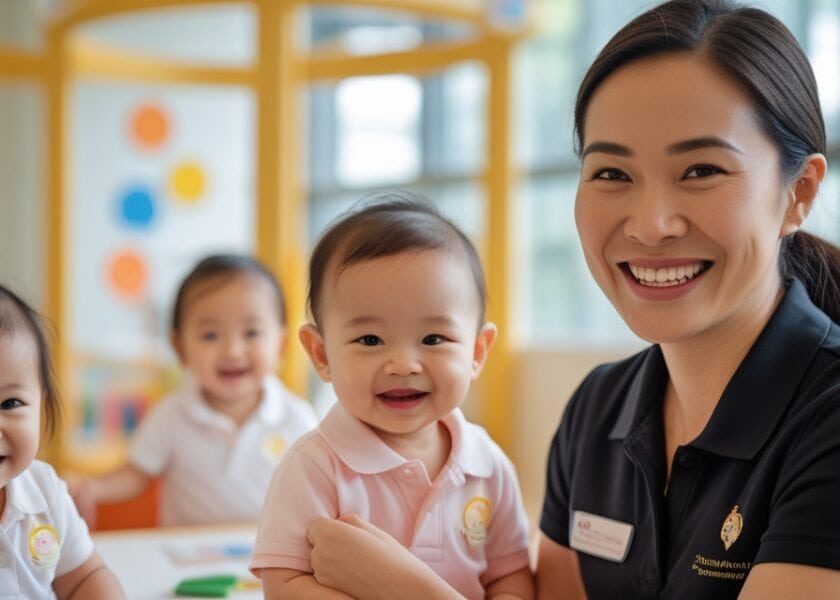
Building Your Child’s Brain: The First Five Years Singapore Parents Need to Know
The Paradox of Singapore Parenting
There is a particular kind of clarity that comes only after you have made a decision. And there is a particular kind of confusion that exists before you make one—informed, intentional, right. For Singapore parents, that confusion often arrives in the earliest days of their child’s life, when the stakes feel impossibly high and the map feels impossibly blank.
You know the feeling. You are holding your newborn, your toddler, or your almost-kindergartener, and you are making choices that everyone tells you will matter forever. Feed them this way. Talk to them constantly. Stimulate their neurons. Read them books. Somewhere beneath all of that well-meaning advice, a quieter question forms: but what actually compounds? What decision made in infancy echoes in primary school?
This is the paradox of modern Singapore parenting. We invest more in our children than any generation before us. We read, we research, we deliberate. We agonize over infant care arrangements with the intensity of a strategic decision. And yet, despite all of this effort, many of us are navigating the most consequential years of our children’s development without a coherent framework—just fragments of advice, annual scrambles, and the persistent sense that we are managing logistics rather than building something lasting.
Quick Summary: What This Framework Offers
If you are a Singapore parent in the thick of early childhood decisions and do not have time to read everything right now, here is what matters most:
- The first five years are not a stage to survive—they are a window to build. The brain constructs more neural connections during this period than at any other time in life.
- Decisions made in infancy do not stay in infancy. The foundations laid in the first year echo through primary school and beyond.
- Singapore parents are not failing—they are navigating without a map. What most families need is not more advice, but a coherent framework that connects infant care, toddler development, and school readiness.
- Quality care is not about convenience. It is about whether the arrangement serves the specific developmental work happening in each stage.
- The families who feel most confident found a partner who understands the whole journey. They are not the ones who found perfect answers.
This article will walk you through why these five years are different, what each developmental stage actually requires, and how to choose with intention rather than simply choosing what is available.
Why These Five Years Are Unlike Any Other
In the first five years of life, the human brain undergoes its most dramatic construction. Neural connections form at a speed that will never be matched again. The architecture being built right now—in your child’s brain, in this very moment—will serve as the foundation for every cognitive capacity they develop for the rest of their lives.
Emotional regulation. Language acquisition. Logical reasoning. The ability to focus, to persist, to bounce back from disappointment. All of these are not innate traits that emerge on their own. They are constructed, painstakingly, over these five years, through millions of interactions, environments, and experiences.
How the Brain Builds in Predictable Sequences
The brain builds in predictable sequences, and each stage has specific requirements. Understanding these stages does not make you a perfect parent. But it does help you understand why certain choices matter more than others—and why the fragmentation of advice that most Singapore parents receive is so frustrating.
- The infant’s brain is building trust and security—the conviction that the world is a place where needs are met and comfort is available.
- The toddler’s brain is building autonomy and language—the sense of self as an agent who can communicate, explore, and do things independently.
- The preschooler’s brain is building the executive functions that will eventually make academic learning possible—the ability to hold information in mind, to resist impulses, to plan rather than simply react.
These are not metaphors. They are developmental realities. The decisions families make about care in infancy are not simply about convenience or logistics. They are about which foundations are being laid.
The Compounding Effect
A child who develops secure attachment in their first year enters toddlerhood with a different starting point than a child who did not. A child who has rich language experiences throughout their second and third years enters preschool with a vocabulary and verbal reasoning capacity that no amount of drilling in Primary One can replicate. The investments compound.
This is why the advice you receive feels so scattered. We are told to worry about infant care in isolation. Then, when the infant becomes a toddler, we are told to worry about toddler care in isolation. Each stage gets its own pressure, its own set of anxieties, its own recommendations that may or may not connect to what came before or what comes after.
What we rarely receive is a coherent framework—a map that shows us how these five years fit together, how decisions made now create the conditions for what comes next.
What Each Year Actually Builds
The First Year: Building Trust
In the first year, the work is about trust. Not abstract trust—concrete, physical, consistent trust.
Does your child learn that when they cry, someone comes? Does their caregiver respond with warmth and presence, or with schedule and routine stripped of responsiveness? The quality of this early relationship sets the stress response system that your child will carry into every challenging situation for the rest of their lives.
Research on adverse childhood experiences has demonstrated this clearly: the physiological pathways for resilience or vulnerability are largely established in this window. When an infant’s brain is building its fundamental sense of security, the choices families make about care arrangements matter enormously—not because parents who choose center-based care are doing something wrong, but because the question is whether the care environment can genuinely serve as a secure base.
For Singapore families navigating infant care—whether through home-based arrangements, community pathways, or center-based programs—the question is not simply whether care is available. The question is whether the care environment offers responsive caregivers trained to read infant cues, ratios sufficient for genuine responsiveness, and consistent, warm presence that allows an infant to form the neural pathways for security.
The Second and Third Years: Building Language and Autonomy
By the second and third years, the developmental work shifts. The toddler is building language at an extraordinary pace—absorbing vocabulary, learning to combine words, beginning to understand that symbols represent things. They are also building the first sense of themselves as separate from their caregivers, testing autonomy, needing environments that allow exploration without constant restriction.
This is where many families experience their first real tension. The infant who was easy to care for becomes the toddler who needs constant supervision. The language explosion that seemed automatic in the research articles requires actual conversation, actual interaction, actual back-and-forth.
The toddler’s environment matters enormously here. Ask yourself:
- Does the environment offer rich language input?
- Are there opportunities for purposeful play that builds motor skills and cognitive capacity?
- Is the caregiver engaged in the child’s development rather than simply managing their safety?
A child who spent their third year in a language-rich environment with responsive caregivers did not just learn words. They learned that communication is rewarding, that conversation is a way to connect, that their voice matters.
The Fourth and Fifth Years: Building What Primary One Actually Needs
By the fourth and fifth years, the focus shifts again—but it is not the focus most parents expect.
When families think about Primary One readiness, they often think about academic skills: letter recognition, number sense, perhaps early reading. These things matter, but they are not the foundation that Primary One teachers consistently tell us they wish parents had built.
What Primary One teachers actually tell us—through research, through professional experience, through quiet conversations with educators across Singapore—is that the children who thrive are not necessarily the ones who arrived with the most academic preparation.
They are the children who arrived curious. The children who could focus. The children who could persist when something was difficult. The children who could regulate their emotions enough to sit in a classroom without constant disruption. The children who could interact with other children with some basic social competence.
These are not skills that appear in Primary One because someone taught them in the last six months before enrollment. They are the accumulated result of five years of appropriate developmental experiences. A child who spent their fourth year in an environment that balanced structure with autonomy did not just play. They developed the executive functions that allow sustained attention and goal-directed behavior.
The academic skills can be taught. The curiosity, the persistence, the emotional regulation—these are much harder to retrofit.
The Gap Singapore Families Need Filled
What most Singapore families receive is not wrong, exactly. It is fragmented. We get advice about infant care from one source, toddler care from another, school readiness from a third. Each piece makes sense in isolation. But no one is showing us how the puzzle fits together.
Here is the framework that connects the five years before Primary One: it is one continuous process of building foundations, where each stage’s investments determine what the next stage can accomplish.
| Year | Primary Developmental Work | What This Requires |
|---|---|---|
| Year One | Trust and Security | Responsive, consistent caregiving; secure attachment bonds |
| Years Two and Three | Language and Autonomy | Rich verbal interaction; opportunities for independent exploration |
| Years Four and Five | Executive Functions | Structured play with guidance; sustained attention opportunities; emotional coaching |
The decisions you make in Year One create the conditions for what Year Three can accomplish. The decisions you make in Year Three create the conditions for what Primary One readiness actually requires. This is not about pressure. It is about understanding cause and effect.
What Quality Childminding Actually Looks Like
Now for the practical question: how does a Singapore family actually access care that serves this five-year framework? How do you find arrangements that build rather than simply babysit?
The Markers of Care That Compounds
What distinguishes quality childminding from adequate care is not difficult to identify, once you understand what you are actually looking for.
Attunement. The caregiver’s ability to notice what the child is feeling, to respond with appropriate warmth, to support rather than simply supervise. This is not a personality trait that some people have and others do not. It is a skill that can be developed—and it makes a measurable difference in child outcomes.
Responsive interaction. Conversations at meal times, narrative during play, genuine engagement rather than presence without participation. Young children learn language through conversation, not through hearing words spoken near them. They learn social-emotional skills through back-and-forth interaction, not through parallel play without adult involvement.
Appropriate ratios. The number of children per caregiver must allow these things to happen even when multiple children need attention simultaneously. In infant care especially, ratio is not a bureaucratic technicality. It is a practical question of whether your child can receive responsive care or whether they are simply being supervised.
Transparency. Parents need to know what is happening during the hours they are away. Not just that their child ate and slept, but how they engaged, what seemed to bring them joy, where they might have needed extra support.
Consistency. Young children cannot learn that relationships are stable if their caregivers change constantly. They cannot build the trust pathways that support later development if the attachment figure keeps rotating. Monday to Friday care blocks with reliable caregivers are not a bonus feature. For children in the first five years, they are a developmental requirement.
Home-Based Care: A Particular Option for Singapore Families
Many Singapore families prefer home-based care—having a caregiver come to the family’s home, maintaining the familiar environment, allowing infants and toddlers to remain in the space where they sleep and eat. This is not merely a preference for convenience.
For infants especially, the stress of transitioning between environments can be significant. Home-based care can offer a continuity that supports the trust-building work of the first year. The infant does not need to adapt to a new environment. The environment comes to them.
For toddlers, the calculation is more complex. Some children thrive in the consistency of home. Others benefit from the social stimulation of peer interaction. There is no universal answer. But families who understand the framework can make choices that fit their specific child’s needs rather than simply choosing what is available.
A Partner for the Full Journey
EduNanny Singapore, operating under the framework established by BUTLER, was built with a specific question in mind. Not just: how do we provide childcare? But: how do we provide childcare that grows with the family, that serves as an actual foundation rather than a temporary arrangement?
Designed for Singapore Families
EduNanny’s childminding service operates within the ECDA Childminding Pilot, which means it is part of a structured, supported pathway designed specifically to meet the needs of Singapore families.
The pilot framework includes specific quality standards—not bureaucratic requirements for their own sake, but actual markers of developmental appropriateness. Caregiver ratios of up to one to three infants ensure that responsiveness is possible. Training requirements ensure that caregivers understand not just how to feed and soothe, but how infants actually develop.
The pilot fee structures aim to keep this quality accessible, and families can utilize their Child Development Accounts and Baby Bonus contributions to manage costs. This is not accidental. The design of the pilot reflects a genuine understanding that affordable care and quality care are not opposing goals. They are both necessary for families who need to make five-year commitments rather than one-year arrangements.
Ongoing Quality, Not Just Initial Quality
EduNanny’s approach incorporates quality markers explicitly. Communication systems keep parents informed about their child’s day—not just that they ate and slept, but how they engaged, what seemed to bring them joy, where they might have needed extra support.
Caregiver training is ongoing, not just initial. Understanding child development is not a one-time accomplishment but a continuous process as research advances and as children grow. The caregiver who understands infant attachment is not the same as the caregiver who understands toddler autonomy or preschool executive function. Quality care requires continuous learning.
A Partner for Five Years, Not Just Today
An arrangement that works for a three-month-old infant may not serve the same child well at thirty months. A family that chose a convenient option when their child was an infant may find themselves scrambling when their three-year-old needs more stimulation than a simple care arrangement can provide.
Choosing with the five-year framework in mind means asking not just: does this work now? But: will this still serve us when my child is four? When they are preparing for Primary One? When the developmental work shifts from trust to language to executive function?
Addressing Your Real Concerns
Singapore parents are exhausted. Not physically alone—though there is that—but existentially exhausted. The weight of wanting to do right by your children, combined with the uncertainty about what right actually means, is a particular kind of burden.
It manifests as the late-night research spirals. The second-guessing after every decision. The persistent anxiety that whatever you chose, you should have chosen something else.
This exhaustion is not a character flaw. It is a rational response to a situation where the stakes feel infinite and the map feels blank. When you do not have a framework, every decision is made in isolation. You cannot see how the infant care choice connects to the preschool choice connects to the Primary One transition. You are managing, not building. You are reacting, not intending.
If you are wondering whether you are making too big a deal of these early years, consider this: the brain builds faster in the first five years than it will at any other point in your child’s life. The foundations being laid now—the stress response patterns, the language pathways, the executive function capacities—are not trivial. They are structural.
But here is the encouraging part: you do not need to be perfect. You need to be intentional. The difference between adequate care and care that compounds is often simply whether the arrangement was chosen with awareness of what each stage needs—or whether it was chosen in response to immediate pressure without the context of the larger journey.
If you are wondering how to know if caregivers are actually good, ask questions that reveal whether caregivers understand development, not just logistics. A good caregiver should be able to tell you about the developmental stage your child is in. They should be able to explain how their approach supports that specific stage. They should be able to describe how they would respond to specific situations—not with a script, but with an understanding of why certain responses support healthy development.
Ask about training. Ask about continuity. Ask about how they handle the transitions between stages. These are not rude questions. They are the questions that reveal whether someone is actually thinking about your child’s development—or just managing their safety.
Your Child Is Building Their Brain Right Now
There is a particular freedom in choosing with intention that parents who have found it consistently describe. The freedom of knowing that your choices are pointing toward something. The relief of not having to second-guess every decision because you understand the principles that guide them. The confidence that comes not from having all the answers, but from having a framework that connects the answers you do not yet have to the ones you are still learning.
The first five years before Primary One are not a stage to survive. They are a window to build.
The decisions you make now—the caregiver you choose, the environment you create, the partner you trust to share in this work—those decisions will compound. They will echo forward into your child’s capacity to learn, to relate, to regulate, to wonder.
You are already investing in your child’s first five years. The question is whether that investment is accumulating toward something coherent, or whether it is scattered across disconnected decisions made in isolation.
Singapore families deserve better than fragmented advice and anxious reassurance. They deserve a framework. They deserve to understand why these years are consequential, what each developmental stage requires, and how to choose in ways that accumulate toward something meaningful.
Your child is building their brain right now. The architecture is forming. The foundations are being laid.
The question is not whether this matters. It already matters.
The question is whether you are building alone, or whether you have found a partner who sees what you are building toward—and who has the expertise, the commitment, and the heart to build with you.
Explore what EduNanny’s approach looks like for your family. Ask the questions that matter. Choose with intention.
Learn more about EduNanny’s approach to childminding or connect with the team to discuss your family’s needs.