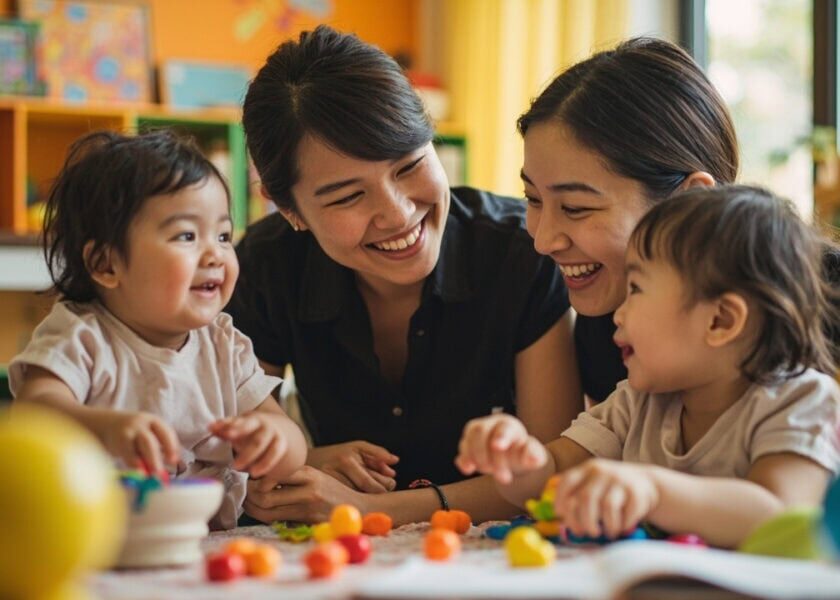
The Caregiver Who Grows With Your Child From Infancy
The Search That Stops Too Soon
Singapore parents are remarkably thorough at the beginning. We search diligently. We visit centres. We ask questions about ratios and qualifications and meal plans. We agonise over that first enrolment decision with a thoroughness that would impress any consultant.
And when we find something that feels right—a caregiver who meets our baby’s eyes, a small ratio that means our child will be known rather than just minded—we exhale with relief that carries us through those first wobbly weeks of adjustment.
But then the child grows. And that is where most of the conversation stops.
What happens when the infant becomes a toddler? When the toddler develops language and opinions and an urgent need to climb everything in sight?
What happens when the child who needed you to interpret every emotion now speaks for herself, now tests boundaries with the full confidence of someone who has learned that she is heard?
The childcare that felt perfect for a six-month-old—those gentle rhythms, that tender physical closeness—may begin to feel like it needs something more. And so the anxiety quietly begins.
It is one of the most universal and least discussed tensions in early parenthood. We want stability. Our children need it. We have worked hard to build a relationship of trust with a caregiver, to establish routines that everyone—baby, parent, caregiver—has come to rely upon.
But we also know that our child’s development in the first five years is not a slow and steady incline. It is a series of sudden hills and valleys, of growth spurts and regression, of phases that arrive without warning and depart just as unexpectedly.
A Different Understanding
The fear that underlies so much of the searching and re-searching that Singapore parents do is not really about finding the perfect centre or the perfect caregiver. It is deeper than that.
It is the fear of having to start again. Of building trust from scratch. Of watching your child go through another period of separation anxiety, of crying at the gate, of needing to learn that this new person is safe.
It is the fear that the stability you worked so hard to create is fragile—that growth itself will undo it.
The reason this fear so often becomes the story is that most childcare arrangements are designed to continue rather than to grow. They are built for the child who arrives. The routines, the curriculum, the caregiver’s approach—these are calibrated for a particular stage of development, and when the child moves beyond that stage, the arrangement either cannot or does not adapt.
The infant programme is wonderful for infants. But when your infant becomes a walker, a talker, a creature of immense and exhausting curiosity, you are suddenly told that a new programme awaits. A new room. Often a new caregiver.
EduNanny Singapore was built around a different understanding. We understood that the early years are not a series of separate stages that require separate solutions. They are a continuous journey—fractured only by the way we choose to organise our childcare systems.
When we work with a family from the infant stage, we are not simply providing care for an infant. We are beginning a relationship that we expect to deepen, to shift, to accompany your child through the most rapid and remarkable years of human development.
What Growing Care Looks Like
Let me tell you what that looks like in practice, because the philosophy only matters if it shows up in the room.
The Infant Stage
When a newborn arrives with us, the care is physical. It is about rhythm and responsiveness, about meeting the child’s most basic needs with warmth and consistency. Our infant ratios—up to one to three, in keeping with the ECDA Childminding Pilot framework—mean that our caregivers can give that kind of attention.
That is not a number we chose lightly. It is the number that makes genuine responsiveness possible. When a six-week-old is hungry, someone is there. When a four-month-old needs comfort after a frightening dream, someone knows the sound of that cry.
We are present in the way that infants require. But we are also present in a way that anticipates what comes next. The caregiver who is soothing your infant is also, quietly, building the language that will matter so much in a few months’ time. She is narrating the world. She is naming emotions. She is responding to your baby’s first attempts at communication with the same attentiveness she will bring to your toddler’s first sentences.
The Transition to Toddlerhood
And then the transition comes. Usually somewhere between twelve and eighteen months, though every child has her own calendar.
The infant who accepted passive care becomes a toddler who demands agency. I want to do it myself. I want that cup. I want to go outside. I want no, no, no—a hundred times a day.
This is not a problem to be managed. This is development happening in real time, and it is beautiful and exhausting in equal measure.
What we have found is that the children who navigate this transition most confidently are the children who do not have to navigate a new caregiver at the same time. The child who has spent a year building trust with a familiar face—someone who knows her rhythms, her preferences, the particular way she expresses frustration, the particular smile that means she is ready to try again—has a secure base from which to explore this new and demanding territory of toddlerhood.
She does not have to wonder if this person will still love her when she is difficult. She already knows.
The toddler needs different things. She needs more language, more explanation, more patience with her growing frustration when words do not yet come easily. She needs physical challenges—a space to climb, to run, to test her body’s new capabilities. She needs boundaries that are firm but not frightening, set by someone who understands that the toddler is not being naughty but is rather doing the hard work of learning what the world can hold and what it cannot.
The Transition to Preschool
The toddler to preschool transition is the next great shift, and it is one that many families do not anticipate with the same clarity they brought to the infant stage.
Somewhere between two and a half and four, the child begins to develop something that looks more like social awareness. She notices other children. She wants to play alongside them before she can play with them. She begins to understand the concept of sharing—not perfectly, not consistently, but as an emerging capacity that will take years to fully develop.
She asks questions that have no simple answers. She is curious about letters and numbers and the names of things. She wants to know why.
The caregiver who has been with your child for two or three years does not have to learn who your child is. She already knows. She knows that this particular three-year-old processes new social situations by watching from the edges before she joins in, and she gently creates the conditions for that watching to feel safe rather than excluded.
She knows that this particular three-year-old lights up when given responsibility—wants to help set the table, wants to be the one who holds the door—and she looks for those moments because she knows they are where learning happens.
Why Sustained Care Changes Everything
Transitions are harder on parents than they are on children.
I say this with confidence because I have watched it play out hundreds of times.
When a child moves from infant to toddler care within the same setting, with the same caregiver, the child often barely notices the shift. There is no disruption because nothing has been disrupted. The caregiver knows this child. The child knows this caregiver. The routine continues with minor adjustments, and within days, sometimes within hours, the new normal has been established.
But the parent feels it differently. The parent notices that the caregiver is now talking about different things—autonomy, language milestones, the new puzzles in the room. The parent feels a twinge of something that is not quite anxiety and not quite grief.
It is the recognition that the baby is gone. That the tender, passive, portable creature who once fit so perfectly in the crook of the arm has become a demanding, verbal, wilful individual who will not sit still for a photo.
What sustained care does for the parent is it gives them one less thing to manage during a time when so much is already shifting. You do not have to find a new caregiver. You do not have to begin the trust-building process again. You do not have to spend weeks wondering if your child is happy, if the new person is kind, if the environment is safe.
The relationship is already there. The safety is already established. Your only job—and it is a big enough job—is to grow alongside your child, to learn who she is becoming, to adapt your own parenting to meet her where she is.
What Sustained Care Makes Possible for the Child
The child who is known—who is truly known, by an adult who has watched her grow from a newborn through toddlerhood into the beginnings of childhood—has something that cannot be bought or engineered. She has a witness.
She has someone who can say, I remember when you first learned to walk, and how scared you were, and how you kept reaching back for my hand even as your feet found their confidence. I remember your first word, and the morning you said your full name for the first time, and how you cried for your mother in those first weeks and how we sat together until you trusted me enough to play.
This kind of memory, held by a consistent caregiver, is not sentimental. It is developmental. It is the foundation of secure attachment, which is the thing that allows children to explore the world with confidence, knowing that there is always a base to return to.
When your child feels known, she can take risks. She can try new things. She can fail and try again because she knows that someone is there who will not think less of her for failing.
Communication That Grows With Your Family
EduNanny’s model acknowledges this. Our communication with parents is not a monthly newsletter or a quarterly update. It is an ongoing conversation.
When CCTV measures are deployed, they are not there for surveillance—they are there so that we can show you, if you want to see, what your child’s day looks like. When a caregiver documents your child’s development, she is doing it not for administrative purposes but so that you know.
So that when you pick up your child and she seems different, you can ask the right questions. So that you can understand the trajectory of her growth in the same way you understand the trajectory of her sleep or her appetite or her emerging personality.
This is what transparency looks like when it is genuine rather than performative. It is not about proving that nothing went wrong. It is about ensuring that you are always part of the picture, even when you are not in the room.
The ECDA Childminding Pilot: The Framework That Makes This Possible
EduNanny by BUTLER understands this. We are not simply providing childcare. We are providing continuity—the kind of continuity that allows children to grow into themselves without the disruption of constant change.
Singapore parents are sometimes told that the best childcare decision is the one that is right for today. We believe that is incomplete.
The best childcare decision is the one that will be right for tomorrow, and the day after, and the years after that. It is the decision that means you do not have to search again.
This is what the ECDA Childminding Pilot has made possible in Singapore, and EduNanny is proud to be part of that framework.
- The pilot creates the conditions for home-based and centre-based care to exist in relationship with each other
- Ratios allow for genuine attention—not just compliance, but real responsiveness
- Fee structures make quality care accessible rather than a luxury reserved for those who can pay premium prices
- When families can use their CDA and Baby Bonus funds, it is not a bureaucratic convenience—it is an acknowledgement that childcare is not a consumer product but a social good
- Monday to Friday care blocks recognise how Singapore families actually live and work
These are not small things. They are the infrastructure that makes sustained care possible. Without them, even the best intentions cannot survive the economics of childcare provision. With them, it becomes possible to build something that lasts.
What This Means for Your Family
You have already done the hardest part. You have chosen. You have searched, you have visited, you have asked questions, and you have made a decision based on love and hope and a very reasonable amount of anxiety.
You have taken the first step, and that step matters.
But the journey does not end at enrolment. It continues. Your child will not remain who she is today. She will become someone new—a dozen times over, in ways that will surprise and delight and exhaust you.
She will need different things from her care at eighteen months than she needed at six months. She will need different things again at three, and again at four, and again at five. These are not problems to be solved by finding new arrangements. They are the natural rhythm of growth, and they can be accompanied rather than interrupted.
The Question Worth Asking
What would it mean to make a childcare decision and then, in a few years, not have to make it again?
What would it mean to trust that the relationship you are building today will grow alongside your child, that the caregiver who holds your newborn’s hand will also hold your toddler’s when she falls, that the centre or the home that feels right now will still feel right when your child is running and talking and asking a thousand questions a day?
It means you can stop searching. It means your child can stop adjusting. It means that the energy you would have spent on finding the next arrangement can be spent on the far more important work of growing alongside your child, of learning who she is becoming, of being present for the ordinary extraordinary days that make up the early years.
A Note of Honesty
EduNanny is not the right choice for every family—honesty about that is part of what it means to earn trust rather than manufacture it.
But for families who want continuity, who want a caregiver who will know their child not just today but across the years, who want to pick up their child one day and hear a story about something that happened when their child was a baby—EduNanny is here.
We are here for the child who will arrive, and we are here for the child that child will become.
The child you enrol is not the child who will one day leave us. And that is not a problem to be solved. It is a story to be honoured.
And we would be grateful for the chance to be part of yours.
If you are exploring infant care or childminding in Singapore and want to understand what sustained, evolving care looks like for your family, we welcome the conversation. Connect with EduNanny to learn more about our approach to thoughtful, developmental childcare from infancy through the early years.
Learn more about EduNanny’s participation in the ECDA Childminding Pilot, or explore our story and our standards.