Making the Unseen Hours Visible for Singapore Parents
The Silence Between Drop-Off and Homecoming
There is a particular kind of silence that lives in the hours between dropping your child at childcare and picking them up again. It is not the silence of peace. It is the silence of absence—the quiet space where your child’s day is happening, and you are not in it.
You kissed them good morning. You watched them walk, or be carried, through a door. And then the day became a question you could not answer. What are they feeling right now? Are they comfortable? Are they engaged? Are they safe in the way that safe means something more than physically unharmed—safe in the sense of being held inside a day that understands them?
These questions surface in the middle of a meeting, or while you are waiting for the train, or when you are reading a message from childcare and find yourself reading it twice, searching for something underneath the words.
If you recognise this silence, you are not alone. This is the experience of every parent who entrusts their child’s early hours to someone else. And it is precisely why EduNanny by BUTLER exists—not as another childcare option, but as a different answer to the question every working parent carries.
The EduNanny Daily Method is a structured, observation-driven approach to childminding that makes every hour of your child’s day visible and understandable. Caregivers track development, document play, and send daily evidence-based updates through our dedicated app and Thomas AI Chatbot. Your child experiences sensory-rich, play-based learning environments with a 1:3 caregiver-to-infant ratio during the pilot programme. The programme participates in the ECDA Childminding Pilot, with fees supported by CDA and Baby Bonus schemes.
Understanding the Real Tension
Singapore parents face a particular kind of pressure that is rarely named with full honesty. The cost of living. The demands of professional life. The commute. The long hours. The expectation to be present and productive on every front—and underneath it all, the quietly exhausting question of whether you are doing enough, whether your child is getting what they need, whether someone else can possibly provide what you would provide if you could be there.
This is not a failure of parenting. This is the reality of parenting in a city where both parents often work, where grandparents may live across the causeway, and where the best intentions run up against the constraints of time and geography.
You are not abandoning your child by returning to work. You are doing what many generations of parents have done—finding trusted hands to hold the hours you cannot hold yourself. The question is not whether to entrust your child to care. The question is whether the care you choose can truly see them the way you see them.
Generic quality assurances do not close this gap. Statements about “qualified staff” or “safe environments” are necessary but insufficient. What parents need is specificity—not philosophy, but practice. Not promises, but evidence.
What Quality Childminding Actually Looks Like
Quality is not an adjective. It is a collection of specific, observable moments that add up to either genuine development or mere supervision.
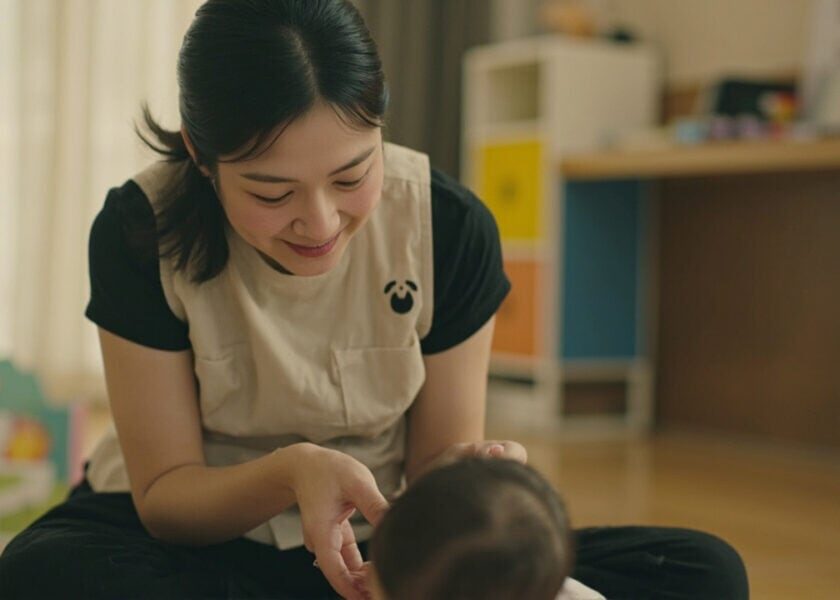
Consider your child’s morning arrival. At most childcare settings, this is a transition—a brief handover, a sign-in, a wave goodbye. At EduNanny, the morning arrival is the beginning of observation. The caregiver notes how your child greeted the room. Did they reach for a toy or hesitate at the door? Did their body carry the ease of good sleep or the weight of a difficult night? Did they reach for a familiar caregiver or scan the room with cautious curiosity?
These are not intrusive observations. They are the small attentions that, gathered over days and weeks, become a portrait of your child’s inner life. A child who always hesitates at the door but relaxes once inside is communicating something. A child who reaches for a particular toy first is revealing a preference that matters. These details are not trivia. They are the building blocks of knowing your child deeply.
The sensory world your child moves through—the textures they touch, the sounds they hear, the light and space they navigate—is considered, not merely decorated. A room designed for observation is different from a room designed for aesthetics. Every element either serves your child’s development or it does not belong there.
Caregivers notice whether your child seeks out rough textures or smooth ones, gravitates toward quiet corners or active spaces, watches other children or prefers solitary play. These responses are data—information about how your child processes the world that, when tracked over time, reveals patterns and preferences that shape how caregivers care for them.
Play is not what happens between meaningful activities. Play is the meaningful activity. Through play, children explore cause and effect. They practice language. They develop motor skills. They negotiate social dynamics with peers. They build the emotional vocabulary they will need for the rest of their lives.
When a toddler builds a tower and knocks it down, they are not wasting time. They are learning about gravity, control, consequence, and the satisfaction of agency. When a baby shakes a rattle and watches it make noise, they are confirming that they exist in a world that responds to them.
At EduNanny, caregivers do not watch play happen. They participate in it, guide it, extend it, and reflect on what it reveals about each child’s emerging interests and abilities. When a caregiver notices that your child has been building towers every morning for a week, they ask: what is my child telling me through this repetition? What skill are they consolidating? How can I support this exploration?
This is what we mean when we say observation-driven care. We are not tracking your child to report back to you. We are watching them because watching is how we understand them. And understanding them is how we serve them well.
The EduNanny Approach: Observation as Practice
EduNanny by BUTLER is not simply a childcare service. It is a commitment to making the unseen hours visible—not as a marketing claim, but as a daily, observable practice.
The caregiver-to-infant ratio at EduNanny reflects this commitment. With up to one to three infants in our care during the pilot programme, your child is not one face in a group. They are one child whose rhythms, preferences, and developmental trajectory we can genuinely track. We know when they are hungry before they cry. We notice when a developmental leap is beginning to emerge. We create space for them to try, to fail, to try again, and to feel the quiet triumph of getting something right on their own terms.
This attention is not magical. It is structural. When there are fewer children per caregiver, there is more bandwidth to notice. When caregivers are trained to observe, not just supervise, there is more information available. When the system is built around documentation and communication, there is nowhere for important details to disappear.
At the end of every day, what you receive is not a generic update. It is evidence. Evidence of what your child played with. How they interacted with other children. What new word they repeated. Which skill they practiced. How they slept. What they ate. And how they seemed—because how a child seems matters as much as what they do.
Instead of guessing whether your child had a good day, you will know. Instead of asking your toddler questions they cannot yet answer reliably, you will have specific information. Instead of the silence that used to live between drop-off and homecoming, you will have a shared understanding of what unfolded.
Questions arise between pickup and bedtime. Is my child teething? Did they take their afternoon nap? How do I continue this activity at home? These are not questions that should wait until the next morning. Through our Thomas AI Chatbot, accessible within our dedicated app, parents have a direct channel for questions, updates, and the kind of small curiosities that arise in the evening hours. Thomas is not a replacement for human connection. It is an extension of it, making the partnership between caregivers and parents continuous rather than episodic.
What Singapore Parents Need to Know
Parents in Singapore deserve honest answers to the questions that keep them up at night.
Will my child be safe—really safe?
Physical safety is the baseline. Every licensed childcare operation in Singapore must meet certain safety standards. But safety in the deeper sense—safety as being known, as being attended to, as mattering—is not guaranteed by regulations alone. At EduNanny, your child is known. Their face is not one of many. Their cries are not background noise. Their rhythms are tracked because they are noticed, not just because there is a check-in sheet to complete.
Will my child develop, or just be babysat?
There is a difference between being watched and being observed. Being watched is passive. It means someone is present in the room and nothing more. Being observed is active. It means someone is paying attention to the details that reveal who your child is becoming. It means noticing that your child prefers building towers to knocking them down, or that they are braver on the second try, or that they hum quietly when they think no one is listening. These observations guide how we respond, what we offer, and where we create space for growth.
Can we afford this?
EduNanny participates in the ECDA Childminding Pilot, offering both home-based and community-based pathways depending on your family’s needs and location. Fees within the pilot are structured to be affordable, and families can utilise the Child Development Account and Baby Bonus schemes. We believe that quality care should not only be excellent in practice but accessible in structure.
Will I lose connection with my child?
Many parents worry that time away will erode the bond they share with their child. The opposite is often true. When you return from work without the anxiety of not knowing, when you can engage with your child from a place of calm rather than guilt, when you know what happened in their day and can build on it at home—you are more present, not less. The daily evidence you receive is not just information. It is an invitation into your child’s world.
Practical Guidance: What to Look for When Choosing Infant Care
If you are researching childcare options in Singapore, here are the questions that actually matter:
- How will I know what happened in my child’s day? Generic daily logs or occasional photos are not the same as specific, observation-driven updates. Ask how caregivers document the day and what you can expect to receive each evening.
- What is the caregiver-to-infant ratio? The fewer children each caregiver is responsible for, the more attention your child receives. Ask specifically, not just about ratios for older children.
- How are caregivers trained in observation? Knowing how to watch a child—really watch them—is a skill that must be taught. Ask about the approach to developmental tracking and documentation.
- What does play look like in practice? Ask to see how a typical morning unfolds. Is play structured around adult agendas, or does it emerge from children’s interests and curiosities?
- Is there a system for parent communication beyond emergencies? You should be able to ask questions and receive answers throughout the day, not just at pickup. Ask about communication tools and response expectations.
- How does the programme fit within Singapore’s support systems? Ask specifically about ECDA participation, CDA accessibility, and Baby Bonus eligibility. The most transparent providers will answer these questions readily.
The Unseen Hours, Made Visible
The early years are not a waiting room before real life begins. They are real life. They are where the architecture of a human being is being built, one interaction, one experience, one observed moment at a time.
When you choose childcare, you are making a decision that sits close to your heart. You are saying: here is my child. Here is the person I love most in the world. Please take care of them the way I would take care of them. Please see them the way I see them.
We hear that. We receive it with the gravity it deserves. And every day, in every observation we make, every interaction we record, every update we send home, we are answering. We are saying: we see them. We see exactly who they are. And we are honoured to be part of their day.
This is the EduNanny Daily Method. Not a philosophy you read on a wall. Not a promise made in a brochure. A daily, disciplined practice of attention, documentation, communication, and intentional care that runs from the moment your child arrives to the moment they go home with you at the end of the day.
That is what EduNanny is. That is what the unseen hours become when they are in our hands. Not invisible. Not uncertain. Not a source of quiet anxiety.
Understood. Attended to. And shared with you, every single day.
If you are researching infant care or childminding options in Singapore and want to understand how the EduNanny Daily Method could work for your family, we welcome the conversation. Learn more about our programme, our approach to observation-driven care, and how we fit within the ECDA Childminding Pilot.
Because childcare that sees your child is not a luxury. In the early years, it is everything.