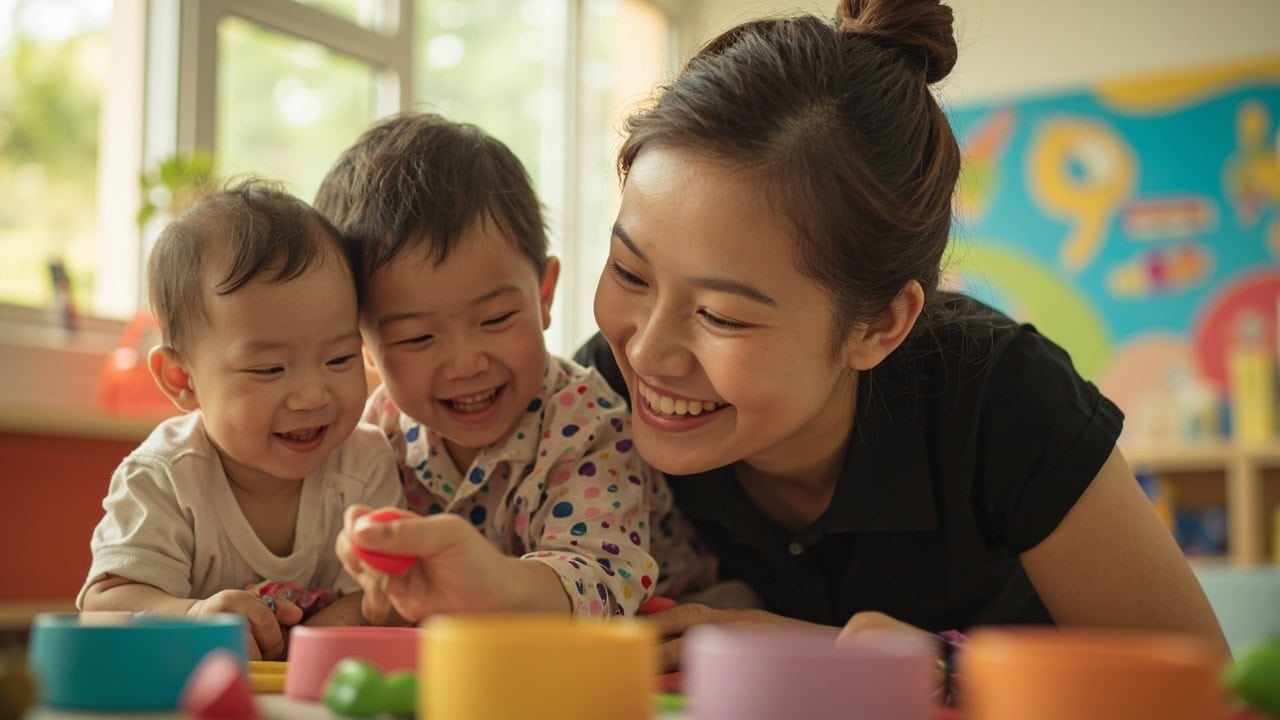
Come Home to a Child Who Is Ready for You
The Fear We Don’t Name
There is a tension that lives in the chest of every working parent in Singapore, and it is one of the most honest tensions a person can carry. You love your child completely. You also have a life — a job, responsibilities, a world outside your front door that requires you to step away.
And every time you step away, a small, quiet fear surfaces. Not a dramatic fear. Something softer and more persistent. The fear that the hours you spend apart are doing something. That distance has a weight. That your child is somehow — in some way you cannot quite name — farther from you at the end of the day than they were at the beginning.
That fear deserves to be named honestly. It is not irrational. It is not guilt for being a bad parent. It is the most natural thing in the world — the ache of a parent who loves deeply and cannot be in two places at once.
Here is what that fear is actually pointing you toward: a question. Not whether you should feel bad about the time you spend away.
What makes the difference between an evening reunion that restores your bond with your child and one that leaves you both feeling like something is missing?
Two Children, Two Homes
Walk with me into what an evening at home actually looks like, because this is where the truth lives.
You come home. You are tired. Your child has been awake since seven in the morning. You have both been moving through your separate days, carrying your separate experiences. And now you are together again, and the transition has to happen — quickly, in most homes.
Dinner needs to be made. Bath time is approaching. There are only a few hours between the end of the workday and the beginning of bedtime. In Singapore, where housing is what it is and lives are structured around long commutes and tight schedules, those hours are not just limited. They are precious.
And in those hours, something either happens or it doesn’t.
The First Child
Notice the difference between two children coming through the same front door at the end of the day.
The first child arrives home wound up. Not just physically restless — emotionally tangled. They have been in an environment all day where their needs were met, yes, but in a generalized way. The caregivers were attentive, kind, but there are four children in the room and only so many hands.
So this child has spent the day moderating. Waiting. Learning not to ask for too much. They come home carrying the armor of a day spent in partial attention, and when their parent walks through the door, the child does not run. The child hesitates. The child clings, or the child melts down, or the child seems strangely distant.
The transition takes a long time. The warmth that the parent hoped for feels elusive. And both of them end the evening a little bit tired, a little bit sadder, a little bit further apart than they started.
The Second Child
Now consider the second child. This child comes home in a different way. Not because the child is different. Because the day was different.
This child has been in an environment where, even among other children, they were genuinely seen. Where a caregiver noticed when they were frustrated before the frustration became a tantrum. Where someone stopped what they were doing and got down to the child’s eye level and said, I see that you’re tired. I see that you want your mummy.
This child has been held in attention all day — not perfectly, not constantly, but consistently. And that consistency has done something essential. It has kept the child’s emotional world from contracting. It has kept them open.
So when this child sees their parent at the door, something shifts. Their face changes. Their body softens. They run. They reach. They are ready — ready to be received, ready to receive, ready to reconnect.
The parent, who has been carrying their own version of readiness all day, feels that readiness returned. The reunion is warm because both of them are available for it. The evening begins not in recovery mode but in connection mode.
The Reframe That Changes Everything
What I am describing is not luck. It is not a personality difference between children. It is not something that happens to lucky families and not to others.
It is a direct and observable consequence of how a child is cared for during the hours you are away.
Quality childcare does not replace your presence. It does not make you less necessary or less important to your child. What it does is prepare your child to come home to you in a way that makes your presence count.
It keeps your child’s emotional channels open so that when you arrive, reconnection is possible. It holds your child’s day together so that the reunion can be about joy, not repair.
You are not choosing between being with your child and entrusting your child to someone else. You are choosing the kind of care that will make every evening you have together feel like the evening you actually want to have.
You are choosing whether your child comes home armored or open. Guarded or ready.
Research will tell you, and your own heart will tell you, that it is not the total number of hours you spend with your child that determines the strength of your bond. It is the quality of the moments you share. It is whether your child is present and available and open to you when you are together.
A child who arrives home from a day of merely adequate care will spend the evening in a state of emotional deficit. They will need to recover before they can connect. And by the time they are ready to connect, it is often already bedtime.
But a child who has been genuinely nurtured — who has been seen, comforted, engaged, and held in steady, warm attention — that child arrives home whole. And a whole child gives you their whole self. That is not a small gift. That is the gift you are actually longing for every time you walk through your front door.
The Architecture of Reconnection
Let me walk you through what happens in those evening hours, because this is where the work of reconnection lives. These are small, repeated acts of presence that, over time, build a bond so sturdy that temporary distance cannot threaten it.
The Pickup
The first thing quality care gives you is a child who is emotionally regulated at pickup. This sounds simple, and it is simple, but its effects ripple through the entire evening.
A child who has been helped to understand and manage big feelings during the day — who has had a caregiver notice when they were overwhelmed and help them settle before the overwhelm became unmanageable — that child walks out of their childcare setting in a state of relative calm.
When you pick up that child, you are picking up a child who is looking at you. Really looking. Not scanning for danger. Not still half in the previous environment. Looking at you with recognition, with desire, with the particular openness of a child who has been well and knows it.
And you, feeling that gaze, feel something shift in your own chest. The workday falls away. You are not just a parent in name. You are a parent in experience. You are being received by your child, and that reception is one of the most nourishing things a person can feel.
The Commute Home
Then there is the walk home — or the drive home, or the commute on the MRT with a tired child on your lap. This is a transitional space. You are no longer at work. Your child is no longer at their care setting. You are between worlds, and this in-between is where the day’s stories live.
What did you do today? asked with genuine curiosity, not obligation. Tell me about your morning.
When your child — still learning to talk, still piecing their day into words — gives you a fragment — blue blocks, Missy, outside, ball — you receive that fragment like the treasure it is.
Because it is your child’s first attempt to bring their outside world into the inside world of your family. And the way you receive it teaches your child something profound: that what happens to them when you are not there matters to you. That their day has value in your eyes. That the distance did not erase your interest in who they are.
The Dinner Hour
This is when children are often at their worst — hungry, overtired, unregulated. And this is precisely why it is one of the most important hours of the day.
If your child has been in a childcare environment where their hunger and fatigue were anticipated and managed — where they were fed at regular intervals and helped to rest when rest was needed — they arrive at this window in a fundamentally different state. They can sit at the table. They can engage. They can be with you instead of falling apart in front of you.
A child who has been genuinely cared for during the day does not need you to entertain them or to desperately compensate for your absence. They simply need you to be there. Present. Warm. Steady.
A child who feels secure in the morning carries that security into the evening. They are not looking for rescue. They are looking for you.
Bedtime
Perhaps most quietly of all, there is bedtime. The story. The lullaby. The moment when the lights go down and your child’s body slowly relaxes against yours and their breathing shifts from the breathing of wakefulness to the breathing of sleep.
This moment — this daily, repeatable, ordinary moment — is where children store their sense of security. In the darkness. In your voice. In the knowledge that the last face they saw before sleep and the first face they will see when they wake will be someone who loves them.
What Quality Childminding Actually Looks Like
Philosophy without practice is just poetry. So let me be specific about what this kind of care actually looks like — because you deserve to know what you are choosing when you choose how your child spends their day.
The Ratio That Changes Everything
Quality begins with numbers. A child who is one of three in a caregiver’s care is one of three in a caregiver’s care. That number determines whether your child is seen or supervised. Whether your child’s smallest distress is noticed and responded to or simply noted and moved past.
It determines whether your child arrives home wound up or settled. Whether your evening reunion is strained or warm.
Look for care ratios that allow for genuine attention. In home-based childminding, smaller numbers are not a limitation — they are the condition that makes everything else possible.
Consistency as Foundation
Consistency is not a feature. It is the foundation on which every other quality is built.
You need to know that on Monday morning, the same trusted person in the same trusted space will be there. And they will be there on Tuesday. And on Wednesday. And so on.
This predictability does something essential for your child: it builds security. A child who knows what to expect from their day can relax into it. A child who is always bracing for change cannot fully arrive in the moment.
Communication That Builds Trust
You have a right to know how your child’s day went — not in a perfunctory way, but in a genuine way. The small things. The real things.
What they ate. How they slept. What made them laugh. What they needed help with.
Look for a care arrangement where communication is a daily practice, not an afterthought. Transparency is what makes trust possible.
The Home Environment
Home-based care offers something that institutional settings cannot fully replicate: warmth, familiarity, and scale. A child in a home environment is in a setting designed for living, not for managing. The spaces are human-sized. The rhythms are domestic. The number of children present allows for real relationship-building.
This is not about aesthetics. It is about what your child’s nervous system registers when they walk through the door each morning. A place that feels like a home will help your child feel like themselves.
Addressing the Real Concerns Singapore Parents Carry
Before you can trust a care arrangement with your child, there are practical questions that need honest answers. Here are the ones that matter most — and what to listen for in the answers.
Can we afford this?
In Singapore, where the cost of raising a child is a real consideration, affordability matters. Look for care arrangements that work within the structures designed to support Singapore families.
Child Development Account (CDA) and Baby Bonus funds should be usable through the programme you choose. Pilot fee structures should be designed with real families in mind — not as a premium product out of reach for ordinary households.
These are not small details. They are the conditions that make quality care accessible rather than aspirational.
Is this regulated and credible?
Look for providers who are part of official frameworks. Being part of the ECDA Childminding Pilot is not just a regulatory detail — it is a statement of intent. It means commitment to the home-based pathway as a meaningful, rigorously supported option for Singapore families.
It means the childminder is not just someone you hope is good. It means there is a system behind them, supporting them, maintaining standards.
What if I have questions outside office hours?
Modern parenting comes with questions that do not always wait for convenient times. A quality care arrangement should include support that is responsive and reliable.
This might include digital tools — chatbots or communication platforms — that give you access to guidance and information whenever you need it. Not to replace human judgment, but to support it.
How do I know what’s actually happening during the day?
Transparency matters. Where observation tools like CCTV are available, they should be available not out of defensiveness but out of respect for the trust you are extending. You deserve to see what your child’s day looks like when you are not there.
Questions Worth Asking Before You Decide
- What is the child-to-caregiver ratio? Smaller numbers mean more attention. For infants, one caregiver to three children (1:3) allows for genuine responsiveness.
- Is the environment consistent? Same caregiver, same space, same routine — day after day. This predictability is the foundation of security.
- How do they handle big emotions? A quality caregiver notices frustration before it becomes a tantrum. They do not just manage behaviour — they help children learn to regulate.
- What does communication look like? You should receive genuine, daily updates — not just a log of meals and naps, but a sense of your child’s emotional state and experience.
- Can you observe before you decide? A credible provider will welcome you. Watch how the children move through the space. Watch how the caregiver responds to them.
Come Home to a Child Who Is Ready for You
You are not failing your child by working. You are not damaging your bond beyond repair by being away during the day.
You are a parent who loves your child, who thinks about them constantly, who carries them with you even when your hands are on a keyboard or a steering wheel or a stack of papers. That love is real. It is felt by your child. And it is not diminished by the hours you spend apart.
What can be diminished — what can quietly erode over time — is your child’s capacity to receive that love when you are together. And that is what quality childcare protects.
Not by doing your job. By doing its own job — the job of keeping your child whole, open, regulated, and emotionally ready for you at the end of the day.
So that when you walk through that door, the child who runs toward you is not a child who has been managed or merely kept safe. They are a child who has been held. Who has been seen. Who has been nurtured in your place — not instead of you, but alongside you.
That is what EduNanny is. We are alongside you. We are in your child’s day so that your child’s evening can be with you.
We are the bridge that makes the reunion possible — not the destination, not the substitute, but the bridge.
And every child who comes through our care and runs into their parent’s arms at the end of the day is proof that what we do matters.
You are the parent your child needs. And you do not have to do it alone.
Speak with us about finding care that keeps your child ready for you.
#SGWorkingParents #InfantCareSingapore #ChildmindingSG #QualityChildcare #ParentChildBond