What Your Morning Goodbye Is Teaching Your Child About Security
What You Were Doing at That Gate
There is a moment every morning that most parents in Singapore experience but almost no one talks about with the honesty it deserves.
It happens somewhere between the air-conditioned lobby and the childcare door. Your child has been fine in the car—maybe even cheerful—and then, as you approach the gate, something shifts. A small hand tightens around yours. A body goes heavy. You feel the exact weight of your child pressing into your legs, refusing to let go, and you are suddenly aware of every other parent walking past, the caregiver waiting with practiced patience, and the clock on your phone that tells you the hands are moving toward a meeting you cannot miss.
So you do what most of us do. You crouch down, you kiss a forehead, you say something quick and cheerful about having fun today, and then—because you have to, because there is no other way—you hand your child to someone else and walk back to the car. Or the MRT. Or the lift at your office building.
And all the way to work, you replay it. You wonder if you should have stayed longer. You wonder if that brief flash of something in your child’s eyes was just resistance, or something deeper. You wonder if you are doing this right.
Here is what I want you to know: what you were doing at that gate was not just a transition. Not just a logistical handoff, not just a necessary inconvenience before the real work of your day begins.
What you were doing was participating in one of the most developmentally significant rituals of your child’s early life. You were part of a goodbye that is teaching your child something profound about the world, about security, about whether people who leave can be trusted to come back.
This is what happens at the gate. Not the logistics of it—what to pack or how to label bottles—but the invisible architecture of the morning goodbye, and why understanding it is one of the most important things you can do as a parent in Singapore today.
What You Were Actually Feeling (And Why It Matters)
The guilt you felt when your child clung to your shirt. The way your chest tightened as you walked away. The brief, uncomfortable thought that perhaps this was a sign something was wrong—with the childcare, with your choice, with you.
These feelings are not weakness. They are not irrationality. They are the biological signature of attachment, and they are a sign that the system is working exactly as it should.
When your child resists at the gate, something is happening in their developing brain that has been happening for tens of thousands of years of human bonding. The attachment system is activating. Your child is not just upset about parting with you in the way an adult might be upset about a business trip. Your child is experiencing a genuine, neurologically real concern about survival.
Not because anything is wrong—because everything is working.
The attachment system is supposed to activate at separation. That activation is the mechanism through which children learn that the world is trustworthy.
What happens next at the gate is what matters. Not whether your child cries—children cry at drop-off and this is often completely normal. What matters is what happens in the minutes and hours that follow:
- Does your child, after an initial protest, settle into the rhythm of the morning?
- Does a caregiver receive your child with warmth, not just competence?
- Is there a moment of transition where your child’s distress is acknowledged and gently redirected rather than bypassed or dismissed?
- Does your child begin to discover that this new environment contains people who are safe, activities that are interesting, and the quiet promise that you will return?
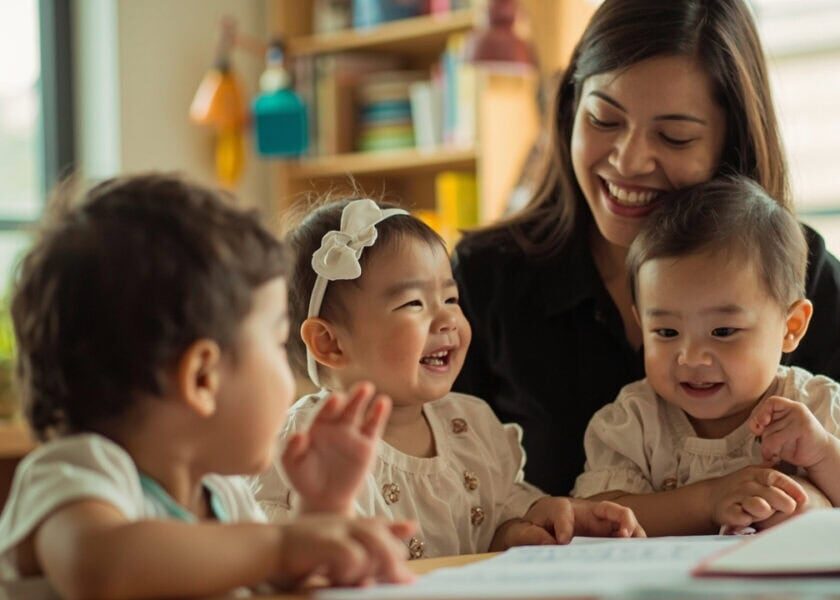
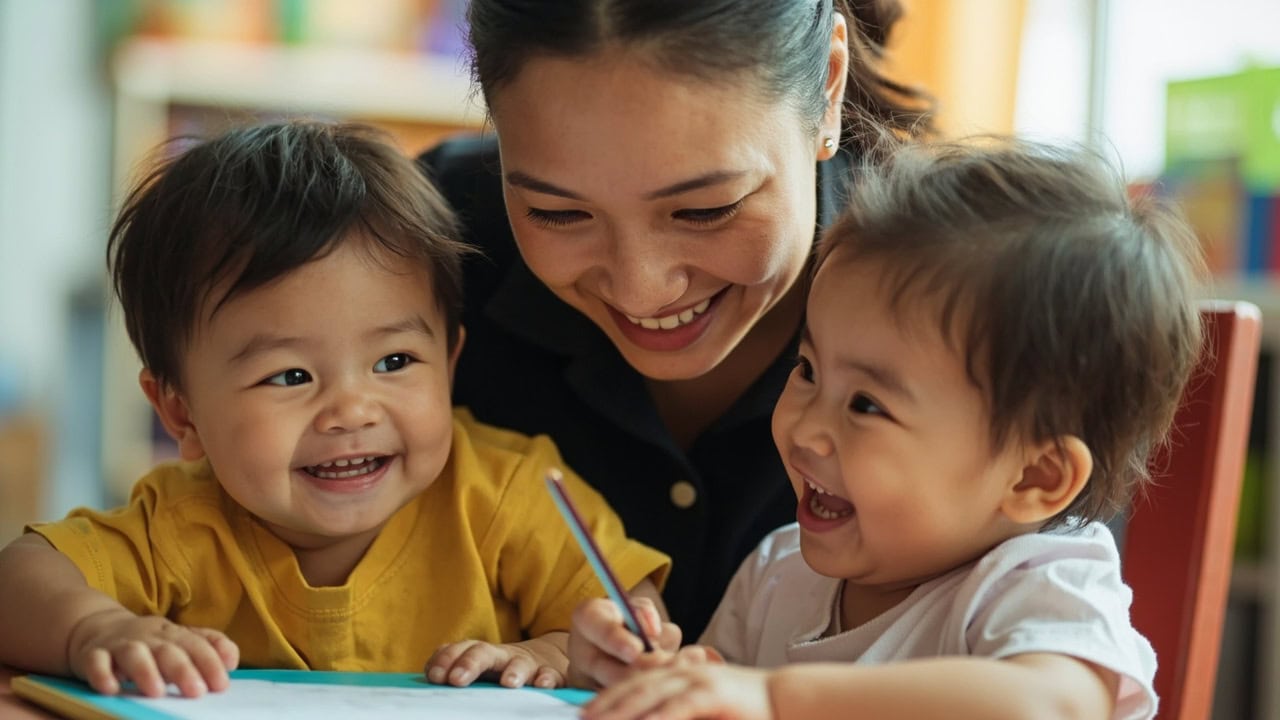
This is the invisible scaffolding that quality infant care provides. It is not visible in the lesson plans or the activity schedules. It is happening in the micro-moments of the morning goodbye—in the way a caregiver bends to your child’s level, in the tone of voice that says I see that this is hard and I am here, in the consistent ritual that gradually teaches your child’s nervous system that goodbye does not mean abandonment.
The Goodbye Across Developmental Stages
The goodbye changes across developmental stages. What your infant experiences at the gate is not the same as what your toddler or your preschooler experiences, and the caregiver’s role shifts accordingly.
For Infants
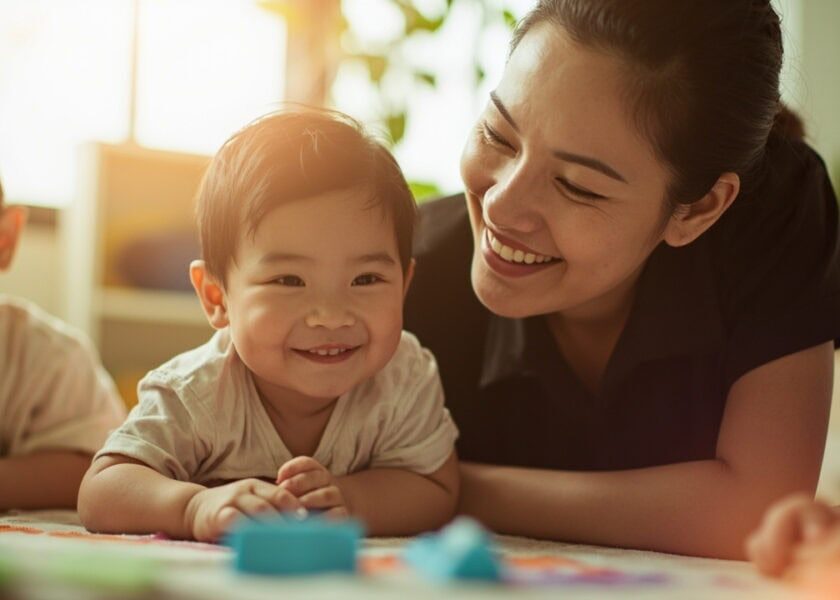
The goodbye is primarily about the caregiver receiving the child into a warm, responsive environment. At this stage, low caregiver-to-infant ratios mean that your baby is not lost in a crowd. There is a specific person who is there for them, who knows their cues, who has been briefed on their rhythms and preferences.
For an infant, the quality of that moment of transfer is crucial. Does the caregiver meet your baby with warmth? Do they receive your baby from your arms in a way that communicates safety? For an infant, the transition moment matters enormously—being placed into arms that are steady and present teaches your baby something about the world before words can even be spoken.
For Toddlers
The goodbye becomes more emotionally complex because the toddler understands more. They know you exist when you leave. They remember that you have left before. And they are beginning to test the limits of their world—who controls this goodbye? Can I stop it?
The toddler who throws themselves dramatically on the floor at drop-off is not being manipulative. They are expressing, the only way they know how, that this goodbye is hard and they have big feelings about it.
The caregiver’s response matters enormously here: warm, firm, consistent. Not punitive. Not giving in to the point where the toddler learns that dramatic protests work. But always, always acknowledging the feeling before redirecting.
For Preschoolers
By the preschool years, the goodbye becomes more negotiable and more verbal, though it is no less real. Your preschooler may articulate their resistance: I do not want you to go. I miss you.
These are not things to dismiss or rush past. They are invitations to connect, and the quality of your response—calm, loving, certain—continues to shape your child’s internal working model of the world.
Normal Adjustment vs. Signs That Need Attention
There is a question that parents often wonder but rarely ask out loud: How do you know when your child’s distress at drop-off is normal, and when it might be a signal of something deeper that needs attention?
This is not a question with a simple answer, but there are patterns worth knowing.
What Normal Adjustment Looks Like
In the early weeks of a new childcare arrangement, an adjustment period is expected. Most children will show some protest at drop-off, and many will settle within fifteen to thirty minutes as they become engaged with the environment and the people in it.
What you want to watch for over time is a pattern:
- Is your child beginning, over weeks, to settle more quickly?
- Is the resistance becoming less total, less panicked, more the manageable resistance of a child who does not like goodbye but trusts the return?
These are signs of healthy attachment working as it should.
Signs That Warrant a Conversation
There are signals that may warrant a conversation with your caregiver and, if persistent, with a developmental professional:
- Your child consistently does not settle after an hour or more—if the distress is prolonged and appears to be escalating rather than adjusting over weeks
- Your child shows other signs of difficulty beyond the morning goodbye: changes in eating, sleeping, regression in developmental milestones, pervasive fearfulness
One of the things that causes unnecessary suffering among parents is the tendency to pathologize normal development. A child who cries at drop-off is not necessarily unhappy in their care. A child who clings is not necessarily insecure.
The question is always what happens next, and whether there is movement toward security over time.
This is why open communication between caregivers and parents matters. Understanding whether your child’s goodbye is developmentally normal or whether it signals something worth attending to is not something that should happen in isolation. It requires observation over time, sharing of information, and a relationship built on transparency.
What Quality Care Looks Like at the Morning Goodbye
Not all childminding is the same. The difference often lives in moments that are invisible to parents until they know what to look for—the micro-moments that either build your child’s security or leave gaps in it.
What Trained Caregivers Do During Drop-Off
Quality caregivers do not simply receive your child. They receive your child with intentionality. They are trained to notice:
- How your child’s body responds when they enter the space
- Whether your child reaches for a familiar object, a particular spot, a known person
- The quality of your child’s distress—is it panicked or protest? Both are normal, but they call for different responses
- The moment your child begins to settle, and what facilitated that shift
They are also trained to:
- Receive your child from your arms with warmth that communicates safety
- Offer brief, honest acknowledgment of your child’s feelings (I see you are sad. Mama will come back after your day is done.)
- Redirect gently but without rushing or dismissing
- Maintain consistency—this same caregiver, this same greeting, this same transition ritual every morning
Your Emotional Regulation Is Part of the Lesson
There is another dimension to this that Singapore parents often carry quietly, and it deserves to be named.
You were not just managing your child’s distress at the gate this morning. You were managing your own.
The guilt. The anxiety. The racing thoughts about whether your child noticed the slight hesitation in your voice, whether your child sensed that you were also finding this hard. The way you walked back to your car feeling like a small part of you was still back at that door.
This is not weakness. This is love doing exactly what it is supposed to do.
Your emotional regulation at the gate is itself part of what your child is learning from.
Children are not just learning from what you say. They are learning from how you are. When you approach the childcare door with a regulated nervous system—calm, grounded, even if you are internally churning—your child reads that.
Your body is communicating something. It says: this place is safe. This person is trustworthy. I am leaving you here and that is okay, and I am okay.
This does not mean you need to perform false cheer. Your child will not be harmed by knowing that you, too, find the goodbye hard. But there is a difference between:
- A parent who sits with their own discomfort and still leaves with quiet conviction
- A parent whose own anxiety pulls them back to the door again and again, extending the goodbye until both child and parent are more dysregulated than when they arrived
The goal is not to feel nothing. The goal is to feel it and still leave with steadiness.
The Ritual of Return
What happens when you return to collect your child also matters. The reunion is part of the same developmental act. When your child sees you return—when that promise is kept—the attachment system settles, and trust is reinforced.
Quality caregivers facilitate this too. They signal to your child that your arrival is imminent in a way that allows anticipation rather than anxiety. They help your child experience the reunion as a return rather than an interruption.
Navigating Infant Care in Singapore
Let me acknowledge something that Singapore parents in particular carry, because it shapes how you experience every aspect of childcare.
You are raising children in one of the most demanding, high-achieving, high-pressure cities in the world. The expectations on Singapore parents are immense:
- You are navigating the costs of raising children in one of the world’s most expensive cities
- You are managing the tension between career and family in a culture that often demands both without always providing the scaffolding to hold them
- You are balancing the expectations of parents and in-laws, the comparisons with other families, the endless awareness of what other children your child’s age are doing and learning and achieving
And on top of all of that, you are being told that the morning goodbye matters. That the quality of how you and your caregiver handle those few minutes will shape your child’s development in ways that echo into adulthood.
This is a lot. And thoughtful, quality-focused approaches to care in Singapore are increasingly designed not just with the child in mind but with the parent in mind—the whole system of the family navigating early childhood today.
Questions to Ask When Choosing Infant Care
If you are researching infant care options, here are some questions worth asking—not to find the perfect provider, but to find the right fit for your family:
- How do caregivers handle drop-off? What does the transition ritual look like?
- What happens if my child is distressed? How do caregivers respond?
- Will the same caregiver receive my child every morning, or does it vary?
- What training do caregivers receive in attachment and early childhood development?
- What is the caregiver-to-child ratio, especially for infants?
- What does the adjustment period look like? How do you support families through it?
- How do you communicate with parents about how the morning went?
What EduNanny Offers
EduNanny operates under the ECDA Childminding Pilot, a structured initiative designed to make quality infant care more accessible to Singapore families. This means caregivers are trained to recognized standards, practices are monitored, and families are not navigating this alone or with a provider that exists in a regulatory vacuum.
EduNanny offers pathways through home-based care, community care, and centre-based options—because different families have different needs, different schedules, different living situations. Some families need the intimacy of home-based care with its low ratios. Others need the community environment of a centre. There is no single right answer, only the right answer for your family.
Within the pilot framework, EduNanny’s services are structured to allow for CDA and Baby Bonus usability—meaning the financial logistics of quality care are one less thing for you to navigate in an already complex landscape.
The Goodbye Is Building Something That Will Last
Let us return to that moment at the gate, because I think you are ready to see it differently now.
You are standing there with your child, and your child is resisting, and you are feeling everything you always feel. The guilt. The tightness in your chest. The slight panic. The question, Am I doing this right?
Here is what I want you to know.
You are not failing. You are not failing your child by working. You are not failing your child by choosing childcare. You are not failing by feeling the weight of the goodbye. You are doing what mammals have always done: you are trusting your child to other capable hands, and you are trusting yourself to return. And the fact that this is hard is a sign of how much you love your child, and how deeply your attachment system is working.
The goodbye your child is learning from is not a perfect goodbye. There may be tears. There may be protest. You may not always execute it with the calm grace you hope for.
But here is what matters: you are showing up. You are present in the goodbye. You are not sneaking away. You are not abandoning. You are leaving, and you are coming back, and the accumulated weight of those returns—thousands of them over the early years—is what builds your child’s security.
Not the absence of goodbye. The presence of return.
The caregiver who receives your child each morning is part of that. They are holding the scaffolding. They are making sure that when you walk away, your child lands in safe, warm, attentive hands.
And over time, as your child learns that the goodbye ends with return, that the caregiver is another safe person, that the world contains trustworthy people beyond you—that is the foundation for everything that follows. The ability to separate and rejoin. The ability to trust. The ability to explore the world because you know you have a home base to return to.
This is not small work. This is not incidental. The daily goodbye is one of the foundational acts of early childhood, and you are doing it every single morning, and it matters more than most of the things you will do in a day.
EduNanny exists because we believe this work deserves to be done with care, with intention, with expertise, and with warmth. We exist because no parent in Singapore should have to navigate the invisible architecture of the morning goodbye without a partner who understands what is actually happening.
We are here at the gate with you. We see what you are doing. And we know that what you are doing—the hard, daily, emotionally real work of the goodbye—is building something in your child that will last a lifetime.
If you are exploring infant care options in Singapore and want to understand how the morning goodbye can be held with the care it deserves, we welcome the conversation.
Walk away from that gate with confidence. Your child will be okay. And so will you.
If you found this article helpful, you might also like to learn more about who we are or explore our approach to quality childminding in Singapore.