How Quality Childcare Builds Your Baby’s Brain in Singapore
The Silence After You Leave: What Neuroscience Tells Us About Infant Brain Development in Quality Childcare
There is a particular silence that fills a room after a parent leaves their infant for the first time. Not a peaceful silence — the kind that hums with a hundred unspoken questions.
Is my baby crying right now? Is she reaching for someone who isn’t me? Is something being lost in these hours that I will never get back?
If you have ever stood at the threshold of a childcare centre, or handed your infant to a caregiver you have known for only a few days, or driven away from home knowing that somewhere across the city, your baby is learning to trust someone else — what you feel is not weakness. It is love in its most honest form.
And here is what the science of early childhood development has made beautifully, unmistakably clear: what you are feeling is also, in a profound way, unnecessary to fear.
What Science Tells Us
- In the first twelve months, your baby’s brain builds more than one million new neural connections every second
- Secure attachment can develop with multiple responsive caregivers — not just one parent at home
- Quality infant care creates a “secure base” from which your child learns to explore confidently
- Trained caregivers actively facilitate neurological development, not just supervise
- Observable signs of healthy development can be seen at pickup and in evening behaviour
- Choosing quality infant care is an active investment in your child’s brain architecture — not a compromise
The Architecture of a Mind: What Is Actually Happening in Your Infant’s Brain
The hours your infant spends in quality care are not hours of passive watching. They are hours of extraordinary, invisible construction. What is being built in your child’s brain during those hours — in the first year of life, in the earliest months — is nothing less than the architecture that will shape how she thinks, how she learns, how she relates to others, and how she meets the world for the rest of her days.
One Million Connections Per Second
In the first twelve months of life, your baby’s brain is building itself at a speed it will never again achieve. At no other point in human development does neural connection happen this rapidly, this densely, this irreversibly.
The brain is not merely growing during this time — it is being fundamentally constructed. Room by room. Connection by connection. In ways that will determine the layout of every room that comes after.
In the earliest months, an infant’s brain produces approximately one million new neural connections every second. Each of those moments — seemingly simple, seemingly ordinary — is a tiny electrical storm in the prefrontal cortex, the hippocampus, the temporal regions. Building pathways that will one day become her capacity for reasoning, memory, language, and emotional regulation.
Overbuilding, Then Refining
By the end of the first year, your child will have formed more neural connections than she will ever need. The brain, in its extraordinary efficiency, has overbuilt on purpose.
Because the next phase — the phase that happens largely between ages one and three — is the phase of pruning. The connections that have been used, reinforced, repeated in meaningful, responsive environments will be strengthened and preserved. The connections that have lain dormant, unused, unstimulated will be eliminated.
The brain is not keeping everything. It is keeping what has been mattered.
This is why the first year is not just important. It is foundational in a way that no other year can be — not because later years don’t matter (they do, profoundly), but because the first year sets the parameters. The brain is establishing its defaults. It is learning, on a cellular level, whether the world is a responsive place, whether exploration is rewarded or frightening, whether its cries bring comfort or silence.
The Active Ingredient in Neurological Construction
The quality of care. The responsiveness of the environment. The consistency and warmth of the adult presence. These are not amenities. They are not luxuries. They are the active ingredients in your child’s neurological construction.
Consider what is required. In the first year, an infant’s brain is exquisitely sensitive to the emotional tenor of her environment. Elevated stress hormones — specifically cortisol — in the early months can affect the development of the hippocampus, the brain region central to memory and learning.
But here is the nuance that matters enormously: not all stress is the same.
- The stress of being left alone to cry for long periods is physiologically different from the stress of a minor frustration, a brief separation, a moment of uncertainty followed by comfort.
- The first is toxic to development.
- The second is manageable, even growth-producing.
The caregiver’s role is to ensure that the stress your infant experiences in care is the manageable kind — the kind that builds resilience rather than eroding it. This requires training. It requires the ability to read an infant’s cues with precision — to recognize the early signs of distress before they escalate, to respond with warmth before the cortisol system has fully activated.
Secure Attachment and the Myth of the Single Caregiver
There is a concept from developmental psychology called the secure base — a term coined by the British psychiatrist John Bowlby, whose work on attachment transformed our understanding of early childhood.
The secure base is the psychological foundation from which a child feels safe enough to explore the world. It is what allows an infant to look away from her caregiver’s face, to reach for a toy, to crawl across a room, to take a small, trembling step toward independence — because she trusts, on a deep and pre-verbal level, that the base is still there, that she can return, that she is held.
For decades, there was a lingering fear — and I understand the fear — that placing an infant in professional care might disrupt this foundation. That the secure base could only be located in one place, with one person, in the home. That hours spent apart might erode the very attachment that makes exploration possible.
What Research Actually Shows
The research does not support this fear. What the research shows, consistently and clearly, is that secure attachment is not about the number of attachment figures in a child’s life. It is about the quality of responsiveness, the consistency of care, the attunement between caregiver and child.
A child can develop a secure base with more than one adult. In fact, children who have multiple responsive, warm, consistent caregivers often demonstrate what researchers call a “secure base script” — a learned expectation that the world is reliable, that adults can be trusted, that exploration leads to reward rather than abandonment.
What this means for parents in Singapore — navigating the very real pressures of dual-income households, demanding careers, and the extraordinary complexity of raising a child in one of the world’s most competitive environments — is significant.
It means that choosing quality infant care is not a compromise. It is not a necessary concession to reality. It is, when done well, an active investment in your child’s secure base. It is saying to your infant: the world has more than one trustworthy person in it, and that is a good thing.
What Quality Infant Care Actually Looks Like
This is where the role of the caregiver becomes not just important but extraordinary.
When we talk about what a trained infant caregiver does, we are not talking about supervision. We are not talking about feeding schedules and diaper changes — though these matter, and they matter with a precision that surprises many parents.
We are talking about something closer to architecture. The caregiver in a quality infant care setting is, in a very real and documented sense, an architect of neural development.
What Caregivers Actually Observe
Consider what a trained caregiver understands when she sees a four-month-old babbling. She sees not just a pleasant sound, but the early firing of language circuits in the temporal cortex — a connection being reinforced by her responsive imitation.
When she watches a nine-month-old pull herself to stand, she sees not just a motor milestone, but the linking of motor planning regions with the reward circuits of the limbic system — the infant learning through her own body that effort produces success.
Your child receives sustained, individualized attention from an adult who knows her rhythms, her preferences, her particular style of seeking comfort. The caregiver learns your infant’s face, your infant’s cry, your infant’s particular way of turning away when she has had enough stimulation. This is not incidental to care. This is care.
Signs You Can Look For
The invisible architecture your child’s brain is building is, by definition, invisible. You cannot see the neural connections forming. But what you can see — and what you deserve to know how to read — are the outward expressions of this internal development.
At pickup, you may notice that your infant is not distressed the moment you arrive. A child who is securely attached in her care environment — who has experienced consistent, responsive care — does not spend the hours of your absence in quiet desperation. She explores. She plays. She engages. And when you arrive, she greets you with the calm confidence of someone who has been well, who trusts that you always return.
In the evening, you may notice your child is tired in a particular way — the deep, satisfied tiredness of a brain that has been productively engaged. Not the irritable, overstimulated exhaustion of a day spent without meaningful interaction. The tiredness of a mind that has been building.
You may notice language emerging earlier than you expected — words and sounds that you did not teach, because your child learned them from a caregiver who spoke to her, who narrated the world, who treated every interaction as an opportunity for language development.
Questions That Actually Matter When Choosing Infant Care
Use this knowledge as a lens — not to second-guess your choices, not to fuel anxiety, but to evaluate. To ask the questions that matter.
When you are considering an infant care arrangement, look past the checklist of logistics. Yes, safety matters. Yes, cleanliness matters. Yes, proximity and cost and schedule matter. But these are the foundation, not the building.
The question that should sit at the top of your evaluation is this: what is happening in my child’s brain during the hours I am not there, and is this environment building it well?
Questions to Ask Any Infant Care Provider
- Caregiver training: What specific training do your caregivers have in infant development, not just childcare? Can they explain what they observe in a four-month-old’s babbling or a nine-month-old’s motor milestones?
- Ratios: How many infants per trained caregiver? Smaller ratios mean more individualized attunement.
- Typical day quality: What does a typical day actually look like for an infant? Not just the schedule of feeding and sleeping, but the quality of interaction. Is your child being spoken to throughout the day?
- Responsiveness: Is your child held when distressed, or left to cry? How are cues being read and responded to?
- Environment design: Is the space designed for developmental stage — mats and mirrors and objects of varying textures that invite the exploration your infant’s brain is hungry for?
This is how you evaluate infant care: not as a logistical problem to be solved, but as a developmental environment to be assessed.
The best infant care programmes know this. They can tell you, with specificity, what your child is working on developmentally, what skills are emerging, what the caregiver is facilitating.
EduNanny Singapore: Built on This Understanding
EduNanny Singapore was built on the understanding that infant care is not supervision — it is architecture. We are part of the ECDA Childminding Pilot, and we carry that designation not as a credential alone but as a commitment to a standard of care that takes seriously the science of what infants need in their first year.
We offer both home-based and centre-based pathways, because Singapore families are not a monolith.
- Home-based care offers intimacy — small ratios and individualized attention that home-based care makes possible.
- Centre-based care offers community and structure.
Both can be excellent. Both can be developmental. What matters is not the setting but the quality of what happens inside it.
What Parents in Singapore Can Expect
Our pilot fee structures have been designed with accessibility in mind, because the neuroscience of infant development should not be the exclusive domain of families who can afford premium private arrangements. CDA and Baby Bonus funds can be used, where applicable, to support these arrangements.
Monday to Friday care blocks provide the consistency that infant brains require — the reliable rhythm that allows a child to build expectations of safety, to learn that morning always comes, that the caregiver always arrives, that the day has a shape.
We communicate with parents because we believe transparency is not just a service feature but a developmental principle. When parents are informed, they are calmer. When parents are calmer, the home environment is calmer. When the home environment is calmer, the infant’s stress regulation is more stable. Communication is not a supplement to quality care. In the first year, when infants are exquisitely attuned to the emotional states of the adults around them, communication is part of the care itself.
Supporting You Alongside the Way
We know that navigating infant care — and all the questions it raises about development, attachment, and whether you are making the right choice — can feel bewildering at times. That is why we developed Thomas AI Chatbot: a tool designed to answer questions about your child’s development, to help you understand what you are observing, to walk alongside you in the work of raising a human being.
Where deployed, our CCTV measures reflect not a lack of trust but a recognition of the reality that parents face. We believe in making the invisible slightly less invisible. Not because we assume something will go wrong, but because we know that what parents need is not reassurance — it is evidence.
A Final Word for Parents in Singapore
Even with all of this — the training, the ratios, the communication, the science — infant care is not perfect. Children will sometimes cry at drop-off. Infants will occasionally have difficult days. The developmental trajectory of every child is not a smooth upward line; it has interruptions, regressions, variations that are entirely normal.
We do not promise miracles. What we promise is something more grounded: that your child will be in an environment designed, by knowledge and by intention, to support the architecture her brain is building in this irreplaceable year.
We live in a city that asks enormous things of parents. Singapore has one of the highest rates of female workforce participation in the world. We have high costs of living, competitive academic cultures, family structures that are evolving rapidly from what they were a generation ago.
The pressure on parents — on mothers especially, though not exclusively — to be present, to be perfect, to somehow reconcile the demands of career with the demands of early childhood is immense.
And into this pressure comes a question that carries enormous weight: should I leave my infant? Is it okay? Am I failing somehow by choosing to return to work, by entrusting my child to someone else’s care?
The neuroscience I have shared with you today answers this question with clarity and with compassion. Your infant’s brain is not being diminished by quality care. It is being constructed. The architecture that will carry your child through primary school and secondary school and into the relationships and careers and challenges of her adult life is being built right now — in your presence and in your absence, in the interactions you have with her at home and in the interactions she has with a trained, warm, responsive caregiver in the hours you are apart.
The return on that investment is not measured in standardised test scores or in the metrics that Singapore society is so skilled at tracking. The return is measured in something harder to quantify but infinitely more important:
- A child who trusts the world.
- Who explores it with confidence.
- Who has learned at the deepest cellular level that she is held, that she is capable, that the adults in her life will respond when she calls.
The Image That Matters
I want to end with a different image from the one I began with.
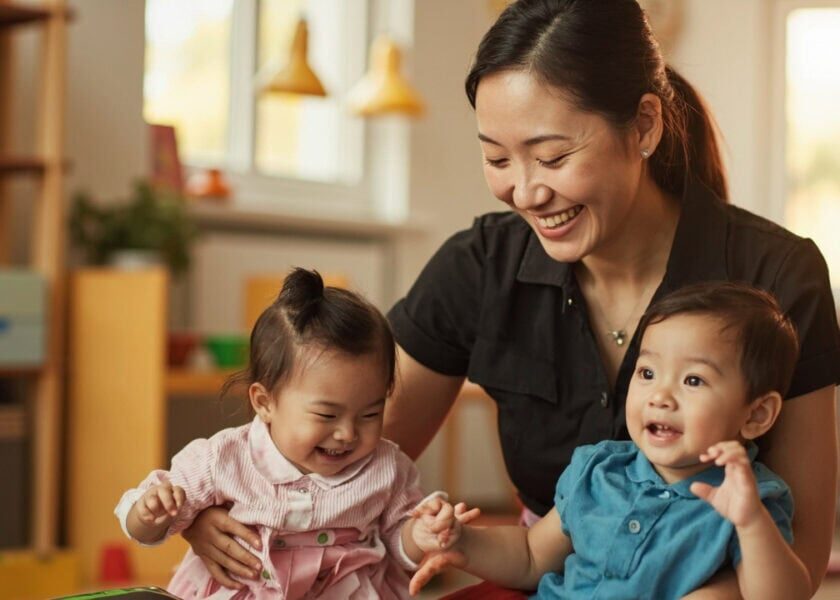
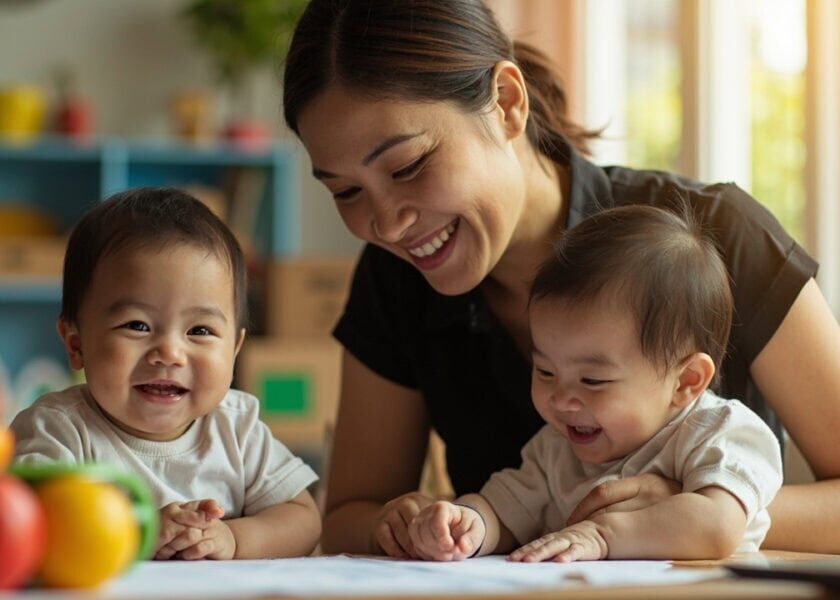
I want to end with the image of a caregiver, trained and present, sitting on the floor of a room where your infant lies. The caregiver is not just watching. She is speaking — quietly, warmly, narrating the world in language that your infant’s temporal cortex is drinking in like water.
She is responding to a cry not with frustration but with attunement — moving toward your child, lifting her, holding her against her chest where your infant can hear the steady rhythm of another human heart.
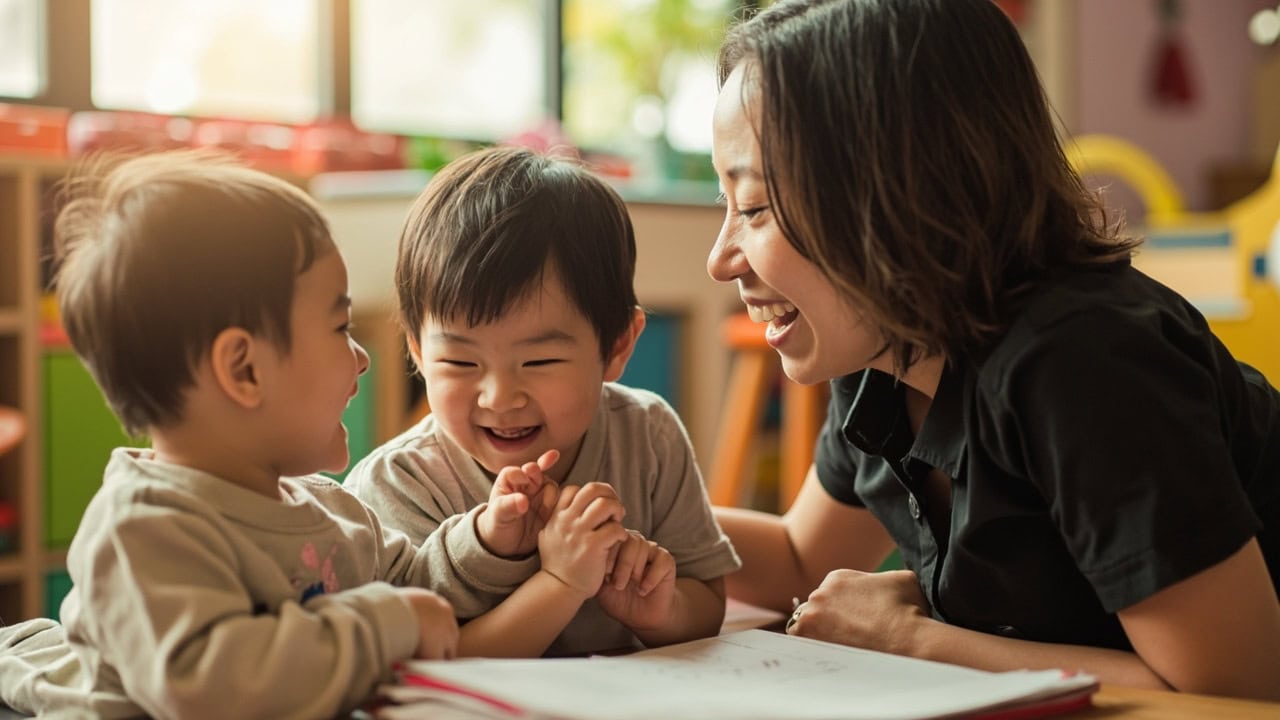
She is creating what developmental scientists call a “serve and return” interaction — the fundamental back-and-forth that builds neural pathways more effectively than any screen, any toy, any curriculum.
And in this room, invisible to the parent who cannot be there, your child’s brain is building. One million new connections per second. The architecture of a person.
That is what is happening in the hours you are not there.
And it is, when the care is right, nothing short of extraordinary.
If you are exploring quality infant care for your family in Singapore, we invite you to learn more about how EduNanny Singapore supports infant brain development through our ECDA Childminding Pilot programme, available in both home-based and centre-based pathways.
Have questions? We are always happy to hear from you at EduNanny Singapore.