The Quiet Trust Your Child Is Building in Singapore Childcare
The World Beyond the Door: Understanding What Your Child Is Really Building in Quality Childcare
There is a moment, somewhere between the car seat and the classroom door, when every parent in Singapore asks the same unspoken question. It is not about safety checklists or staff qualifications or whether the centre has good reviews. It is simpler than that. It is this: what is happening to my child right now, in this building I am walking away from?
You hand over the bag with the spare clothes. You crouch down to say goodbye. You watch them settle into an activity or reach for a toy, and then you turn and leave. And in that turn, a whole world opens up that you cannot see.
This article is about that world. Not the world of policies and ratios and licensing visits. The world your child actually lives in when you are not there. The world of felt experience, of tiny revelations, of the slow and quiet construction of a self.
Because here is what we rarely say plainly: the question beneath your question is not whether your child is safe. You already trust, in your bones, that safety can be verified. The question beneath your question is whether they are happy. Whether they belong. Whether the hours they spend in care are hours in which they are becoming someone who trusts the world, who reaches for it, who knows how to be with other people.
The Architecture of Felt Safety: Why the Numbers Matter
There is a word that educators and developmental psychologists use when they describe the earliest months and years of a child’s life. That word is felt safety. It is not the same as physical safety.
A room can be baby-proofed. A schedule can be consistent. Doors can be locked. But felt safety is something else entirely. It is:
- The experience of warmth against your child’s skin
- The particular pitch of a voice that says, without words, I see you, I am here, you are not alone
- The pace at which a caregiver moves through the room — unhurried, responsive, attentive
- The texture of the environment, the temperature of the air, the way morning light falls across a play mat
It is a thousand small sensory truths that add up to a feeling the child cannot yet name but carries with them nonetheless.
Why This Matters More Than You Might Think
For infants especially, felt safety is not a luxury. It is the architecture of the self.
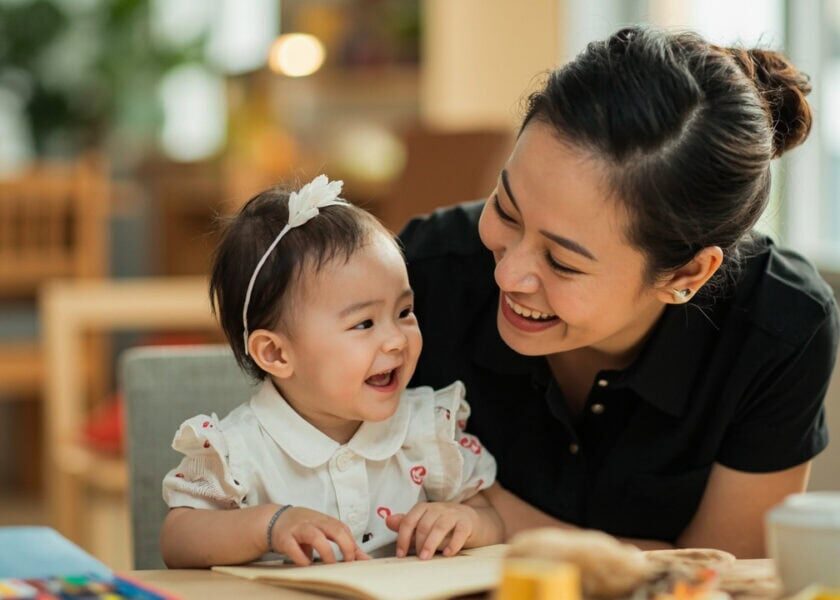
When a baby cries and someone comes — not just anyone, but someone who has learned to read the particular quality of that cry, who knows whether it means hunger or discomfort or simply a longing to be held — something foundational is being built.
That baby is not just being comforted in that moment. That baby is learning, at the deepest level, that the world is a place where needs are met and voices answer. That baby is building what researchers call an internal working model of trust — a silent template that will shape how they relate to people, to challenges, to the unknown, for the rest of their lives.
This is what quality infant care creates. Not just supervision. Not just stimulation. A felt environment of safety that the child lives inside, breathes in, absorbs.
The Ratio That Makes This Possible
Here is why the numbers matter — not as abstract statistics, but as the condition for what your child actually experiences.
In EduNanny Singapore’s ECDA Childminding Pilot, we hold to up to one-to-three infant ratios. One caregiver for every three infants. That is not an accident of policy. It is a deliberate choice to ensure that each child can be seen, known, and responded to.
Think about what this means in practice: when your infant reaches up with grabby hands, there is a face close enough to meet theirs. When your toddler falls and looks around for reassurance, there is an attuned voice that says, I know, I saw, you’re okay.
This is the first thing we want you to understand about what your child is building inside quality childcare: the foundations of trust are being laid in moments you will never witness, in experiences that are shaping who they are becoming.
What Children Actually Learn in Quality Care
But your child is not only building trust. They are building self. And the second great work of quality childcare is what we might call the curriculum of the heart.
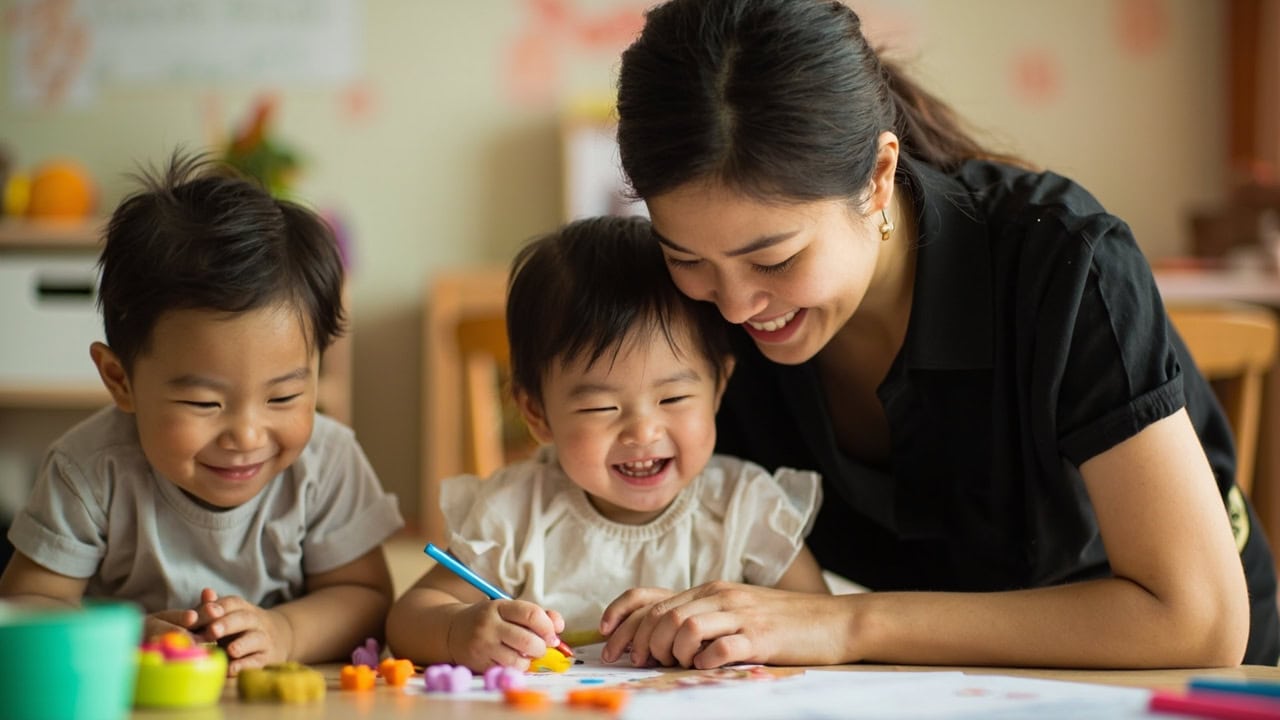
Children in good care are not simply waiting for you to return. They are learning. Not in the way school teaches, through instruction and correction, but in the way humans have always learned — through lived experience, through relationship, through the thousand small negotiations of being alive in a room with other people.
A Morning Circle, A Small Social Lesson
Consider a toddler in a morning circle in any quality childcare setting in Singapore. They are sitting among five other children, and a caregiver is singing a song with actions. The toddler watches. They do not yet know all the actions. They reach for a friend’s hand when the song says to, and the friend pulls away, and there is a flash of something — disappointment, confusion, the beginning of a social learning that no textbook can teach.
A caregiver notices. The caregiver does not intervene heavy-handedly. They simply narrate: Siti wanted to hold hands, and Jiale wasn’t ready yet.
The toddler looks up. They are hearing their own experience reflected back. They are learning that feelings have names, that other people have feelings too, that social life is a skill that can be learned.
This is emotional curriculum. And it happens every single day, in every interaction, in the gentle push and pull of group life.
What Quality Childcare Actually Teaches
Quality childcare teaches children:
- How to be frustrated and still be okay
- How to share and feel the loss of sharing and learn that there is enough
- How to express anger without destroying the relationship
- How to be curious and follow that curiosity into new discoveries
- How to feel joy in the company of others and know that joy is amplifiable, that it grows when it is shared
These are not soft skills. These are the core competencies of being human. And they are built not through lecture but through experience — through the daily lived curriculum of quality care.
What Your Child Is Building at Every Stage
For infants (0–18 months) — The work of infancy is primary: building the internal working model of trust. Your baby is learning that the world is reliable, that their cries bring response, that their needs matter to someone who is paying close attention. Every feeding, every nappy change, every moment of being held by a consistent caregiver is building the foundation for all future relationships.
For toddlers (18 months–3 years) — Toddlers are discovering agency. They are learning I am a separate person who can act on the world and the world responds to me. Quality care provides safe boundaries within which this exploration can happen — a place to test, to push, to discover, to fail, and to try again with support nearby.
For preschoolers (3–6 years) — Preschoolers are building social competence and emotional vocabulary. They are learning to navigate friendships, to understand group dynamics, to regulate bigger feelings. They are also building the confidence to approach learning — I am a learner, the world is interesting, I can figure things out.
The Difference Between Being Watched and Being Known
There is a distinction that matters enormously, though it rarely gets named.
Being watched is surveillance. A camera in the ceiling can tell you what room your child is in. It cannot tell you whether your child is flourishing.
Being known is something else entirely. It is a caregiver who has spent weeks learning to read your child’s particular signals — the way they lift their arms when they want to be picked up, the sound they make when they are tired versus hungry, the particular quality of their laugh when they are truly delighted.
EduNanny Singapore’s caregivers are trained not just in the mechanics of childcare but in the attunement that makes care responsive and emotionally intelligent. When you entrust your child to us, you are not entrusting them to a supervisor. You are entrusting them to a relationship — someone who will read their signals, respond to their needs, and help them build the emotional architecture they will carry forward into school, into friendship, into family, into life.
How to Know Your Child Is Thriving
There is a question that parents often ask when they are choosing care: How will I know?
How will I know my child is thriving? How will I know the days are good? How will I know that what happens behind the door is worth the letting go?
Parents are separated from their children’s experience for the first time. You have spent every hour, in those early months and years, witnessing every expression, every milestone, every small victory. And then care begins, and a curtain falls.
But here is what we want to offer you, in place of that uncertainty: a new way of reading your child. Not a camera feed, not an hourly report, but a deeper fluency in what your child reveals when they come home.
Signs Your Child Is Living Inside Quality Care
Children who are living inside quality care carry evidence home with them. Not in words, but in being. Look for:
- More settled, not less — They have learned, in the course of the day, how to be in a group, how to navigate small disappointments, how to recover from frustration. And so they are available for play, for connection, for the soft and unstructured hours of being with family.
- Curiosity that persists — Because curiosity has been nourished, not dampened, they come home interested in the world, eager to share, ready to explore.
- New words and gestures — Not just vocabulary, but new ways of showing you what they have learned about being a person in the world.
- Growing emotional vocabulary — They can name their feelings because someone has been naming them together, reflecting back what they see.
- Confidence in their body — More sure-footed, more willing to try physical challenges, more trusting of their own capabilities.
This is what quality care produces: not a child who is merely occupied, but a child who is enriched. Not a child who has merely survived the day, but a child who has thrived within it.
The Story That Says It All
A few months ago, a mother shared something with us. She said she used to spend her mornings at work distracted, checking her phone, worrying. Until she noticed something.
Her daughter, who had been in care with us for several months, had started doing something at home. When she felt frustrated — when a block tower fell, when a toy was taken — she would pause, take a breath, and say, It’s okay, I can try again.
She had learned this somewhere. Not from a worksheet, not from a lesson. From the lived experience of being in a place where adults helped her name her feelings and taught her, gently, that she could survive them.
The mother said: I realized she was bringing something home from care. Not just fun. Something real. Something that was making her stronger.
That is what quality care does. It gives your child something to bring home. A foundation. An internal resource. A quiet confidence that the world is navigable and that they are equipped to navigate it.
Navigating the Real Tensions Singapore Parents Face
We know that choosing care is not easy for Singapore parents. The logistics alone are staggering. The guilt is real. The second-guessing, the early mornings, the commute, the calendar that barely holds.
And beneath all of it, the wondering: Am I doing the right thing? Is this what my child needs? Is this what I want for them?
We do not pretend these tensions do not exist. They do.
But we also believe something else. We believe that when care is done well, it is not a compromise. It is a gift. Not to you, but to your child.
The gift of learning to belong outside the family. The gift of peers, of diverse rhythms, of a world that is wider than home. The gift of a caregiver who holds a piece of their early world with care and attention.
About Guilt
Guilt is part of the territory of loving your child deeply. But guilt is not information. It does not tell you whether your choice is right or wrong — it tells you that you care. The question is not whether to feel the weight of this decision. The question is whether the decision you make is one you can feel good about over time. Quality care, done with intention and skill, is something you can feel good about.
About Trust
You cannot watch every moment. You never could, even when you were home together. What you can do is choose a place where the conditions for flourishing are built into the fabric of daily life — where ratios allow for attunement, where training supports responsiveness, where the environment is designed for the child’s interior world, not just their physical safety.
What EduNanny Singapore Offers and How to Choose
EduNanny Singapore is part of the ECDA Childminding Pilot, which means we operate within a framework that takes seriously both the developmental needs of children and the practical realities of Singapore families.
What this means for you:
- Pathways that fit — Home-based and centre-based options so families can find the arrangement that works for their situation
- Affordable within the pilot framework — Our fees are structured with accessibility in mind
- CDA and Baby Bonus funds can be used — We believe quality care should be within reach
- Monday to Friday care blocks — Designed to meet the rhythm of working life
- Built-in communication — So you are never left to wonder about your child’s day
Questions to Ask Any Care Provider
If you are beginning to research infant care options, here are the questions we suggest asking — not just of EduNanny, but of any care provider:
- What is the caregiver-to-child ratio? For infants, lower is better. One-to-three allows for the attunement that builds trust.
- How are caregivers trained in emotional responsiveness? Certifications matter, but so does the culture of responsiveness. Ask how they handle crying, separation, frustration.
- What does a typical day look like? Look for rhythm and routine — not rigid schedules, but predictable patterns that help children feel secure.
- How do they communicate with parents? Find out what level of updates you can expect and how they handle concerns.
- Can you observe a session? If possible, spend time in the environment. Watch how caregivers move, speak, respond. Does it feel warm? Attentive? Alive?
- What happens when my child is upset? Listen for answers that describe attunement, not just comfort. Look for responses that help the child build capacity, not just stop crying.
We have also built Thomas, our AI chatbot, to support you in navigating parenting in Singapore. Thomas answers questions, offers guidance, helps you understand what you are seeing in your child, and connects you with resources and with our team. Because parenting can feel overwhelming, and we want to be a steady presence in your pocket as well as in your child’s life.
The Invitation
We are EduNanny Singapore, and we believe in this work. Not as a service industry, but as a vocation.
Every child in our care is a whole person with an inner life we are privileged to be part of. Every family who trusts us is a partnership we take seriously. Every day, in small moments and large, we are helping to build what matters most: children who trust, children who feel safe, children who know how to be in the world.
The door closes behind you every morning. But what happens on the other side of that door is not a mystery to be feared. It is a world to be trusted. A world where your child is held, seen, known. Where they are learning everything that will matter most. Where they are building, quietly and steadily, the person they are going to become.
We are honoured to be part of that building. And we would be honoured to walk through that door with you.
EduNanny Singapore offers infant care and childminding through the ECDA Childminding Pilot. Contact us to learn more about our home-based and centre-based pathways, or explore our approach to development-focused childcare.