Why Quality Childcare Gives Both Children What They Need
The Sibling Equation: Understanding What Is Really at Stake
There is a question that many Singapore parents carry quietly, often late at night or in the small hours between feedings. It is not the question they bring to their first childcare tour, or the one they voice at playgroup. It surfaces later, when the family is growing and the stakes feel higher.
It sounds something like this: If I bring my second child into the same arrangement, will my first child lose what made it good? Or if I move them both, will either of them truly get what they need?
You are not wrong to feel the weight of it. The sibling equation is one of the most important—and most unexamined—tensions facing Singapore families who are doing their best to raise children well in a world that asks a great deal of working parents.
Much of the conversation around siblings and childcare is framed, even subtly, as a problem to be solved. How do you manage the guilt of not being there equally for both children? How do you balance the needs of a newborn and a toddler? How do you avoid the feeling that one child is getting less?
But here is what many parents do not realise: the presence of siblings in a professional childcare setting does not dilute the quality of individual attention. When the environment is designed well and the caregivers are trained properly, it actually enriches it.
What Quality Sibling Care Actually Does
Having siblings in the same childcare arrangement is not simply a matter of logistics. It is not merely convenient. When it is done well, sibling care in a quality environment becomes something more significant: it becomes a framework for how children learn to be in relationship with one another.
Think about what your children actually need as they grow. They need individual attention—attention calibrated to their specific developmental stage, their temperament, their current obsessions and fears and joys. But they also need something harder to provide: they need to learn what it means to share space with someone who is not you. Someone who is their peer, their companion, their competitor, their ally.
Siblings in quality care are learning, every day, how to negotiate, how to empathise, how to assert, how to yield. These are not lessons that can be taught. They must be lived.
Children who grow up in environments where their individual needs were met, where their siblings’ individual needs were also met, where the adults in their lives were attentive without being intrusive, warm without being controlling—that is the environment in which secure attachment develops. And secure attachment is not just a feeling. It is a platform. It is what allows children to explore, to take risks, to learn, to fail, to try again.
The Sibling Advantage: What Unfolds in Quality Care
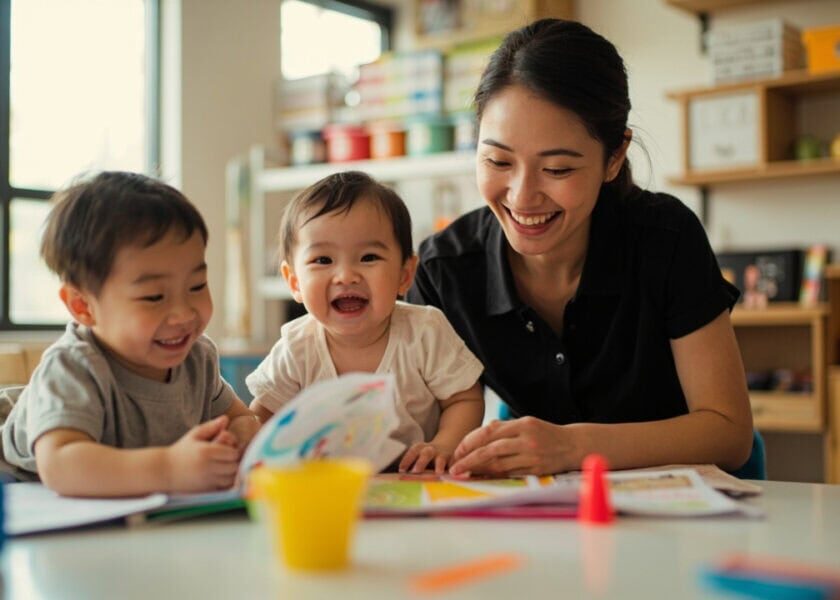
When siblings are in quality care together, something unexpected often happens: the older child becomes a kind of guide. Not because adults have asked her to be, but because children learn by watching and doing. The toddler who has been in care for a year sees the new baby arrive and understands, on some level, that she once was that small, that dependent, that new. This changes her. It matures her without robbing her of her childhood. It gives her a role that has meaning.
And the younger child? The one who joins later? He is not starting from scratch. He is entering an environment that already has warmth, routine, and familiarity—because his sibling has helped build it. The transition that so many parents fear when adding a second child becomes less a rupture and more an arrival. He is coming home, in a sense, to a place his sister has already taught him to love.
How Quality Care Serves Different Developmental Stages
The question many parents ask is whether a toddler and an infant can truly thrive in the same environment. The answer is yes, when the environment is intelligently designed.
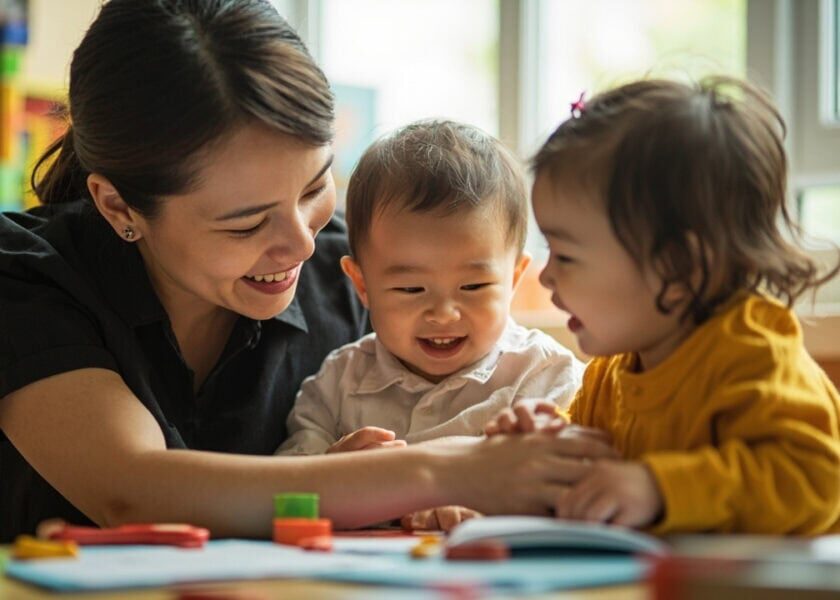
This means having zones that serve different developmental needs. It means caregivers who understand that a nine-month-old’s needs and a two-year-old’s needs are not in competition—they simply require different scaffolding. When you see a childcare setting where both are thriving in the same room, you are seeing something that works.
The Art of Individualisation
Caregivers in quality settings are trained not just in infant development, but in something more subtle: how to individualise. How to hold the baby for her afternoon bottle while the toddler is in a parallel activity that builds her fine motor skills. How to notice when one child needs more verbal engagement and another needs more physical reassurance. How to read the room—literally—before tensions rise, and to intervene with warmth rather than correction.
This is not an accident. This is design. And it matters enormously when you are trying to serve more than one child in the same family.
Five Signals That Quality Care Serves Siblings Well
How do you know if the arrangement you are considering actually delivers this? How do you evaluate whether the childcare you are looking at can genuinely serve two children well?
There are signals. Observable ones.
1. Intentional Transitions Between Children
Watch how the caregiver moves between children. In a quality environment, a caregiver moving from one child to another should feel intentional, not rushed. You should be able to see a moment of handoff—a pause, a connection, a brief acknowledgment of where the interaction left off. This signals that the caregiver is tracking each child’s individual narrative, not just managing tasks.
2. Parallel Play is Allowed and Supported
Siblings in care should not always be together. One of the marks of a sophisticated childcare setting is that children can be in the same room but engaged in different activities, at different levels, according to their developmental readiness. A caregiver who can hold that space—who can give each child appropriate challenge without forcing them together or pulling them apart—demonstrates the kind of flexibility that serves siblings well.
3. Conflicts Are Handled as Learning Opportunities
Not if conflicts arise—they will, with siblings especially. How they are responded to matters. In quality care, the caregiver’s role is not to adjudicate or immediately intervene, but to create the conditions where children can begin to negotiate with one another. Sometimes that means moving closer. Sometimes it means stepping back slightly. The best caregivers have a sense for when a child needs support and when they need room.
4. Communication is Individualised
Ask about how you, as a parent, are told about each child’s day. Is it general, or is it specific? Quality childcare for siblings will find ways to give you windows into each child’s experience, not just a collective report. Not just that the children were fine, but how they were fine, what they discovered, what they struggled with, what made them laugh. This kind of communication is not a luxury. For families with multiple children in care, it is essential. It is how you know that both children are being seen.
5. Age-Appropriate Engagement Within the Same Space
Look for an environment where different developmental needs are not in competition but are each served thoughtfully. This means caregivers who understand that siblings of different ages have different needs, and the space itself accommodates those differences without forcing uniformity.
The Continuity Question: When Your Second Child Arrives
Now let me address something that I know is weighing on many of you.
What happens to the first child’s care arrangement when the second child arrives? Many families, facing this moment, make a decision that feels cautious but ends up being disruptive. They move the first child out of the arrangement that was already working, or they delay enrolling the second child, or they make do with a different, lesser arrangement because they assume they cannot replicate what worked for child number one.
The disruption you are trying to avoid by making compromises may be greater than the disruption you are trying to preserve by maintaining quality.
Children are extraordinarily adaptive, but they are also extraordinarily sensitive to changes in their care environment. The first child, who has built trust in her caregiver, who has a routine she understands, who feels safe in that space—that child does not benefit from being uprooted. She benefits from continuity.
And that continuity is a gift to your second child as well, because she gets to enter an environment that is already warm, already established, already proven.
Making Quality Care Work for Your Growing Family
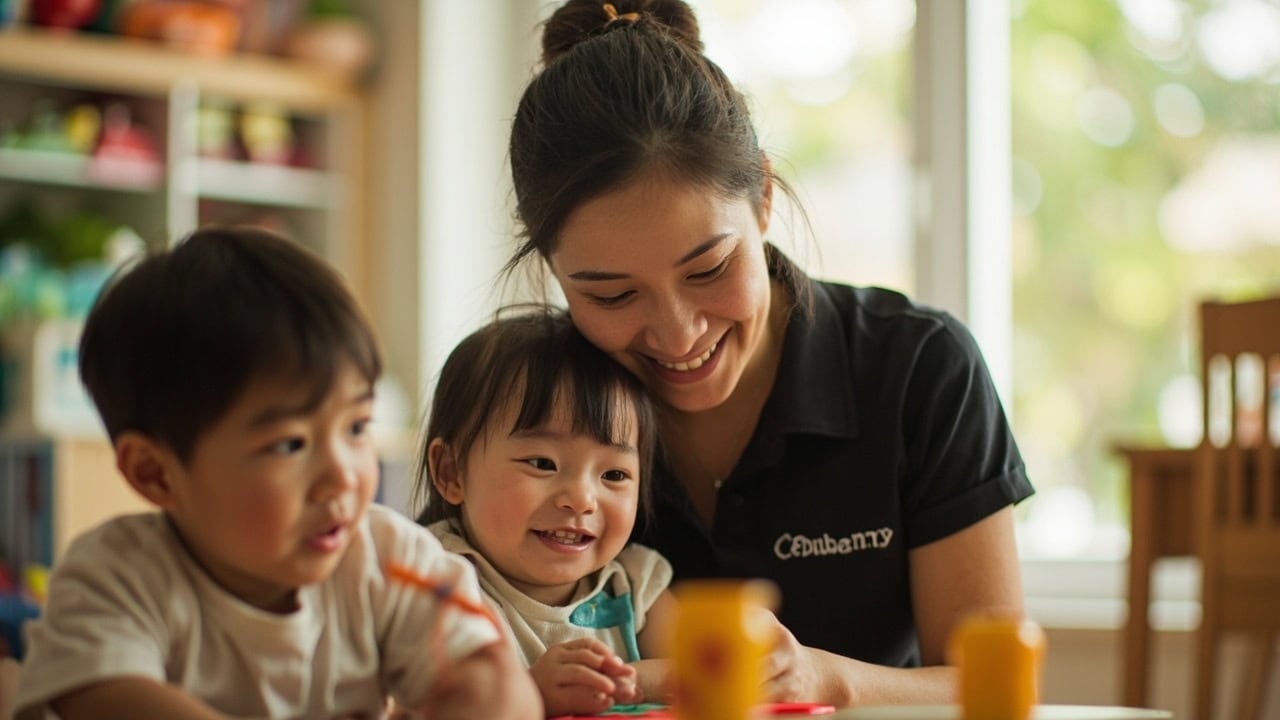
The ECDA Childminding Pilot, under which EduNanny by BUTLER operates, was designed with exactly this kind of family growth in mind. It offers pathways that can accommodate multiple children from the same family, with ratios and structures that allow siblings to be cared for together when that is what the family needs, or separately within the same service when different developmental needs require it.
The flexibility exists precisely because the people who designed this model understand that families are not static. They grow. They change. And the childcare arrangement should be able to grow with them.
Singapore has made real investments in making quality childcare accessible, through mechanisms like the Child Development Account and the Baby Bonus scheme. For families navigating this decision, these are not peripheral considerations. They are central to whether the right choice is also the feasible one.
Your second child deserves the same quality foundation as your first. Not a lesser version, not a more convenient one, not a compromise. The same quality. That is not an aspiration. That is a reasonable expectation. And it is available, when you know what to look for and where to look.
Moving Forward with Confidence
I want to offer a different frame. Not guilt, but purpose. Not management, but growth.
When your children are in care that serves them both well, you are not choosing between them. You are giving them both the same gift: the knowledge that they matter. That their needs are known and met. That the adults around them are paying attention.
Quality sibling care builds children who are not competing for their parents’ love because they already know it is inexhaustible. It builds children who can celebrate each other’s wins instead of resenting them. It builds children who have learned, through lived experience, that the world can be a warm and ordered place even when Mummy and Daddy are not there every moment.
The sibling equation is not unsolvable. It has an answer.
And the answer is not sacrifice or guilt or the quiet feeling that someone is always getting less than they deserve. The answer is quality. Attention. Intention. The right people in the room.
Your children are watching how you solve this. They are learning, from you, what it means to raise siblings well. And the gift you give them in choosing carefully now is the same gift they will give each other for the rest of their lives: the knowledge that they are both, always, enough.
If you are exploring how quality childminding can serve your growing family, EduNanny by BUTLER is an ECDA-approved childminding service built around the needs of Singapore families. We welcome the opportunity to answer your questions and help you find the right arrangement for your children—together.
Learn more about our approach to developmentally-informed childminding, or connect with our team to begin a conversation about what your family needs.
#SingaporeChildcare #SiblingCare #ChildmindingSG #QualityInfantCare #EduNannySG