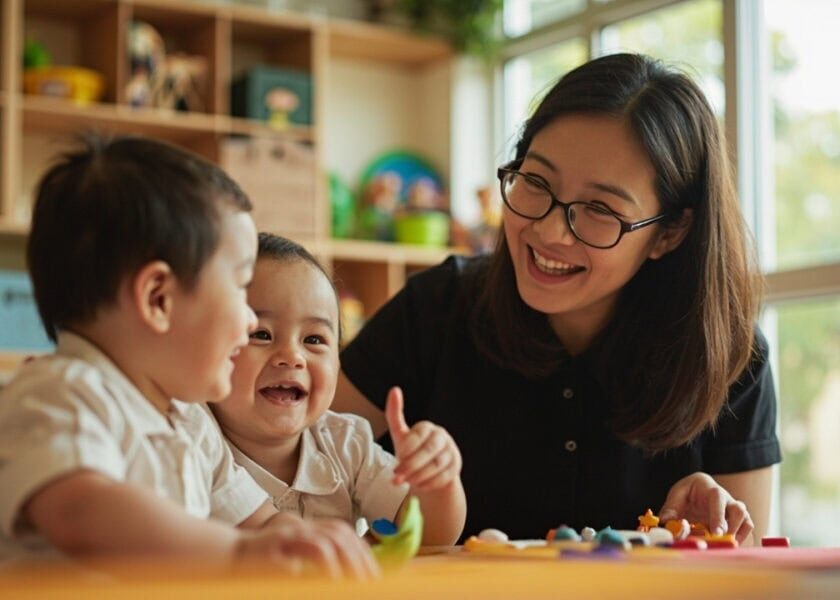
Beyond Parallel Care: Why Sibling Care Changes Everything for Singapore Families
The Silence Before the Second Enrollment
There is a particular kind of silence that falls over a Singapore parent the moment they realize they will be doing this again. Not the joyful silence of expecting a second child—that one is full of planning and preparation. This silence is different. It is the quiet recognition that the trust built so carefully with a first child’s caregiver, the rhythm finally established, the peace felt walking through the door each morning—all of that is about to be tested in an entirely new way.
You have done this before. You know how to choose childcare. You know what to look for, what questions to ask, what settling looks like when it is working. And yet, when you bring your second child into professional care, something shifts. The confidence earned the first time feels fragile when applied to a second.
This is the tension that most childcare conversations in Singapore simply do not address. We talk endlessly about choosing the right centre, about settling anxiety and trust, about the first thousand days. What we rarely speak about is what happens when you have children at different stages and you are looking for one care environment that can hold them both well.
The Real Question Behind the Second Enrollment
When you enroll one child, the decision is complex but contained. You are looking for quality, safety, warmth, and developmental support. You are looking for someone who will notice when your child is tired before they cry, who will read their hunger cues, who will hold them with genuine care.
Now multiply that by two—or three. Consider that your infant and your preschooler have different developmental needs, different rhythms, different ways of showing distress and expressing joy. Your toddler is learning to share, to negotiate, to test boundaries. Your infant is learning that the world is a safe place, that their cries will be answered, that they are held. These are not parallel processes. They are deeply interconnected, unfolding in the same shared space.
General childcare handles this by managing separate age groups within the same centre. That is not sibling care. That is parallel care. There is a difference, and it matters more than most parents realize until they live it.
What Professional Sibling Care Actually Means
Professional sibling care means something specific. It means caregivers who understand that a toddler’s disruption during a feeding is not just a logistical challenge but a developmental moment. It means routines designed to include both ages, not simply schedule them around each other.
It means recognizing that the bond between your children is not background noise but a developmental asset that either thrives or stagnates depending on how the care environment responds to it.
The Sibling Bond as a Developmental Asset
When siblings are in quality professional care together, something remarkable can happen. Your older child begins to understand their role as a mentor, as someone whose experience matters. Your younger child watches their sibling navigate the world and absorbs confidence from that observation.
They develop what researchers call sibling attachment—a bond distinct from the one they share with you, and one that will shape their relational life for decades to come. This bond does not simply happen. It requires a care environment that knows how to nurture it.
That is what trained sibling care adds to the equation. It takes the already important work of infant care—responsiveness, observation, developmental support—and adds a second dimension: the sibling relationship itself, and how it unfolds in a professional setting.
What the Second Enrollment Feels Like as a Parent
Now consider what this requires from you as a parent. The second enrollment is not simply a logistical exercise. It is an emotional one. You are bringing someone new into your family’s life, asking them to understand both your children as individuals and as siblings, and you are doing this with the heightened awareness of someone who has been through this once before.
Consider the questions that surface:
- What if the caregiver does not read my infant’s cues as well as the first one did?
- What if my toddler feels displaced by a new arrival?
- What if the transition unravels the sibling bond rather than strengthening it?
These are not irrational fears. They are the honest questions of a parent who cares deeply about both children and understands that the second enrollment is not a repetition—it is a new creation.
This is why the relationship you build with a sibling care provider must be different from the one you built the first time. It is not just about trust in their competence with your infant. It is about trust in their understanding of sibling dynamics, their ability to facilitate connection rather than simply manage coexistence, and their willingness to see your family as a whole rather than a collection of individuals who happen to share a surname.
Evaluating Sibling Care: What to Look For
More than half of Singapore families have more than one child under twelve. Many are making enrollment decisions for multiple children simultaneously or sequentially—navigating two pickup times, two settling periods, two sets of caregiver relationships. This is not a luxury concern. It is a universal concern for families across income levels.
Questions to Ask When Evaluating Sibling Care
- How does the caregiver handle situations where both children need attention simultaneously?
- Are siblings kept in the same room or environment, or separated by age group?
- How does the daily routine accommodate different developmental stages?
- What training have caregivers received specifically related to sibling dynamics?
- How does the caregiver communicate updates about each child’s day?
- What happens during settling periods for both children—is it managed together or separately?
Signs of Quality Sibling Care
- The caregiver can describe each child as an individual while also explaining how they relate to each other
- Routines are flexible enough to accommodate a toddler’s need for autonomy and an infant’s need for consistency
- You see moments of spontaneous connection between siblings, not just scheduled interaction
- The caregiver treats the sibling relationship as something to nurture, not just manage
- Transitions for both children feel supported, not rushed
The EduNanny Approach
EduNanny by BUTLER was built with this complexity in mind. As part of the ECDA Childminding Pilot, caregivers are trained not only in infant development but in the broader science of early childhood care—including how siblings form and strengthen their bonds in shared professional environments.
The home-based pathway allows siblings to be cared for in a setting that feels like family, with ratios that enable genuine attention to each child’s individual needs. When one caregiver works with up to three children, each child is known—not as a slot in a programme, but as a person with their own temperament, their own pace, and their own place in the sibling unit.
In centre-based settings, siblings may be in different rooms, different age groups, different schedules. That separation serves administrative purposes, but it does not serve siblings. At EduNanny, children can be in the same environment, cared for by the same trusted adult, with routines that weave together rather than run parallel.
Consider what that means in real life. Your toddler wakes and knows the caregiver who greets them. Your infant is fed and settled by the same hands that will later read your toddler a story. When your toddler has a meltdown—and they will, because toddlers do—your infant watches how the caregiver responds with calm confidence. That is modeling. That is the silent curriculum of sibling care: watching someone you trust handle your sibling with patience and warmth, over and over, until that becomes the template for how your children will relate to each other when they are older.
Making It Financially Accessible
Within the EduNanny pilot fee structures, services are designed to be accessible. Your Child Development Account can be used. Your Baby Bonus can be applied. These are not peripheral benefits. They are part of how quality sibling care should be available to families across Singapore, not just those with significant disposable income.
Support Beyond the Caregiver
Modern parents need support that meets them where they are. That is why EduNanny developed the Thomas AI Chatbot—not as a gimmick, but as a practical resource for the questions that arise at odd hours, the anxieties that surface between pickups, the small uncertainties that come with managing multiple children’s care.
Thomas is there when your caregiver is not. He is not a replacement for human relationship. He is an extension of a commitment to being present for your family in the ways you actually need.
What Thriving Siblings Look Like in Quality Care
It looks like a toddler who brings a blanket to their baby sibling during rest time. It looks like an older child who narrates what they are doing to the younger one, building language and connection simultaneously. It looks like children who fight over toys and then resolve it, with a caregiver nearby who does not rush in but creates the conditions for negotiation.
It looks like siblings who have learned, in a professional care environment, that they are a team—and that there is a trusted adult who loves them both.
This is what general childcare, however well-intentioned, often cannot deliver. It is not because the caregivers lack skill. It is because the structure is built for individual children, not sibling units. When you choose sibling care that is designed for siblings, you are not just saving logistics. You are investing in the bond your children will carry into adulthood.
Addressing Common Concerns
Will my toddler feel displaced? This is one of the most common concerns parents raise. The answer lies in the caregiver’s ability to recognize the toddler’s established relationship with the care environment as a source of security, not competition. In trained sibling care, your toddler’s existing routine becomes a foundation rather than something to compete against. The caregiver acknowledges that your older child was there first—and that this matters.
What if the caregiver cannot meet both children’s needs? This fear reflects a real concern: that dividing attention means diminishing quality. In settings with appropriate caregiver-to-child ratios, this concern diminishes significantly. When one caregiver works with a small group of children—knowing each child as an individual—the risk of generic, one-size-fits-all care decreases.
Can sibling care actually strengthen their bond? The sibling bond does not strengthen automatically simply because children are together. It strengthens when the care environment actively creates conditions for connection: shared routines that include both ages, moments where older siblings can contribute meaningfully, quiet spaces where children observe each other in safe, supported ways.
Ready to Explore Sibling Care?
There is a moment—different for everyone—when you stop managing and start trusting. It does not happen all at once. It happens in small moments: when you stop triple-checking the schedule, when you stop debriefing the caregiver at pickup with anxious questions, when you stop bracing for what went wrong.
It happens when you realize that the care environment is not just watching your children—it is nurturing them. That the caregiver knows your toddler’s need for autonomy and your infant’s need for consistency and holds both with equal care. That your family is being seen as a family.
When you choose sibling care that is done well, you are not just choosing convenience. You are choosing to believe that your children can thrive together, that the sibling bond is worth investing in, that the professional environment can be a place where that bond deepens rather than frays.
You are choosing to trust that the caregiver who holds your infant will also hold your relationship between your children—the most enduring relationship they will have in their lives, the one that will outlast yours.
Every family who welcomes a caregiver into their home is entrusting something fragile and irreplaceable. The trust between siblings. The confidence of a parent who has learned, the hard way, that not all childcare is equal. The knowledge that the early years are not a rehearsal but a foundation, and that what is built now will echo forward into how your children relate to each other as teenagers, as adults, as parents themselves.
For parents in Singapore navigating care decisions for more than one child, sibling care that serves the whole family—today and for the bonds that will last a lifetime—is worth taking seriously.
If you are considering your options, we welcome the opportunity to speak with you. You can also learn more about EduNanny and our approach to family-level childcare in Singapore.