The Hidden Skills Your Child Needs for Singapore Primary 1 Success
What Singapore’s Primary 1 Actually Requires
When children walk through the gates of Primary 1, they enter an environment built around structure, expectations, and social complexity that many of us underestimate.
They are expected to sit still for extended periods. They are expected to transition between activities without the freedom to wander. They are expected to manage frustration when they do not understand something immediately, to raise their hand before speaking, to wait their turn, to share attention with thirty other children who are also learning these same skills for the first time.
These sound like simple things. They are not. They are, in fact, extraordinarily complex developmental achievements.
The ability to sit still and attend is not a personality trait. It is an executive function skill that develops over years, through specific kinds of experiences. The ability to manage frustration, to wait, to self-soothe, to regulate one’s own emotional state in a room full of stimulation and demands — these are not things children are born knowing how to do. They are things that must be built.
The Most Under-Discussed Pillar of School Readiness
If you have been researching school readiness, you have likely encountered plenty of content about early literacy, numeracy, and academic acceleration. These are the domains that are easy to measure, easy to market, and easy for parents to see on paper.
What is much harder to find — and much more important — is the conversation about executive function and self-regulation. These are the skills that determine whether a child can access what they know in a classroom setting.
A child may have the cognitive ability to learn, may have been read to extensively, may know more than most of their peers — and yet struggle enormously in P1 because their self-regulation skills have not kept pace. They become the child who cannot stay seated, who speaks out of turn, who falls apart when routines change unexpectedly.
Not because they are not smart. Because they have not had the experiences that develop the regulatory architecture their brain needs to function in a structured school environment.
This is the readiness gap that no one is talking about. And it is the gap that quality childcare is uniquely positioned to close.
How Quality Childcare Builds P1 Readiness
Here is what quality childcare does, every single day, in ways that feel ordinary to the adults who provide it and invisible to parents who drop off and pick up without understanding what is being built.
Daily Routines and Transitions
When a child learns to transition from playtime to snack time to nap time to outdoor time, they are not just learning what comes next. They are learning to regulate their attention, to shift gears, to tolerate the mild frustration of ending an activity they enjoy in order to move to a structured next step.
These micro-transitions, repeated hundreds of times across a childcare year, are the raw material of self-regulation. They are practice for the bigger transitions that P1 will demand.
Caregiver Responsiveness and Emotional Development
When a child has a big feeling and a warm, regulated adult acknowledges that feeling, names it, and helps them move through it, the child learns something profound: that difficult emotions are survivable, and that seeking connection during distress is effective.
This is not just emotional support. This is the developmental foundation of self-soothing, of emotional resilience, of the capacity to be soothed by someone other than a parent.
Children who have had this experience repeatedly arrive at P1 with an emotional toolkit. Children who have not had this experience arrive at P1 with no internal manual for managing the inevitable frustrations of school life.
Structured Peer Interaction
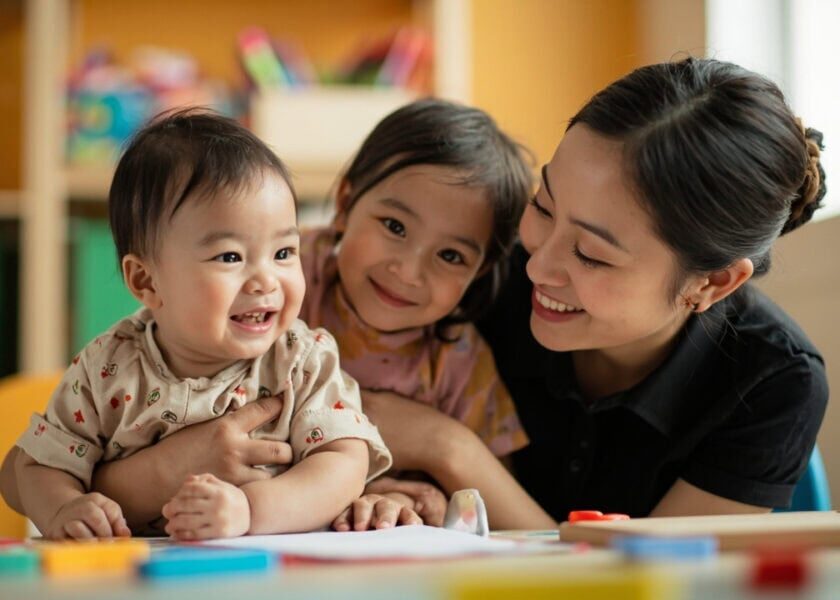
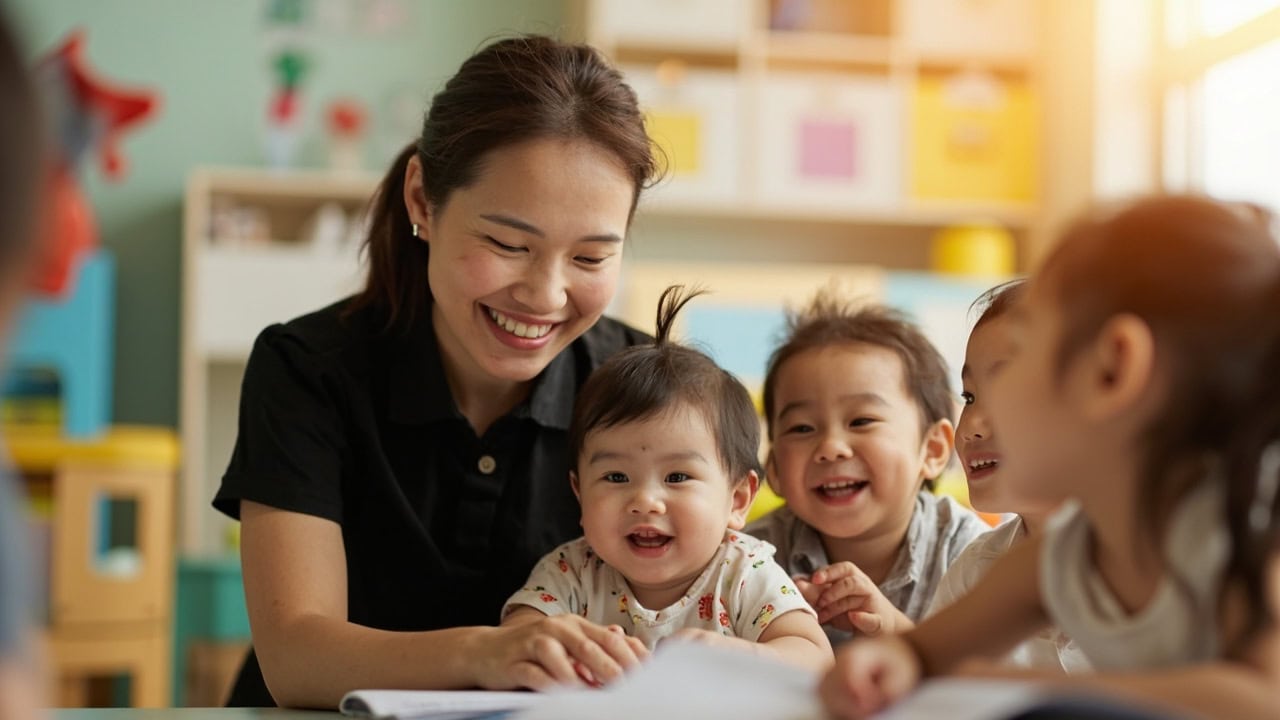
When children learn to share, to negotiate, to wait their turn, to resolve conflicts with scaffolding from a skilled caregiver, they are developing the social competence that P1 requires.
The P1 classroom is not just an academic environment. It is a social ecosystem. Children who can read social cues, who can navigate minor conflicts without escalation, who can adapt their behaviour to social context — these children are able to learn. Children who cannot do these things spend their cognitive energy on social survival rather than academic engagement.
Motor Skills Development
Fine motor skills and gross motor skills are not optional accessories to academic readiness. They are central to it.
Children who have not had sufficient opportunities to develop fine motor control — through playdough, crayons, building blocks, cutting and pasting — arrive at P1 struggling with the physical demands of writing. Holding a pencil correctly requires hand strength and precision that must be developed over years.
Gross motor skills matter too. A child who has had daily opportunities to run, climb, jump, balance, and navigate physical space has developed body awareness, coordination, and the sensory integration that supports attention and focus. The movement that some adults dismiss as restlessness is, in fact, the work of development. Children who move well sit better. Children who have mastered their bodies are better able to master their attention.
P1 Readiness at a Glance
| Readiness Domain | What It Enables in P1 | How Quality Childcare Builds It |
|---|---|---|
| Executive Function | Sustained attention, following multi-step instructions | Daily routines, structured transitions |
| Self-Regulation | Managing frustration, waiting, emotional control | Co-regulation with responsive caregivers |
| Social Competence | Peer navigation, conflict resolution, cooperation | Scaffolded peer interaction, guided play |
| Fine Motor Skills | Pencil grip, writing, cutting, manipulation | Playdough, crayons, building, craft activities |
| Gross Motor Skills | Body awareness, coordination, seated attention | Running, climbing, jumping, outdoor play |
| Emotional Security | Resilience, willingness to try, help-seeking | Warm caregiver attachment, consistent presence |
What to Look for in Quality Childcare
Most parents cannot see what truly matters when touring childcare centres or interviewing caregivers. They see the toys, the walls, the curriculum on paper. They do not see the micro-moments of regulation support, the scaffolded peer interaction, the fine motor enrichment happening through seemingly simple activities.
Here is something concrete to help you assess whether your child’s care is genuinely building P1 readiness.
Observable Indicators of Quality
- Watch how children transition. When activity time ends, do children receive clear, calm signals? Do they have time to finish what they are doing before moving? Do caregivers offer gentle redirection rather than abrupt commands? These small transition moments reveal whether the environment is designed to support self-regulation or simply to maintain order through compliance.
- Watch how caregivers respond to children’s distress. When a child is crying or frustrated, does the caregiver move toward them, offer presence and words? Or does the caregiver redirect attention away? The response pattern tells you everything about whether the emotional development happening in that environment is one of connection and co-regulation or one of dismissal and suppression.
- Observe the physical environment. Is there space for gross motor play? Is there access to materials that develop fine motor skills — not just screens and passive toys, but things to manipulate, build, tear, paste, and create? The physical environment is a curriculum. What is in it tells you what development is being prioritised.
- Ask yourself about your child’s happiness. Watch whether your child seems genuinely happy, not just quiet. Children who are developing well in a warm, responsive environment tend to be curious, engaged, and emotionally available. Children who are merely being kept safe and occupied tend to show less of this vitality.
Questions to Ask During Tours and Interviews
- How do you handle conflict between children?
- What does a typical day’s routine look like?
- How are children supported through transitions between activities?
- What do you do when a child is struggling emotionally?
- How do you support children who are having difficulty with a particular activity?
- What kinds of play materials and activities do you offer throughout the day?
- How do you communicate with parents about their child’s day?
The specificity and thoughtfulness of their answers will reveal a great deal about their understanding of child development and their intentionality in daily care.
The Long-Arc Perspective: Why Today’s Decision Matters
Here is the question worth sitting with: when you imagine your child three years from now, walking into a Primary 1 classroom full of structure and social complexity, what do you want to be true about them?
You want them to be able to manage frustration. You want them to be able to sit and attend. You want them to be able to navigate peer relationships with some degree of independence. You want them to be emotionally resilient. You want them to be physically ready for the demands of writing and focused work.
None of these things happen by accident. They are built, slowly, daily, through hundreds of intentional interactions with a responsive caregiver, in an environment designed to develop the whole child.
They cannot be accelerated in the final months before P1. They cannot be taught through workbook programmes or academic enrichment classes that target the wrong skills. They are built across years of daily experience, and the quality of those experiences determines whether your child walks into Primary 1 ready or merely present.
This is why the childcare decision matters so profoundly. Not because childcare is the only influence on your child’s development — it is not. But because for the hours your child spends in care, it becomes a primary developmental environment. The choices made in that environment, the quality of the caregiver relationship, the intentionality of the daily structure — these are not incidental. They are formative.
The childcare decision you make at eighteen months or two years old is not just a childcare decision. It is a Primary 1 readiness decision made three years in advance. And most parents do not realise this until the window has already closed.
How EduNanny Approaches Childminding Differently
We understand this at EduNanny Singapore. We understand that parents are not looking for a babysitter. They are looking for a developmental partner in raising their child. Someone who sees the long arc, not just the immediate task.
EduNanny was built with this understanding at its centre. Our childminding programme, developed through the ECDA Childminding Pilot, reflects a conviction that home-based care, when executed with excellence, is not an inferior alternative to centre-based care. It is a distinct pathway with unique developmental advantages.
The Advantages of Home-Based Childminding
- Smaller group sizes allow for genuinely individualized attention — every child is known, not just watched
- Home environment provides a natural, comfortable setting for learning and exploration
- Caregiver-to-child ratios that allow for the responsive interaction that builds executive function and emotional security
- Consistency of care from a primary caregiver who builds a deep relationship with your child over time
Addressing Real Parent Concerns
We know that trust is not built through promises alone. It is built through transparency, communication, and consistent follow-through. That is why our programme incorporates the measures that Singapore parents consistently tell us they need.
- Clear communication channels and regular updates on your child’s day
- Visibility into the care environment — for families who value it, CCTV access provides that additional layer of reassurance
- CDA and Baby Bonus usability — structured to reduce the financial burden of quality care without compromising on standards
- Consistent scheduling — Monday to Friday care blocks that fit the rhythm of working life and support your child’s developing sense of routine and security
Beyond the structure and the logistics, there is something else that EduNanny represents: the conviction that childminding is not a stopgap or a lesser choice made by parents who cannot afford better.
It is a profession of genuine importance, performed by people who understand child development, who bring warmth and intentionality to their work, and who recognise that every routine transition, every response to a child’s distress, every moment of scaffolded peer interaction is quietly building the child who will walk into Primary 1 three years from now.
Ready to Explore Your Options?
If you are a parent in Singapore, standing at the beginning of this journey, uncertain about what lies ahead and afraid of getting it wrong, we want you to know something.
You are not inadequate for feeling this fear. You are not unprepared because you do not already know everything about child development. The fact that you are thinking carefully about this — that you are asking questions and looking for depth rather than surface — that is exactly the kind of thoughtfulness that will serve your child well.
The question is not whether you love your child. You clearly do. The question is whether the care you choose is building what matters.
The answer to that question is not found in a brochure or a checklist. It is found in the daily experience of your child, in the quality of the relationships they are forming, in the developmental richness of their environment, and in the intentionality of the people who are caring for them while you work.
We are not here to tell you that EduNanny is the only right choice. We are here to tell you what to look for, so that whatever choice you make, you make it with understanding rather than uncertainty.
But we will also tell you this: if what you are looking for is a care arrangement designed from the ground up with P1 readiness in mind — not as a marketing claim, but as a genuine developmental commitment — then EduNanny Singapore is worth your consideration.
Our approach to daily care is built around the understanding that every interaction is a building block. Every routine is an opportunity. Every moment of connection between a skilled caregiver and a developing child is quietly constructing the executive function, the emotional resilience, the social competence, and the physical readiness that Primary 1 requires.
Three years from now, when your child walks into that classroom, they will carry everything they have been built into. Every moment of responsiveness. Every supported transition. Every instance of being soothed and seen and known. And every moment of being overlooked, rushed, or simply supervised.
The foundation will be there, for better or for worse, and it will not be possible to go back and pour a stronger one.
This is the weight and the beauty of the early years. It is the reason we do what we do. It is the reason we believe childminding matters. And it is the reason we invite you to think about this decision not as a childcare decision, but as the school readiness decision it truly is.
Your child is ready for more than you think. The right care will help them show it.
If you are considering your childcare options in Singapore and want to understand how EduNanny’s approach to home-based childminding supports genuine school readiness, we welcome the conversation. Connect with EduNanny Singapore today to learn more about our childminding programme and what makes it different.