The First Thousand Days Secret Singapore Parents Need for School Readiness
The False Choice That Has Burdened Singapore Parents
The fear that quality early care and school readiness exist on opposite ends of a spectrum is one of the most pervasive—and most damaging—myths in modern parenting. It is the myth that says warmth precludes rigor. That love cannot coexist with learning. That the first thousand days of your child’s life must be spent in a binary trade-off between emotional security and educational preparation.
Parents voice this fear in different ways. “I want my child to be happy first,” they say, “but I also worry they won’t be ready.” Or: “I know play-based learning is important, but Singapore is competitive. I don’t want my child to fall behind.”
The underlying question is always the same: Can I have both?
The answer from decades of developmental research is a resounding yes. But understanding why requires us to look at what Primary 1 actually requires—and what it does not.
What Primary 1 Teachers Actually Look For
Open a classroom door in any Singapore primary school in the first weeks of Primary 1. Watch what the teacher is actually looking for.
It is not whether your child can read. It is not whether they have memorised their alphabets or can count to twenty. The teacher is looking for something else entirely—something more fundamental and, frankly, more difficult to teach at six years old than any academic skill.
The teacher is looking for a child who can:
- Sit with attention when instructed
- Listen when someone else speaks
- Manage the small frustration of not being first
- Transition between activities without dissolving
- Engage with curiosity instead of fear
- Look at a problem they have not seen before and trust that they can figure it out
These are not academic capacities. These are developmental ones. They are the products of the first thousand days—every day from conception to approximately age three—and they are the actual foundations that Primary 1 teachers report as the determinants of early school success.
Not literacy. Not numeracy. The capacity to learn.
When we talk about school readiness in Singapore, we often talk about the wrong things. We talk about curriculum. We talk about whether a childcare centre has Mandarin immersion or phonics programs or coding for toddlers. These are not meaningless, but they are not what Primary 1 actually requires.
What Primary 1 requires is a child whose brain has been built, day by day through intentional, warm, relationship-based care, to have the neurological infrastructure for attention, flexibility, emotional regulation, language comprehension, and social confidence.
Here is the profound truth that the research makes clear: This infrastructure is not built through curriculum. It is built through relationship.
The Three Developmental Foundations of School Readiness
Language: The Invisible Foundation
Consider language, because language is where this becomes most visible.
By age three, a child’s vocabulary and language processing capacity has already diverged significantly based on the quantity and quality of language they have been exposed to in their first thousand days. This is not a matter of intelligence. It is a matter of exposure.
The child who has been spoken to, sung to, read to, narrated to throughout infancy—whose caregiver has described the world as they moved through it, who has been responded to with words as well as with touch—arrives at three with a neural architecture for language that serves them for the rest of their academic lives.
By Primary 1, this child is not simply better at reading. They are better at listening to instruction. They are better at understanding narrative. They are better at expressing themselves in written form. They have the language substrate that all academic learning builds upon.
Where does this language-rich exposure happen most consistently in a young child’s life? It happens in the moments of care—the feeding, the bathing, the dressing, the walking, the settling, the waking. It happens in the space between a caregiver and a child where words are as natural as touch.
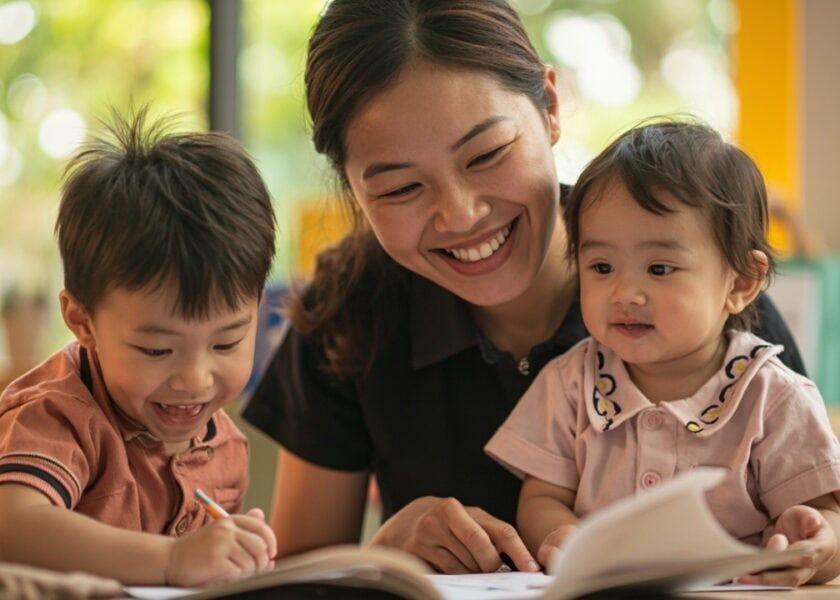
A professional childminder who is trained to narrate, to engage, to respond to a child’s attempts at communication with rich, expanded language—this is not a babysitter. This is a language architect. This is someone who is literally building your child’s brain.
The difference between a caregiver who speaks to a child in full sentences and one who speaks in fragments, between one who reads a picture book interactively and one who simply shows pictures, between one who pauses to let the child respond and one who fills every silence—these differences compound over the first thousand days into measurable, significant developmental gaps.
Motor Development: How the Body Builds the Brain
In our anxiety about academic preparation, we have largely forgotten that the body builds the brain. This is not metaphor. This is neuroscience.
The development of fine motor skills—the ability to hold a pencil, to cut with scissors, to manipulate objects with precision—is directly connected to the development of neural pathways that also support cognitive function, including attention and memory.
A child who has been given ample opportunity to move, to explore, to grasp, to climb, to balance, to push, to pull in their first three years enters Primary 1 with a sensorimotor foundation that supports not just physical coordination but classroom behaviour.
Watch a Primary 1 class during writing time. The children who fidget, who struggle to hold their pencils, who fatigue quickly, who cannot sit still—they are not poorly behaved. They are often children whose motor development was not supported in the critical years. Their bodies are demanding the movement their brains have not been prepared to inhibit.
Quality infant care does not leave motor development to chance. It structures the day to include guided physical activity. Tummy time becomes a purposeful developmental practice, not merely a parental instruction to be done at home.
Outdoor exploration, climbing, running, ball play, sensory play—these are not luxuries or break times. They are the medium through which the child’s neurological system builds the capacity for the sitting, the focusing, the writing, the attending that Primary 1 demands.
Social-Emotional Readiness: The Capacity to Trust and Learn
There is a third capacity that Singapore parents feel most viscerally but discuss least openly: social-emotional readiness.
The fear that choosing quality care means choosing separation anxiety, that leaving your child in someone’s care will somehow damage their attachment security, that they will feel abandoned or replaceable—this fear is real and honest. But it misunderstands what quality social-emotional care actually builds.
A child who has formed a secure attachment with a primary caregiver in their first year is not made insecure by secondary caregiving relationships. This is not how attachment works.
Attachment research—decades of it—consistently shows that children can form multiple healthy attachments, provided that each caregiving relationship is warm, consistent, and responsive.
What secure attachment in infancy creates is a child who has an internal working model of trust. This child knows that caregivers are reliable, that the world is a place where their needs will be met, that they can venture out and return safely.
This is, precisely, what Primary 1 requires.
The child who arrives at school with this foundation is not the child who cries at the gate and cannot be consoled. They are the child who may experience a moment of transition anxiety and recover. They are the child who can separate from the morning routine because they trust you will return. They are the child who can engage with a new teacher because they have learned that new adults can be safe. They are the child who can navigate the social complexity of a classroom because they have had practice in a small, warm, consistent group setting where social skills were scaffolded by attentive caregivers.
Quality infant care, done right, does not undermine your child’s emotional security. It extends it.
Preparation vs Premature Pressure: The Critical Distinction
What is the difference between preparing your child for school and pressuring them?
This question matters, because Singapore’s educational culture can create a real risk of mistaking developmentally inappropriate acceleration for readiness.
We have all seen the videos of toddlers in academic tutoring, the preschools that have adopted Primary 1 curriculum by age four, the children who can read at three and do sums at four and have lost, somewhere in the process, the ability to play imaginatively, to be bored, to wonder, to simply be children.
Here is the line: Developmentally appropriate preparation builds the capacities that learning requires. Premature academic pressure attempts to deliver the content of later learning before the brain is ready to receive it.
Consider the reader-ready child. A child who has been read to every day for three years, whose caregiver has asked open-ended questions about stories, who has been given time and space to tell their own narratives—this child enters Primary 1 as a reader not because they were taught to read, but because they have been immersed in a language-rich environment that has built their phonemic awareness, their vocabulary, their comprehension capacity, their love of story.
They read because reading has always been associated with joy and intimacy. This is developmentally appropriate preparation.
Now consider the child who has been drilled on alphabets and sight words since age two, who has been tested on reading comprehension in preschool, who has been given homework before their fine motor skills could support a pencil properly. This child has been subjected to premature academic pressure. They may produce reading outputs, but they have often lost the intrinsic motivation that makes sustained reading a lifelong pleasure.
The research consistently shows that this approach does not produce durable academic advantages. What it produces is burnout.
The distinction is between building the house and decorating the outside before the foundation is laid. Quality childcare builds the foundation. When these foundations are strong, academic learning happens naturally, joyfully, and with far less resistance in Primary 1 and beyond.
The child who is ready does not need to be pressured into readiness. They simply learn.
What Quality Childcare Actually Looks Like
So what does quality childcare include, for a child in their first thousand days?
A quality day begins with greeting. A warm, consistent arrival routine where the caregiver and parent handover the child’s morning, where the child’s state is communicated, where the child sees that their trusted adults know each other and collaborate. This is not a logistics exchange. This is a continuity ritual that tells the child: we are all in this together.
The day includes language-rich interaction throughout—not formal lessons, but ongoing narration, conversation, singing, rhyming, and response. A caregiver who describes the morning snack as they prepare it. Who comments on the texture of an orange, the sound of rain on the window, the shape of a block. Who pauses for the child’s response and expands it back.
There is structured movement: outdoor time in the morning, guided physical play, opportunities for the child to climb, balance, run, dig, pour, and explore. The body is a learning instrument and it is treated as such.
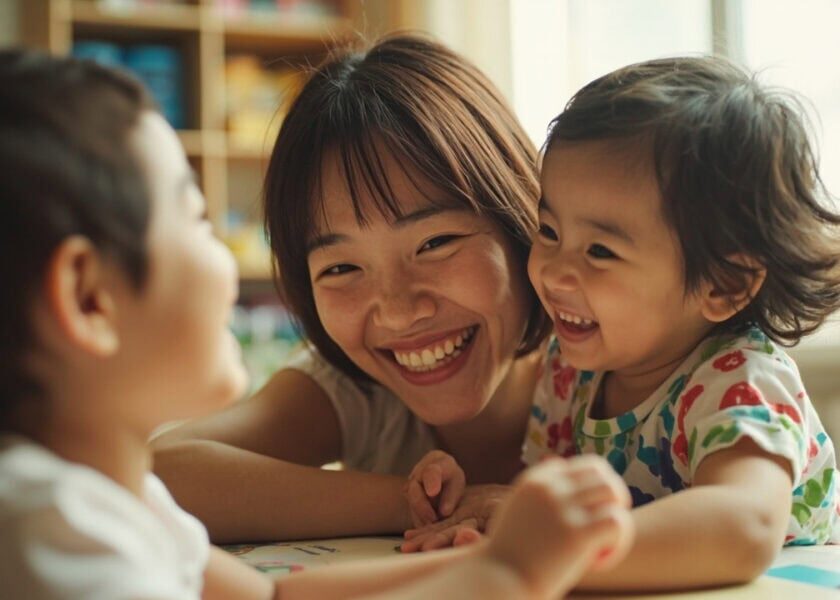
There is guided social interaction: small group play with adult scaffolding, where the caregiver helps children navigate sharing, taking turns, expressing feelings, and resolving small conflicts. This is not unstructured play with an absent adult. This is social-emotional coaching in real time.
There is rest, because the developing brain requires it. There is routine, because routine is not the enemy of flexibility—it is the foundation that makes flexibility possible. The child who knows what comes next can be curious within that knowing.
And there is observation. A quality caregiver notes the child’s developmental milestones—not to report to parents in anxiety-producing checklists, but to track development, to identify where support is needed, to adjust the environment accordingly.
This individual developmental tracking is only possible with low ratios. One caregiver with three infants can see what each child is doing, can notice delays or leaps, can respond. This is the difference between supervision and development.
How to Choose Childcare with Conviction
If you are researching childcare options in Singapore, these questions will tell you whether an arrangement is building readiness or merely providing supervision:
- What is the caregiver-to-child ratio? For infants, one-to-three or better is what developmental science requires. Ask specifically, not just for the centre as a whole, but for your child’s specific group.
- What does a typical day look like? Look for language-rich interaction throughout—not just during designated lesson times. Look for structured movement. Look for guided social play with adult involvement.
- How does the caregiver respond to a child’s communication attempts? Do they expand the child’s sounds into words? Do they wait for responses? Do they narrate the world as they move through it?
- Is there individual developmental tracking? A quality caregiver notices where each child is developmentally and adjusts the environment and interaction accordingly.
- How is movement treated? Is it a scheduled activity or a developmental necessity woven throughout the day?
- How do they handle transitions and emotional moments? Look for warm, consistent responses that scaffold emotional regulation, not dismissal or isolation.
The answers to these questions will tell you far more than any curriculum brochure.
The EduNanny Approach: Developmental Partnership for the First Thousand Days
EduNanny operates within the ECDA Childminding Pilot, part of Singapore’s formal recognition of home-based and community-based childcare pathways. We understand that families need options that fit their lives—options that are not all centre-based, that recognise the value of care in a home-like environment, that allow flexibility while maintaining quality standards.
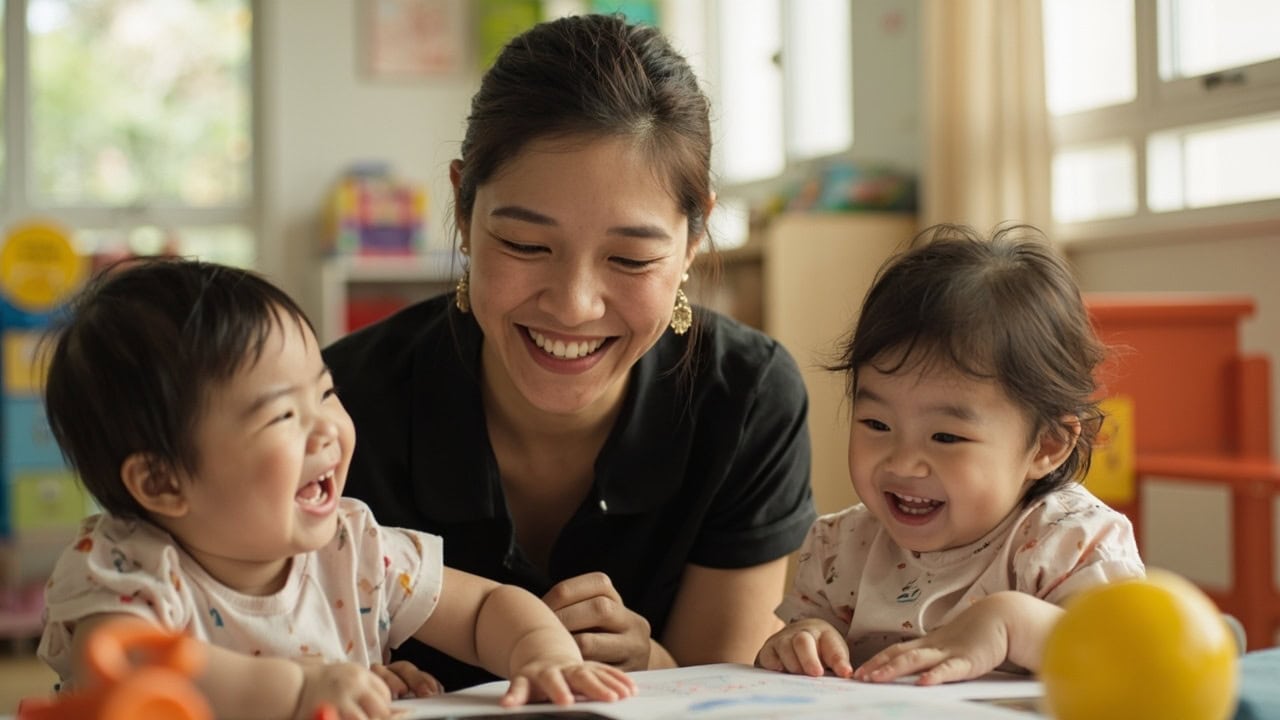
Our caregiver-to-child ratios reflect what the research demands. For infants, we maintain ratios of up to one to three. This means that each infant receives the individual attention, the responsive interaction, the developmental tracking, the language-rich engagement that builds readiness.
The ratio is not a logistical detail. It is a developmental necessity. When a childminder is responsible for three infants instead of six, they have time to speak, to listen, to narrate, to expand, to respond, to notice the first attempts at words and mirror them back until the child hears themselves as a communicator. That one-to-three ratio is the difference between a child who is supervised and a child who is developed.
Our pilot fee structures are designed to be accessible. We know that Singapore families make significant financial decisions about childcare, and we believe that quality should not be available only to families with significant resources. CDA and Baby Bonus are usable within our structures.
We offer Monday to Friday care blocks because we know that Singapore parents work. Our care is structured around your work life, not in spite of it.
Communication and transparency are built into our practice. Where CCTV measures are deployed, they are deployed not as surveillance of caregivers but as reassurance for parents. You should know what your child’s day looks like. You should be able to see the language-rich interactions, the guided play, the warm responses, the building of readiness that is happening while you are at work.
And we are not just childcare. We are developmental partners. This means that we extend quality principles beyond the hours of care. We help you understand what your child’s day has included and why. We help you bring language-rich interaction, guided motor play, and social-emotional scaffolding into your evenings and weekends.
You do not have to be a trained educator to build your child’s readiness. You just need to know what matters and why. We help you know.
Singapore’s educational system is demanding. It begins earlier than in most countries. The streaming conversations, the weighted assessments, the competition for secondary school placement—these are real pressures that your children will face.
The best preparation for this system is not to fight it with premature academic pressure. It is to build your child a foundation so strong that the system becomes navigable rather than overwhelming.
A child who enters Primary 1 with strong language capacity, attention regulation, motor coordination, social-emotional security, and executive function—this child may still find the academic demands challenging, but they have the infrastructure to meet the challenge. They can listen. They can focus. They can manage frustration. They can learn. They are not starting from a deficit of capacity.
Your Child Deserves Your Conviction, Not Your Guilt
Singapore parents carry enough guilt. I do not want to add to it. I want to give you something different. I want to give you conviction.
The fear that you must choose between your child’s happiness and their school readiness is not yours alone, but it is, nonetheless, a false choice. The science says that the developmental foundations of school readiness are the same foundations of emotional security.
- A child who is nurtured is a child who is prepared.
- A child who is engaged with language is a child who is ready to read.
- A child who has moved, explored, climbed, fallen, and been supported through it all is a child whose body and brain are ready to sit and learn.
- A child who has been held in mind by a consistent, warm, responsive caregiver is a child who can separate, can transition, can trust, can belong to a classroom community.
You are not choosing between your child and their future. You are choosing both. You are choosing a childcare arrangement that serves your child’s immediate well-being and their long-term trajectory simultaneously.
That is not a compromise. That is the wisest investment a parent can make.
The first thousand days build the architecture of the brain. The capacities that Primary 1 requires—language, attention, motor coordination, social-emotional security, executive function—are not taught in Primary 1. They are built in the thousand days before. And they are built through relationship. Through intentional, warm, responsive, professionally designed care.
I have seen, in my work with families across Singapore, what happens when this investment is made with intention. I have seen children walk into Primary 1 classrooms not with anxiety but with curiosity. I have seen them navigate the transition from home to school because they have done it before, in a small, warm, consistent setting, with a caregiver who held them in mind.
I have seen them engage with learning because they have always known that learning is something that feels good, that is supported, that is shared.
This is what quality childcare builds. This is what EduNanny is here to provide. Not just for the years before Primary 1, but for the child who walks into that classroom ready—emotionally, developmentally, humanly ready—to learn.
The first thousand days are now. And the choice you make in these days will shape the child who walks into Primary 1, into Secondary 1, into a life of learning and belonging.
That child deserves your best. And that child deserves quality care.
Choose with conviction.
Curious about how EduNanny supports the first thousand days? Speak with our team to explore your family’s childcare options, or learn more about our approach.
You can also visit EduNanny Singapore to learn about our ECDA-approved childminding services.